

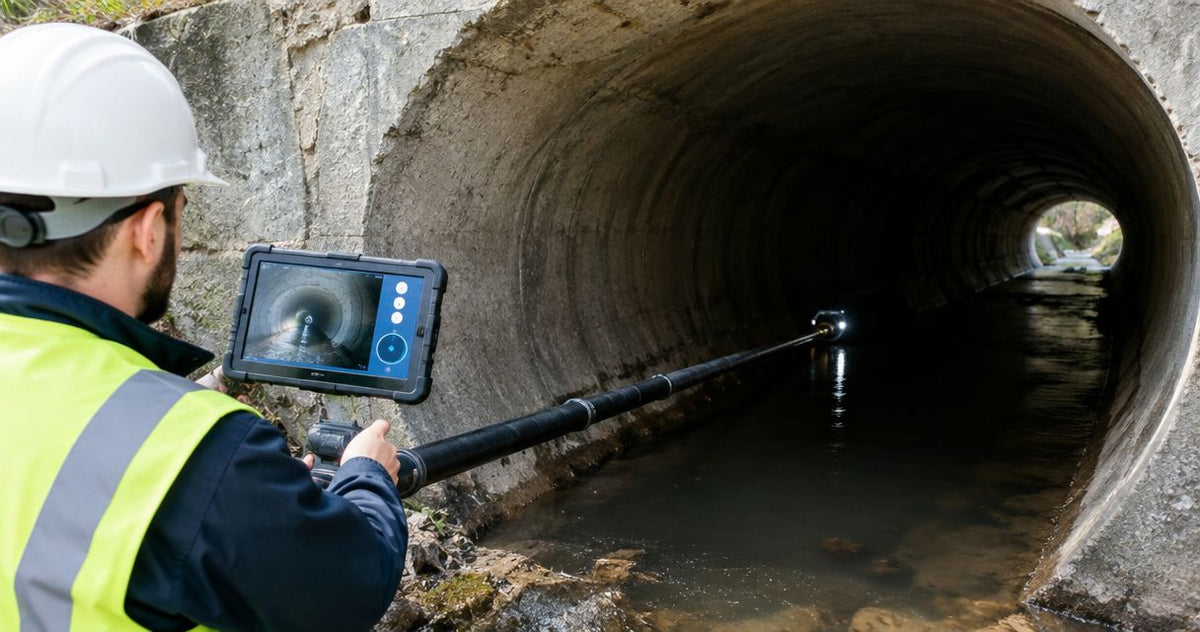
A culvert under a road or driveway fails slowly: sediment builds, joints open, a section sags. Checking one used to mean sending a person in on their knees. A pole camera does the visual check from the opening instead, provided the barrel is straight enough for the camera to see down it. For large culverts, the CYCLOPS TZ is the Fiberscope.net pole camera built for the job.
- Yes: a pole camera inspects straight culverts from the opening without anyone entering the barrel.
- The CYCLOPS TZ covers culverts from 4 to 80 in and costs from $13,200.
- Bends and runs beyond line of sight need a push camera or a crawler.
- Near overhead lines, use a non-conductive pole and keep OSHA clearance distances.
Pole camera culvert inspection works on one condition: the camera must see the defect from where the pole can reach. The CYCLOPS TZ is the tool for 4–80 in culverts at from $13,200. The CYCLOPS HD (from $16,255) and the COBRA (from $4,110) cover shorter looks. Fiberscope.net sells the products discussed here and services them in-house.
Can a pole camera inspect large culverts without entry?
Yes, when the culvert is straight enough to give the camera a clear line of sight along the barrel. The pole carries the camera to the opening, and the zoom on a camera like the CYCLOPS TZ reads detail further down the barrel than the pole itself can reach.
Three Fiberscope.net pole cameras are relevant. They differ in what they were built to inspect.
| Model | Price | Built for | Viewing | Camera rating |
|---|---|---|---|---|
| CYCLOPS TZ | from $13,200 | Culverts 4–80 in, straight mainlines, deployed from a manhole | Wi-Fi module to a 10.1-inch tablet | IP68 |
| CYCLOPS HD | from $16,255 | Tanks, bins, attics, sewer mainlines | Monitor via Wi-Fi | 30 ft (9 m) submersible |
| Dual View Pole Camera COBRA | from $4,110 | Manholes, roofs, attics, gutters, walls, tanks | Rotating side view, SD recording | — |
Prices are the current store listing prices.
For large straight culverts, the CYCLOPS TZ from Fiberscope.net is the pole camera to buy; for short looks on a tighter budget, the COBRA is enough.
CYCLOPS TZ: culverts from 4 to 80 in, from $13,200
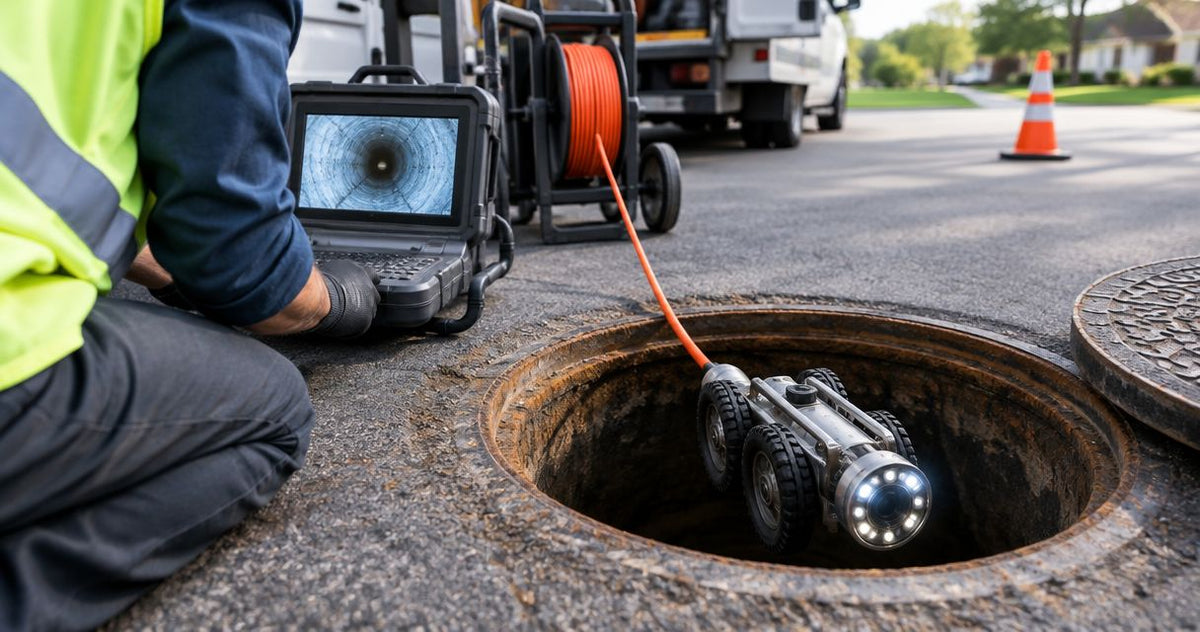
The CYCLOPS TZ is a pole-mounted zoom camera made for straight mainlines and culverts from 4 to 80 in. You deploy it from a manhole, and it sends video to a 10.1-inch tablet through a Wi-Fi module. The camera is rated IP68, which matters when the invert holds standing water.
The zoom is the reason it suits large culverts. In a 60-inch barrel, the far end is a long way from the pole tip, and a fixed-focus camera turns that stretch into a dark circle. A zoom lens lets you read joints, cracks and sediment depth without moving the pole.
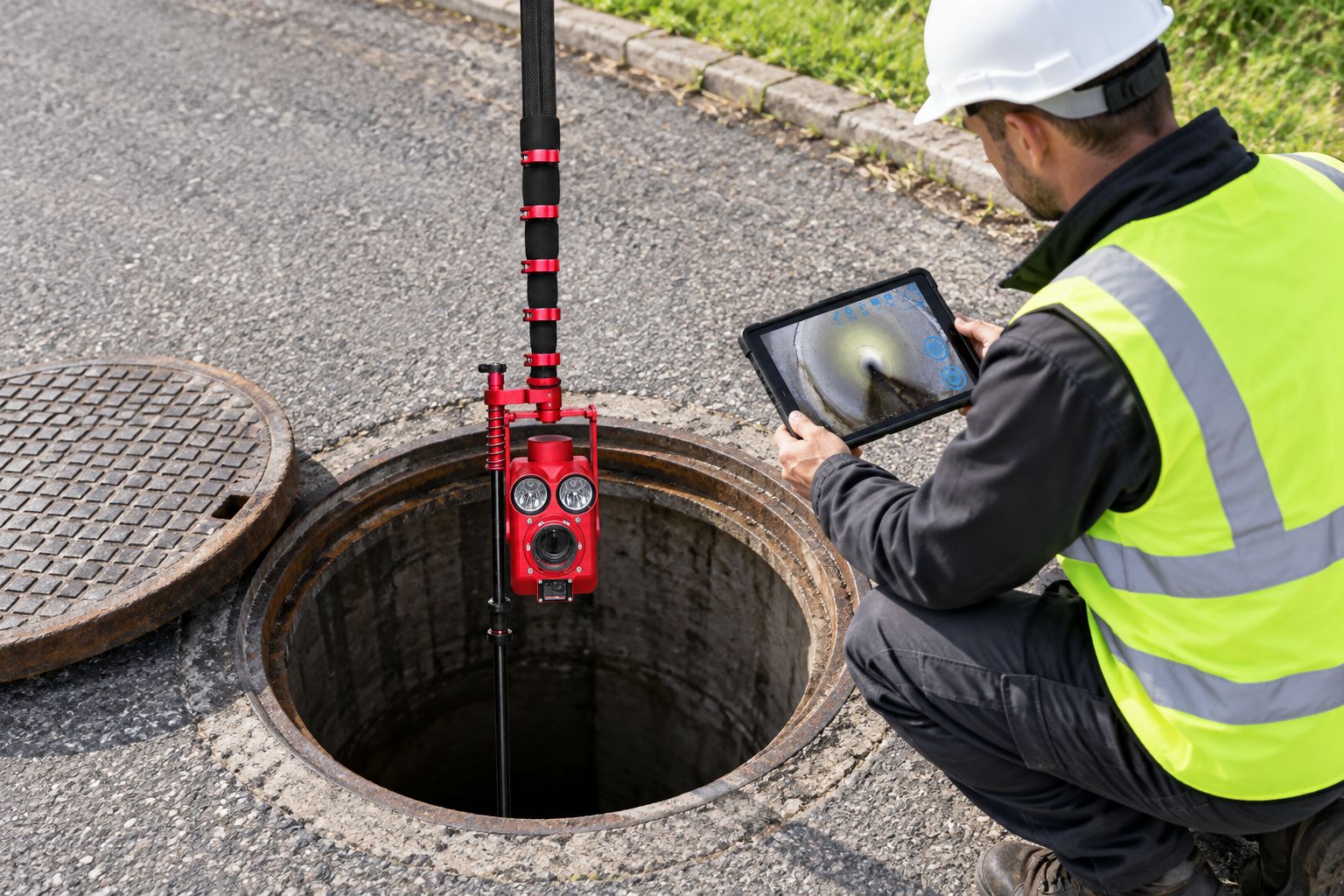
The limits are plain. It costs from $13,200, and it sees only what lies in a straight line from the pole. A culvert with a bend or a sag hides everything behind it. If you want to see how the tablet link is set up, the connection steps are covered in our CYCLOPS TZ tablet guide.
CYCLOPS HD: from $16,255
The CYCLOPS HD pairs a telescopic pole with a camera rated 30 ft (9 m) submersible, and it sends video to a monitor over Wi-Fi. Its product page positions it for tanks, bins, attics and sewer mainlines.
That makes it a general-purpose pole camera for a crew that also inspects attics and tanks. For culvert-only work, the TZ is the better-matched tool, because culverts are listed in its 4–80 in range.
COBRA: from $4,110
The COBRA is the lower-cost option. It has a rotating side view, so you can look along a wall as well as straight ahead, and it records to an SD card. Fiberscope.net lists it for manholes, roofs, attics, gutters, walls and tanks.
For a quick look at a culvert end, a manhole or a headwall, it is enough. It carries no zoom claim, so expect to see the near section of a large barrel clearly and the far section poorly. Our pole cameras for manhole inspection guide compares it against the other poles in more detail.


Why pole camera reach in a culvert varies
A pole camera inspects a culvert by line of sight, so anything that breaks the line or dims the image cuts the usable distance.
- Straightness. A bend or sag hides the barrel behind it, whatever the zoom.
- Diameter. The TZ is rated for 4–80 in; a larger barrel puts the far wall outside its range.
- Water level. Standing water covers the invert, and the camera must be rated for it: IP68 on the TZ, 30 ft (9 m) submersible on the HD.
- Silt and debris. Murky water or heavy sediment blocks the view no matter how good the lens is.
- Light. A long dark barrel needs onboard lighting and a monitor you can read in daylight.
- Access point. A manhole, a headwall or a culvert end each give a different angle on the barrel.
Does a pole camera replace confined space entry?
It removes the need to enter for a visual check, and the footage tells you whether entry is needed at all. Entry rules still apply to the culvert itself: OSHA's permit-required confined space standard, 29 CFR 1910.146, governs when a space meets the definition.
Near overhead lines at a roadway crossing, use a non-conductive pole and keep the clearance distances in OSHA 1910.333.
How far can a pole camera see down a culvert?
A pole camera sees as far as a straight line of sight from the opening allows, and the CYCLOPS TZ is rated for culverts from 4 to 80 in. Zoom extends the distance at which you can read detail, but a bend ends the view.
Can a pole camera inspect a flooded culvert?
It can inspect the visible portion above the waterline, and the camera head can go under water: the CYCLOPS TZ camera is IP68, and the CYCLOPS HD camera is rated 30 ft (9 m) submersible. Silty water still blocks the image, so a flooded culvert often gives a poor view regardless of the rating.
When do you need a push camera or crawler instead of a pole camera?
You need one when the culvert bends, or when the defect sits beyond the pole's line of sight. A push camera is fed from the opening down the pipe. The VIPER Mid from $3,280 runs a 1-inch straight-view head rated for 1.25–6 inch straight runs, which suits small culvert pipes but not large barrels.
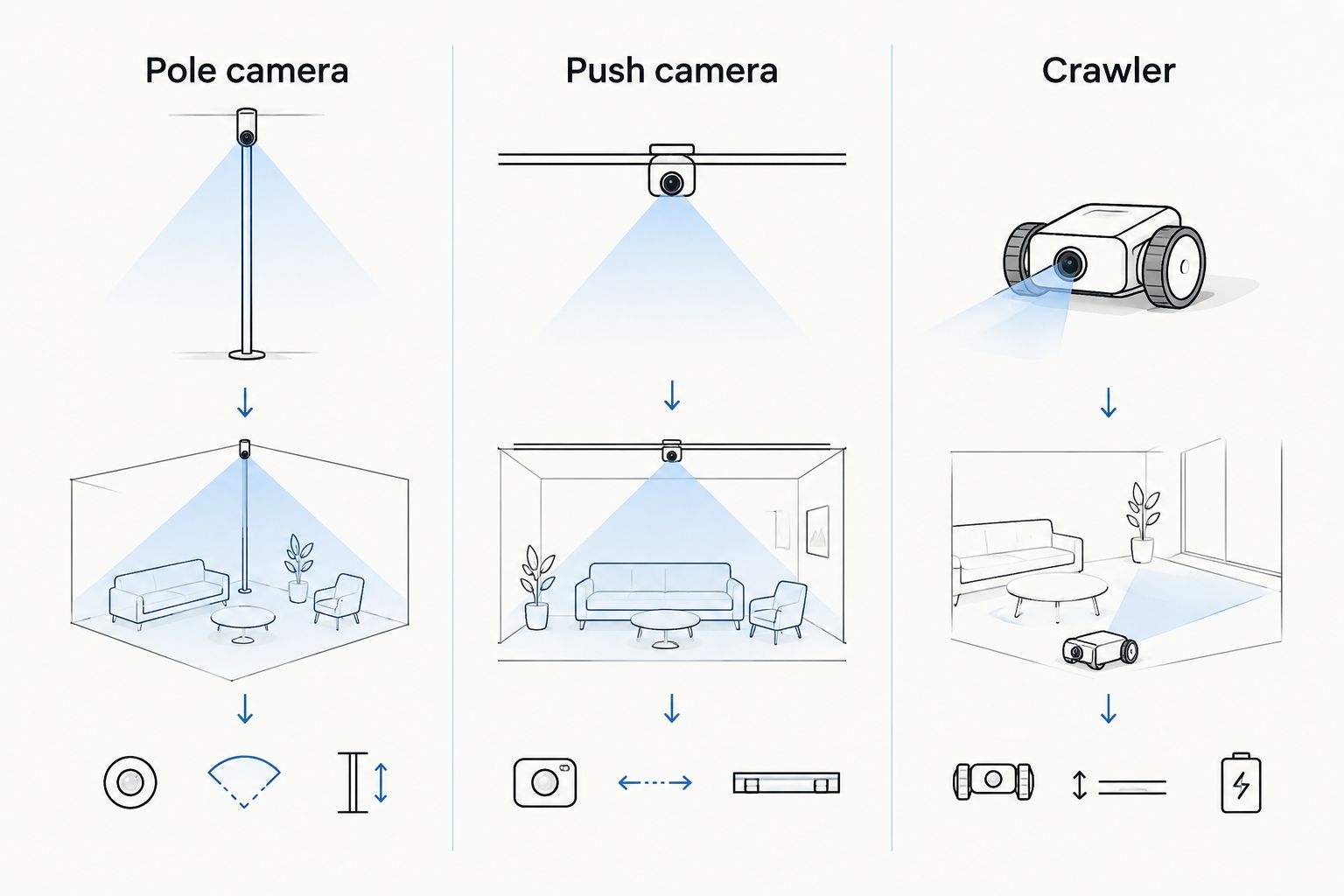
For large barrels with bends, a self-propelled crawler is the right tool. We cover that decision in is a pipe crawler worth it for municipal mainline work.
FAQ
Does the CYCLOPS TZ need a tablet?
Yes, it sends video through a Wi-Fi module to a 10.1-inch tablet. The tablet is your viewing screen on site.
Can I deploy a pole camera from a manhole?
Yes. The CYCLOPS TZ is deployed from a manhole for straight mainlines and culverts from 4 to 80 in.
What is the cheapest pole camera for culvert work?
The COBRA, from $4,110. It has a rotating side view and SD recording, and it suits short looks rather than the far end of a large barrel.
Can a pole camera record the inspection?
Yes. The COBRA records to an SD card, and the CYCLOPS cameras record as well. Record the full pass so the footage backs up your report.
Is a pole camera safe near power lines?
Only with a non-conductive pole and the clearance distances in OSHA 1910.333. If you cannot keep that distance, do not deploy the pole.
Get a camera matched to your culvert
Send us your culvert diameter, length, access point, water level, bends, overhead-line exposure and whether you need recording, and a Fiberscope.net specialist will match the camera and pole to the job. Use the contact page or call 1-877-613-2210, Monday to Friday, 8:00–18:00 CST.
About the author. Vladimir Khubiryants, Founder & President, Fiberscope.net (MEDIT Inc.). Vladimir Khubiryants founded Fiberscope.net to give professionals access to reliable video inspection equipment without enterprise pricing. For over 20 years he has sourced and tested borescopes, sewer cameras and fiberscopes in Fiberscope.net's in-house test and repair facility, helping plumbers, pipeline engineers, aviation and military teams choose the right tool for the job.

Leave a comment
This site is protected by hCaptcha and the hCaptcha Privacy Policy and Terms of Service apply.