

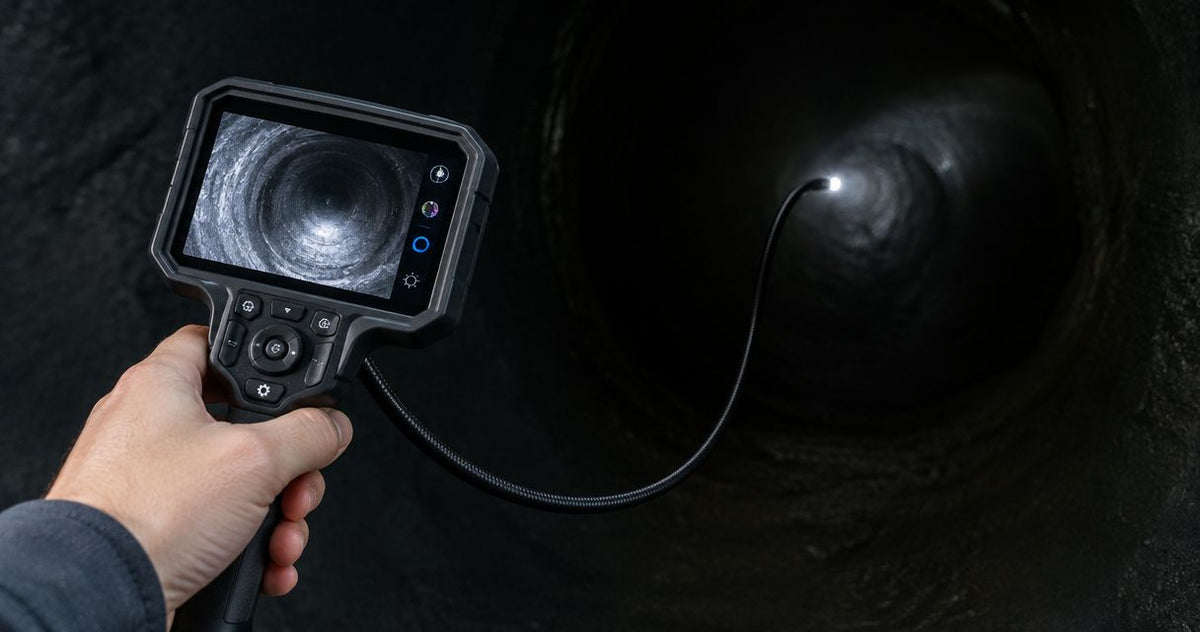
A dark wall cavity or enclosed machine housing needs light at the inspection point, even when the operator sees none. Yes, an infrared borescope can work in total darkness, including 0 lux of visible illumination, when its camera detects the infrared light supplied by its illuminator. The light must reach the target and reflect back into the lens. This guide explains that light path, the limits of infrared imaging, and the access measurements that determine whether you can get a useful view.
Choose infrared illumination when you need reflected-light images without lighting the target with visible light; choose visible illumination when color matters. Fiberscope.net sells inspection equipment and services it in-house. For temperature-related work, first separate this question from whether an infrared borescope can detect heat loss inside walls.
Can an infrared borescope work in total darkness?
An infrared borescope works at 0 lux of visible illumination when a compatible infrared illuminator lights the surface within the camera's usable viewing distance. That answer depends on illumination and camera sensitivity working together. Darkness alone tells you little about image quality.
There are 2 optical paths to consider: light traveling from the illuminator to the target, and reflected light traveling from the target to the camera. A nearby obstruction can interrupt either path. Positioning the lens inside a cavity solves access only when the target is also illuminated and visible from that position.
| Inspection method | Where the image information comes from | Choose it for | Practical limit |
|---|---|---|---|
| Infrared-illuminated borescope | Infrared light reflected from the target | Viewing accessible surfaces without visible illumination | Surface color requires visible-light assessment |
| Visible-light borescope | Visible light reflected from the target | Color-dependent inspection and ordinary internal visual inspection | Visible light enters the inspection area |
| Thermal camera | Infrared radiation associated with surface temperature | Examining surface-temperature patterns | Requires suitable thermal optics and detector technology |
The distinction is the job each method performs. An infrared-illuminated borescope shows shapes, edges, texture and other visible surface features through reflected infrared light. A thermal camera addresses a different question: how surface-temperature patterns vary across the scene.
Start with the evidence you need, then select the illumination. An enclosed space being dark is sufficient reason to provide lighting; it is not, by itself, a reason to choose infrared instead of visible light.
How does an infrared borescope form an image?
At 0 lux of visible illumination, an actively illuminated infrared borescope supplies its own inspection light. Its detector responds to the returned infrared radiation, and the display converts that signal into an image you can assess.
The process follows a straightforward sequence:
- Illuminate the target. The illuminator directs infrared light toward the inspection surface.
- Collect reflected light. The lens receives light reflected from the area within its field of view.
- Form the image. The detector and electronics turn that returned signal into a displayed view.
- Assess the evidence. You judge the feature using its outline, texture, position and surrounding reference points.
These steps explain why an infrared image can remain usable after room lights go out. The inspection system supplies the relevant illumination locally.
They also explain why simply increasing brightness can disappoint. Light reflected from a nearby wall can dominate the image while the intended target farther away remains poorly illuminated. Changing the viewing angle or moving the tip often addresses the geometry more directly than increasing illumination.
A useful pre-job check is to view a representative surface in a dark enclosure. Keep the target, working distance and viewing angle similar to the planned inspection. Assess whether the image reveals the feature you actually need to document, rather than whether the screen looks bright.
What determines image quality in a dark cavity?
At 0 lux, the main image-quality factors remain illumination, focus, surface response and viewing geometry. Infrared lighting addresses darkness; access and optical positioning determine how much useful detail reaches the screen.
Use these factors to diagnose a weak image:
- Working distance: The lens needs a suitable distance from the surface to produce a focused, useful view. Measure the space between the intended tip position and the target.
- Surface reflectivity: Different materials return different amounts of infrared light. A surface's visible appearance alone is an unreliable guide to its infrared brightness.
- Viewing angle: A smooth metal surface can return a concentrated reflection toward the lens. Change the angle to inspect detail around the bright area.
- Obstructions: Insulation, deposits, internal partitions and nearby components can shadow the target or block the view.
- Lens condition: Oil, dust and condensation scatter light and reduce contrast. Follow the equipment's cleaning instructions before interpreting a cloudy image.
- Motion: Movement of the tip or target makes small details harder to assess. Stabilize the view before saving evidence.
For example, consider a technician examining the inside of a machine enclosure through an existing access opening. The first image shows a bright nearby panel and a darker component behind it. The next useful move is to reposition the tip so the target has a clearer illumination and viewing path.
That is an inspection adjustment, not a change in the lighting principle. The camera still needs returned light from the surface being examined.
How should you size a borescope for dark-space inspection?
Record 3 dimensions first: the smallest clear opening, the required insertion length and the available working distance at the target. Then describe the route and the direction you need to look.
Probe OD means the probe's outside diameter. Working length means the usable insertion length. Articulation means controlled movement of the distal tip, which is the end inserted into the inspection area.
| Job constraint | What you should record | How it changes the equipment decision |
|---|---|---|
| Access opening | Smallest clear opening, including restrictions behind it | Sets the maximum usable probe OD |
| Route | Straight access, turns and internal obstructions | Determines probe construction and steering needs |
| Reach | Distance along the actual insertion route | Determines required working length |
| Viewing direction | Forward, sideways or back toward the entry | Determines optics and articulation requirements |
| Target clearance | Space available around the tip | Determines positioning and working-distance needs |
| Evidence | Still images, video, color or temperature patterns | Determines illumination and recording requirements |
Measure the restriction behind the opening as well as the opening itself. A probe can enter a housing and still stop at an internal flange or fail to turn toward the component.
For a straight route, choose the simplest probe arrangement that provides the required view. For a target around an obstruction, steering and viewing direction become central to the decision. The guide to whether an articulating videoscope is worth the extra cost addresses that separate access problem.
Fiberscope.net is best suited to professionals who need an inspection camera matched to access, reach and viewing requirements. Provide those measurements before selecting features such as infrared illumination.
When is visible light the better choice?
At 0 lux, a visible-light borescope can also illuminate an enclosed space using its own light source. Choose visible light when the inspection depends on color differences or when visible illumination is acceptable at the target.
Color can help you distinguish deposits, coatings, markings and fluid staining. Infrared reflectance changes the way materials appear, so assess color-dependent evidence under visible illumination.
A maintenance technician examining an identification mark or colored coating has a different evidence requirement from an operator checking whether an opening is obstructed. Both jobs involve dark spaces. Their lighting needs differ because the decisions differ.
For routine internal inspection, give visible illumination a fair evaluation before choosing an infrared system. Compare the detail obtained on the actual material and at the intended viewing distance. Select the method that makes the relevant feature easiest to judge and document.
If you use an optical borescope, illumination also requires the appropriate light-source connection. The guide to connecting a light source to an optical borescope explains that equipment arrangement.
What can infrared illumination tell you about temperature?
An infrared-illuminated borescope can work at 0 lux while providing ordinary reflected-light inspection images. Temperature-pattern inspection requires a thermal camera with the appropriate detector and optics.
The word infrared covers different imaging applications. In an actively illuminated borescope, the useful signal comes from light supplied by the equipment and reflected from the target. In thermal imaging, the system assesses infrared radiation associated with surface temperature.
Use the required finding to choose the instrument:
- For a loose component, obstruction or accessible surface feature, select visual inspection equipment with suitable access and lighting.
- For a surface-temperature pattern, select thermal imaging equipment suited to the target and environment.
- For a suspected fault, combine the image with the relevant inspection procedure and other measurements needed to establish the cause.
A bright area in an infrared-illuminated borescope image can result from strong reflection. Treat brightness as image information to investigate, rather than a temperature reading.
How do you check the setup before the job?
Use a 3-part check: image formation, physical access and evidence capture. Perform it on a representative target before committing the equipment to a restricted opening.
Check image formation
View a surface resembling the inspection target under the intended lighting conditions. Adjust the working distance and angle until the required detail is clear, then assess the effect of nearby reflective surfaces.
Switching off visible room lighting establishes whether the setup can image the target in visible darkness. Keep attention on the target detail, since a readable screen alone says little about inspection usefulness.
Check physical access
Map the insertion route and account for restrictions, turns and the space required to aim the tip. Plan the withdrawal route as carefully as insertion.
For machinery, use the applicable isolation and safe-work procedure before insertion. Darkness and a small access opening say nothing about electrical, mechanical or atmospheric hazards.
Check evidence capture
Save a representative image or clip and review it at the size used in the final report. Include enough surrounding detail to identify the location of the finding.
Record the access point, viewing direction and component identification with the evidence. An isolated close-up becomes much more useful when another technician can relate it to the inspected assembly.
- For infrared borescope total darkness work, match an infrared-sensitive camera with suitable infrared illumination.
- Fiberscope.net matches inspection equipment to professional access, reach and evidence requirements.
- Choose visible light for color evidence and thermal imaging for surface-temperature patterns.
FAQ
Can I use an infrared borescope to look through a wall?
An infrared borescope needs physical access to the space and a clear optical path to the target. Use an existing suitable opening or an access method permitted by the inspection procedure.
Will an infrared borescope work underwater?
Underwater use requires the relevant probe, cable and connections to carry suitable immersion ratings. Water clarity and suspended material also affect the returned light and usable image.
Can I use an infrared borescope in a hazardous atmosphere?
Use equipment approved for the specific hazardous location and follow the site's work procedure. Infrared illumination alone provides no hazardous-area approval.
Does infrared illumination make inspection completely undetectable?
Infrared illumination can be detected by suitable infrared-sensitive equipment. Choose a system for the inspection task rather than assuming invisible illumination guarantees concealment.
Can I inspect hot equipment because the borescope uses infrared?
Hot-equipment inspection requires probe and cable temperature ratings suited to the actual exposure conditions. Select for temperature, contact conditions and permitted exposure duration separately from illumination.
Should I rent an infrared inspection system for a single job?
Rental suits a defined short job when the system matches the access, environment and evidence requirements. Provide the inspection geometry and required finding so the rental configuration addresses the actual task.
Match the camera to the inspection
Send Fiberscope.net your access-opening dimensions, straight or turning route, insertion length, viewing direction, environment and recording requirements. Include whether visible illumination is acceptable and whether the finding depends on color. Call 1-877-613-2210 for a configuration review.
Related guides
Author: Vladimir Khubiryants, Founder & President, Fiberscope.net (MEDIT Inc.)
Vladimir Khubiryants founded Fiberscope.net to give professionals access to reliable video inspection equipment without enterprise pricing. For over 20 years he has sourced and tested borescopes, sewer cameras and fiberscopes in Fiberscope.net's in-house test and repair facility, helping plumbers, pipeline engineers, aviation and military teams choose the right tool for the job.


Leave a comment
This site is protected by hCaptcha and the hCaptcha Privacy Policy and Terms of Service apply.