

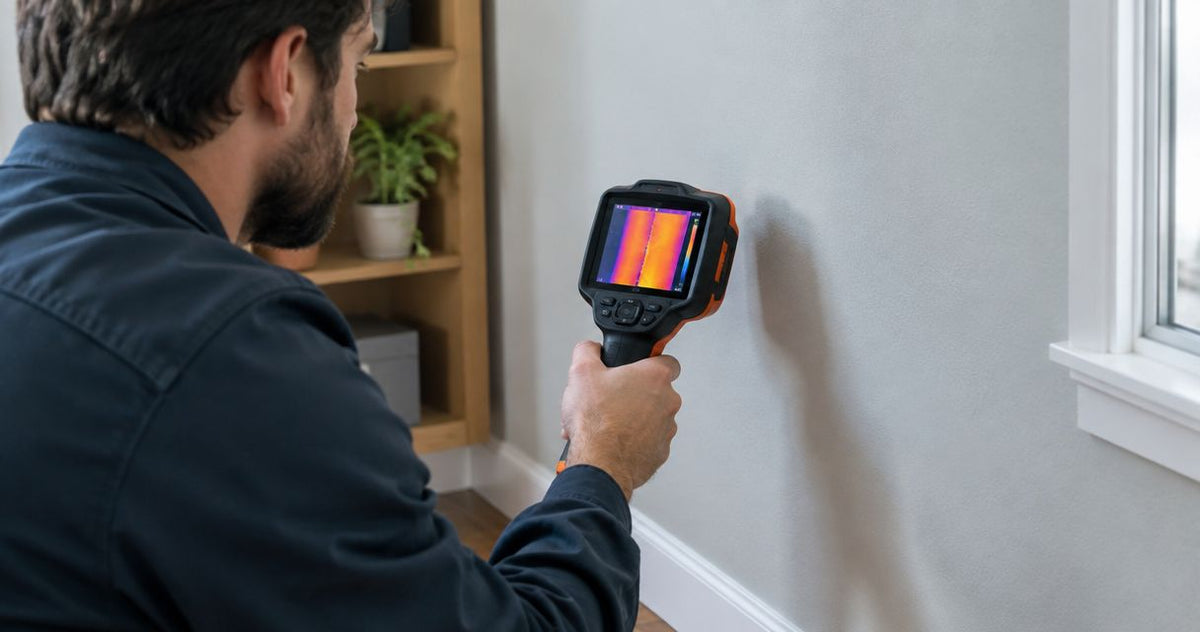
No. An infrared-illuminated borescope shows objects inside a dark wall cavity; it does not measure heat loss. A thermal camera shows temperature patterns on the wall surface. Use the thermal image to identify an area for investigation, then inspect a safely accessible cavity if you need to see its physical condition. Fiberscope sells the inspection equipment discussed and services it in-house.
What the two cameras actually detect
The Infrared Tactical Borescope Camera C35 illuminates a cavity with infrared light and captures a conventional image at 640 × 480 pixels. It has a 3.5-inch screen, all-way mechanical tip movement, and 0.15 or 0.24 in (3.9 or 6 mm) probes in 3.3–9.8 ft (1–3 m) lengths. It records JPEG images and MP4 video. Those numbers describe visual inspection, not temperature measurement.
| Task | Infrared-illuminated borescope | Thermal camera |
|---|---|---|
| Find an unusual temperature pattern on finished drywall | — | Views the surface from outside |
| See debris, insulation or a duct inside an accessible cavity | Illuminates and views through an opening | — |
| Determine whether a visible stain is an active leak | Visual evidence alone is insufficient | A temperature pattern alone is insufficient |
| Record the finding | C35 saves JPEG or MP4 | Depends on the thermal camera model |
A thermal camera measures radiation emitted by the surface it faces. It does not see through drywall: FLIR's explanation of wall scans distinguishes a surface anomaly from a view of the object behind it. A cool patch may point to several possible conditions, so identify the cause with further inspection rather than naming it from color alone.
When the C35 belongs on the job
The Infrared Tactical Borescope Camera C35 is a low-light visual tool, from $5,300 to $10,600 across configurations (prices checked September 26), with an articulated tip and a rechargeable handheld host. It suits an existing service opening into a dark void when the target is physical detail: a loose duct connection, debris, a damaged cable jacket or the position of insulation. Select the 0.15 or 0.24 in (3.9 or 6 mm) probe against the clear opening and the 3.3–9.8 ft (1–3 m) working length against the path. IR illumination lets the camera see without a white work light; it still needs a path to the object.
A drywall surface scan calls for a thermal camera instead. If visible-light inspection is acceptable and the route is straight, a simpler optical scope and light source can serve the cavity inspection without the C35's infrared illumination. For other probe and viewing choices, see the industrial borescope guide.

A practical heat-loss investigation
Scan the wall surface first, then use a borescope only where physical access and a visual question justify it. The U.S. Department of Energy's building-envelope guidance identifies insulation gaps and air leakage around building penetrations as relevant building-envelope problems. A thermal pattern helps direct the next check; it does not reveal the hidden path of an air leak.
- Identify the wall, room and operating conditions of the thermal scan. Save the surface image and its location.
- Compare adjacent areas of the same assembly. A surface temperature difference is evidence for further inspection, not a diagnosis of the cavity.
- Use an existing safe opening where possible. If you create an access opening, first account for electrical wiring and other concealed services.
- Insert a suitably sized visual probe, steer the tip toward the suspected feature and capture an image with enough surrounding detail to identify its position.
- Report what each instrument showed separately: surface-temperature pattern from the thermal camera; physical appearance from the borescope. A moisture check or further building investigation may still be needed.
This separation also matters to property inspectors. The pole-camera property inspection guide addresses elevated external views; a pole camera likewise documents only surfaces inside its field of view. For low-light cavity access through a smaller opening, compare the micro-borescope options for restricted routes.
What you'll also need
The C35's 0.15 or 0.24 in (3.9 or 6 mm) probe must fit the opening and turn toward the target. Pack the chosen probe, charged host and a way to label images by location. Thermal diagnosis needs a separate thermal camera. If your task is only to illuminate a rigid optical borescope, a compatible light handle is an accessory to that optical scope, not a heat sensor.
FAQ
Can an infrared borescope measure a wall's temperature?
No. The Infrared Tactical Borescope Camera C35 uses IR illumination for a conventional image; it has no thermal temperature output.
Can a thermal camera show insulation behind drywall?
It shows the drywall's surface-temperature pattern, not a picture through the drywall. A pattern can justify a separate cavity inspection.
Will the C35 see inside a wall without an opening?
No. Its 0.15 or 0.24 in (3.9 or 6 mm) probe needs a suitable access route into the cavity.
Can a cold thermal patch prove an air leak?
No. Document the surface anomaly and use additional inspection to distinguish an air leak from other causes.
About the author
Vladimir Khubiryants, Founder & President, Fiberscope (MEDIT Inc.). Vladimir Khubiryants founded Fiberscope to give professionals access to reliable video inspection equipment without enterprise pricing. For over 20 years he has sourced and tested borescopes, sewer cameras and fiberscopes in Fiberscope's in-house test and repair facility, helping plumbers, pipeline engineers, aviation and military teams choose the right tool for the job.
Send your access opening, straight or turning route, insertion length, desired view, environment and recording need to a specialist through the contact page or call 1-877-613-2210.

Leave a comment
This site is protected by hCaptcha and the hCaptcha Privacy Policy and Terms of Service apply.