

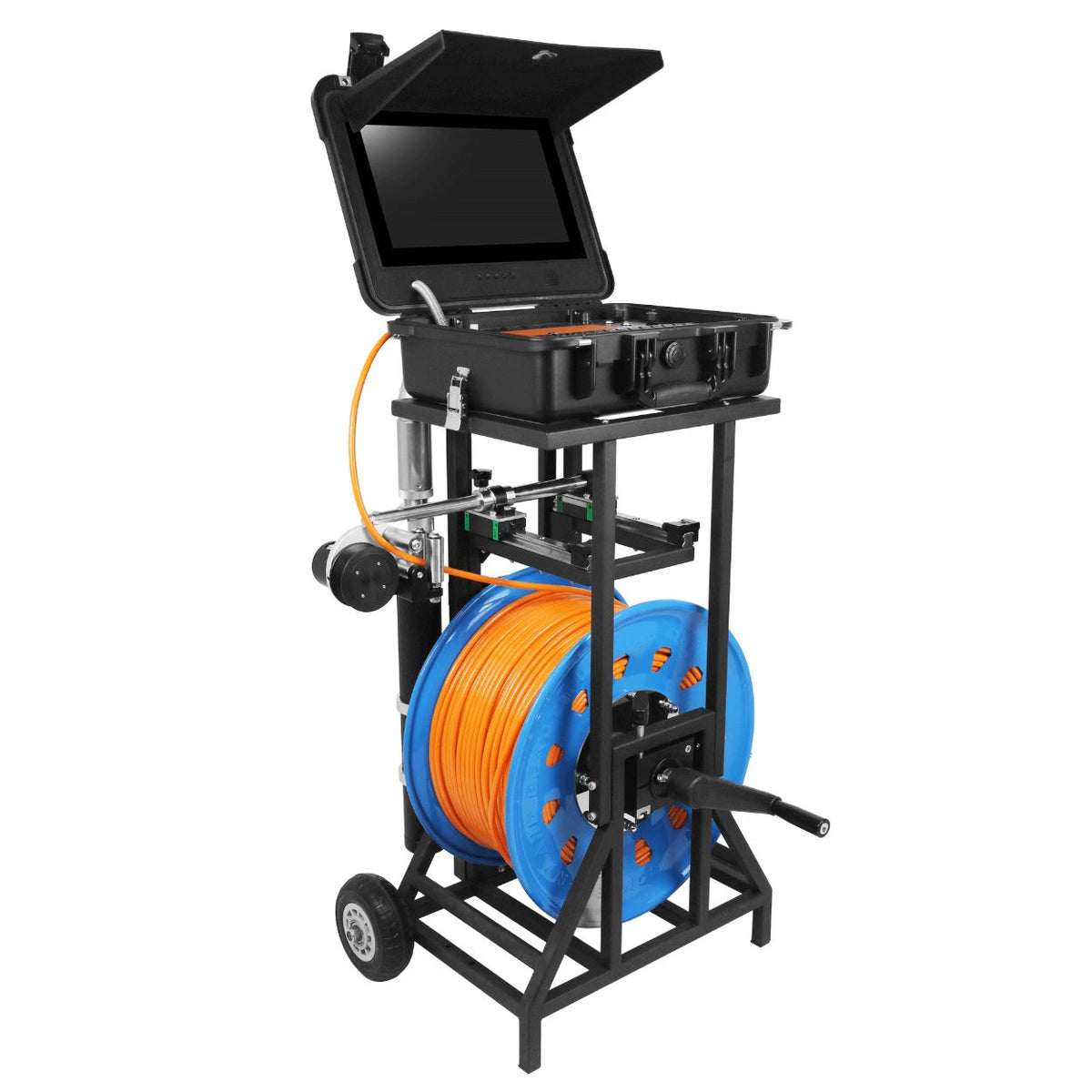
Choose the Well Inspection Camera STRAHL HD for water-well casing inspections with manual deployment; choose the Motorized Downhole Well Camera STRAHL HD when powered cable handling is needed. For dry boreholes and shafts within 110 m (360 ft) of cable reach, choose the STRAHL PT Downhole Camera. Cable length, immersion pressure and retrieval method are separate buying decisions.
- STRAHL HD borehole cameras provide downward and rotating side views for casing and screen inspection.
- Manual STRAHL HD cable configurations are 200 m (656 ft) and 300 m (984 ft).
- Motorized Downhole Well Camera STRAHL HD replaces hand-cranking with powered deployment and retrieval.
- STRAHL PT has 110 m (360 ft) of cable and pan-and-tilt viewing for dry vertical inspections.
- Match the smallest restriction, water conditions and retrieval plan before choosing a reel.
Borehole cameras compared at a glance
These are three complete drop-camera systems, not accessories or pole-mounted substitutes. Fiberscope.net supplies the cameras and provides in-house testing, repair and technician support. Product details and prices checked September 30, 2026.
| Complete system | Best for | Cable reach | Viewing direction | Deployment | Key limitation |
|---|---|---|---|---|---|
| Well Inspection Camera STRAHL HD | Routine water-well casing and screen inspections | 200 m (656 ft) or 300 m (984 ft) configurations | Downward view plus 360° rotating side view | Manual reel with mechanical brake | Retrieval requires hand-cranking; the 45 mm head must clear restrictions |
| Motorized Downhole Well Camera STRAHL HD | Repeated vertical inspections needing powered cable handling | Select the working length for the job | Downward view plus 360° rotating side view | Motorized winch | The powered winch needs AC supply; motorization does not resolve a blocked route |
| STRAHL PT Downhole Camera | Dry boreholes, chimneys and vertical shafts needing directional viewing | 110 m (360 ft) | Pan 360°; tilt 160° | Drop cable and reel with battery-powered monitor | Dry-inspection choice here, not a substitute for a pressure-rated deep-water system |
The manual STRAHL HD head and cable are rated IP68 to 30 bar in freshwater. The motorized STRAHL HD camera head is rated to 30 bar. Neither statement makes the monitor, keyboard or entire reel waterproof.
Why depth alone does not select the camera
A camera can have enough cable to reach the bottom and still be wrong for the inspection. The head might not pass a casing restriction, the water might obscure the wall, or the crew might have no practical way to retrieve the deployed cable. Establish those conditions before comparing screen size.
Keep these measurements separate:
- Target depth: distance from the chosen surface reference to the deepest feature that needs recording.
- Available cable: working length of the selected reel, allowing for the route from the reel to the well opening.
- Immersion pressure: pressure on the submerged head, rather than simply the total borehole depth.
- Minimum clear opening: the smallest passage along the route, including remaining pump equipment and cables.
- Viewing requirement: downward footage for obstructions, sidewall footage for casing joints and screens, or directed pan-and-tilt views.
- Retrieval method: manual or powered handling, with appropriate power and access at the wellhead.
A longer cable increases reach; it does not increase a camera head's pressure rating. Record the water level as well as total well depth. They answer different questions.
1. Well Inspection Camera STRAHL HD: best for manual water-well inspection
The Well Inspection Camera STRAHL HD combines a fixed downward-facing camera with a side camera that rotates through 360°. The head is 45 mm (1.77 in) in diameter, and the flexible cable is 8 mm in diameter. Available manual configurations carry 200 m (656 ft) or 300 m (984 ft) of cable.
That dual view suits casing work. Look downward to assess the route and an obstruction, then rotate the side camera to document a joint, buildup or screen around the bore. The manual reel has a mechanical brake, while the display shows camera depth for associating findings with a position.
Well Inspection Camera STRAHL HD strengths:
- Separate downward and rotating side views address both the route and the casing wall.
- The head and cable have a stated IP68, 30 bar freshwater rating.
- The supplied 13-inch display supports on-site viewing; the description specifies snapshot and video storage to USB flash memory.
- Battery operation avoids dependence on an AC-powered winch for the manual configuration.
Well Inspection Camera STRAHL HD limits:
- Lowering and retrieval are manual cable-handling tasks.
- A 45 mm head does not establish clearance past a pump, drop pipe or irregular casing joint.
- Camera footage shows visible condition, not wall thickness, water quality or a measured flow rate.
Best for: a well contractor who needs casing and screen footage and can manage manual retrieval. Verdict: choose the manual STRAHL HD when its head clearance, selected cable length and freshwater rating fit the job. Do not buy the longer reel unless the inspection route needs it.
2. Motorized Downhole Well Camera STRAHL HD: best for powered retrieval
The Motorized Downhole Well Camera STRAHL HD changes cable handling, not the purpose of the inspection. A powered winch unwinds and retrieves the cable instead of requiring the operator to crank the reel. The system includes the camera head, winch and reel, monitor and accessories.
Its dual-view head looks downward and sideways, with 360° side viewing. The head has a stated 30 bar pressure rating; the cable diameter is 8 mm. The winch description specifies AC 110–230 V power, so site power belongs in the deployment plan even if the monitor has its own power arrangement.
Motorized Downhole Well Camera STRAHL HD strengths:
- Powered lowering and retrieval replace manual winching.
- Downward and rotating side views support obstruction and casing assessment.
- A meter counter, recording and text overlay help connect a finding with its recorded position.
Motorized Downhole Well Camera STRAHL HD limits:
- The powered winch needs a suitable AC supply at the site.
- A motor does not make a camera pass a restriction or remove an entanglement.
- Powered cable handling does not establish better image detail than the manual system.
Best for: contractors making repeated deployments or inspections where manual retrieval is the operational constraint. Verdict: choose the motorized STRAHL HD for cable handling, not on an assumption that it automatically reaches deeper or sees more. For occasional work with manageable manual retrieval, the manual system remains the simpler choice.
3. STRAHL PT Downhole Camera: best for directed viewing in dry shafts
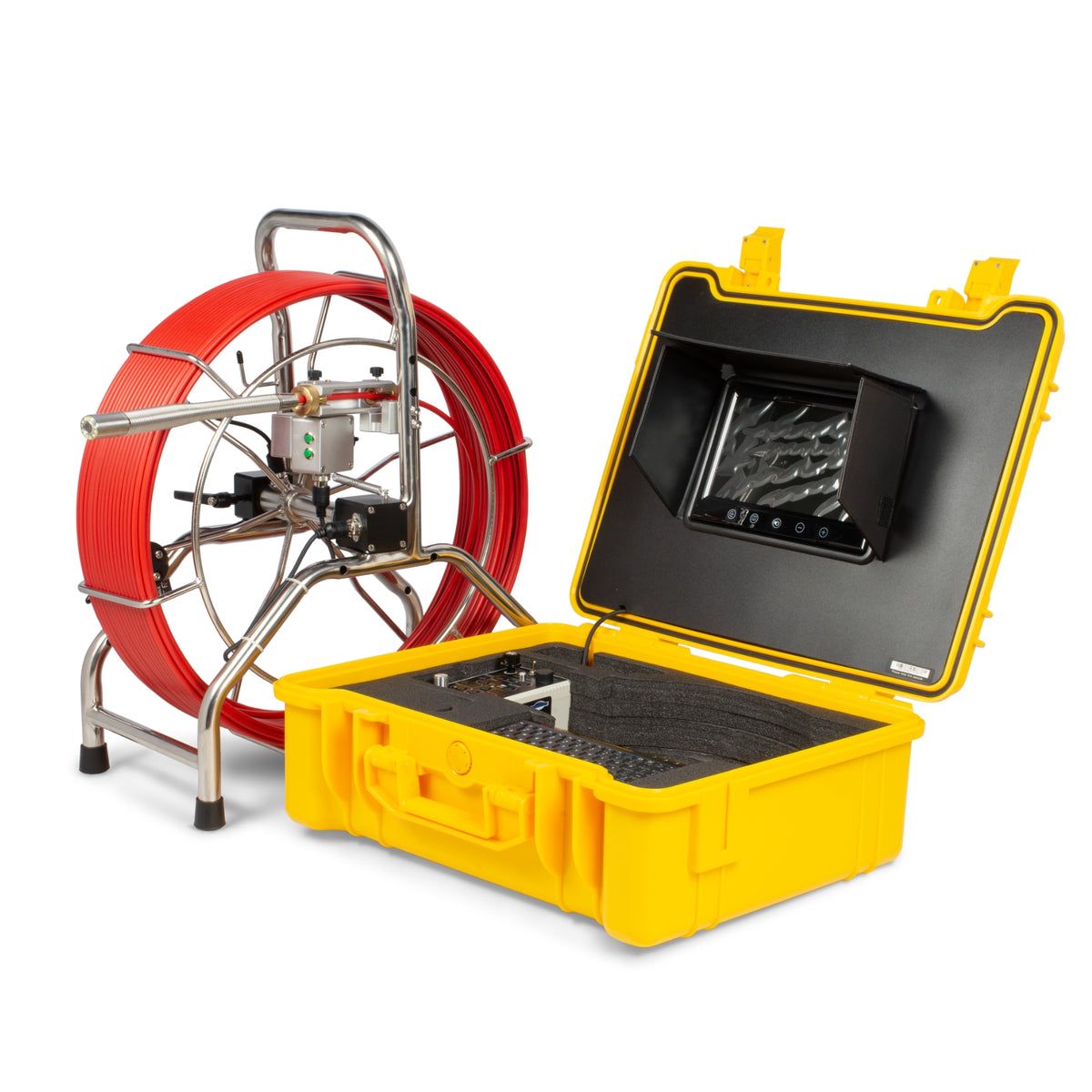
The STRAHL PT Downhole Camera is a drop inspection system for dry boreholes, shafts and chimneys. Its stainless-steel head measures 50 mm in diameter and 154 mm in length. The head pans through 360° and tilts through 160°, allowing the operator to aim toward a wall feature without repositioning the whole reel.
The reel holds 110 m (360 ft) of reinforced flexible cable with a 6.5 mm diameter. A footage counter, battery-operated monitor, recorded footage, text overlay and audio support a documented inspection. The 50 mm head must clear the actual access route; nominal shaft size alone is insufficient.
STRAHL PT Downhole Camera strengths:
- Pan-and-tilt viewing lets the operator direct the image toward a crack, joint or obstruction.
- A 110 m drop cable suits longer dry vertical routes than a short pole can reach.
- The head includes a 512 Hz sonde, a transmitter for a compatible surface receiver.
STRAHL PT Downhole Camera limits:
- Its dry-shaft application is not a deep-water pressure specification.
- Locating requires a separate compatible 512 Hz receiver; steel casing and rebar distort the field.
- The 50 mm head and any fitted guide need clear passage through every restriction.
Best for: dry vertical inspections where aimed wall views are more useful than fixed downward and rotating side views. Verdict: choose STRAHL PT for the dry route and pan-and-tilt function; use a pressure-rated STRAHL HD system for the submerged-water application described above.
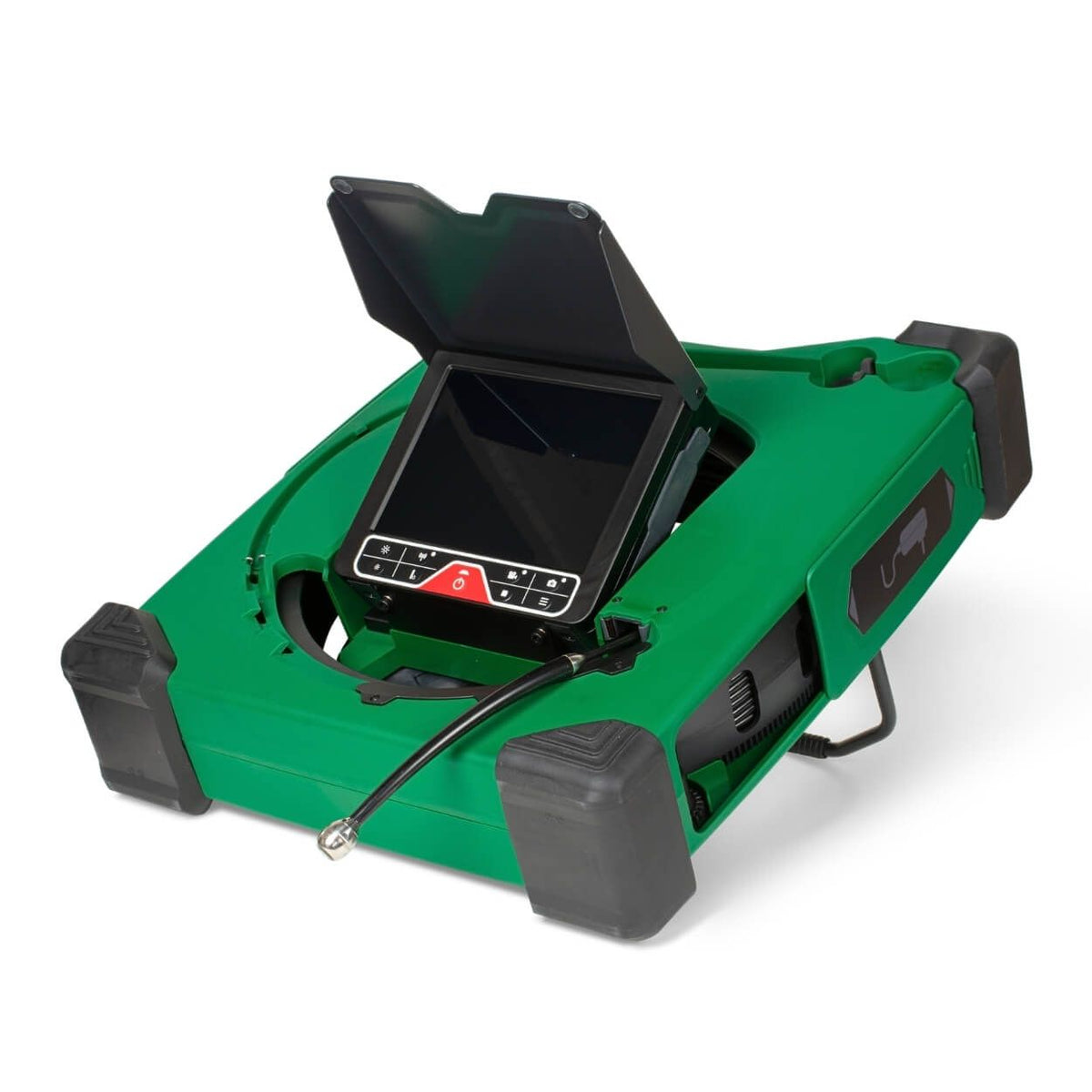
Watch Fiberscope.net compare the manual STRAHL PT and STRAHL HD systems. The video shows their reel and camera-head arrangements; the wet-well recommendations in this guide apply to the STRAHL HD systems.
Choose the system around the inspection evidence
Casing damage and screen encrustation
A downward camera helps establish the route, but a side view is needed to examine the wall directly. STRAHL HD's rotating side camera suits a circumferential record of joints, screen openings and visible buildup. Pause at each feature and save its depth reference with the image, rather than recording a continuous descent without identifying findings.
The USGS description of groundwater-well components explains the different roles of casing, screens and pumps. Distinguishing those parts helps keep the inspection report specific: a restricted screen and damaged casing are different findings.
Lost pump or tool assessment
Downward and side views can document a visible lost item and the space around it before a separate recovery operation. A camera is not a fishing tool. Do not infer that the motorized camera winch is rated to lift a pump or force an obstruction free.
Record the item's position, visible orientation and remaining clearance. If the route is already occupied by pipe or cable, head diameter alone is not enough to establish safe passage or retrieval.
Water entry and visibility
Optical footage needs a visible wall. Suspended material can obscure a feature regardless of reel length or the presence of a side camera. The EPA's optical-televiewer guidance identifies fluid clarity and lighting as limitations of optical borehole imaging.
A rotating side camera is not automatically an oriented optical televiewer. Do not treat an ordinary video record as a measured fracture-orientation log, or describe visible movement as a quantified water-entry rate. Those claims require the appropriate measurement method.
Inspect the well without overstating the result
A depth counter connects footage to deployed cable length. Establish the reference point at the wellhead and use it consistently in the video notes and report. Describe a joint or obstruction by that reference instead of mixing distance below ground with distance from the reel.
For a drinking-water well, visual condition does not establish potability. EPA guidance on protecting private well water recommends annual testing for total coliform bacteria, nitrates, total dissolved solids and pH. A clear camera image cannot replace laboratory results.
Common buying and reporting mistakes are:
- Treating cable length as an immersion-depth guarantee.
- Choosing a head from nominal casing diameter while ignoring remaining pump hardware.
- Expecting a powered reel to solve poor clearance or cloudy water.
- Calling the whole system waterproof because its head is sealed.
- Promising exact sonde locating through steel casing.
- Presenting a visual inspection as proof of water quality or a quantified structural measurement.
Compare complete configurations
Compare the camera head, reel, monitor, power arrangement and recording setup together. Prices checked September 30, 2026; manual and motorized HD price ranges cover their listed variants. The motorized system's working length should be matched through the configuration review below, rather than assumed from its name.


FAQ
Which borehole camera should I choose for a water well?
Choose the Well Inspection Camera STRAHL HD for manual deployment and downward plus rotating side-view footage. Its head and cable are rated IP68 to 30 bar in freshwater. Choose the motorized STRAHL HD when powered cable handling is needed.
How much cable does the manual STRAHL HD carry?
The manual Well Inspection Camera STRAHL HD has 200 m (656 ft) and 300 m (984 ft) cable configurations. Cable reach and pressure limits are separate specifications.
Does a motorized borehole camera inspect deeper than a manual one?
Motorization changes deployment and retrieval, not the camera's pressure rating. Working length and the limits of the selected head and cable determine whether the system fits the target depth.
What is the STRAHL PT cable length?
The STRAHL PT Downhole Camera carries 110 m (360 ft) of cable. This guide recommends it for dry vertical inspections needing pan-and-tilt views.
Can I lower a camera beside an installed pump?
Only if the entire camera and guide assembly has a clear deployment and retrieval route. The smallest gap past pipe, cable and pump hardware matters more than nominal casing diameter.
Does IP68 mean the monitor and reel are waterproof?
No. An IP68 rating applies to the specified component under stated conditions. It does not extend to the monitor, keyboard or complete reel assembly.
Can STRAHL PT be located through steel casing?
STRAHL PT has a 512 Hz transmitter and requires a separate compatible receiver for locating. Steel casing and other metal distort the field, so exact position or depth should not be promised.
Can borehole camera footage prove that water is safe to drink?
No. Camera footage documents visible conditions; drinking-water safety requires appropriate water testing. Clear water on screen is not a laboratory result.
Related guides
- Compare manual and motorized well inspection cameras
- Understand inspection-camera water ratings by component
Match the camera to the well
For water-well casing inspection, start with the manual STRAHL HD; move to the motorized system for powered cable handling, not a presumed depth advantage. Send Fiberscope.net your well diameter and smallest restriction, target depth, water level and conditions, pump and cable clearance, required views and recording needs, and manual or motorized reel preference. A specialist will match the head, working length and deployment setup. Call 1-877-613-2210.
Vladimir Khubiryants
Founder & President, Fiberscope.net (MEDIT Inc.)
Vladimir Khubiryants founded Fiberscope.net to give professionals access to reliable video inspection equipment without enterprise pricing. For over 20 years he has sourced and tested borescopes, sewer cameras and fiberscopes in Fiberscope.net's in-house test and repair facility, helping plumbers, pipeline engineers, aviation and military teams choose the right tool for the job.

Leave a comment
This site is protected by hCaptcha and the hCaptcha Privacy Policy and Terms of Service apply.