

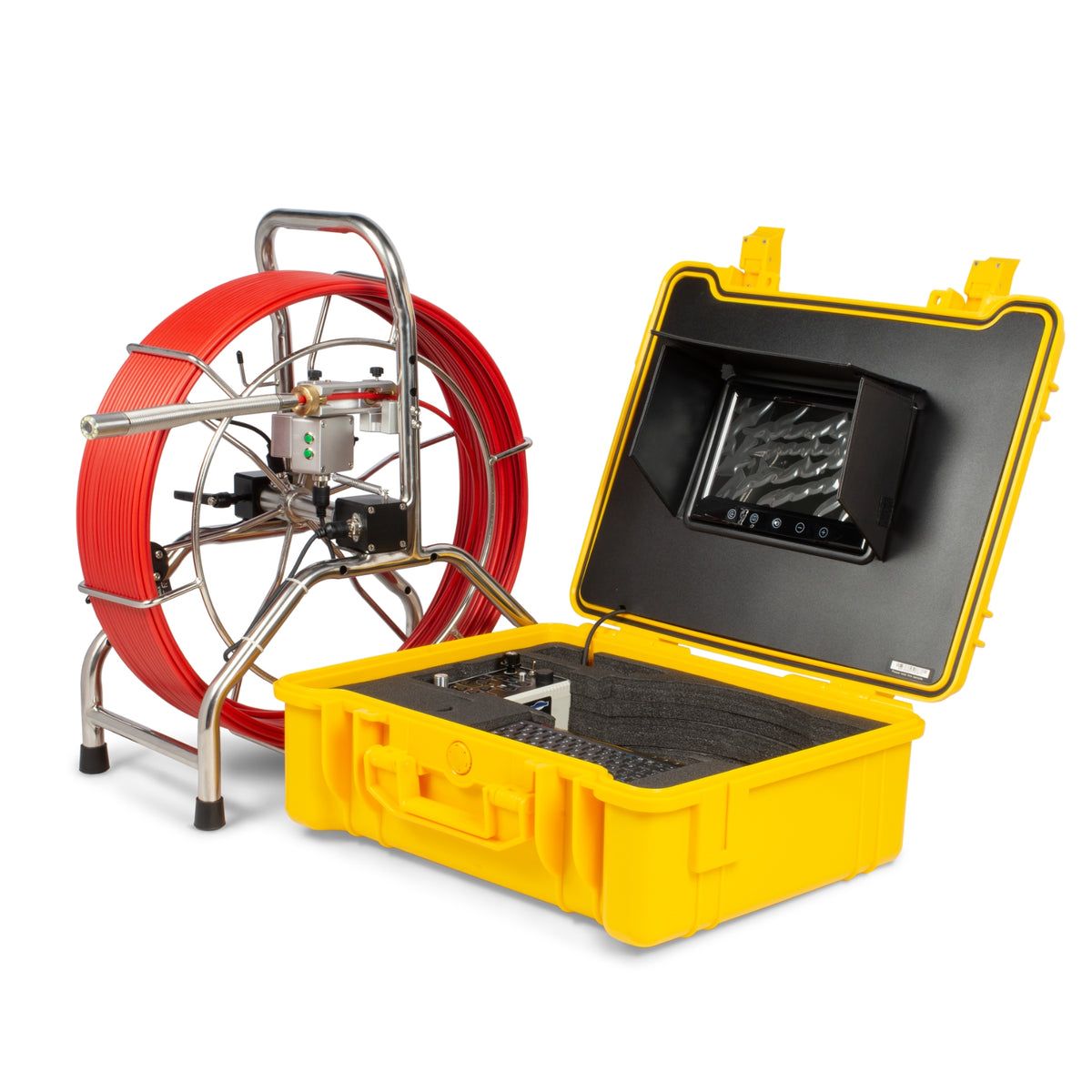
A 4-inch lateral that turns twice before the cleanout calls for more than a camera head that fits the pipe. The reel must reach the defect, the head must pass the fittings, and the crew needs footage it can deliver to the owner. This comparison sets two push cameras against those jobs rather than comparing a store with a whole product family.
Choose Sewer Camera VIPER Mid for 2–6-inch bends when you want a 9-inch monitor and SD/USB recording in the complete system; choose RIDGID SeeSnake rM200A when an 8-inch line, 200-ft reel or SeeSnake monitor workflow matters. Fiberscope.net sells the VIPER Mid and services its equipment in-house.
- VIPER Mid suits 2–6-inch bends with a 9-inch monitor and SD/USB recording in the complete system.
- RIDGID SeeSnake rM200A covers 1.5–8-inch lines with a 200-ft cable and interchangeable drums.
- Both can support 512 Hz locating; VIPER Mid needs the self-leveling sonde-head variant and a separate receiver.
Compare the complete camera systems
The Sewer Camera VIPER Mid includes a head, mid reel and control box; the RIDGID SeeSnake rM200A is listed as a camera reel with a D2A drum, while a SeeSnake monitor is a separate component. The specifications below were checked September 29, 2026, against the two product pages. The VIPER figures describe its 1-inch straight-view head and the longest mid reel; locating uses a different, self-leveling head option.
| Job constraint | Sewer Camera VIPER Mid | RIDGID SeeSnake rM200A |
|---|---|---|
| Straight pipe | 1.25–6 in with 1-inch straight-view head | 1.5–8 in |
| Published bend pipe range | 2–6 in with 1-inch straight-view head | — |
| Longest cable in compared configuration | 197 ft (60 m) | 200 ft (61 m), D2A drum |
| Push cable diameter | 0.26 in (6.5 mm) | 0.3 in (7.5 mm) |
| Camera head | 1 in; straight-view or optional self-leveling variant | 1 in (25 mm); self-leveling TruSense |
| Display and capture | 9-inch monitor; AVI/JPEG to SD or USB | SeeSnake monitor required for viewing and recording |
| Locating transmitter | 512 Hz with selected self-leveling head | 512 Hz Flexmitter |
| Price of Fiberscope.net system | From $3,280 USD; variants to $3,850 USD | Check complete reel-plus-monitor quote |
Prices checked September 29, 2026. The VIPER Mid price range reflects the live 40 m and 60 m straight-view and self-leveling/sonde variants. The rM200A listing does not price an equivalent complete monitor package here, so the two figures are not a like-for-like total.
VIPER Mid suits a 3–6-inch lateral with a self-contained recording case
The VIPER Mid's 1-inch straight-view head is rated for 1.25–6-inch straight runs and 2–6-inch bends. That makes a 3- or 4-inch building lateral a better-defined use than a tight 1.5-inch trap; the straight-run rating is not a bend rating. The 197-ft (60 m) mid reel has a footage counter, and the 9-inch screen records AVI video and JPEG stills to SD or USB. Battery runtime is up to 3.5 hours.
For a pre-purchase scope or a post-jetting check, those are practical features: advance from the cleanout, record the footage, and note the counter position at a root intrusion, belly or offset joint. The 1-inch straight-view head and mid reel are rated IP68, which applies to those parts rather than the whole control case. For a 1.5-inch P-trap, choose a smaller head after measuring the opening and turn; the VIPER Mid's 2-inch bend minimum does not support that route. The sewer inspection camera guide covers other head sizes.
RIDGID rM200A suits 8-inch work and an existing SeeSnake crew
RIDGID rates the rM200A for 1.5–8-inch lines and a 200-ft (61 m) D2A cable, extending the published upper pipe range by 2 inches against the VIPER Mid straight-view head. Its 1-inch (25 mm) self-leveling camera carries TruSense high-dynamic-range imaging and a TiltSense angle indicator. RIDGID also lists interchangeable D2 drums; its D2B drum uses a shorter 165-ft (50 m) cable. This is the stronger fit when a crew already owns a compatible SeeSnake monitor or routinely inspects larger laterals.
The rM200A reel's listing includes a hanger for the CS6x Versa, not the monitor itself. A CS6x Versa monitor adds a 5.7-inch screen, USB footage storage and phone/tablet viewing through HQx Live. Price and transport weight must therefore be compared for the reel plus the chosen monitor and power arrangement, rather than the reel alone. RIDGID's published 2.8-inch (70 mm) minimum bend radius is a push-cable property, not a promise that the head will clear every trap.
Locating a buried defect takes a receiver on either system
Both models have a 512 Hz route to locating, but the configurations differ. On VIPER Mid, choose the 1-inch self-leveling head with its 512 Hz sonde, the small transmitter in the head. The ordinary straight-view no-sonde variant does not provide that feature. RIDGID lists a 512 Hz Flexmitter on the rM200A. In either case, a separate 512 Hz receiver is needed above ground; the receiver listens to the head's signal and is not the camera.
A metal pipe, rebar or nearby interference can distort the field, so a depth indication is not an exact excavation depth. For excavation work, mark the signal along the route and reconcile the finding with access points and site records. The 512 Hz locating guide covers the effect of pavement and reinforcement.
Reporting needs decide more than the head resolution
For a homeowner's condition report, a clip and a measured distance from the cleanout may be enough to show a root mass or offset. VIPER Mid stores video and stills on removable media from its supplied control case. RIDGID's CS6x Versa supports USB files and connected viewing, and the rM200A's TruSense image and angle feedback can help a crew that uses that monitor ecosystem.
Neither camera alone supplies a completed condition-assessment report. For municipal coding, NASSCO's PACP program defines a method of identifying and recording pipeline conditions. Choose the camera and software workflow around the report a contract requires; do not infer PACP output from the presence of a video recorder. For a 3–6-inch lateral, the head's route through bends and a usable record usually matter more than a three-foot cable-length difference.
Which one should a plumber buy?
For 2–6-inch bends on residential laterals, buy the VIPER Mid configuration with the head and 40 m or 60 m reel matched to the run. The monitor and recording hardware are already in the case. Add the 512 Hz self-leveling head and a receiver if you also need to locate a defect before digging. Its limit is the 6-inch published upper straight-run range with the compared head and 2-inch published lower bend range.
For 6–8-inch lines, buy the RIDGID rM200A configuration if its 200-ft reel and SeeSnake monitor workflow fit the crew. It covers a larger published line range and offers interchangeable D2 drums and TruSense. Budget for a monitor as part of the working system. The reel alone is an incomplete viewing setup.
FAQ
Can VIPER Mid pass a 1.5-inch P-trap?
The VIPER Mid 1-inch straight-view head is rated for 1.25-inch straight runs, but its published bend range starts at 2-inch pipe. A 1.5-inch P-trap needs a smaller camera chosen for that turn.
Is a monitor included with RIDGID SeeSnake rM200A?
The US rM200A reel listing includes a D2A drum and a CS6x Versa hanger, not a monitor. Add a compatible SeeSnake monitor to view and record an inspection.
Which camera works in an 8-inch line?
RIDGID rates the SeeSnake rM200A for lines through 8 inches. The VIPER Mid 1-inch straight-view head is rated through 6-inch straight runs and bends.
Can both cameras locate a buried head?
Yes, with a 512 Hz transmitter-equipped head and a separate matching receiver. The rM200A has a 512 Hz Flexmitter; VIPER Mid requires its 1-inch self-leveling 512 Hz sonde variant.
Do these push cameras drive themselves through a sewer?
No. An operator advances the push cable from its reel. Pipe guides center a head, but powered travel requires a different kind of camera.
Configuration review
Send your pipe ID, cleanout opening, run length, bends or traps, pipe material, locating need and existing receiver frequency, plus recording requirements to Fiberscope.net's technical team, or call 1-877-613-2210. A specialist can match a VIPER Mid head and reel to the route, or tell you when the RIDGID rM200A or a smaller camera is the sounder choice.
Review a sewer-camera configuration
Share the pipe ID, access, run length, turns, locating frequency and footage requirements.
Vladimir Khubiryants
Founder & President, Fiberscope.net (MEDIT Inc.)
Vladimir Khubiryants founded Fiberscope.net to give professionals access to reliable video inspection equipment without enterprise pricing. For over 20 years he has sourced and tested borescopes, sewer cameras and fiberscopes in Fiberscope.net's in-house test and repair facility, helping plumbers, pipeline engineers, aviation and military teams choose the right tool for the job.

Leave a comment
This site is protected by hCaptcha and the hCaptcha Privacy Policy and Terms of Service apply.