

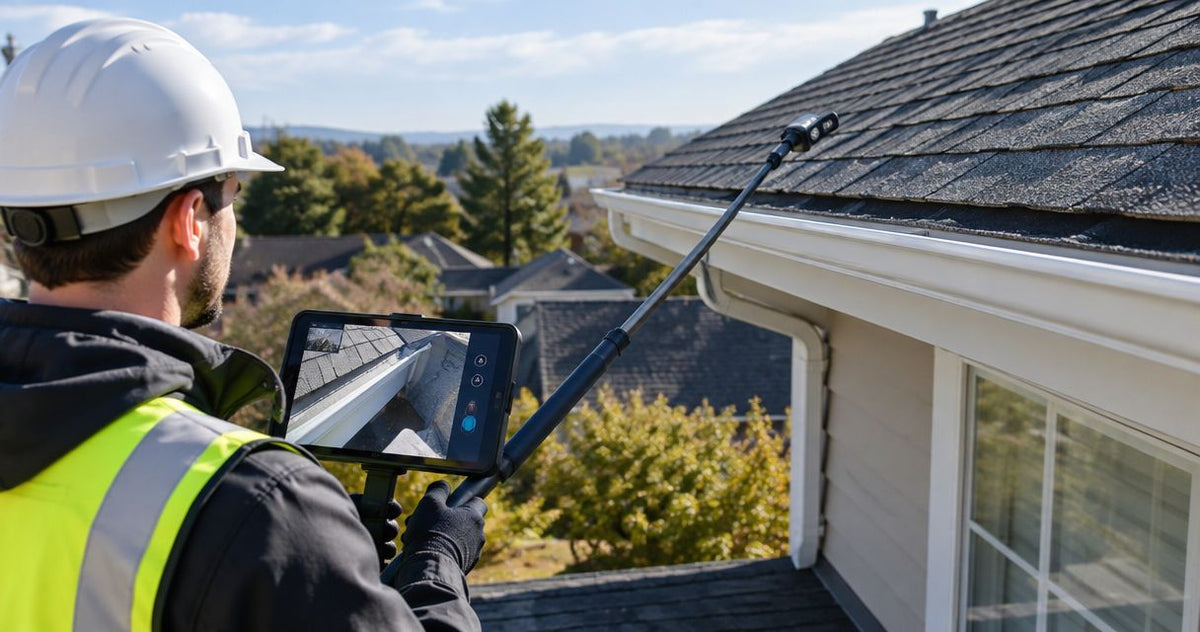
Pole inspection cameras for property inspectors mount a small camera head on a telescoping shaft so gutters, roof valleys, soffits, and second-story flashing get documented from the ground or a single low ladder position instead of a full roof walk. Roof and property inspectors need a different set of trade-offs than plumbers running pipe cameras: sunlight-readable screens, one-handed pole control, and photo files that drop straight into a report matter more here than pipe-diameter range or sonde locating.
- A pole inspection camera for property inspectors extends reach to gutters and roof valleys without a full roof walk.
- The Cobra Dual View Inspection Pole Camera pairs forward and side viewing on one shaft for eave and gutter runs.
- A rigid borescope or an articulating scope like the Videoscope Voyager M40 HD covers tight cavities a pole camera cannot reach.
- Sunlight-readable screens and one-handed grip matter more for 2026 roof work than pipe-locating features built for drain cameras.
- Confirm pole reach and view angle against your tallest roof line before buying, not against a marketing photo.
Why pole cameras matter for roof and property inspectors
A property inspection scope usually calls for photo evidence of gutter condition, roof valley debris, chimney flashing, and soffit vents. On a single-story home, a ladder gets you close enough. On a two-story home or anything with a steep pitch, a full roof walk adds fall risk and time you can't always bill for.
A pole camera adds reach without adding height risk, and the file becomes part of your report instead of a note that says "not accessible from the ground." That's the segment-specific value: documenting a visible condition from a stationary, safe position, not locating a buried line or a sonde transmitter the way a drain camera does. Fiberscope's inspection camera catalog includes both pole-mounted systems and borescopes built for the cavities a pole can't reach, and picking correctly starts with your job conditions, not the spec sheet.
Job conditions to define before you shop
Before comparing pole cameras, write down:
- The tallest eave, valley, or chimney point you need to reach from ground level or one ladder position
- Whether you need a forward view only, a side view only, or both on the same pass
- Whether the screen needs to stay readable in direct sunlight on an open roof
- Whether the pole needs to collapse to fit a service vehicle
- The file format your reporting software accepts
- How long a single property walkthrough runs, and whether the camera needs to last that whole visit on one charge
Fiberscope sells the products discussed below. Recommendations are based on current published specifications and stated use cases; confirm final configuration and compatibility with Fiberscope before purchase.
Measure your reach requirements first, not last
Walk the property perimeter and note every point you currently can't inspect without moving a ladder. That list drives every other decision.
- Single-story eaves and gutter runs already reachable from a stepladder
- Two-story eaves that would otherwise need an extension ladder
- Roof valleys, crickets, and chimney flashing invisible from the ground
- Detached structures like garages or sheds with a separate roofline
- Any span where slope or wind makes ladder placement unsafe
Decide whether you need forward view, side view, or both
A single forward-facing lens works for a straight look down a gutter run or up under an eave. A side- or dual-view head adds a second lens so you can check gutter walls and hangers without rotating the whole pole.
Some inspectors start by taping a phone to a painter's pole. That works for one test shot; it does not hold steady video, store files for a report, or survive daily field use. A purpose-built system like the Cobra Dual View Inspection Pole Camera mounts the camera head on a telescoping shaft designed for that reach, which solves the steadiness and file-storage problem the taped-phone approach can't.
- Gutter runs where you need to see debris along the bottom and sides at once
- Fascia and soffit checks that need an upward and sideways look in one pass
- Roof valleys where a single forward view already shows what you need
- Chimney crown and cap checks that need only a straight-down look
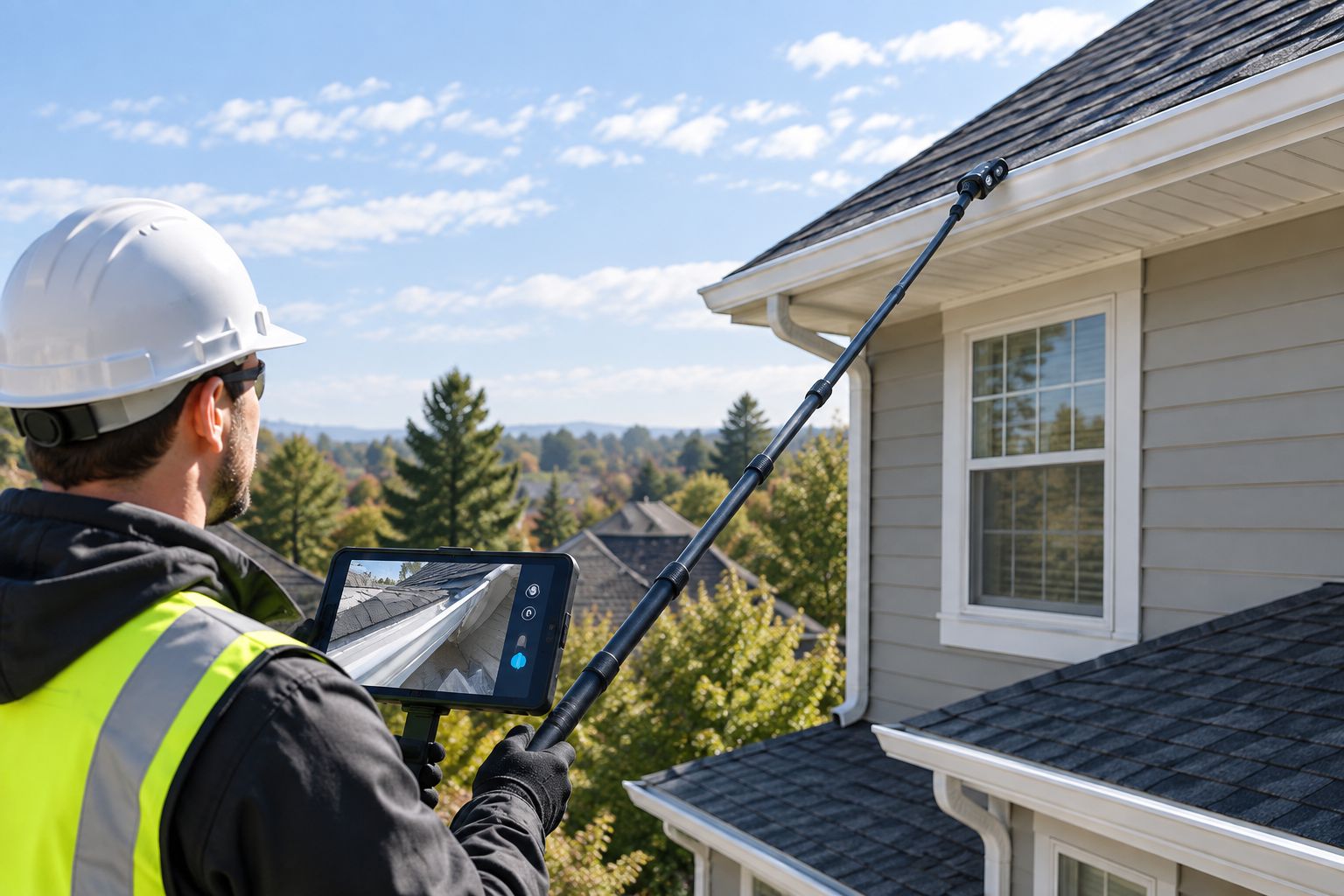
Confirm pole material and one-handed control
An aluminum shaft is lighter for a full day of overhead work; a fiberglass shaft resists dents better near masonry and metal roofing. Either way, the locking collars need to hold the extension at your working height without creeping shut mid-shot.
- Total extended weight you can hold one-handed at full reach
- Collar-lock type: twist-lock versus push-button
- Whether the head rotates independently of the pole or turns with it
- Grip material for wet or gloved hands
Check screen readability and recording format
A screen that looks fine in a showroom can wash out completely on an open roof in full sun. Confirm this before the first job, not after.
- Daylight-visible display or a shading hood
- On-board SD recording versus a tethered tablet
- File format compatible with your reporting software
- Battery swap versus charge-in-place, matched to your typical walkthrough length
Plan for tight cavities a pole camera can't reach
A pole camera is built for open-air reach along a roofline, not for looking inside a wall cavity, attic vent, or equipment port. For that, a rigid borescope gives a short, straight-line look through a knockout or vent opening. When the path bends, an articulating video borescope such as the Videoscope Voyager M40 HD steers through duct runs and cavities a rigid scope's fixed shaft can't turn through.
- Access opening diameter versus the scope's outside diameter
- Straight-line depth needed for a rigid borescope to be usable
- Bend count and radius if an articulating scope is required instead
- Lighting output needed for a dark, enclosed cavity
Match documentation output to your report software
- Exportable JPG or video file, not a proprietary format locked to one app
- Timestamp overlay if your report template requires it
- Cloud upload versus local SD card as your primary backup
- Multiple angle captures per stop when a single frame won't show the full condition
Pole cameras vs other inspection equipment for property work
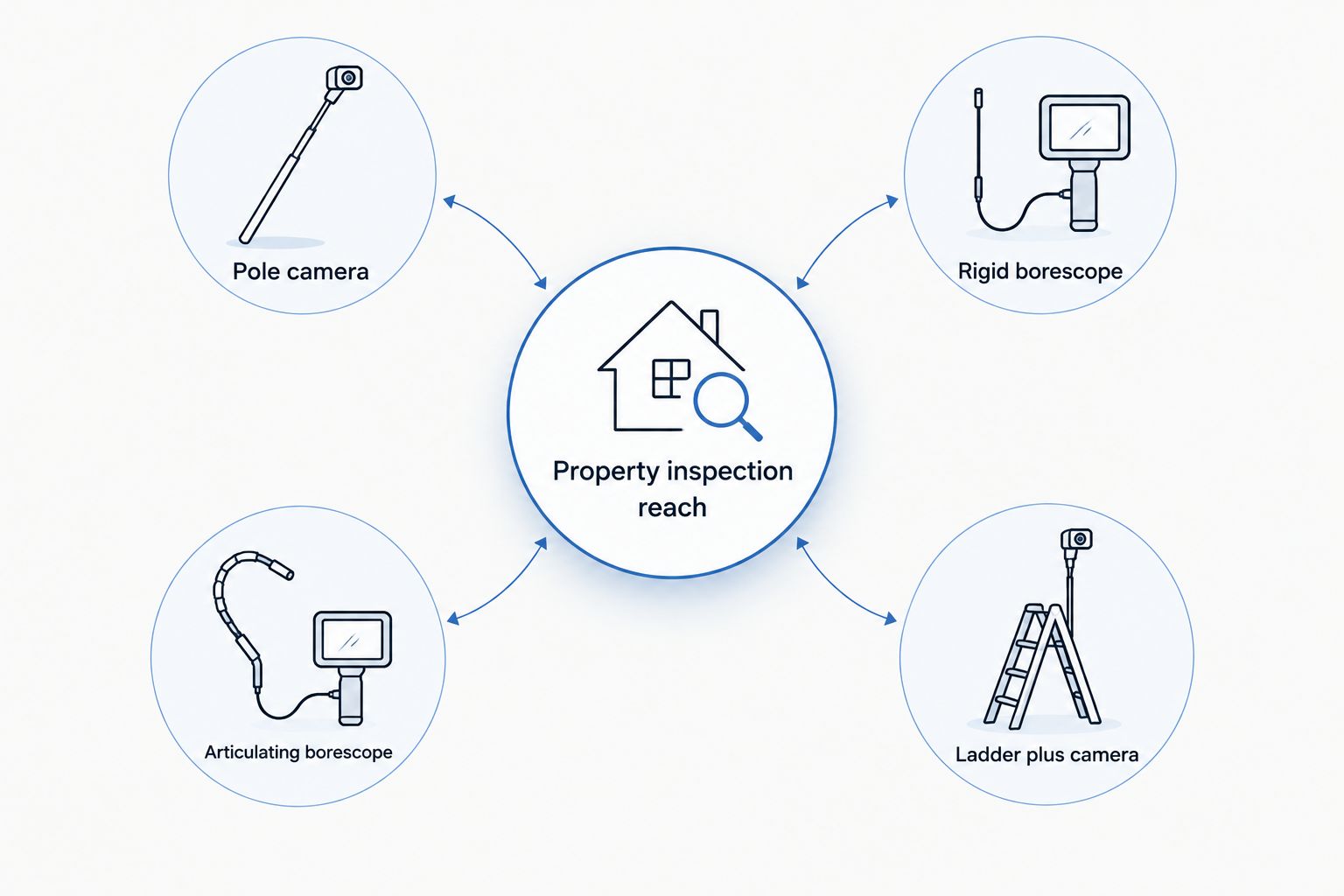
None of these four replace each other. Matching the option to the job condition avoids buying reach you don't need or missing reach you do.
| Option | Best for | Key limitation |
|---|---|---|
| Pole camera | Gutter runs, eaves, and roof valleys reachable by extending a shaft from the ground or a low ladder | Needs line-of-sight down the shaft; does not access enclosed cavities |
| Rigid borescope | Short, straight-line looks into vents, knockouts, and equipment ports | Fixed shaft length blocks bent or offset paths |
| Articulating video borescope | Bent duct runs, wall cavities, and equipment interiors a rigid scope can't turn through | Slower setup and a narrower field of view than a pole camera at open-air distances |
| Ladder + handheld camera | One-off spot checks where a ladder placement is already safe | No reach advantage; still requires the ladder move a pole camera avoids |
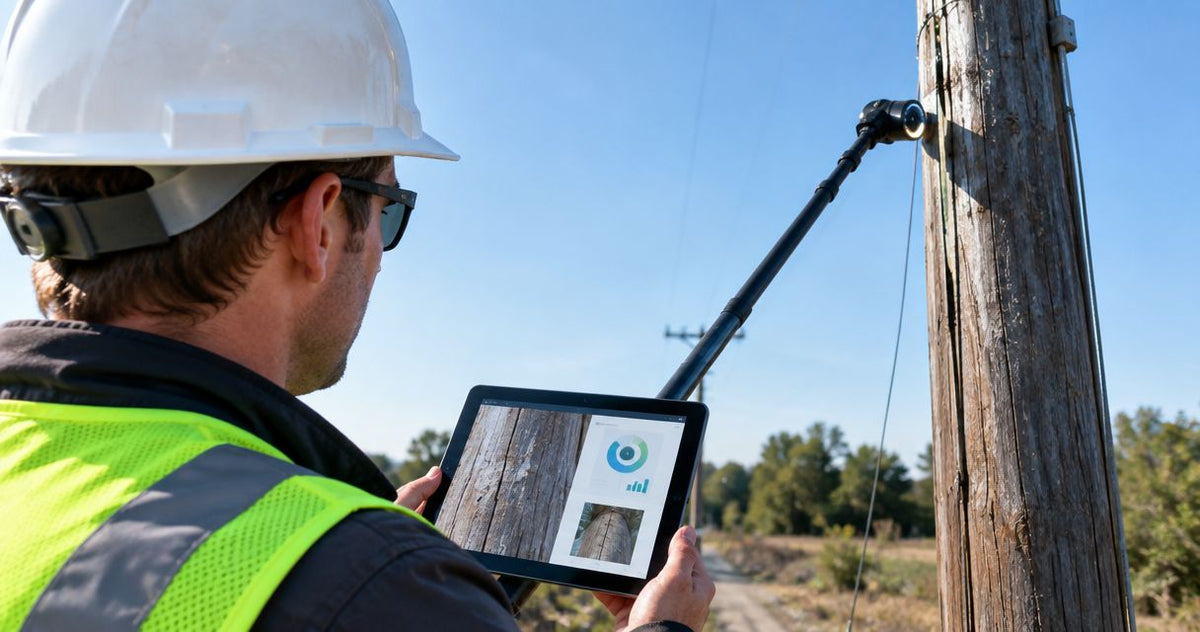
Common mistakes property inspectors make with pole cameras
- Buying reach off a spec sheet number instead of measuring the actual tallest eave on the properties you inspect most.
- Assuming dual view means locating capability. A pole camera carries no sonde or transmitter, so it can't be tracked with a locator receiver.
- Skipping a full-sun screen test before the first job, then finding the display washes out on an open roof.
- Reaching for a rigid borescope to cover an open-air gutter run instead of a telescoping pole; the shaft length and grip aren't built for that kind of reach.
- Storing footage only on a tethered tablet with no local card backup, then losing the file when the app crashes mid-inspection.
“A pole camera earns its place when the alternative is an extension ladder, not when a phone camera already shows what you need.”
FAQ
What is a pole inspection camera used for in property inspections?
A pole inspection camera mounts a camera head on an extendable shaft so a roof, gutter, or eave can be viewed and photographed from the ground or a low ladder position. It documents visible conditions for a report rather than accessing enclosed cavities.
Is a pole camera the same as a borescope?
No. A pole camera reaches along an open-air roofline or gutter run, while a borescope, rigid or articulating, is built to enter an enclosed cavity, vent, or duct through a small access opening.
Can a pole camera replace a ladder for every roof inspection?
It replaces the ladder move for reachable eaves, valleys, and gutter runs within the pole's extension, but it doesn't cover enclosed spaces like attics or wall cavities, which need a separate scope.
Does a pole camera work in bright sunlight?
That depends on the screen. Confirm daylight readability or a shading hood before the first job; a display that looks fine indoors can wash out on an open roof.
What's the difference between a pole camera and a pan-and-tilt drain camera?
A pole camera works in open air along a roofline or gutter. A pan-and-tilt drain camera is a push-camera system built to travel inside a pipe, with a different reach, deployment method, and documentation purpose entirely.
Can a pole camera see inside a chimney flue?
A pole camera can typically view a chimney crown or cap from above, but the enclosed flue interior usually needs a borescope sized to the flue's access opening.
How much training does a pole camera require?
Operating the pole and reading the screen takes little training; the harder skill is judging which conditions still need a ladder or a separate borescope pass.
Does Fiberscope sell pole cameras with recording capability?
Fiberscope's catalog includes pole-mounted systems such as the Cobra Dual View Inspection Pole Camera; confirm current recording format and screen specification on the product page before ordering.
One last thing
Dual-view heads solve a narrow problem: seeing gutter walls and hangers without rotating the pole. If most of your 2026 workload is flat commercial roofs and open valleys, a single forward-facing lens on a lighter pole is easier to run one-handed all day than a dual-view head built for tight gutter geometry. Match the head to the roof type you inspect most often, not the one you inspect occasionally.


Leave a comment
This site is protected by hCaptcha and the hCaptcha Privacy Policy and Terms of Service apply.