

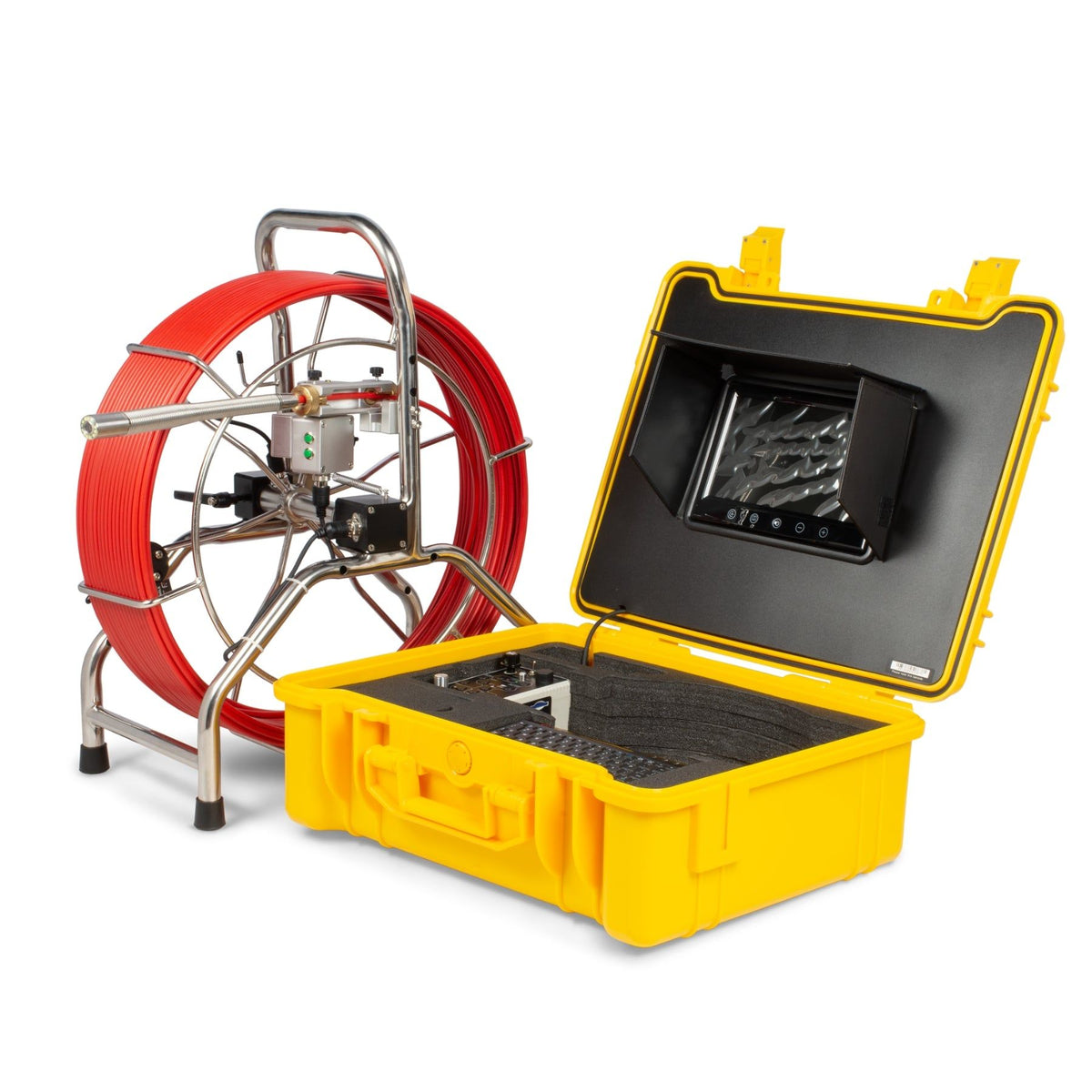
The best sewer inspection cameras depend on the route: choose Sewer Camera VIPER Mid for 2–6-inch bends on residential laterals, MiniFlex 2 19mm for tight PVC traps, HATHORN Mini for 200-ft app-based inspection, and ANACONDA for longer pushes or directed wall views. A more expensive system is not better if its head cannot clear the access or its cable does not suit the turns.
- VIPER Mid combines a supplied monitor and SD/USB recording with 40 m or 60 m reels for lateral inspection.
- MiniFlex 19mm addresses tight PVC traps; MiniFlex 36mm serves larger 2–6-inch drain routes.
- HATHORN Micron, Mini and Mid provide local Wi-Fi viewing and app recording; bring a compatible device and battery.
- iSnake provides pan-and-tilt viewing on a 30 m cable; ANACONDA MID and ANACONDA extend the reel choices.
- Match the head, bends, cable reach and recording setup before buying; a 512 Hz sonde still needs a separate receiver.
How these cameras were selected
This guide compares complete push-camera systems sold by Fiberscope.net, not accessories, clearance products or powered crawlers. Recommendations are based on access diameter, bend passage, working length, view direction, recording and locating needs. Fiberscope.net supplies these systems and provides in-house testing, repair and technician support; this is not an independent lab ranking.
A lateral is the branch connecting a building to the sewer main. Its cleanout, reductions and bends can control camera selection more than its largest pipe diameter. A 4-inch straight lateral, a 1½-inch kitchen branch and a long storm line are different jobs. The camera should document visible roots, offset joints, cracks or remaining debris, not be used to clear an obstruction.
Prices and product specifications checked September 30, 2026. All prices below are in USD. Cable capacity is not a guaranteed push distance through every route.
Sewer inspection cameras compared by job
| System | Best-fit job | Available cable | Viewing and recording | Main limitation |
|---|---|---|---|---|
| Sewer Camera VIPER Mid | Residential laterals with 2–6-inch bends | 40 m or 60 m | Supplied 9-inch monitor; SD/USB | The 1-inch straight-view head is not a 1½-inch trap tool |
| Drain Camera VIPER | Lower-cost modular drain inspection | 40 m Mini reel; micro configurations differ | Supplied 9-inch monitor; SD/USB | Head choice changes pipe fit and locating |
| MiniFlex 2 19mm | Small PVC traps and repeated elbows | 20 m or 40 m | Supplied 8-inch touchscreen; SD | Passage remains condition-dependent |
| MiniFlex 2 36mm | 2–6-inch drains with upright viewing | 35 m | Supplied 8-inch touchscreen; recording | Shorter reach than the larger lateral reels |
| HATHORN Micron | 1½–4-inch drains with mobile viewing | 100 ft | Phone/tablet app | Device and battery supplied separately |
| HATHORN Mini | 2–6-inch laterals with mobile viewing | 200 ft | Phone/tablet app | Not the small-trap choice |
| HATHORN Mid | Larger lines with mobile viewing | 200 ft | Phone/tablet app | At 12 inches, centering and cable travel are significant limits |
| iSnake | Directed wall views in secondary laterals | 30 m (98 ft) | Supplied control monitor; USB | Shorter reach than the larger lateral reels |
| ANACONDA MID | Laterals needing interchangeable forward/PT views | Up to 60 m (197 ft) | Supplied 13-inch monitor; USB | PT head requires pipe from 3 inches |
| ANACONDA | Longer mainline, storm and culvert pushes | Up to 120 m (394 ft) | Supplied 13-inch monitor; USB | Large-reel rod is not the tight-branch choice |
Self-leveling keeps the image upright. Pan-and-tilt, abbreviated PT, changes the camera's viewing direction. Neither feature drives the camera down the pipe.
1. Sewer Camera VIPER Mid: best for residential laterals with a supplied monitor
The Sewer Camera VIPER Mid uses a 1-inch straight-view head rated for 1.25–6-inch straight runs and 2–6-inch bends. That distinction matters: a straight-pipe minimum is not permission to push it through a 1½-inch trap.
Choose a 40 m or 60 m reel and either the straight-view no-sonde head or the self-leveling head with a 512 Hz transmitter. The supplied 9-inch monitor records AVI video and JPEG images to SD or USB. A footage counter helps associate a visible defect with distance from the access point.
Strengths: supplied viewing and recording hardware, two reel lengths, and a locating-capable head option. Limit: no pan-and-tilt view, and the compared straight-view head's bend minimum is 2 inches. Choose it for: pre-purchase scopes, roots and offset joints in laterals, and checks after jetting or repair when the route fits those dimensions.
From $3,280 USD; variants $3,280–$3,850 USD.

2. Drain Camera VIPER: best for a lower-cost modular setup
The Drain Camera VIPER offers different heads and reels around a supplied 9-inch control monitor. The 0.67-inch head is listed for 0.75–4-inch straight runs and 1.5–4-inch bends. The 1-inch straight-view head covers 1.25–6-inch straight runs and 2–6-inch bends; the handheld Mini reel carries 40 m of cable.
The 0.27-inch Micro Cam configuration is different: its fixed head has no spring neck and no sonde, and is listed for 0.5–1-inch straight runs. Do not buy that cheapest configuration expecting a sewer-lateral camera. Recording is to SD or USB; only the 1-inch self-leveling 512 Hz head option supports the locating arrangement described later.
Strengths: lower starting price and several job-specific configurations. Limit: the lowest price does not buy every head capability. Choose it for: a known drain route where the selected head's dimensions and reel fit.
From $2,050 USD; variants $2,050–$2,530 USD.

Watch Fiberscope.net inspect a sewer pipe with Drain Camera VIPER, including setup, pushing through a bend and retrieval.
3. MiniFlex 2 19mm: best for tight PVC traps
The MiniFlex 2 19mm Small Drain Camera Extended Set uses a small head and Flexi-Tube neck for a 1¼-inch PVC P-trap or repeated 90° turns in 1½-inch pipe. Maneuverability depends on fitting geometry and pipe condition; scale or a damaged joint can still stop it.
Choose 20 m or 40 m cable. The supplied 8-inch touchscreen supports photos, video and audio to SD, a distance counter and text overlay. Its head includes a 512 Hz sonde. For a pool-line example, Hayden E. reports: “I've already used it successfully to navigate 1.5" pool elbows to diagnose a collapsed skimmer line.” That is one real route, not a guarantee for every pool fitting.
Strengths: documented restricted-bend applications and recording in one case. Limit: no pan-and-tilt view; small-pipe maneuverability does not make it the first choice for a wide mainline. Choose it for: kitchen, bath, pool and spa branches where the turn is the problem.
From $5,229 USD; variants $5,229–$5,515 USD.

Watch Fiberscope.net's MiniFlex small-P-trap demonstration. It shows an earlier MiniFlex's bend application, not the current set's complete specification.
4. MiniFlex 2 36mm: best for 2–6-inch drains with upright viewing
The MiniFlex 2 36mm Drain Camera Extended Set has a 36 mm self-leveling head, a 35 m cable and an 8-inch touchscreen. Its description covers 2–6-inch pipes and condition-dependent bend passage. It adds a slope sensor that displays camera-head inclination.
A footage counter, text overlay, recording and a 512 Hz sonde support documenting a branch or smaller lateral. Inclination at the head is not automatically a surveyed gradient for the entire pipe: describe what the display shows rather than claiming a full elevation survey.
Strengths: upright image, head-inclination display and compact viewing hardware. Limit: the 35 m cable cannot cover a measured route beyond that length; the larger head is not the 19mm model's tight-trap substitute. Choose it for: 2–6-inch work within its reach when upright viewing matters.
From $6,890 USD.

5. HATHORN Micron: best for smaller drains with app viewing
The Wi-Fi Drain Camera HATHORN Micron has a 1-inch straight-view head, 100 ft of cable and a listed 1½–4-inch pipe range. Its page describes passage through a 1½-inch bend, not the repeated-elbow and 1¼-inch PVC trap applications stated for MiniFlex 19mm.
The reel produces its own Wi-Fi signal for a compatible phone or tablet. The app handles viewing, recording and playback; internet access is not needed for that local link. The system includes a 512 Hz sonde and counter. Bring the mobile device and an 18 V Milwaukee-compatible battery separately.
Strengths: approximately 16 lb system weight and mobile viewing. Limit: a larger head than MiniFlex's small-drain configuration, with fewer documented tight-turn applications. Choose it for: ordinary small-drain work where 100 ft and a phone-based record are sufficient.
From $4,300 USD.

6. HATHORN Mini: best for 200-ft mobile-viewing lateral work
The Wi-Fi Plumbing Camera HATHORN Mini covers 2–6-inch pipes with a 1.23-inch self-leveling head and 200 ft of push cable. A reel counter, 512 Hz sonde and local Wi-Fi link support inspection and locating with a separate receiver.
The free mobile app provides live viewing and recording. As with the other HATHORN systems here, the battery and viewing device are not included. Its head is IP68, pressure-sealed to 60 psi; this does not make the phone or reel assembly submersible.
Strengths: 200-ft cable, upright image and app-based recording. Limit: a 2-inch pipe application is not a small P-trap promise, and the operating package needs separate power and viewing hardware. Choose it for: a plumber's lateral work when the crew prefers a phone or tablet over a supplied monitor.
From $7,300 USD.

7. HATHORN Mid: best for larger mobile-viewing routes with clear limits
The Wi-Fi Sewer Camera HATHORN Mid carries 200 ft of cable with a 1.23-inch or 1.43-inch self-leveling head. The cable is 0.4 inch with the smaller head or 0.5 inch with the larger head. Both configurations include a 512 Hz sonde, footage counter and app viewing.
Its page lists lines through 12 inches, but explicitly warns that a centering skid is needed at that size and that side-to-side cable movement can limit reach and useful coverage. It recommends a powered crawler for better performance in 12-inch pipelines. That limitation belongs in the buying decision, not a footnote after purchase.
Strengths: head choices and a 200-ft mobile-viewing system. Limit: not a dependable default for long 12-inch mains. Choose it for: larger commercial routes when head, cable and centering fit; evaluate a crawler if stable powered travel is required.
From $7,900 USD; both listed head variants are $7,900 USD.

Hathorn's manufacturer overview describes its wider camera range and service network. The individual model dimensions above control the recommendations.
8. iSnake: best for shorter directed wall inspections
The Pan-and-Tilt Drain Camera iSnake has a 33 mm (1.3-inch) PT head, manual focus and a 30 m (98-ft) cable. Its description targets secondary laterals and drainage pipes from 2 inches.
The supplied battery-operated control monitor records photos and video to USB, with audio, text overlay and an on-screen cable counter. Turning the view helps inspect a joint or sidewall without relying only on forward footage.
Strengths: directed viewing and manual focus in a compact system. Limit: 30 m reach is shorter than the larger lateral reels. Choose it for: a measured route within 30 m where examining the wall matters more than maximum reel length. Its pan-and-tilt head changes the view, not the route the cable must travel.
From $5,690 USD.

9. ANACONDA MID: best for lateral PT inspection with interchangeable heads
The Pipe Camera ANACONDA MID uses up to 60 m (197 ft) of 7 mm fiberglass push cable and a 13-inch monitor. Choose a 40 mm self-leveling straight-view head for pipe from 2 inches or a 50 mm PT head for pipe from 3 inches.
Both heads carry a 512 Hz sonde. Photo and video recording go to USB; a wireless keyboard adds text. The keyboard's Wi-Fi connection is not phone/tablet video streaming. Its heads and reel are IP68-rated, not the whole control assembly.
Strengths: head choice, controlled wall views and a longer reel than iSnake. Limit: the 50 mm PT head is not the choice for a 2-inch route. Choose it for: building sewers and laterals where a forward inspection and directed joint views are both needed.
From $5,340 USD; variants $5,340–$7,150 USD.

Watch Fiberscope.net demonstrate ANACONDA MID's wall-viewing application.
10. ANACONDA: best for longer mainline and storm-line pushes
The Sewer Camera ANACONDA carries up to 120 m (394 ft) of 11 mm fiberglass rod on its large reel. Its 40 mm self-leveling head is for pipe from 2 inches; its 50 mm PT head is for pipe from 3 inches. Both include a 512 Hz transmitter.
The 13-inch monitor supports photo/video capture to USB, text entry through a wireless keyboard and distance tracking. The larger rod is intended for longer pushes, not the tight small-branch applications of MiniFlex 19mm. Choosing the large reel does not guarantee reaching the full cable length through every bend or damaged section.
Strengths: the longest reel in this guide and interchangeable viewing options. Limit: it is still pushed by the operator; PT and a skid do not make it a crawler. Choose it for: accessible storm, culvert and mainline routes where long cable reach and wall inspection are needed.
From $6,990 USD; variants $6,990–$8,800 USD.

What else the inspection setup needs
Locating requires three parts: a camera system, a head containing a transmitter of the stated frequency, and a separate receiver supporting that frequency. MiniFlex, HATHORN and both ANACONDA heads here use 512 Hz. VIPER locating requires the 1-inch self-leveling 512 Hz configuration. Rebar and metal distort the field, so a receiver's depth indication is not an exact excavation depth.
A skid centers and protects the head but increases the assembly's outside diameter. Match it to the head and narrowest fitting. It does not make a tight fitting passable or propel the camera. Locators and skids are accessories, not competing camera picks.
Apply water ratings only to named parts under stated conditions. IEC's explanation of ingress-protection ratings distinguishes enclosure protection from a blanket claim that every system component can be immersed.
Recording footage is not a completed inspection report
For pre-purchase scopes, identify the access, inspected route, distance reference and visible limits. For post-jetting or post-repair work, save evidence of the remaining condition rather than only a clip of the head moving through the pipe.
For contracts requiring standardized coding, NASSCO's PACP, LACP and building-drain programs describe distinct assessment and reporting methods. A camera with USB recording does not automatically create a compliant coded report. Choose the reporting workflow as well as the camera.
FAQ
What is the best sewer inspection camera for residential laterals?
Sewer Camera VIPER Mid is a practical supplied-monitor choice for 1.25–6-inch straight runs and 2–6-inch bends. HATHORN Mini is an alternative for 2–6-inch routes when 200-ft reach and app viewing suit the crew.
Which camera is better for a small PVC P-trap?
MiniFlex 2 19mm is specified for a 1¼-inch PVC P-trap and repeated 90° bends in 1½-inch pipe. Actual pipe condition affects passage.
Which system has the longest cable in this guide?
Sewer Camera ANACONDA has up to 120 m (394 ft) on its large reel. That is cable capacity, not guaranteed inspection distance through every route.
Does HATHORN Mid work well in every 12-inch sewer?
No. Its product page requires centering at that size and warns that cable movement can limit reach and coverage. It recommends a powered crawler for better performance in 12-inch pipelines.
Does ANACONDA stream video to a phone?
The Wi-Fi reference concerns the keyboard used for text entry, not phone video. Footage is viewed on the supplied monitor and recorded to USB.
Do cameras with 512 Hz sondes include a complete locating setup?
No. The camera head's 512 Hz transmitter needs a separate compatible 512 Hz receiver at the surface. Metal and rebar can distort position and depth readings.
Does pan-and-tilt mean the camera drives itself?
No. Pan-and-tilt changes view direction. These systems use operator-driven push cables; powered travel requires a crawler.
Related buying guides
- Choose a camera for tight drains and traps
- Compare VIPER Mid with RIDGID SeeSnake rM200A
- Understand 512 Hz locating beneath pavement
Match the head and reel to the job
Start with VIPER Mid for ordinary lateral work, MiniFlex 19mm for restricted PVC turns, and ANACONDA when reach or directed wall viewing changes the requirement. A rental or demo is a sensible option for an unfamiliar route or occasional job.
Send Fiberscope.net your pipe ID, access opening, run length, bends or traps, pipe material, locating need and existing receiver frequency, plus recording and report requirements. A technical specialist will match the head and reel to that route. Call 1-877-613-2210.
Vladimir Khubiryants
Founder & President, Fiberscope.net (MEDIT Inc.)
Vladimir Khubiryants founded Fiberscope.net to give professionals access to reliable video inspection equipment without enterprise pricing. For over 20 years he has sourced and tested borescopes, sewer cameras and fiberscopes in Fiberscope.net's in-house test and repair facility, helping plumbers, pipeline engineers, aviation and military teams choose the right tool for the job.

Leave a comment
This site is protected by hCaptcha and the hCaptcha Privacy Policy and Terms of Service apply.