

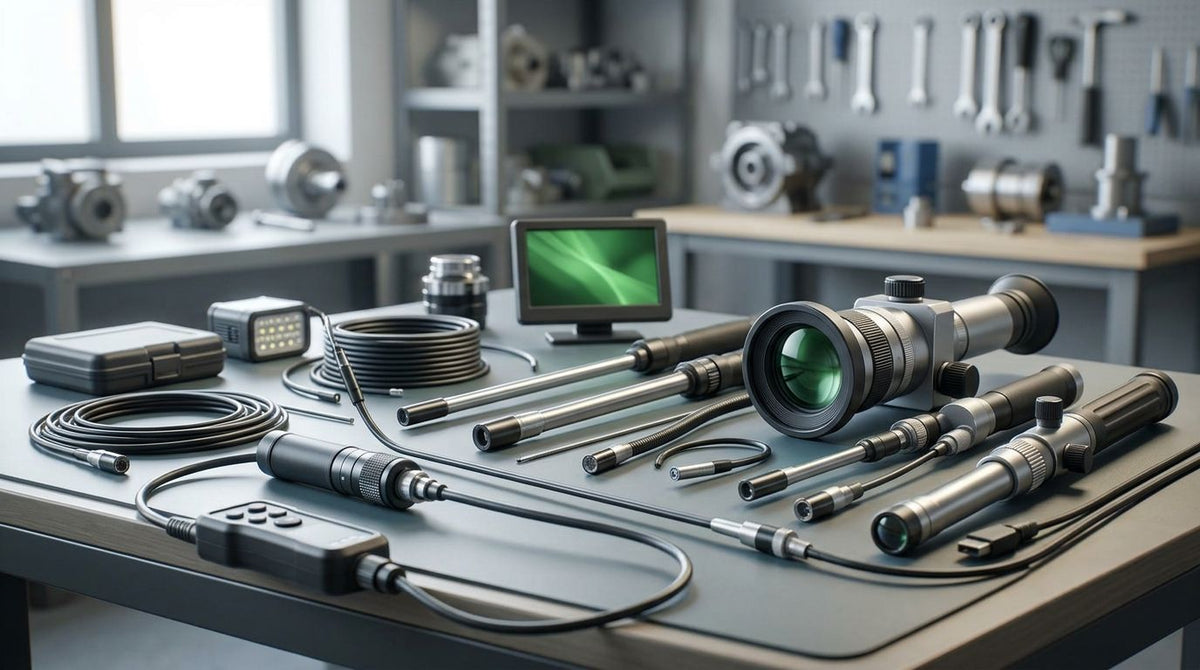
A machinist inspecting a burr inside a straight bore and a safe technician looking through a narrow, turning access hole need different optical instruments. A rigid tube can give a clear direct view of the first job but will stop at the first bend in the second. This guide compares three complete optical scopes by outside diameter (OD), path, working length and image detail, then explains the separate light and capture equipment each inspection needs.
For straight machine bores, the Rigid Borescope has a 0.11 in (2.7 mm) diameter option. The Super Thin Micro Borescope starts at 0.04 in (1.0 mm) for a flexible route. For a still tighter opening, the Ultra Fine Micro Borescope offers 0.37, 0.5 and 0.75 mm optical probes. Fiberscope sells these scopes and services them in-house.
Size the opening, route and view
The smallest restriction sets probe OD; the path determines whether a rigid tube or a flexible fiber bundle can reach the target. Measure the opening, any internal shoulder, the length to the target and the bend radius. Evident's visual-inspection guide distinguishes rigid scopes for straight entry from flexible ones for curved paths. A flexible insertion tube follows a route as you guide it; flexibility alone does not steer its tip.
| Inspection path | Optical scope | Image relay | Main trade-off |
|---|---|---|---|
| Straight machined bore or equipment port | Rigid Borescope | Glass rod lenses | Clear optical view, but the shaft stays straight |
| Small opening followed by a curved cavity | Super Thin Micro Borescope | Coherent fiber image bundle | Flexible or semi-rigid options; detail depends on fiber count |
| Sub-millimeter entry into a precision part | Ultra Fine Micro Borescope | 3,000 or 10,000 imaging fibers by probe | Access as narrow as 0.37 mm; fixed forward view |
Choose direction of view separately from field of view. Direction is where the lens points: forward toward the end of a bore, or sideways toward its wall. Field of view is how wide an area the lens includes. Hawkeye's optical-selection guide shows why an angled prism or mirror makes a bore wall visible when a forward lens looks past it. This article covers optical instruments; for a screen and joystick-controlled tip in an engine or gearbox, use the industrial borescope guide.
Rigid Borescope: straight access and rod-lens optics
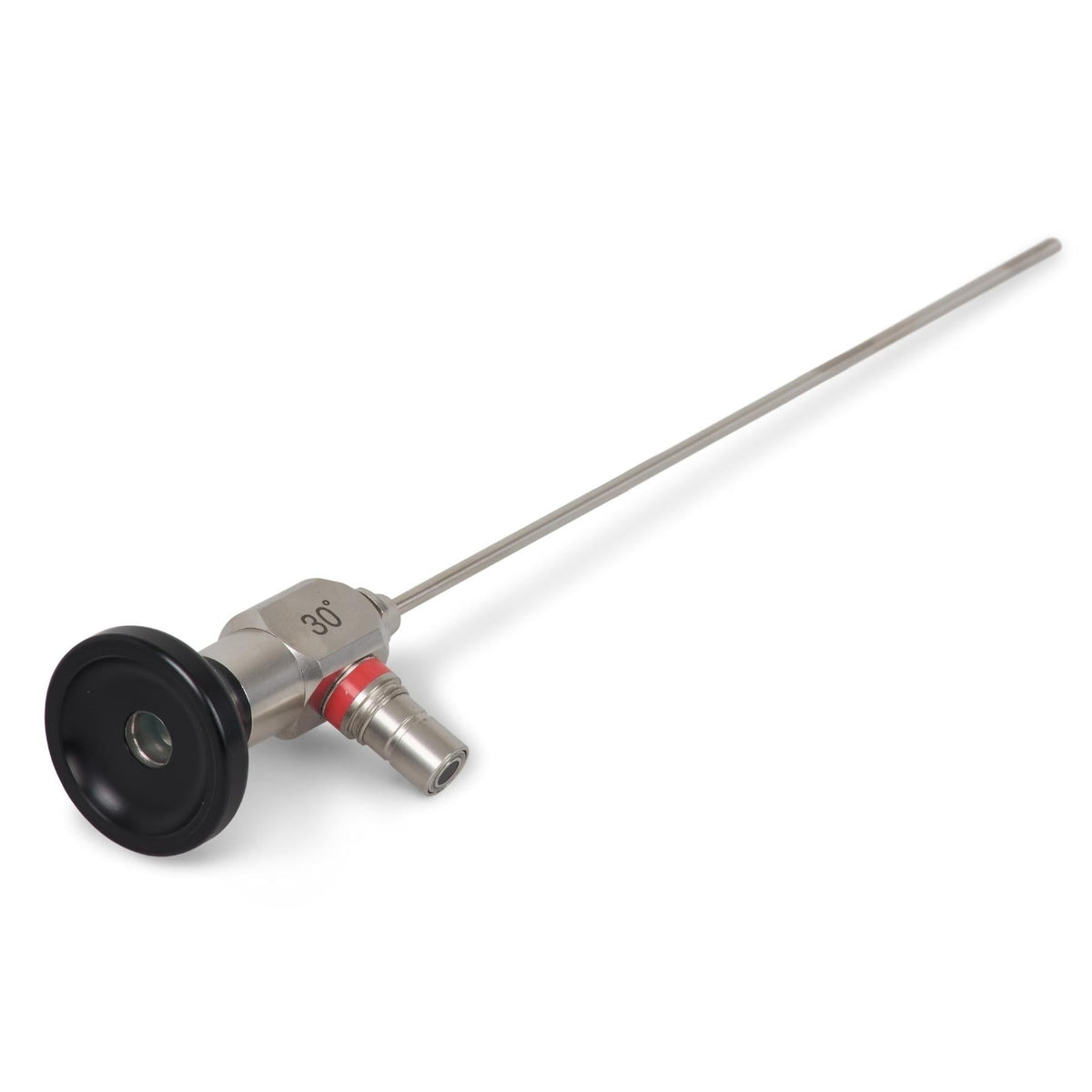
The Rigid Borescope offers a 0.11 in (2.7 mm) configuration and transmits the image through glass rod lenses to a standard C-mount eyepiece. Stainless-steel body and insertion tube suit repeat straight-line inspections of bores and machined parts. Its light post accepts a compatible source; the optics themselves do not light a dark cavity. A separate camera at the eyepiece is needed for a saved inspection record.
From $378 to $3,320 across store variants, prices checked September 26. This is the first choice when a straight route admits the selected tube and a machinist wants to inspect a burr or surface finish by eye. It will not follow an offset passage. When a wall condition is the target, select the appropriate viewing configuration for that target; do not assume a forward view will show the side wall.

Super Thin Micro Borescope: a flexible narrow route
The Super Thin Micro Borescope starts at 0.04 in (1.0 mm) OD, with working lengths up to 4.9 ft (1.5 m) and a 45° field of view. Choose its flexible or semi-rigid insertion probe for a machine passage or small cavity with a turn. The coherent fiber bundle carries the image to an eyepiece; a wider probe transmits more image fibers and light. The insertion sheath can be submerged, while the eyepiece and light connection remain outside the wet area.
From $1,750 to $3,100 across variants. A service technician inspecting the inside of a casting through an opening wider than its 0.04 in (1.0 mm) probe can use this class when the route turns beyond the entry. A rigid scope of the same length cannot bend with it. This is still direct optical viewing: a compatible light source supplies illumination, and an eyepiece camera is separate if the job requires photographs.

Ultra Fine Micro Borescope: the smallest opening
The Ultra Fine Micro Borescope comes in 0.37, 0.5 and 0.75 mm diameters, with 12 or 24 in (305 or 610 mm) working lengths. The first two carry 3,000 imaging fibers; the 0.75 mm version carries 10,000. Choose the wider version when the opening admits it and image detail matters more than the narrowest possible access. Its direction of view is 0° forward, and it has no articulation. The 0.5 mm probe has a 1 in (25 mm) minimum bend radius.
From $3,520 to $3,930 across store variants. This is the optical choice for an exceptionally narrow straight sightline in a precision component or inspection opening. A side-facing target beyond a bend calls for a different viewing arrangement, even when the 0.37 mm probe physically enters the hole. Hawkeye's MicroFlex specification offers a competing 0.5 mm flexible optical scope with a 23.6 in (600 mm) working length. Its 1.5 in (38 mm) minimum bend radius is wider than the Ultra Fine 0.5 mm probe's 1 in (25 mm) radius; choose the Hawkeye where an existing Hawkeye optical setup matters more than that tighter bend. Manufacturer specifications checked September 26.

What you'll also need
Each optical instrument needs light coupled into its light post; a camera is an additional part when you need a file. The MS-LED Light Source and a fiber-optic light guide are suitable for a bench setup with a matching light connector. For a computer capture setup, ImagePRO USB 3.0 Camera attaches to a compatible 32 mm eyepiece through an optical coupler and connects to a computer over USB 3.0. Those are accessories, not independent inspection probes. The USB camera guide separates eyepiece capture devices from complete probe systems.
A saved image from a 3,000-fiber probe will not acquire more optical detail simply because the attached camera has a higher sensor resolution. Choose the probe diameter and image bundle first, then the camera and light. If you only need to inspect one straight bore by eye, the rod-lens scope and a compatible light source are the simpler setup.
FAQ
Can an optical borescope record video on its own?
No. These optical scopes relay an image to an eyepiece. Recording needs a compatible eyepiece camera and viewing or capture device.
Which scope follows a curved opening?
The Super Thin Micro Borescope has flexible and semi-rigid insertion choices starting at 0.04 in (1.0 mm) OD. The Rigid Borescope follows a straight route.
Why choose the 0.75 mm Ultra Fine probe over 0.37 mm?
The 0.75 mm version carries 10,000 imaging fibers, versus 3,000 at 0.37 mm. Use the wider probe when the entire entry route clears it.
Can a forward-view scope see the wall of a bore?
A forward lens looks toward the end of the passage. Choose a suitable angled or side-view optical configuration when the bore wall is the inspection target.
Does the light source come with the Ultra Fine Micro Borescope?
No. The optical scope is supplied without a light source; pair it with a compatible light and cable to illuminate the target.
About the author
Vladimir Khubiryants, Founder & President, Fiberscope (MEDIT Inc.). Vladimir Khubiryants founded Fiberscope to give professionals access to reliable video inspection equipment without enterprise pricing. For over 20 years he has sourced and tested borescopes, sewer cameras and fiberscopes in Fiberscope's in-house test and repair facility, helping plumbers, pipeline engineers, aviation and military teams choose the right tool for the job.
Send your access opening, straight or turning route, insertion length, required direction of view, environment and recording needs through the contact page or call 1-877-613-2210. A Fiberscope specialist will match the scope, light and capture equipment to the job.

Leave a comment
This site is protected by hCaptcha and the hCaptcha Privacy Policy and Terms of Service apply.