


A push camera head that rides on the pipe floor gives a lopsided picture. The lens sits low, water pools in front of it, and every joint looks like a wall. A skid holds the head off the pipe wall and centers it, so the lens looks down the axis of the line. In a 4 to 6 inch lateral, that is the difference between reading a joint and guessing at it. This guide covers what a skid does, when to leave it off, and how to match one to the head you run.
The short answer: use a skid with a 1 in (25 mm) head in mainline-size runs of 4 to 6 inches, and run the bare head through traps, tight bends and lines close to the head's minimum size. Fiberscope.net carries the Mini Roller Skid, TrapMaster and Universal Roller Skid from CPI Products, plus the POLECAT pole adaptor. Fiberscope.net sells the products discussed here and services them in-house.
What a sewer camera skid does on a push camera
A sewer camera skid is a carrier that supports a push-camera head and keeps it centered in the pipe; it does not move the head. You still supply all the force through the push cable.
That separates a skid from a crawler, which is a powered, self-propelled unit. Pan-and-tilt heads change where the lens points. Skids change where the head sits. Neither one drives the camera down the line.
Centering matters for three reasons:
- The lens sees the pipe cross-section evenly, so joint offsets and cracks read correctly on the monitor.
- The head stays out of standing water and sediment that collect on the pipe floor.
- Roller skids cut cable drag on long pushes, because the head rolls over the floor instead of dragging on it.
Match the skid to head size and pipe size
The head outside diameter (OD) and the pipe inside diameter decide whether a skid helps at all. A skid adds diameter around the head, so it only makes sense when the pipe is clearly larger than the head.
These are the head sizes and pipe ranges for the push cameras most often paired with a skid:
| Camera | Head OD | Rated pipe range |
|---|---|---|
| MiniFlex 2 19mm | 0.75 in (19 mm) | From 1.25-inch |
| MiniFlex 2 36mm | 1.42 in (36 mm) | 2 to 6-inch |
| VIPER Mid, 1-inch straight-view head | 1 in (25 mm) | 1.25 to 6-inch straight runs |
The MiniFlex 2 36mm and the VIPER Mid 1-inch head are the ones that gain most from a skid, because 4 to 6 inch lines leave the most room around the head. The 0.75 in (19 mm) MiniFlex 2 19mm is built to turn through small traps and fittings, which is where a skid gets in the way.
Pan-and-tilt heads work with a skid the same way. The skid supports and centers the head, and the pan and tilt aim the lens. If you run one, the pan-and-tilt push cameras guide covers how to choose between them.
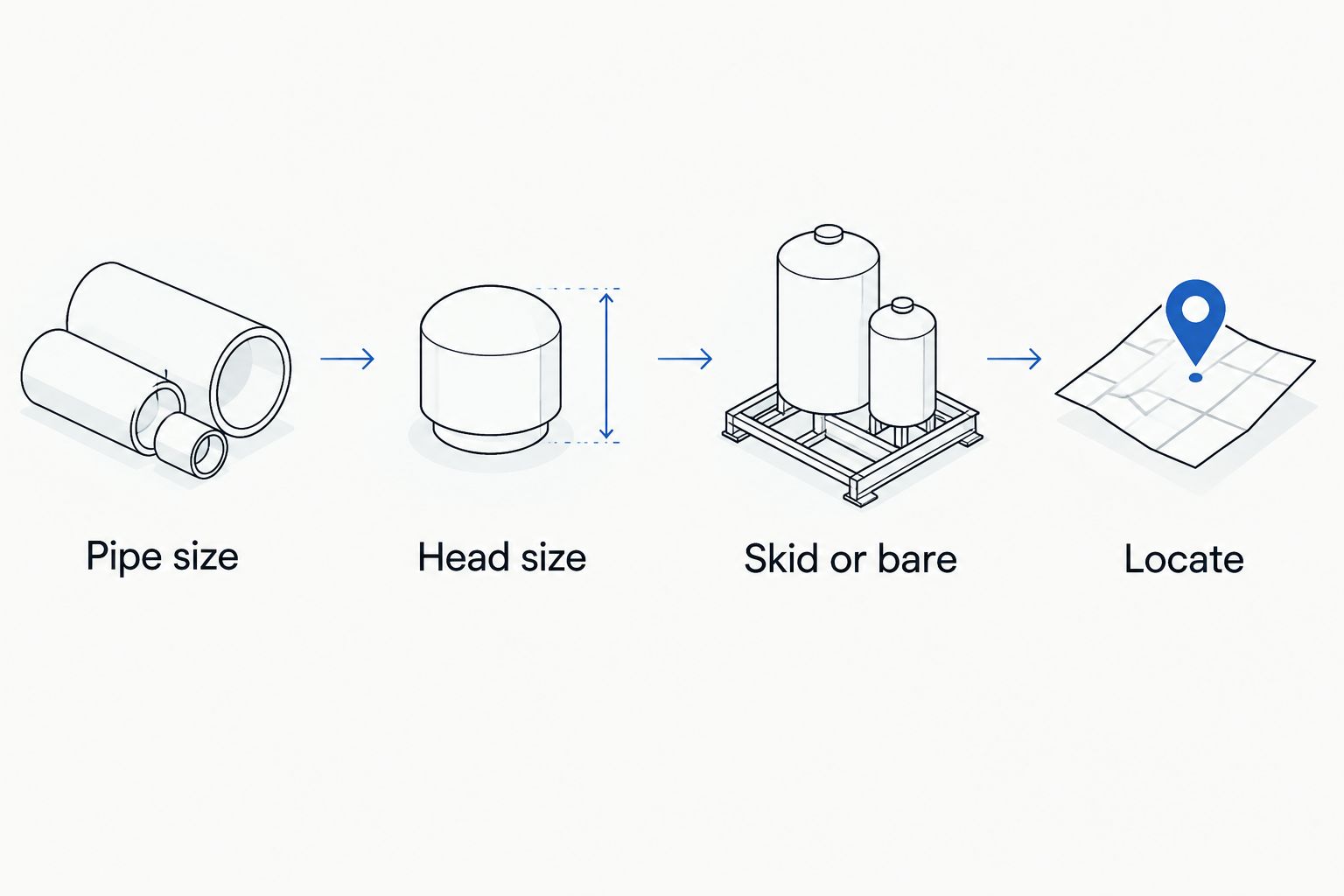
Set the order of decisions this way: measure the pipe ID first, check the head OD against it, then decide whether a skid fits the access. The smallest fitting on the route sets the limit, not the main run.
- A sewer camera skid centers a push-camera head; it does not propel it.
- Use a skid with a 1 in (25 mm) head in 4 to 6 inch runs.
- Run the bare head through P-traps, tight bends and lines near the head's minimum size.
- Skid fit depends on head OD and the smallest fitting on the route.
The skids Fiberscope.net carries
The CPI Products lineup splits into roller skids and a pole adaptor. Each one answers a different access problem.
Mini Roller Skid. A smaller roller skid for lighter heads in mid-size lines. Rollers reduce drag over long pushes and keep the head off the floor.
TrapMaster. A skid built around trap-and-fitting work. If your route includes a trap, ask a specialist which of the TrapMaster and the Mini Roller clears it for your head before you buy either.
Universal Roller Skid. The wider roller skid for larger heads in bigger lines. The current listing sits on the universal skids page, and a smaller option is on the small sewer camera skid page.
POLECAT pole adaptor. An adaptor for mounting a camera head on a pole instead of pushing it on a cable. Use it when the target is reachable from a manhole or cleanout and a push is not needed.
Fit ranges for the skids depend on the head and the pipe, so match them with a specialist rather than from a chart. Accessories are not interchangeable across every head.
When to leave the skid off
A skid is wrong for the job any time it makes the assembly larger than the smallest fitting on the route. Three cases come up most often:
- P-traps and tight 90° bends. The skid lengthens the rigid section of the head and snags at the turn. Run the bare head.
- Lines close to the head's minimum size. A 1.25-inch line with a 0.75 in (19 mm) head leaves little room, and a skid takes all of it.
- Short, clean pushes. Under a few feet of cable, drag is not the problem, so the skid adds nothing.
Customers run the small heads exactly this way. Hayden E. wrote that he used the MiniFlex 19 to navigate 1.5-inch pool elbows and diagnose a collapsed skimmer line, a job where a skid would have stopped the head at the first elbow.
For 1.5-inch and 2-inch lines, the better tool is a smaller head, not a skid. The portable sewer camera roundup compares heads by weight, reach and bend capability.
Skid or crawler
A skid suits a push camera in runs where cable drag stays manageable; a crawler suits long mainlines where you cannot push enough cable to get there. Municipal mainline work in 6 to 24 inch pipes is crawler territory. Plumbers working 1.5 to 6 inch laterals and branch lines are skid territory.
If your work crosses both, buy the push camera and skid first. A crawler is a different class of purchase.
What you'll also need
The skid is one part of a push-camera setup. Check these before you order:
- A head sized to the pipe. The head OD sets whether any skid works. The VIPER spare heads and reels are listed separately for that reason.
- Cable length and head compatibility. Reel length and the head on it decide how far you push. The sewer camera reel and head compatibility guide lists what pairs with what.
- A locator, if you need to mark the line. Locating takes a camera with a sonde in the head, plus a separate compatible receiver. The SnapTrack receiver runs 512 and 640 Hz, with 815 Hz and 33 kHz optional. A skid does not change how a sonde is read, but keep the receiver frequency matched to the head's sonde.
Common mistakes
- Buying a skid before measuring the smallest fitting on the route.
- Expecting a skid to push the camera. It supports and centers the head only.
- Using a skid in a P-trap because it worked in the main run.
- Pairing a skid with a head it was not built for, then losing the image when the head tilts inside it.
- Skipping the pole adaptor for jobs reachable from a manhole, then pushing 40 ft (12 m) of cable for no reason.
FAQ
What is a sewer camera skid used for?
A sewer camera skid holds a push-camera head off the pipe wall and centers it. That gives an even view down the pipe and reduces cable drag over long pushes.
Does a skid make a push camera self-propelled?
No. A skid only supports and centers the head, and you still push the cable by hand. Only a powered crawler moves itself.
Do I need a skid for a 1.5-inch drain?
Usually no. A small head such as the 0.75 in (19 mm) MiniFlex 2 19mm is built for lines that size, and a skid would take the clearance the head needs.
Can one skid fit every camera head?
No. Fit depends on the head OD and the smallest fitting on your route. Send the head model and pipe sizes to a specialist before ordering.
What is the POLECAT?
The POLECAT is a pole adaptor from CPI Products, not a skid. It mounts a camera head on a pole for jobs reachable from a manhole or cleanout.
When should I buy a crawler instead of a skid?
Buy a crawler for long mainline runs in 6 to 24 inch pipes where hand-pushing cable cannot reach the defect. Laterals and branch lines are push-camera work.
Get a skid matched to your camera
Send Fiberscope.net your pipe ID, access point, run length, bends and traps, pipe material, locating needs and existing locator frequency, and a specialist will match the right skid to your head. Call 1-877-613-2210, Mon to Fri 8:00 to 18:00 CST.
About the author. Vladimir Khubiryants founded Fiberscope.net to give professionals access to reliable video inspection equipment without enterprise pricing. For over 20 years he has sourced and tested borescopes, sewer cameras and fiberscopes in Fiberscope.net's in-house test and repair facility, helping plumbers, pipeline engineers, aviation and military teams choose the right tool for the job. See our cameras in use on YouTube and Instagram.

Leave a comment
This site is protected by hCaptcha and the hCaptcha Privacy Policy and Terms of Service apply.