

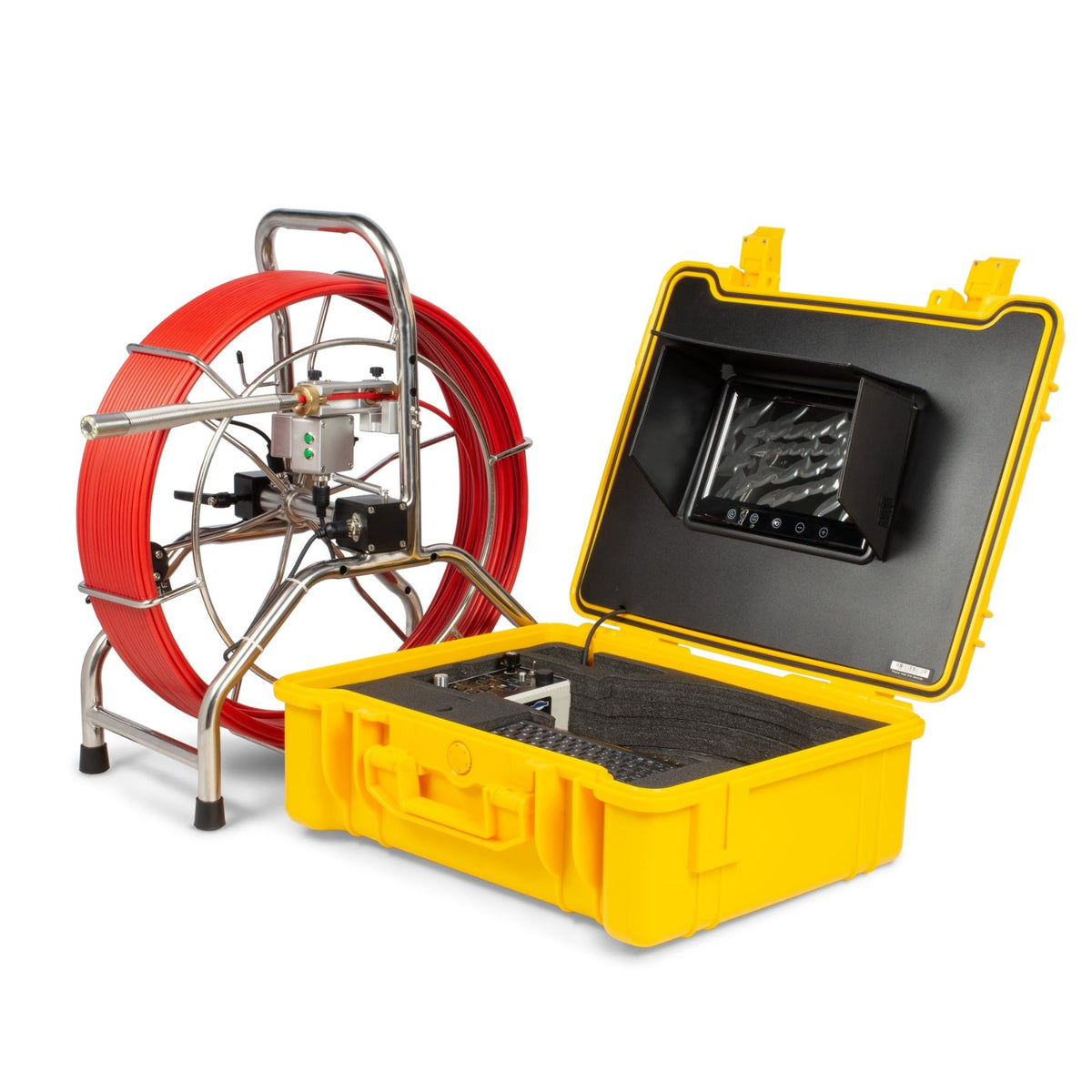
Best for residential laterals with a dedicated monitor: Sewer Camera VIPER Mid, ordered with its 1-inch self-levelling 512 Hz sonde head. Best for tight traps: MiniFlex 2 19mm Small Drain Camera Extended Set. Best for phone-based recording in 2–6 inch lines: Wi-Fi Plumbing Camera HATHORN Mini. Each needs a separate compatible receiver to locate the camera head from the surface.
- The best sewer camera with locator starts with pipe fit, not transmitter frequency.
- VIPER Mid requires the 1-inch self-levelling head labeled 512 Hz Sonde; no-sonde variants do not qualify.
- MiniFlex 19mm handles tight small-drain routes; MiniFlex 36mm adds self-levelling and camera-head inclination measurement.
- HATHORN cameras stream to your mobile device; ANACONDA cameras offer self-levelling or pan-and-tilt heads.
- A 512 Hz receiver locates the sonde, not the whole pipe. Metal and rebar can distort readings.
By Vladimir Khubiryants, Founder & President, Fiberscope.net (MEDIT Inc.). Updated October 1, 2026.
What makes a good sewer camera with locating?
A sonde is the transmitter inside the camera head. The camera shows the defect; the sonde gives a compatible surface receiver a signal to locate. Neither feature helps if the head cannot pass the access point or the cable cannot reach the problem.
Choose a Fiberscope.net sewer camera with locating in this order:
- Mechanical fit: Head outside diameter, neck geometry and any skid must clear the narrowest fitting.
- Route: Separate a straight lateral from a route through elbows and P-traps. A lateral is the connection between a building and the main sewer.
- Reach: Match supplied cable length to the job. Bends, deposits and friction limit actual push distance.
- View: Straight view looks ahead; self-levelling keeps the image upright; pan-and-tilt lets you look at joints and sidewalls.
- Evidence: Choose a dedicated monitor with removable storage or mobile-device viewing and recording.
- Locating: Match the head's 512 Hz transmitter to the receiver's 512 Hz sonde mode. A passive power mode is not a substitute.
Sewer cameras with 512 Hz sondes at a glance
Every camera below qualifies only in the configuration described. Receivers are accessories, not camera picks.
| Complete camera system | Best for | Qualifying head and supplied cable | Main limitation |
|---|---|---|---|
| Sewer Camera VIPER Mid | Dedicated-monitor residential lateral work | 1-inch self-levelling 512 Hz head; 40 m or 60 m Mid reel | No-sonde variants cannot be located |
| Drain Camera VIPER | Handheld-reel inspections | 1-inch self-levelling 512 Hz head; 40 m Mini reel | Smaller and side-view no-sonde heads do not qualify |
| MiniFlex 2 19mm Small Drain Camera Extended Set | Tight small-drain traps and elbows | 512 Hz head; 20 m or 40 m cable | Straight view, not self-levelling |
| MiniFlex 2 36mm Drain Camera Extended Set | 2–6 inch drains needing upright images and inclination | 36 mm self-levelling 512 Hz head; 35 m cable | Larger head than MiniFlex 19mm |
| Wi-Fi Drain Camera HATHORN Micron | Lightweight mobile-device inspections | 1-inch 512 Hz head; 100 ft cable | Battery and viewing device are separate |
| Wi-Fi Plumbing Camera HATHORN Mini | Mobile-device recording in 2–6 inch lines | 1.23-inch self-levelling 512 Hz head; 200 ft cable | Requires a compatible phone or tablet |
| Wi-Fi Sewer Camera HATHORN Mid | Larger-line mobile-device inspections | 1.23- or 1.43-inch self-levelling 512 Hz head; 200 ft cable | Push performance suffers in large pipes |
| Pipe Camera ANACONDA MID | Sidewall inspection on shorter routes | 40 mm self-levelling or 50 mm pan-and-tilt 512 Hz head; up to 60 m | Head geometry rules out tight small drains |
| Sewer Camera ANACONDA | Long mainline and culvert pushes | Same head choices; up to 120 m cable | Stiffer rod is not the choice for tight traps |
1. Sewer Camera VIPER Mid: best for a dedicated lateral-inspection setup

Sewer Camera VIPER Mid combines a stand-up reel with a 9-inch monitor, recording to SD or USB, text input and a footage counter. Its 1-inch head is listed for 1.25–6 inch straight runs and 2–6 inch pipes with bends.
The locating configuration is the head named 1-inch Self-levelling Straight View | 512 Hz Sonde, with either 40 m (131.2 ft) or 60 m (196.8 ft) of cable. Self-levelling keeps the view upright as the head rolls.
Advantages:
- Dedicated display rather than reliance on your phone.
- Two cable lengths for different lateral jobs.
- Removable-media recording and footage annotation.
Limitations:
- The standard straight-view no-sonde head does not provide locating.
- Forward viewing cannot turn to face a sidewall connection.
Best for: Plumbers documenting lateral defects and checking a line after cleaning or repair. Choose it when a dedicated monitor and longer cable matter more than trap passage.
2. Drain Camera VIPER: best for a handheld reel

Drain Camera VIPER qualifies here with the 1-inch self-levelling 512 Hz head and 40 m (131.2 ft) Handheld Mini Reel. Its control base has a 9-inch display and SD/USB recording.
The handheld reel distinguishes this setup from VIPER Mid. Do not apply the system's smallest-head access claims to its locating head: the 0.27-inch, 0.67-inch and listed 1-inch side-view configurations have no sonde.
Advantages:
- Handheld reel for jobs that do not require the larger stand-up reel.
- Upright forward image with the qualifying head.
- Dedicated monitor and removable recording media.
Limitations:
- Smaller no-sonde heads cannot provide this guide's locating function.
- The Mini reel's footage counter is optional.
Best for: Crews preferring a handheld reel and 40 m cable. Choose the sonde-equipped configuration, not simply the VIPER name.
3. MiniFlex 2 19mm: best for tight traps and elbows

The MiniFlex 2 19mm Small Drain Camera Extended Set is the small-drain option for multiple 90° bends in 1.5-inch pipe and a P-trap in 1.25-inch PVC. Passage remains condition-dependent; scale and fitting geometry still matter.
It has a built-in 512 Hz sonde, 20 m or 40 m cable, an 8-inch touchscreen, SD recording, text overlay and a footage counter. The flexible neck is the reason to choose it for kitchen, bathroom, pool and spa routes that stop a larger head.
Advantages:
- Documented small-pipe bend and PVC P-trap applications.
- Viewing and recording in one case.
- Photo, video and audio capture.
Limitations:
- Straight-view head does not keep the image upright automatically.
- It is not a pan-and-tilt system for detailed sidewall viewing.
Best for: Plumbers whose hardest access is a trap or a series of small elbows. Choose it for route geometry, not as a replacement for every larger sewer camera.
4. MiniFlex 2 36mm: best for inclination information in 2–6 inch drains

MiniFlex 2 36mm Drain Camera Extended Set combines a 36 mm self-levelling head, 512 Hz sonde and 35 m cable. The 8-inch touchscreen supports recording, text generation and a footage counter.
Its slope sensor displays camera-head inclination. That gives useful orientation information, but it is not a surveyed measurement of the entire pipe's grade.
Advantages:
- Upright image in the stated 2–6 inch application range.
- Inclination display alongside inspection footage.
- Compact case-based viewing and recording.
Limitations:
- The 36 mm head is not the small-trap option offered by MiniFlex 19mm.
- Supplied cable is shorter than the 200 ft HATHORN options.
Best for: Drain inspections needing upright footage and head-inclination information. Choose it when those features justify the larger head.
5. Wi-Fi Drain Camera HATHORN Micron: best for a lightweight mobile setup

Wi-Fi Drain Camera HATHORN Micron carries 100 ft of cable, a 1-inch head and an integrated 512 Hz sonde. At approximately 16 lb, it suits crews carrying equipment between residential drain jobs.
It generates its own Wi-Fi signal for viewing and photo/video recording through an Apple or Android device. The stated inspection range is 1.5–4 inches; the camera head is pressure-sealed to 60 psi.
Advantages:
- Lightweight reel with a footage counter.
- Uses a mobile device for viewing and recording.
- Powered by 18V Milwaukee batteries or equivalent.
Limitations:
- Battery and mobile device are not included.
- Straight view is not self-levelling; 100 ft cable limits supplied reach.
Best for: Shorter drain jobs where carrying weight matters. Choose Wi-Fi Drain Camera HATHORN Micron for portability, not long sewer runs.
6. Wi-Fi Plumbing Camera HATHORN Mini: best for 200 ft mobile-device recording

Wi-Fi Plumbing Camera HATHORN Mini combines 200 ft of 3/8-inch push cable, a 1.23-inch self-levelling head and a 512 Hz sonde. Its stated pipe range is 2–6 inches.
The reel creates its own Wi-Fi connection to your viewing device. The app supports photo, video and audio recording, while the reel's meter counter tracks cable deployment.
Advantages:
- Longer supplied cable than HATHORN Micron.
- Upright image for lateral inspection.
- Recording on the phone or tablet used for viewing.
Limitations:
- Battery and mobile device are separate.
- A self-levelling head still looks forward; it cannot aim around the sidewall.
Best for: Residential crews already using tablets for job documentation. Choose it for a 200 ft mobile workflow in 2–6 inch lines.
7. Wi-Fi Sewer Camera HATHORN Mid: best for larger-line mobile inspection

Wi-Fi Sewer Camera HATHORN Mid offers 200 ft cable, 1.23- or 1.43-inch self-levelling heads, and a 512 Hz sonde. It uses its own Wi-Fi signal and the HATHORN app for viewing and recording.
The important limit is large-pipe push performance. In 12-inch lines, the product page calls for a centering skid and warns that the cable can move side to side, reducing useful reach. A powered crawler is the better tool when reliable travel through that diameter is the deciding requirement.
Advantages:
- Two head/cable configurations.
- Upright viewing and app-based recording.
- Footage counter on the reel.
Limitations:
- Battery and mobile device are separate.
- It does not propel itself; a skid does not turn it into a crawler.
Best for: Larger-line work suited to manual advancement. Choose it only where push-camera deployment fits the route.
8. Pipe Camera ANACONDA MID: best for sidewall viewing on shorter routes

Pipe Camera ANACONDA MID uses up to 60 m (197 ft) of 7 mm fiberglass push cable. Choose a 40 mm self-levelling head for forward inspection or a 50 mm pan-and-tilt head for directed sidewall viewing; both contain 512 Hz sondes.
The pan-and-tilt head is 154 mm long, offers 160° tilt, and is listed for pipes from 3 inches. The 13-inch monitor control unit records photos and video to USB. Its Wi-Fi keyboard adds text; it does not stream inspection video to a tablet.
Advantages:
- Head choice based on required view.
- Thinner rod than the large ANACONDA reel.
- Dedicated display, USB recording and footage counter.
Limitations:
- Pan-and-tilt head geometry excludes tight small-drain traps.
- Camera movement is manual, not powered.
Best for: Inspectors examining joints and connections where the larger head fits. Choose the MID reel when route flexibility matters more than maximum cable length.
9. Sewer Camera ANACONDA: best for long mainline pushes

Sewer Camera ANACONDA uses the same self-levelling and pan-and-tilt head choices with a large reel carrying up to 120 m (394 ft) of 11 mm rod. Both heads have built-in 512 Hz sondes.
The stiffer rod suits long mainline, storm-line and culvert pushes. Recording is to USB through the dedicated 13-inch control unit; cable length is capacity, not guaranteed inspection distance.
Advantages:
- Longest supplied cable in this comparison.
- Directed sidewall viewing with the pan-and-tilt head.
- Footage counter and interchangeable head options.
Limitations:
- Stiffer rod is not the choice for tight residential traps.
- It remains a push camera, not a self-propelled crawler.
Best for: Long routes with access sized for the selected head. Choose it for reach and viewing control, not minimum access diameter.
What you need to locate the camera head
A complete Fiberscope.net sewer-camera locating setup needs a camera system, an active 512 Hz sonde in the selected head, and a receiver supporting 512 Hz sonde mode.
| Receiver accessory | Sonde frequencies | Best fit | Limitation |
|---|---|---|---|
| Schonstedt 512Hz Sonde Locator (XT512) | 512 Hz | Dedicated 512 Hz camera-head locating | Passive 50/60 Hz detection is a different function |
| SnapTrack Sewer Camera Sonde Locator | 512/640 Hz; optional 815 Hz and 33 kHz | Crews needing more than one sonde frequency | Receiver does not add a transmitter to a no-sonde camera |
Schonstedt's 512 Hz device guidance distinguishes sonde locating from other underground-locating functions. Match the mode as well as the number on the receiver.
Before insertion, power the camera, enable its sonde and perform an above-ground check using the receiver's instructions. Radiodetection's sonde guidance calls for matching frequencies and checking operation before deployment. Its procedure also identifies ghost signals: secondary responses that must not be mistaken for the sonde's true position.
A sonde marks the camera head's position, not every foot of the pipe. To establish a route, stop and locate the head at successive positions. Keep the surface marks tied to the footage and access point.
Why no camera wins on guaranteed locating depth
Depth depends on the transmitter, receiver, orientation and surroundings. Metal pipe, reinforced concrete and nearby conductors can distort the signal. A depth number on a screen is not a promise of excavation clearance.
Radiodetection's depth-reading guidance treats depth as a guide and warns about interference and signal coupling. Follow the receiver's checking procedure and local safe-digging requirements rather than ranking camera systems by an advertised maximum depth.
Locating references checked October 1, 2026; procedures and controls vary by receiver model.
How the cameras were ranked
This is a job-fit comparison of camera systems sold by Fiberscope.net, not a laboratory test or a ranking of every brand. Mechanical clearance comes first, followed by route, supplied cable, view, recording and the exact sonde-equipped configuration. A longer reel does not outrank a smaller system when the smaller one is the only camera that passes the fitting.
FAQ
What is the best sewer camera with locator for a plumber?
Sewer Camera VIPER Mid is a practical choice for residential lateral work with a dedicated monitor, using its 1-inch self-levelling 512 Hz head. For tight small-drain traps, choose MiniFlex 2 19mm Small Drain Camera Extended Set instead.
Does a built-in 512 Hz sonde mean a locator is included?
No. A built-in 512 Hz sonde is the transmitter in the camera head. The handheld receiver is a separate part of the locating setup.
Can I locate every VIPER camera head?
No. The qualifying VIPER and VIPER Mid configuration is the 1-inch self-levelling straight-view head labeled 512 Hz Sonde. The listed no-sonde configurations cannot provide camera-head locating.
Can MiniFlex inspect a 1.25-inch P-trap?
MiniFlex 2 19mm Small Drain Camera Extended Set is listed for a P-trap in 1.25-inch PVC and multiple 90-degree bends in 1.5-inch pipe. Passage depends on fitting geometry and pipe condition.
Does HATHORN need an internet connection to show video?
The HATHORN Micron, Mini and Mid systems generate their own Wi-Fi signal for a compatible mobile device. Viewing and recording use the app; the battery and viewing device are separate.
Can a 512 Hz camera be located under reinforced concrete?
A compatible receiver detects the sonde's signal, but rebar and nearby metal can distort position and depth readings. Use the receiver's checking procedure and do not treat the displayed depth as exact.
Is ANACONDA a sewer crawler?
No. ANACONDA and ANACONDA MID are manually advanced push-camera systems. Pan-and-tilt changes the view direction, and a centering skid supports the head; neither provides propulsion.
Does 200 ft of cable guarantee a 200 ft inspection?
No. Supplied cable length is not guaranteed push distance. Bends, friction, deposits, access geometry and cable movement determine how far the camera can travel.
Which setup should you choose?
For a dedicated lateral-inspection system, start with Sewer Camera VIPER Mid and its 1-inch self-levelling 512 Hz head. Choose MiniFlex 19mm when traps set the limit, HATHORN Mini when mobile-device recording fits the crew, or an ANACONDA system when directed sidewall viewing matters.
One useful distinction: the footage counter measures deployed cable, while the locator estimates the sonde's surface position and depth. Those are different measurements. Record both rather than using one as a substitute for the other.
Related guides
- Compare sewer inspection cameras for plumbers
- Choose a sewer camera for tight drains
- Understand 512 Hz sonde locating under pavement
About the author
Vladimir Khubiryants, Founder & President, Fiberscope.net (MEDIT Inc.)
Vladimir Khubiryants founded Fiberscope.net to give professionals access to reliable video inspection equipment without enterprise pricing. For over 20 years he has sourced and tested borescopes, sewer cameras and fiberscopes in Fiberscope.net's in-house test and repair facility, helping plumbers, pipeline engineers, aviation and military teams choose the right tool for the job.
Send us your pipe ID, access point, run length, bends or traps, pipe material, locating need and existing receiver frequency, plus recording or reporting requirements. A Fiberscope.net specialist will match the right head, reel and receiver.

Leave a comment
This site is protected by hCaptcha and the hCaptcha Privacy Policy and Terms of Service apply.