

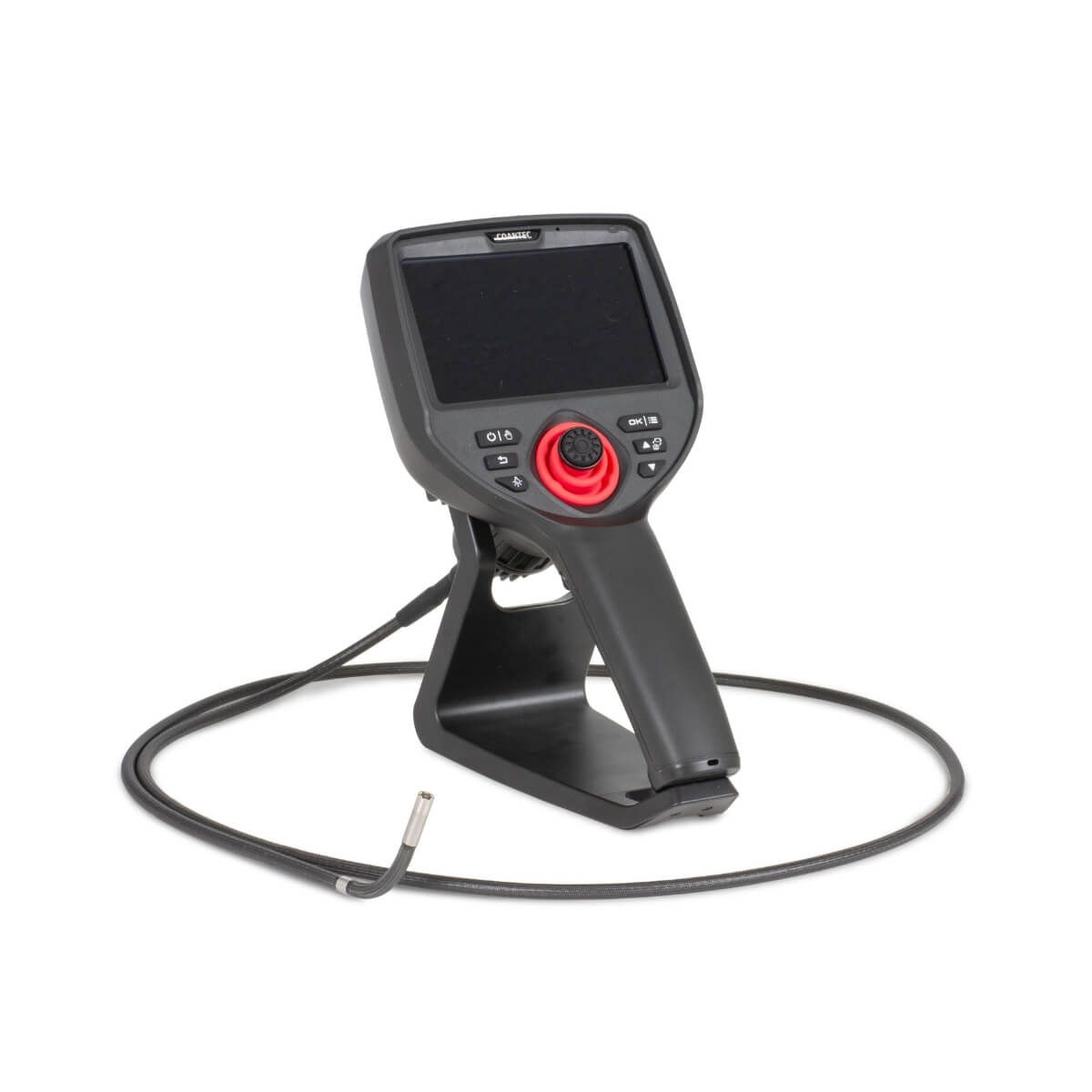
A confined-space inspection camera needs to show the defect from the opening you can actually use. For close-range work inside isolated machinery, image quality depends on probe diameter, illumination, focus and viewing angle as much as camera resolution. For tanks and vessels with a potentially explosive atmosphere, equipment approval comes first.
The Videoscope VOYAGER M40 is Fiberscope.net’s first choice for general close-range visual inspection where all-way articulation and interchangeable probes matter. Its 0.15 in (3.9 mm) probe provides 1280×720 resolution; its 0.24 in (6.0 mm) probe offers up to 2 MP. The Micro Video Borescope MICRON prioritizes smaller access, while the High Temperature Borescope Camera VOYAGER C40 prioritizes cooled inspection. Fiberscope.net sells the systems discussed and services them in-house.
- Choose VOYAGER M40 for articulated close-range inspection; camera resolution changes with probe diameter.
- MICRON combines 400×400 imaging with small-diameter access and USB 3.0 or HDMI viewing.
- VOYAGER C40 high-temperature inspection requires compressor cooling and a limited exposure window.
- A confined space inspection camera needs separate hazardous-location approval where flammable atmospheres are possible.
By Vladimir Khubiryants, Founder & President, Fiberscope.net (MEDIT Inc.)
Which borescope camera has the best image quality for confined space inspections?
The VOYAGER M40 offers the strongest general-purpose combination in this comparison: up to 2 MP imaging with a 0.24 in (6.0 mm) probe and 360° all-way tip control. For narrower access, the 0.15 in (3.9 mm) version provides 1280×720 imaging, while the 0.08 in (2.0 mm) and 0.11 in (2.8 mm) versions provide 640×480.
These configurations suit different openings. A larger camera helps only when its head reaches the target, has enough room to turn and can illuminate the surface at a useful distance. Start with the narrowest restriction along the complete route, then choose the imaging configuration.
A turbine inspection port, heat-exchanger tube and vessel manway present different problems. The first two often call for a small close-range probe. A large vessel also requires enough illumination and deployment control to reach surfaces beyond the opening. The camera must match the inspection procedure and the environment.
This comparison separates imaging specifications from safety requirements. None of the four systems below is recommended here for an explosive atmosphere. Such work requires equipment approved for the site’s hazardous-location classification.
Choose by resolution, access and illumination
VOYAGER M40 camera resolution ranges from 640×480 to up to 2 MP across the listed articulating diameters. Its host screen is 800×480. Those two specifications describe different parts of the imaging chain.
Use these six criteria to choose a borescope for confined-space inspection:
- Camera resolution: compare the exact probe configuration. A maximum megapixel figure for a family does not describe every diameter.
- Probe outside diameter: measure the smallest opening, internal restriction and space around the target. Keep enough clearance for insertion and withdrawal.
- Illumination: choose lighting suited to the target’s distance, surface and surrounding cavity. Inspect reflective metal at several angles to control glare.
- Focus and working distance: position the lens within its useful focal range. A detailed sensor still needs a focused view of the defect.
- Articulation and direction of view: articulation means controlled movement of the tip. It helps aim at a sidewall, blade edge or recessed surface.
- Display and saved evidence: check the live screen and an exported file. A large screen helps interpretation, while saved images preserve the evidence for the report.
For a demonstration, use a representative component with the same access route and surface finish as the job. Include the smallest defect the inspection procedure requires you to recognize. Hold the tip still, vary the viewing angle and examine the original exported image on a larger screen.
Compare the complete inspection systems
The four systems below range from a 0.04 in (1.0 mm) MICRON probe to the 0.26 in (6.6 mm) cooled VOYAGER C40 probe. Their imaging and deployment roles differ; choose the row that matches the job before comparing camera resolution.
| Complete system | Best use case | Probe diameter | Camera imaging | Tip control | Viewing and evidence |
|---|---|---|---|---|---|
| Videoscope VOYAGER M40 | General articulated close-range inspection | 0.08, 0.11, 0.15 and 0.24 in (2.0, 2.8, 3.9 and 6.0 mm) | 640×480 at 2.0/2.8 mm; 1280×720 at 3.9 mm; up to 2 MP at 6.0 mm | 360° all-way joystick control | 5-inch 800×480 touchscreen; image and video capture |
| Micro Video Borescope MICRON | Very small access and close-up internal views | 0.04 or 0.08 in (1.0 or 1.95 mm) | 400×400; 160,000 pixels; 30 fps | — | USB 3.0 computer connection, HDMI output and included viewing tablet |
| High Temperature Borescope Camera VOYAGER C40 | Temperature-controlled inspection of hot components | 0.26 in (6.6 mm) | — | Four-way at 3.28–16.40 ft (1–5 m); two-way at 19.69–26.25 ft (6–8 m) | Host image/video capture and export |
| Infrared Tactical Borescope Camera C35 | Low-light visual inspection requiring IR illumination | 0.15 or 0.24 in (3.9 or 6 mm) | 640×480 | Mechanical all-way movement | 3.5-inch screen; JPEG images and MP4 video |


VOYAGER M40: general close-range inspection
The VOYAGER M40’s 0.15 in (3.9 mm), 1280×720 probe is a practical starting point when an inspection route accommodates that diameter and requires articulated viewing. Move to the 0.24 in (6.0 mm) probe for up to 2 MP when the opening and internal turning space allow it.
White LED illumination lights the target. Joystick control aims the tip in all directions, and interchangeable insertion probes let the host serve different access requirements. The integrated 5-inch screen supports immediate viewing and assessment.
This configuration suits industrial maintenance jobs where you need to examine several surfaces through one access point, such as an isolated gearbox or pump housing with sufficient clearance. The same selection principle applies to aircraft components: access, viewing direction and the approved inspection procedure determine the probe.
Smaller M40 probes trade resolution for access. The 0.08 in (2.0 mm) and 0.11 in (2.8 mm) versions capture 640×480, so choose them when clearance is the deciding factor. Tungsten-braided M40 insertion probes carry an IP68 rating; apply that rating to the probes, rather than the entire handheld system.
Micro Video Borescope MICRON: prioritize small access
The Micro Video Borescope MICRON offers 0.04 in (1.0 mm) and 0.08 in (1.95 mm) probe diameters with 400×400 imaging at 30 fps. Its focal range is 0.12–1.97 in (3–50 mm), making lens-to-target distance a central part of the setup.
An imaging hub combines the light source and video processor. USB 3.0 connects the system to a computer, while HDMI provides a larger-screen viewing route; a viewing tablet is included. The standard working length is 6.5 ft (2 m).
MICRON suits small internal passages and close-up examination where a larger articulating camera cannot clear the route. Its 160,000-pixel sensor gives fewer pixels than the M40’s 1280×720 configuration. Choose it for access to the required view, rather than as the highest-resolution option.
Positioning matters in a narrow passage. Keep the target within the focal range and stabilize the insertion tube while assessing a small feature. USB or HDMI viewing helps another technician review the live image without crowding the access point.
High Temperature VOYAGER C40: match heat and exposure time
The High Temperature Borescope Camera VOYAGER C40 supports inspection at up to 392 °F (200 °C) for 5–8 minutes with its integrated cooling arrangement. The 0.26 in (6.6 mm) insertion probe requires a compressor feeding its cooling tube.
Probe lengths run from 3.28 to 26.25 ft (1–8 m). Four-way articulation applies to 3.28–16.40 ft (1–5 m) probes; 19.69–26.25 ft (6–8 m) probes use two-way articulation. Choose both length and tip-control arrangement around the route to the inspection surface.
This system suits hot-component inspection when the procedure, access clearance and cooling setup permit deployment. Plan the compressor supply, insertion route and withdrawal before beginning the exposure window. The host captures images and videos for later assessment.
Its advantage is the cooled deployment envelope. Treat the temperature rating and exposure duration together. Hazardous-location approval is a separate requirement from heat resistance.
C35: IR illumination for low-light visual inspection
The Infrared Tactical Borescope Camera C35 combines 640×480 imaging with 0.15 or 0.24 in (3.9 or 6 mm) probes and mechanical all-way tip movement. Probe lengths range from 3.28 to 9.84 ft (1–3 m).
The C35 uses infrared illumination for visual examination where white light is unsuitable. A 3.5-inch display provides live viewing and playback. Adjustable exposure and frame rate support image setup, and the host captures JPEG images and MP4 video.
Choose the C35 when the inspection calls for IR illumination and the route accommodates its probe. For ordinary illuminated component inspection, the M40 offers a more direct resolution-based choice. The C35 is an IR-illuminated visual borescope, not a thermal camera.
Match the probe to the route
A 0.15 in (3.9 mm) M40 probe captures 1280×720, while a smaller 0.08 in (2.0 mm) M40 probe captures 640×480. This makes access sizing a direct image-quality decision.
| Inspection constraint | Configuration to assess | Decision to make |
|---|---|---|
| Route clears the 3.9 mm head and allows tip movement | M40 0.15 in (3.9 mm) | Assess 1280×720 imaging and the required viewing angle |
| Route clears the 6.0 mm head and allows tip movement | M40 0.24 in (6.0 mm) | Assess up-to-2-MP imaging against the actual defect |
| Smaller access controls the job | M40 2.0/2.8 mm or MICRON 1.0/1.95 mm | Compare clearance, camera positioning and usable detail |
| Hot component requires cooled insertion | High Temperature VOYAGER C40 | Match 6.6 mm clearance, cooling and exposure time |
| Potentially explosive atmosphere | Site-approved hazardous-location equipment | Match the complete system’s approval to the location |
Measure the route beyond the entrance. Include restrictions, required turns and room to recover the tip. For cold-engine inspection through a spark-plug opening, the same clearance and sidewall-view decisions apply; see the automotive video borescope selection guide.
Hazardous-location equipment comes before image quality
OSHA 1910.307 requires electrical equipment to suit the hazardous location and the ignitable gas, vapor, dust or fiber present. Start with the site classification and required equipment approval, then compare resolution and lighting within the suitable equipment class.
Under OSHA’s hazardous-location requirements, equipment selection must address the actual atmosphere. Give the site’s responsible safety professional the complete proposed configuration: camera, insertion probe, cable connections, host and any accessories entering the classified area.
Record these requirements in the equipment request:
- Site classification: applicable Class/Division or Zone.
- Gas or dust group and required temperature classification.
- Approved ambient-temperature range.
- Certification or approval identification for the exact equipment assembly.
- Which components enter the classified area and which remain outside.
- Certificate conditions, approved accessories and deployment restrictions.
A probe’s IP68 rating addresses ingress protection. Explosion protection requires a separate assessment. Likewise, compressor cooling on the high-temperature C40 addresses heat exposure; it does not confer hazardous-location approval.
Keeping the operator outside is only one part of the risk assessment. OSHA’s pipeline-camera interpretation of July 11, 1995 explains that hazardous-location requirements can apply when workers outside a sewer remain exposed to an explosion hazard.
Confined-space safety and inspection evidence
OSHA 1910.146 defines a confined space by three conditions: bodily entry is possible, entry or exit is restricted, and the space is not designed for continuous occupancy. A narrow machine passage and a permit-required tank therefore require different safety assessments.
Use the employer’s applicable entry and isolation procedures. OSHA’s general-industry confined-space standard addresses permit-space evaluation, hazard control and entry practices. Camera images establish visual condition; atmospheric testing and safety controls establish the conditions for the work.
For the inspection report, capture an orientation view, the close-up defect and its location within the component. Preserve the original exported files. Include probe configuration, viewing direction and the inspection surface so another technician can understand what the image shows.
FAQ
How should I demonstrate a borescope before choosing a probe?
Use a representative component with the same access route, surface finish and required defect detail. Assess the live image and the original exported file while varying viewing angle and lighting.
What should I measure beyond the entry opening?
Measure the smallest internal restriction, insertion distance and room to turn and withdraw the tip. The entrance diameter alone cannot establish whether an articulating head reaches the target.
Which MICRON viewing connections support a larger screen?
The Micro Video Borescope MICRON provides HDMI output and a USB 3.0 computer connection. Its system also includes a viewing tablet.
What equipment does the high-temperature C40 cooling arrangement need?
The High Temperature Borescope Camera VOYAGER C40 requires a compressor supplying its integrated cooling tube. Plan cooling and withdrawal around the 5–8 minute exposure window at up to 392 °F (200 °C).
What should I send with a hazardous-location camera request?
Send the site classification, gas or dust group, temperature classification and ambient-temperature requirements. Identify every system component that enters the classified area so the exact equipment approval can be assessed.
What should accompany a close-up inspection photograph?
Include an orientation image, the defect location and the probe configuration used. Preserve the original exported image so the report can be reviewed against the inspection procedure.
Configure the inspection system
Start with the M40’s 0.15 in (3.9 mm) configuration for general articulated close-range inspection when the route permits it. Choose MICRON for smaller access, the cooled VOYAGER C40 for a defined hot-component procedure, or C35 when IR illumination is required.
Send your access opening, straight or turning route, insertion length, viewing direction, temperature, liquids, hazardous-location classification and recording needs to a Fiberscope.net specialist. Call 1-877-613-2210 for a configuration review.
About the author
Vladimir Khubiryants, Founder & President, Fiberscope.net (MEDIT Inc.)
Vladimir Khubiryants founded Fiberscope.net to give professionals access to reliable video inspection equipment without enterprise pricing. For over 20 years he has sourced and tested borescopes, sewer cameras and fiberscopes in Fiberscope.net's in-house test and repair facility, helping plumbers, pipeline engineers, aviation and military teams choose the right tool for the job.

Leave a comment
This site is protected by hCaptcha and the hCaptcha Privacy Policy and Terms of Service apply.