

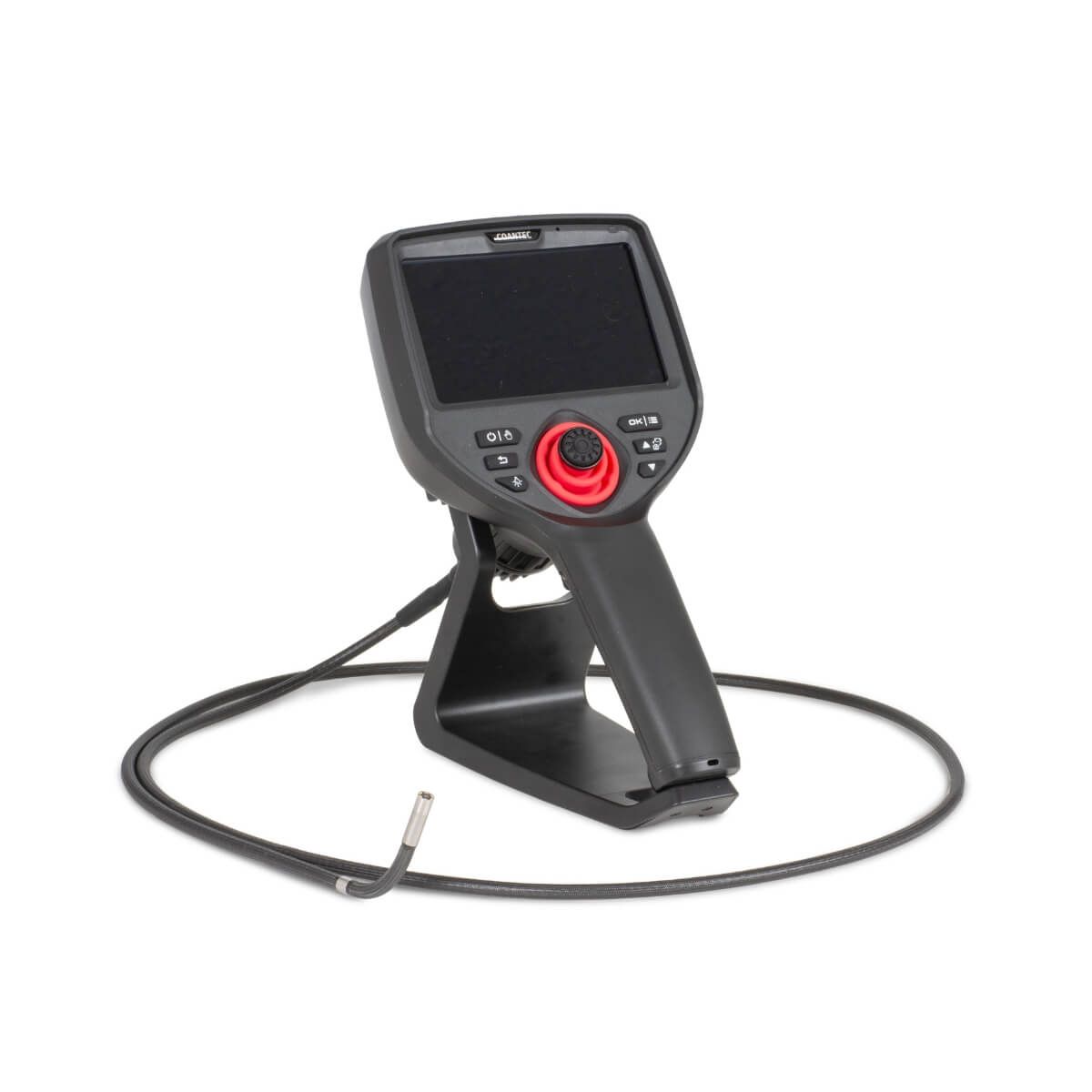
A misfire investigation often starts at a straight spark-plug opening, but the technician needs to see the cylinder wall, piston crown or valve seat from that opening. A forward-facing probe can show the piston and miss the wall. A camera chosen only for its small diameter can pass through the hole yet lack the tip control or image evidence the repair order needs. This guide matches video borescopes to access diameter, direction of view, working length and temperature.
For routine cold-engine work, the Videoscope VOYAGER M40 offers 0.08–0.24 in (2.0–6.0 mm) articulating probes and a 5-inch screen. The High Temperature Borescope Camera VOYAGER C40 has a 0.26 in (6.6 mm) probe for short inspections at up to 392 °F (200 °C) with compressed-air cooling. The Micro Video Borescope MICRON is for smaller access, with a 0.0394 in (1.00 mm) probe option and a USB imaging hub. Fiberscope sells the products discussed and services them in-house.
Size the access before choosing a camera
Probe outside diameter (OD) must clear the narrowest part of the route, while the viewing direction must show the target surface. Measure the actual access on the vehicle after removing the plug or cover; the nominal spark-plug thread size is not the clear opening for the probe. The cylinder bore itself is straight. To inspect its wall from the plug opening, steer an articulating tip toward the wall or use a suitable side-view probe.
| Inspection constraint | Equipment decision | Practical limit |
|---|---|---|
| Cold cylinder through a plug opening; wall or valve needs viewing | VOYAGER M40, with a 0.08, 0.11, 0.154 or 0.24 in (2.0, 2.8, 3.9 or 6.0 mm) articulating probe | Select OD against the opening and working length against the path |
| Heated passage requiring brief visual access | VOYAGER C40, 0.26 in (6.6 mm) probe and compressed-air cooling | 392 °F (200 °C) for 5–8 minutes with cooling |
| Very narrow straight access to a visible target | MICRON, 0.0394 or 0.0748 in (1.00 or 1.9 mm) variant | USB imaging hub needs a viewing device; no steerable tip described |
Start with a cold engine for a spark-plug-hole inspection. NGK's spark-plug installation guidance says plugs should be removed and installed in a cool engine because hot metal expansion risks thread damage. The high-temperature VOYAGER C40 solves a different task: a brief inspection through a heated passage with a cooling-air supply, rather than routine cylinder viewing through a recently run engine.
Viewing direction matters as much as OD. A forward lens points down the bore; articulation turns the lens toward a wall or valve. The M40's side-view version is an orderable configuration. Evident's visual-inspection guide likewise separates tube diameter, articulation and optical viewing direction as selection decisions.
Compare three complete video systems
VOYAGER M40 is the practical starting point for cold cylinder-wall work; VOYAGER C40 earns its place when the inspection environment stays hot; MICRON serves access too narrow for either. Prices checked September 26. The ranges reflect store configurations in USD.
| System | Probe and working length | Viewing and evidence | Application boundary |
|---|---|---|---|
| Videoscope VOYAGER M40 | 0.08–0.24 in (2.0–6.0 mm) articulating probes; listed lengths 3.3–19.7 ft (1–6 m) by variant | 5-inch, 800 × 480 screen; one-touch image capture; rechargeable host | Choose diameter and direction of view for the plug opening and target |
| High Temperature Borescope Camera VOYAGER C40 | 0.26 in (6.6 mm); 3.3–26.2 ft (1–8 m) variants | Handheld host captures image and video; cooling tube uses compressed air | 392 °F (200 °C) for 5–8 minutes with cooling |
| Micro Video Borescope MICRON | 0.0394 or 0.0748 in (1.00 or 1.9 mm) listed variants; 4.9 or 6.5 ft (1.5 or 2 m) | 400 × 400 image; USB 3.0 to computer and HDMI output via hub | Tiny openings and straight viewing; separate imaging hub |
Videoscope VOYAGER M40 for cold-engine inspection
The Videoscope VOYAGER M40 offers 360° joystick articulation with listed 0.08, 0.11, 0.154 and 0.24 in (2.0, 2.8, 3.9 and 6.0 mm) probe diameters. The integrated 5-inch, 800 × 480 touchscreen lets a mechanic see the live image and play back captured footage at the vehicle. Its interchangeable probe system gives the shop a route to narrower or longer configurations; the variant selection sets the actual working length.
For a cold engine, enter through the measured plug opening with the tip straight. Once the lens reaches the chamber, articulate toward the cylinder wall or the valve face. A side-view version can be ordered where a fixed lateral look is preferable. The 0.08 and 0.11 in (2.0 and 2.8 mm) probes have 640 × 480 sensors; the 0.154 in (3.9 mm) probe has 1280 × 720. The insertion probes carry an IP68 rating, which applies to the probe rather than the touchscreen host.
From $4,160 to $8,240 across the listed variants. M40 is the choice for repeat cold-engine inspections where the target is off the straight line from the access hole. The 0.24 in (6.0 mm) configuration needs a wider opening than the 0.08 in (2.0 mm) option; buy for the smallest recurring port, then the image requirement. Watch the VOYAGER M40 in use.

High Temperature Borescope Camera VOYAGER C40 for brief heated access
The High Temperature Borescope Camera VOYAGER C40 uses a 0.26 in (6.6 mm) probe with an internal cooling tube for a 5–8 minute inspection at up to 392 °F (200 °C). That rating requires a compressor to supply the cooling air. The 3.3–16.4 ft (1–5 m) variants use four-way articulation; the 19.7–26.2 ft (6–8 m) variants use two-way articulation. It captures images and video with its handheld host and travels in a protective case.
Use this system for a heated exhaust-side or industrial-engine access route when waiting for full cooldown is outside the job plan and the opening clears 0.26 in (6.6 mm). For a standard spark-plug-hole cylinder check, the smaller M40 probes and cold-engine procedure are more appropriate. From $3,320 to $9,820 across the listed lengths; the lower figure is for a 3.3 ft (1 m) configuration.

Micro Video Borescope MICRON for very small openings
The Micro Video Borescope MICRON has 0.0394 in (1.00 mm) and 0.0748 in (1.9 mm) listed probe variants with 4.9 ft (1.5 m) and 6.5 ft (2 m) working lengths. Its color sensor outputs 400 × 400 video through an imaging hub with integrated LED lighting. USB 3.0 connects the hub to a computer; HDMI provides a separate display-output route. The ETFE-coated probe resists oil and water.
MICRON serves a narrow straight port that rules out the M40's 0.08 in (2.0 mm) articulating option, provided the probe can be guided to the target. A small OD alone does not give a sideways view of a cylinder wall; MICRON is better for a direct line of sight through a restricted opening. From $11,100 to $11,900 across the listed variants. For an ordinary plug opening that admits a steerable M40 probe, the M40 gives better control over where the lens points.

Other options for a different job
A rigid optical borescope is useful when a straight entry and optical view are enough; it needs an appropriate light source and an attached camera setup to make video. See the rigid borescope guide for that separate equipment class. An optical accessory such as the USB Borescope Camera has no probe of its own and cannot replace any of the three complete video systems above.
For inspections where measuring a defect in three dimensions is part of the work order, Waygate's Mentor Visual iQ+ provides Real3D measurement and a dedicated reporting workflow. Waygate's model is stronger on measured defect dimensions; the M40 is a more focused choice for visual access and image capture at a car in a service bay. Waygate specifications checked September 26. A consumer handheld camera can also be enough for an occasional straightforward check, but choose a named, measurable probe and capture method before committing a customer diagnosis to it.
What you'll also need
A cold, clean plug opening and a plan for the captured image are part of the camera setup. Keep dirt out of the cylinder while removing the plug, label captures by cylinder number, and save the original image with the service record. A photo of a mark is evidence of its appearance and location; follow your normal mechanical diagnosis before assigning a cause. The M40's optional side-view probe is a product configuration rather than a retrofit for MICRON.
If you already own a rigid optical scope, the SPARK / SPARK XTR LED Light Handle supplies illumination through the optical scope's light connection. It is an accessory to that optical setup, not an added light handle for the M40, C40 or MICRON.
Common inspection mistakes
A probe that clears a spark-plug opening may still point away from the cylinder-wall feature. Note the desired view before ordering: a piston-crown image needs a different lens direction from a wall inspection. A cold engine protects spark-plug threads during removal and avoids making high-temperature capability the default purchase criterion.
- Measure the smallest actual access and compare it with probe OD; the M40 offers 0.08–0.24 in (2.0–6.0 mm) articulated configurations, while the C40 uses 0.26 in (6.6 mm).
- Decide whether a steerable tip or a side-view configuration is needed to see the surface. A small forward-facing camera can pass the opening and still miss a side wall.
- Plan the complete imaging path. M40 has its own 5-inch display; MICRON uses a USB imaging hub and viewing device. Preserve images by vehicle and cylinder so the evidence remains interpretable.
FAQ
Can I inspect a cylinder wall through the spark-plug hole?
Yes, with a probe that clears the actual opening and points toward the wall. Videoscope VOYAGER M40 has 360° tip articulation in its 0.08–0.24 in (2.0–6.0 mm) probe range; a side-view version is also orderable.
When should I use a heat-resistant borescope in an automotive shop?
Use High Temperature Borescope Camera VOYAGER C40 for a brief heated-access inspection with a compressor supplying cooling air. Its limit is up to 392 °F (200 °C) for 5–8 minutes under that condition.
Does Micro Video Borescope MICRON connect to a phone app?
MICRON uses a USB 3.0 imaging hub for computer viewing and has an HDMI output for a separate display. Choose the computer or display as the viewing device.
Can MICRON inspect a cylinder wall simply because its probe is narrow?
A 0.0394 in (1.00 mm) probe clears a smaller opening than a 0.08 in (2.0 mm) M40 probe, but clearance alone does not turn the view toward the wall. Use articulation or an appropriate side-view setup for a wall inspection.
Is a waterproof probe the same as a waterproof borescope host?
No. The M40 insertion probes carry IP68; the product does not assign that rating to its touchscreen host. Protect the display and connectors separately.
About the author
Vladimir Khubiryants, Founder & President, Fiberscope (MEDIT Inc.). Vladimir Khubiryants founded Fiberscope to give professionals access to reliable video inspection equipment without enterprise pricing. For over 20 years he has sourced and tested borescopes, sewer cameras and fiberscopes in Fiberscope's in-house test and repair facility, helping plumbers, pipeline engineers, aviation and military teams choose the right tool for the job.
Send a Fiberscope specialist the access opening, straight or turning route, required insertion length, desired viewing direction, operating temperature and recording need. Use the contact page or call 1-877-613-2210 to match the probe and host to the job.

Leave a comment
This site is protected by hCaptcha and the hCaptcha Privacy Policy and Terms of Service apply.