

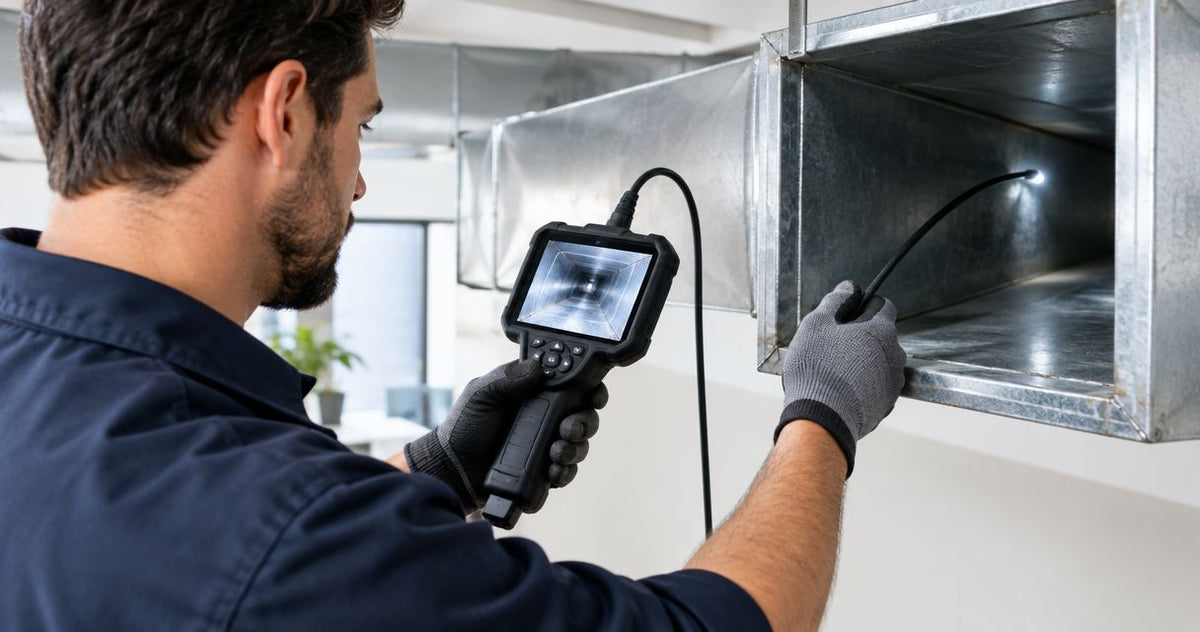
An HVAC duct inspection camera costs from $3,050 to buy when you start with a purpose-built system like the Duct Inspection Camera DUCT-SCAN MICRO. Pole-mounted and articulating options sit between $4,110 and $4,160, and the price covers the camera system only; short jobs are often cheaper to rent than to buy.
- A duct inspection camera system starts from $3,050 at Fiberscope.net.
- Pole and articulating systems run $4,110 to $4,160 for attic, plenum and tight-access work.
- Match the camera to access opening, route and recording needs before comparing prices.
- For one or two jobs, renting costs less than buying.
The price spread comes from how the camera reaches the duct: a dropdown cable with a rotating head, a telescopic pole, or an articulating probe. Fiberscope.net sells these systems, rents them and services them in-house, so the numbers below come straight from the store pages.
How much does an HVAC duct inspection camera cost?
A complete HVAC duct inspection camera costs from $3,050 to $4,160 across the three systems below. Prices checked on the publish date of this article.
| System | Reach method | From | Best suited to |
|---|---|---|---|
| DUCT-SCAN MICRO | Dropdown cable, remotely rotatable HD head | $3,050 | Air channels, shafts, trunk lines |
| Dual View Pole Camera COBRA | Telescopic pole, rotating side view | $4,110 | Attics, walls, gutters, tanks, manholes |
| Videoscope VOYAGER M40 | Flexible probe, full tip articulation | $4,160 | Tight turns, plenum and coil access |
The three systems are priced within about $1,100 of each other. Access and route decide which one fits, so the cheapest is not automatically the right buy.
What the DUCT-SCAN MICRO costs and what it does: from $3,050
The DUCT-SCAN MICRO is the entry point at $3,050. It pairs a remotely rotatable HD camera head with a dropdown cable, and it records to a USB drive.
The rotating head lets you look at the side walls of a trunk line without moving the cable. It suits duct cleaners who need before-and-after evidence of an air channel. Its limit is route: a dropdown cable goes where you can lower it, so it is a poor fit for runs with several turns.
What the COBRA costs and what it does: from $4,110
The Dual View Pole Camera COBRA is $4,110 from Fiberscope.net. It is a telescopic pole camera with a rotating view and SD card recording, built for inspections in attics, walls, gutters, tanks, manholes and roofs.
For HVAC work it covers attic ducting and plenum access from a standing position. It is the better pick when the job is reaching up and over rather than down a shaft. It does not turn corners inside a duct, so branch runs need a different tool.
What the VOYAGER M40 costs and what it does: from $4,160
The Videoscope VOYAGER M40 is $4,160. Its tip articulates through 360° with a joystick, and the probes are rated IP68, which means immersion beyond 3.3 ft (1 m) under the maker's stated conditions.
Articulation is what you pay for here. If the route bends at a coil, damper or take-off, steering the tip is the difference between seeing the problem and guessing at it. For straight trunk lines, you are paying for steering you will rarely use, and the DUCT-SCAN MICRO is the cheaper answer.
Why duct camera prices vary
Four factors move the price:
- Reach method. Dropdown cable, telescopic pole or flexible articulating probe each need different mechanics.
- Head control. A remotely rotating head or a fully articulating tip costs more than a fixed view.
- Recording. USB or SD recording is built into these systems; check the output you need for client reports.
- Environment rating. An IP68 probe costs more to build than an unrated one.
- Support. Fiberscope.net backs each system with in-house testing, repair and a one-year warranty, which sits inside the price rather than on top of it.
What you will also need
The system price covers the camera. Budget separately for any accessory the job calls for, such as a light source or light guide cable if you add an optical scope. For the full range of duct tools, see the best HVAC duct inspection cameras comparison.


Is buying worth it versus renting?
Buying pays off when you document duct work regularly. NADCA's ACR standard calls for documenting duct cleaning results, and a camera that records straight to USB or SD makes that routine. Read the NADCA guidance for what your reports need to show, then see how to document duct cleaning for NADCA ACR with a camera.
For a single job, renting is cheaper. Fiberscope.net runs a rental program, and you can demo before you commit.
Common budget mistakes
- Buying an articulating videoscope for straight trunk lines you could cover with a rotating-head dropdown camera.
- Buying a pole camera for ductwork that has no vertical or overhead access.
- Skipping recording, then having no evidence to show the client.
FAQ
What is the cheapest professional HVAC duct camera?
The DUCT-SCAN MICRO is the lowest-priced duct system at Fiberscope.net, from $3,050. It has a remotely rotatable HD head on a dropdown cable and records to USB.
Does a duct camera record video?
Yes. The DUCT-SCAN MICRO records to USB, and the COBRA records to an SD card. The VOYAGER M40 also records.
Is an articulating videoscope worth $4,160 for duct work?
It is worth it when the route has bends at coils, dampers or take-offs. For straight trunk lines, the $3,050 DUCT-SCAN MICRO is the better value.
Can I rent a duct camera instead of buying?
Yes. Fiberscope.net rents inspection cameras for short jobs, and you can demo a system before buying.
Does a warranty come with the camera?
Every Fiberscope.net system carries a one-year warranty and in-house repair support.
Get a configuration review
Send your duct size, access opening, route and bends, run length and recording needs, and a Fiberscope.net specialist will match the right system. Call 1-877-613-2210, Monday to Friday 8:00 to 18:00 CST, or use the contacts page at store.fiberscope.net/pages/contacts. Watch Fiberscope.net systems in use on the YouTube channel.
About the author. Vladimir Khubiryants founded Fiberscope.net to give professionals access to reliable video inspection equipment without enterprise pricing. For over 20 years he has sourced and tested borescopes, sewer cameras and fiberscopes in Fiberscope.net's in-house test and repair facility, helping plumbers, pipeline engineers, aviation and military teams choose the right tool for the job.

Leave a comment
This site is protected by hCaptcha and the hCaptcha Privacy Policy and Terms of Service apply.