

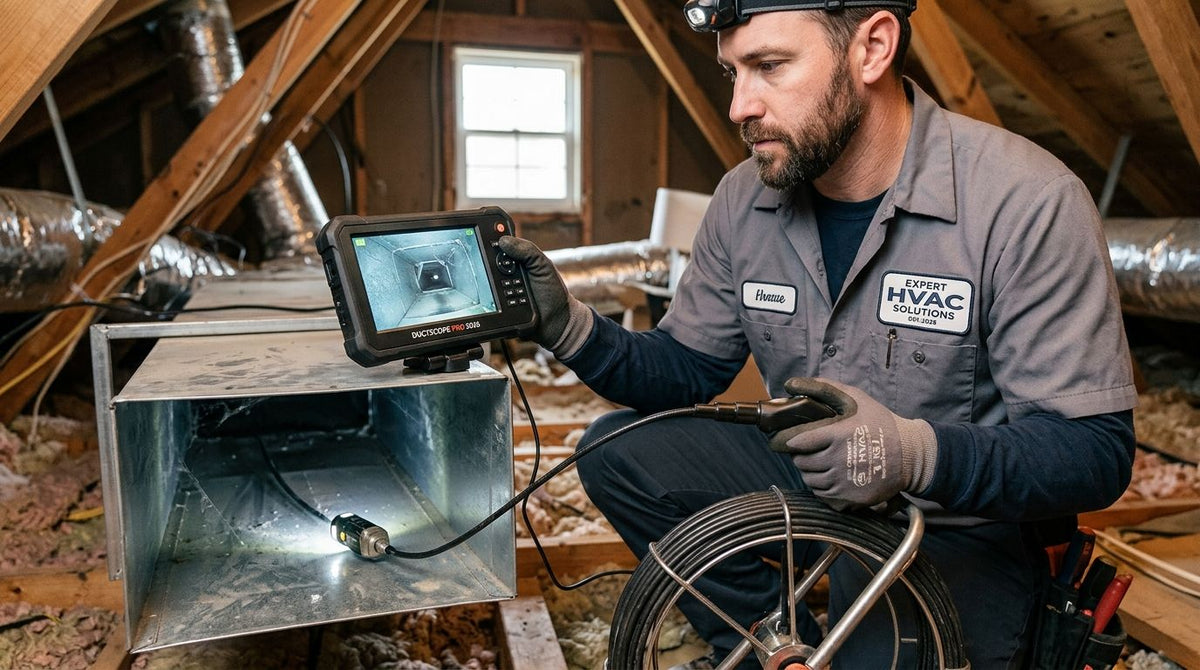
The best HVAC duct inspection cameras in 2026 depend first on how the camera enters and moves through the space. For an enclosed round duct from 2 inches in diameter that can accept a push cable, iSnake is the verified long-run option; small service ports, short straight checks, and open plenums call for different systems.
- iSnake fits enclosed round ducts from 2 inches in diameter when a push cable can travel the route.
- VOYAGER M40 fits small access ports and short routes that need an articulating probe.
- Rigid Borescope fits short straight sight lines; COBRA fits open plenums and shafts.
- Measure the opening, route, restrictions, and evidence needs before choosing an HVAC duct inspection camera.
This 2026 guide compares four Fiberscope camera systems across four access conditions. They are not interchangeable product rankings. Fiberscope sells the products discussed. Recommendations are based on current published specifications and stated use cases; confirm final configuration and compatibility with Fiberscope before purchase.
Start with the access route, not image features
“HVAC duct inspection” can mean pushing a cable through an enclosed run, steering a probe through a service port, looking straight through a panel opening, or extending a pole into an open plenum. The deployment method decides which equipment class belongs on the job.
Record these conditions before selecting a 2026 setup:
- Access opening: Measure the narrowest grille slot, service port, cut-in, or panel opening the camera must clear.
- Duct geometry: Record both dimensions for rectangular duct and the internal diameter for round duct. Do not turn a round-duct diameter rating into a rectangular width claim.
- Material: Note sheet metal, lined duct, or flexible duct. Construction affects cable movement and whether pushing a camera is appropriate.
- Route length: Measure along the path from access point to target.
- Restrictions: Count elbows, transitions, dampers, takeoffs, branches, and likely obstructions.
- Deployment direction: Decide whether the tool will be pushed, lowered, steered through a short path, or held in an open space.
- Evidence: Confirm whether a live view is enough or the job needs saved images or video.
For example, a 2-inch-diameter round duct with a clear route is different from a rectangular duct with a 2-inch-wide access slot. The first can be checked against a published diameter range. The second must be checked against the camera-head dimensions and every restriction on the actual route.
HVAC inspection cameras at a glance
| System | Equipment class | Best fit | Verify before purchase | Not ideal for |
|---|---|---|---|---|
| iSnake | Push camera | Enclosed round ducts from 2 inches in diameter | 33mm head clearance, 98-foot reach, bends, duct material, and cable passage | Narrow slots, delicate flexible duct, or routes blocked by dampers |
| VOYAGER M40 | Articulating videoscope | Small access ports and short routes needing controlled tip direction | Probe diameter, selected working length, articulation, and probe stiffness | Long runs requiring substantial push distance |
| Rigid Borescope | Rigid optical scope | Short straight sight lines through a prepared opening | Shaft diameter, shaft length, direction of view, lighting, and capture setup | Any route that turns after entry |
| COBRA Dual View Pole Camera | Telescopic pole camera | Open plenums, shafts, ceiling spaces, and attic access | 23-foot extended reach, head clearance, viewing angle, and operator position | Enclosed horizontal duct or a route beyond an obstruction |
The best HVAC duct inspection cameras in 2026 are matched to access geometry. A longer reach in the wrong equipment class does not make a system suitable.
iSnake for enclosed duct runs
The iSnake uses a 33mm pan-and-tilt head with manual focus on a 98-foot flexible push cable. Its product information explicitly includes ducts and gives a published fit starting at 2 inches in diameter.
The system records photos, video, text, and audio to USB storage and displays cable length on screen. Pan-and-tilt control lets the operator examine different interior surfaces without rotating the full cable.
In a 4-inch-diameter round metal duct with a clear 70-foot route, iSnake has enough published reach. That example does not prove passage through a grille, damper, transition, elbow, or flexible section; measure each restriction first.
Recommendation: Choose iSnake for an enclosed round duct from 2 inches in diameter when its 33mm head clears the full route and 98 feet is sufficient.
VOYAGER M40 for small ports and controlled tip direction
The VOYAGER M40 is an articulating videoscope with available 2.0mm, 2.8mm, 3.9mm, and 6.0mm insertion probes. Its joystick controls the tip through 360 degrees, and its 5-inch display supports image capture and playback. Resolution varies by probe diameter, so the exact probe must be selected before quoting image specifications.
This class works when the target is close enough for the selected probe length and the operator needs to aim around an internal feature. Probe diameter alone does not prove suitability; working length, stiffness, route geometry, and articulation all matter.
For a nearby coil face reached through a small service port, a selected 2.8mm articulating probe may fit where a 33mm push-camera head cannot. It is not a substitute for a semi-rigid 98-foot cable in a long horizontal run.
Recommendation: Choose VOYAGER M40 for a measured short route through a small port when controlled tip direction is more important than long push distance.
Rigid Borescope for short straight checks
The Rigid Borescope is available in multiple shaft diameters and lengths, including listed diameters of 2.7mm, 4mm, and 6mm and lengths from 175mm to 600mm. Direction-of-view options vary by configuration, so the shaft must be matched to where the target sits relative to the opening.
A rigid shaft gives a stable straight sight line but cannot follow an elbow. For a target directly behind a removable panel, the selected shaft can provide a controlled view. If the target is around the first bend, image quality and shaft length do not solve the access problem.
Image or video capture requires a suitable camera and coupler configuration; do not assume the optical scope alone includes recording.
Recommendation: Choose Rigid Borescope only when the opening, target distance, and direction of view form a short straight path.
COBRA for open plenums and shafts
The COBRA Dual View Pole Camera extends to 23 feet and carries straight-view and side-view cameras on a head with 360-degree panning. Its control unit records snapshots and video to an SD card.
This deployment suits open areas where the operator can extend the pole directly toward the target. An open ceiling plenum within the pole’s reach can fit the COBRA. An enclosed horizontal branch behind an elbow cannot; the rigid pole does not travel through duct bends.
Recommendation: Choose COBRA for direct reach into an open plenum, shaft, ceiling space, or attic—not for travel inside enclosed ductwork.
A five-step selection check for 2026
- Measure the opening. Record the actual slot, port, hatch, or cut-in the camera must clear.
- Map the route. Note distance, elbows, transitions, dampers, branches, material, and restrictions.
- Choose the deployment class. Match the route to a push cable, articulating probe, rigid shaft, or telescopic pole.
- Define the evidence. Specify live viewing, images, video, direction of view, and any distance reference.
- Verify the exact configuration. Match head or probe diameter, working length, recording method, and exclusions to the job.
Do not choose a 2026 system because its category name contains “inspection camera.” A camera can clear the entry point and still fail before reaching the target if the full deployment path is not verified.
FAQ
What is the best camera for an enclosed HVAC duct run?
iSnake is the relevant option here when its 33mm head clears the route and a push cable can be advanced safely. Its published fit starts at 2 inches in diameter, and its cable is 98 feet long.
Does a 2-inch duct rating mean a camera fits a 2-inch-wide rectangular opening?
No. A diameter rating describes a round internal dimension. Check rectangular openings against the camera-head dimensions and every restriction on the route.
Which HVAC inspection camera fits a small service port?
VOYAGER M40 offers articulating probes in several diameters, including 2.0mm, 2.8mm, 3.9mm, and 6.0mm. Select the exact probe diameter and working length from the measured opening and route.
Can a rigid borescope inspect around a duct elbow?
No. Rigid Borescope provides a straight sight line and cannot follow an elbow. Use a suitable flexible or push-style system when the route turns.
Is a pole camera suitable inside horizontal ductwork?
No. COBRA is for direct reach into open spaces such as plenums, shafts, and attic areas. Its rigid pole does not travel through enclosed duct around bends.
What should an HVAC camera configuration request include?
Provide the opening dimensions, duct geometry and material, route length, restrictions, deployment direction, target area, and required image or video evidence.
One last thing
The best HVAC duct inspection camera in 2026 is selected by access geometry before image features. Send Fiberscope the opening dimensions, duct dimensions and material, route length, restrictions, deployment direction, and evidence requirements for a configuration review.

Leave a comment
This site is protected by hCaptcha and the hCaptcha Privacy Policy and Terms of Service apply.