

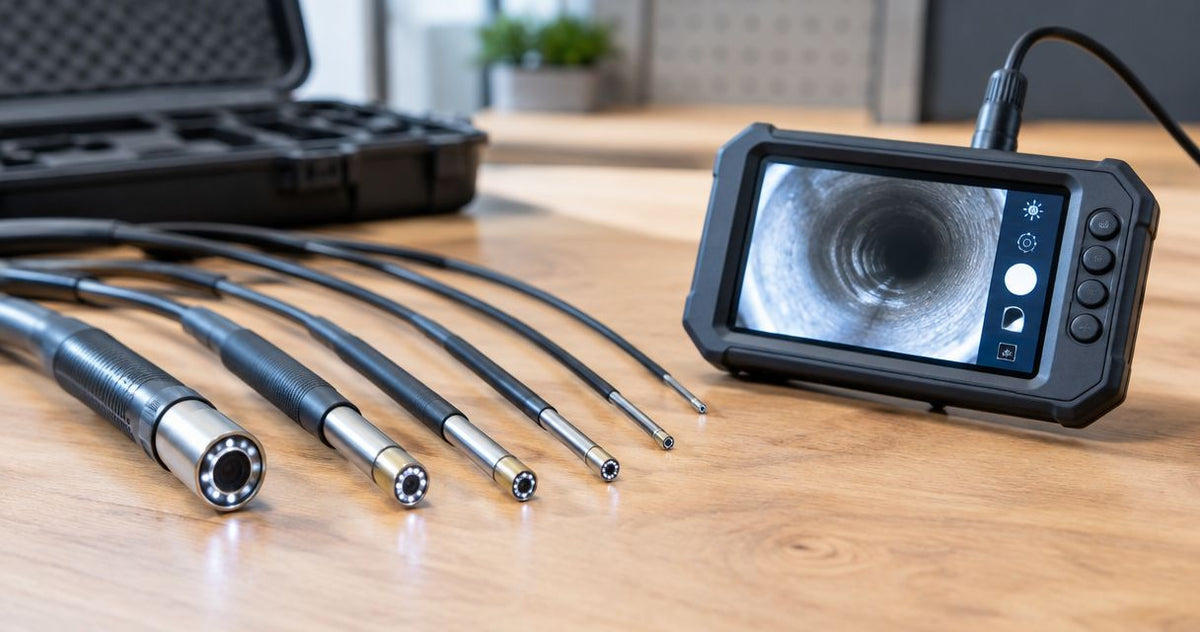
A probe that won't pass the narrowest point on the route returns no footage, so the probe diameter is the first spec to settle on any inspection camera. Fiberscope.net sells the cameras covered here and services them in-house.
The shortest answer: for 1.25-inch P-traps and small drains, the 0.75 in (19 mm) MiniFlex 2 19mm is the smallest drain camera head in this guide. For 2 to 6 inch lines, the 1.42 in (36 mm) MiniFlex 2 36mm gives a larger head with more room for lighting and optics. For micro-bore work such as keyways, drill points and gun barrels, you need a micro borescope, a different class of tool.
- Inspection camera probe diameter must clear the narrowest point on the route, not the pipe or bore nominal size.
- The MiniFlex 2 19mm head is 0.75 in (19 mm) and turns through a 1.25-inch P-trap.
- The MiniFlex 2 36mm head is 1.42 in (36 mm) and is sold for 2 to 6 inch pipes.
- For bores under 0.5 in (13 mm), use a micro borescope instead of a drain camera.
How probe diameter decides the camera
The probe, or camera head, has to be smaller than the tightest restriction on the route. That restriction is rarely the pipe itself. It is a P-trap bend, a cleanout fitting, a spark-plug hole, a keyway or the land diameter of a rifle barrel (the narrowest point inside the bore, measured between the raised ridges of the rifling).
Four criteria sort the options below:
- Head outside diameter (OD): the number that has to clear the narrowest fitting.
- Pipe or bore range: the smallest and largest line the head is sold for. A head far smaller than the pipe floats off-center and gives a poor view of the wall.
- Turning ability: a head can fit a 1.25-inch trap and still jam at a tight 90° bend if the cable is stiff.
- Image and lighting: smaller heads carry smaller sensors and fewer LEDs, so detail drops as diameter falls.
Probe diameters at a glance
Prices checked September 2026. Sorted from the smallest head to the largest.
| Camera | Head OD | Pipe range | Suits | From |
|---|---|---|---|---|
| MiniFlex 2 19mm | 0.75 in (19 mm) | Small drains from 1.25 in | P-traps, tight fixture drains | $5,229 |
| VIPER 1 in straight head | 1 in (25 mm) | 1.25 to 6 in straight runs | Residential laterals | — |
| MiniFlex 2 36mm | 1.42 in (36 mm) | 2 to 6 in | Larger drains and branch lines | $6,890 |
| HATHORN Mini | — | — | Wi-Fi plumbing work | $7,300 |
| HATHORN Mid | — | 2 to 12 in | Sewer lines, municipal work | $7,900 |
The dash means the head OD is not a number to quote here. Check the product page before you rely on that head for a tight fitting.
MiniFlex 2 19mm: the smallest drain head
The MiniFlex 2 19mm Small Drain Camera Extended Set has a 0.75 in (19 mm) head. That is the size that turns through a 1.25-inch P-trap, which is the situation that stops larger drain cameras on kitchen sinks and bathroom lavatories. It carries a 512 Hz sonde in the head, so a compatible locator can pinpoint a defect from above.
The small head means a smaller range of pipe sizes works well. In a 4-inch line it sits low and the view of the upper wall is limited. A customer, Hayden E., reports using it on 1.5 inch pool elbows to diagnose a collapsed skimmer line, which is the kind of job the 19 mm head exists for.
From $5,229. Buy it if most of your calls are under-sink and fixture drains.
VIPER: 1 in head for residential laterals
The VIPER drain camera pairs a 1 in (25 mm) straight-view head with a push cable on a reel, and is rated for 1.25 to 6 inch straight runs. That covers most residential laterals running to the street. The 1 in self-levelling head carries the 512 Hz sonde and is IP68 rated.
A 1 in head is too large for a 1.25-inch P-trap with tight bends. For 1.5-inch lines with sharp 90° turns, the MiniFlex 2 19mm is the better tool. Spare camera heads and cable reels are sold separately if you want to swap lengths later.
MiniFlex 2 36mm: more head for 2 to 6 inch pipes
The MiniFlex 2 36mm has a 1.42 in (36 mm) head and is sold for 2 to 6 inch pipes. The extra diameter gives room for more lighting and a bigger imaging chip, so debris, scale and pipe joints show with more detail than on the 19 mm head. It also carries a 512 Hz sonde.
The tradeoff is access. A 1.42 in head will not pass a 1.25-inch P-trap, and it will struggle in a 1.5-inch line with tight bends. Use it after the trap is pulled or from a cleanout.
From $6,890. Buy it for 3 to 4 inch branch lines where picture quality matters more than squeezing through fixtures.
HATHORN Mini and Mid: Wi-Fi heads for bigger lines
The HATHORN family sends video over its own Wi-Fi signal to a phone or tablet through a free app. The HATHORN Mini is built as a rugged plumbing camera from $7,300. The HATHORN Mid is sold for sewer lines from 2 to 12 inches, from $7,900, and suits municipal and contractor work on larger pipes.
Wi-Fi links the handle or reel to your device. It does not change how the head fits, so check each head against your smallest fitting before choosing between them. The HATHORN Micron, at $4,300 and about 16 lb (7.3 kg), is the lightest of the group and is sold for drain lines up to 100 ft (30 m).
Micro borescopes: when the bore is under half an inch
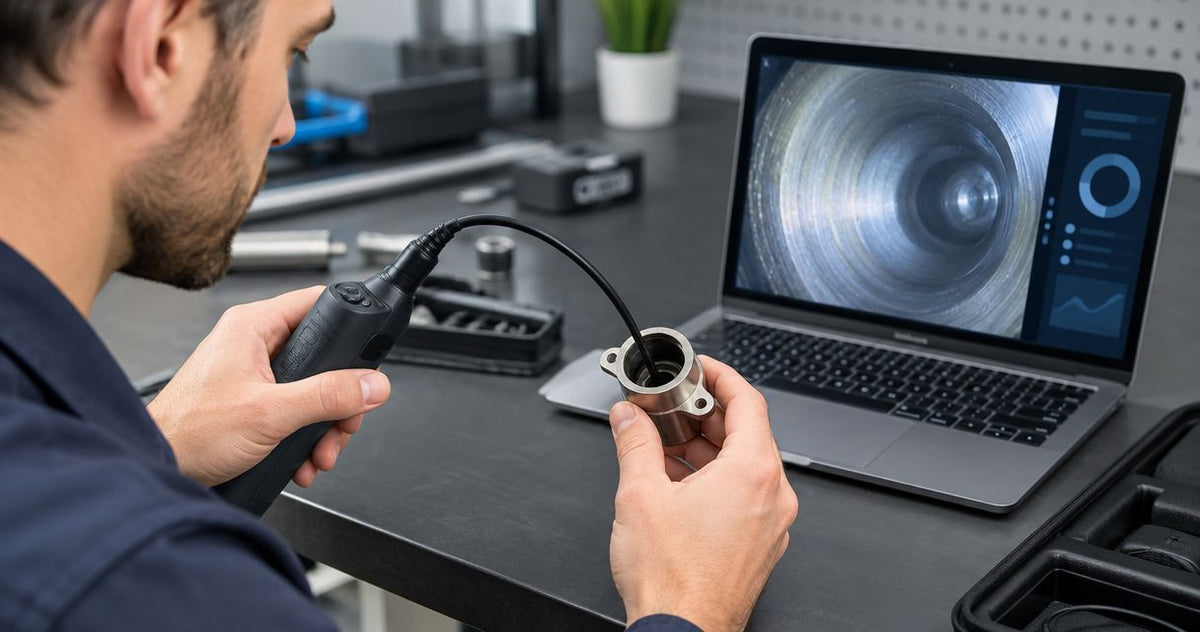
A drain camera head cannot enter a keyway, a drill point or a rifle barrel. For those, a micro borescope with a probe of a few millimeters is the tool. The rule is simple: the probe OD must be smaller than the narrowest point it travels through. A 3.9 mm (0.15 in) probe clears the .308 land diameter of 7.62 mm (0.30 in) with room to spare.
For options, see the guide to the best micro borescopes, and for firearms specifically the gun barrel borescope guide. For automotive work, the spark-plug hole sets the maximum probe OD, so measure it before you compare cameras.


Sizing a camera to the job
- 1.25-inch P-trap or small fixture drain: a 0.75 in (19 mm) head.
- 1.5 to 2 inch line with tight bends: the 19 mm head again; larger heads stall at the first elbow.
- 3 to 6 inch straight lateral: a 1 in (25 mm) to 1.42 in (36 mm) head.
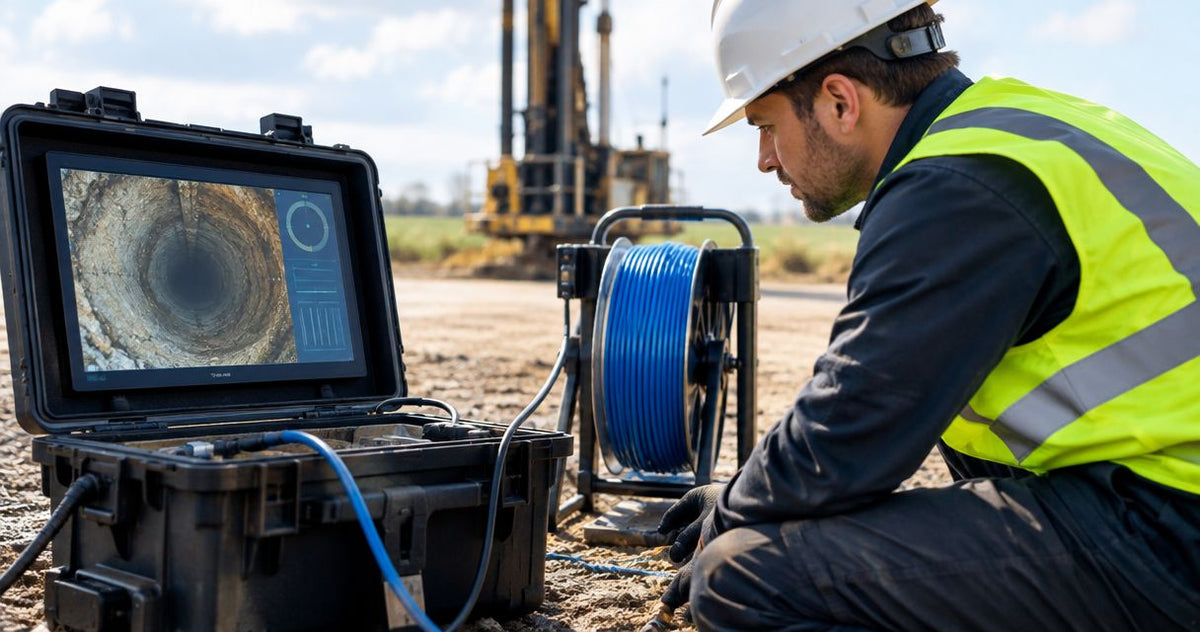
- 6 to 12 inch sewer line: a mainline system such as the HATHORN Mid.
- Keyways, drill points, gun bores: a micro borescope, under 0.5 in.
For head-by-head comparisons by trade, the drain inspection camera guide for plumbers covers the plumbing side in more detail.
Common mistakes
- Measuring the pipe instead of the narrowest fitting. The trap or cleanout sets the limit.
- Buying the biggest head that fits the pipe. A larger head can mean a stiffer cable and trouble at bends.
- Skipping the sonde. If you need to locate a break before excavation, the head needs a sonde and you need a separate compatible receiver.
- Assuming a waterproof head means a waterproof system. Check which part carries the IP rating.
FAQ
What probe diameter do I need for a P-trap?
A 0.75 in (19 mm) head turns through a 1.25-inch P-trap. Larger heads, including the 1 in (25 mm) VIPER head, are better suited to lines with gentler bends.
Does a smaller probe give a worse image?
Smaller heads carry smaller sensors and fewer LEDs, so detail drops as diameter falls. Use the largest head that still clears your narrowest fitting.
What does IP68 mean on a camera head?
IP68 means protection against immersion beyond 1 m under conditions the manufacturer states, as defined in IEC 60529. It applies to the rated part, not necessarily the whole system.
Can I locate a camera head from above ground?
Yes, if the head has a sonde and you use a compatible receiver. The MiniFlex 2 heads and the VIPER 1 in head carry a 512 Hz sonde.
How do I measure a gun barrel for probe size?
Measure the land diameter, the narrowest point in the bore. The probe OD must be smaller than that number.
Get a head matched to your job
Send Fiberscope.net your smallest fitting, pipe ID, run length, bends and whether you need locating, and a specialist will match the right head and reel. Call 1-877-613-2210, Mon to Fri 8:00 to 18:00 CST, or use the contact page on store.fiberscope.net.
About the author
Vladimir Khubiryants founded Fiberscope.net to give professionals access to reliable video inspection equipment without enterprise pricing. For over 20 years he has sourced and tested borescopes, sewer cameras and fiberscopes in Fiberscope.net's in-house test and repair facility, helping plumbers, pipeline engineers, aviation and military teams choose the right tool for the job.

Leave a comment
This site is protected by hCaptcha and the hCaptcha Privacy Policy and Terms of Service apply.