

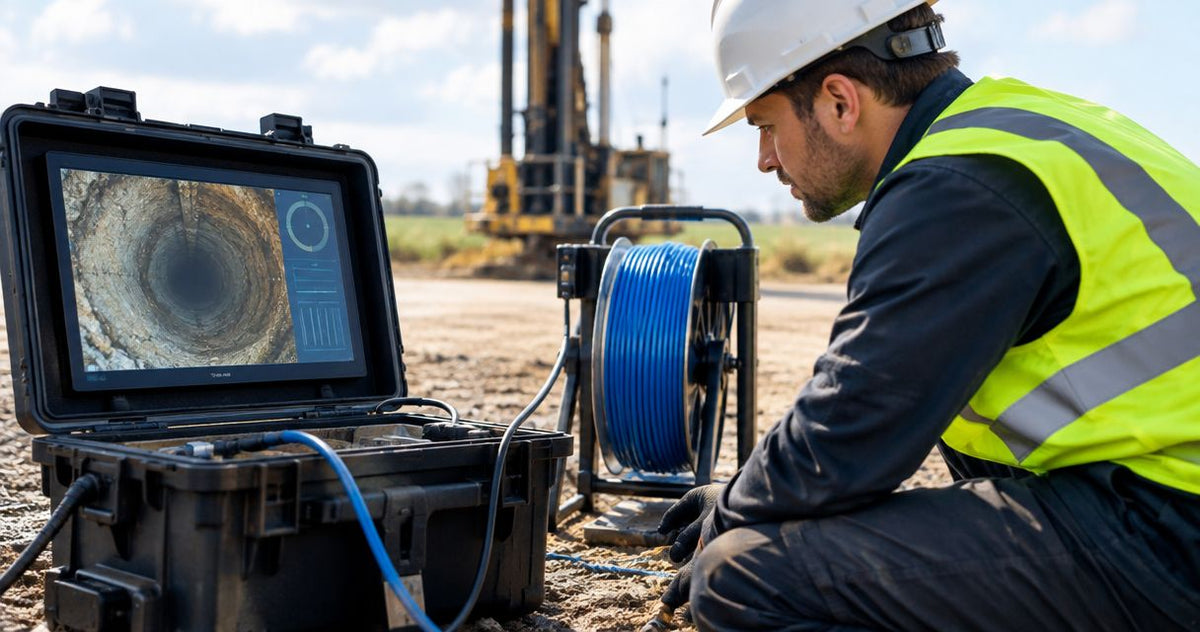
A well camera fails in one of two ways: the head floods at depth, or the cable runs out before the casing problem does. Both come from reading a single number on a spec sheet. This guide ranks the downhole cameras by pressure rating first, then separates what the rating tells you from what the cable length decides.
The short answer: the Well Inspection Camera STRAHL HD and the Motorized Downhole Well Camera STRAHL HD carry the highest stated rating, 30 bar, which equals 435 psi or about 1,000 ft (305 m) of fresh water. The STRAHL PT Downhole Camera is rated IP68 without a pressure figure. Fiberscope.net sells the products discussed here and services them in-house.
- Best for deep boreholes: Well Inspection Camera STRAHL HD, rated 30 bar (435 psi, about 1,000 ft of water).
- Best for long manual-free runs: Motorized Downhole Well Camera STRAHL HD, also 30 bar.
- Best for casing and screen views at moderate depth: STRAHL PT Downhole Camera, IP68.
- Drain cameras with 3 bar or 60 psi ratings are not well tools.
How depth rating is ranked here
A well camera's usable depth is the lower of two numbers: the pressure rating of the head and cable, and the length of cable on the reel. The ranking below sorts by pressure rating, then by how the camera is deployed.
Criteria used:
- Stated pressure rating in bar or psi, converted to feet of fresh water at 0.433 psi per foot.
- IP code when no pressure figure is given. IP68 means submersion beyond 1 m under conditions the manufacturer sets, so it is not a depth number by itself.
- Viewing method: rotating side view or pan and tilt, since a downhole camera spends most of its time looking at casing walls.
- Deployment: manual reel or motorized reel.
- Recording and display, because depth is wasted if you can't keep the evidence.
Depth ratings at a glance
| Camera | Rating | Water depth equivalent | Suits |
|---|---|---|---|
| Well Inspection Camera STRAHL HD | IP68, 30 bar | about 1,000 ft (305 m) | Deep boreholes, casing and screen views |
| Motorized Downhole Well Camera STRAHL HD | 30 bar | about 1,000 ft (305 m) | Deep runs where hand-cranking is the bottleneck |
| STRAHL PT Downhole Camera | IP68 | no pressure figure | Moderate-depth wells, pan and tilt looks |
| HATHORN Micron, Mini, Mid | 60 psi | about 138 ft (42 m) | Drain and sewer lines, not wells |
| MiniFlex 2 | 3 bar | about 100 ft (30 m) | Drain lines, not wells |
| CYCLOPS HD camera | 30 ft submersible | 30 ft (9 m) | Tanks and manholes from a pole |
The last three rows are included so you can see why a drain camera's wet rating does not transfer to a borehole.
1. Well Inspection Camera STRAHL HD: best for deep boreholes
The Well Inspection Camera STRAHL HD is rated IP68 to 30 bar. That is 435 psi, equal to roughly 1,000 ft (305 m) of fresh water, the highest pressure rating in the catalog for a well camera.
It uses a rotating side-view head, which is the right geometry for a casing wall: you rotate to scan perforations, screen encrustation and cracks rather than staring down the bore. Video records to a USB stick. It has a wireless keyboard for the controller but no Wi-Fi video link, so plan on viewing at the wellhead.
- Strength: highest pressure rating, side view for casing and screens.
- Limit: a 30 bar head is only useful to the depth your cable reaches; check the reel length on the product page against your well depth.
- Limit: manual deployment means long runs take time at the reel.
Verdict: Buy for deep drilled wells and boreholes where casing condition is the question.
2. Motorized Downhole Well Camera STRAHL HD: best for long, repeat runs
The Motorized Downhole Well Camera STRAHL HD is rated 30 bar, matching the manual model, and adds a motorized reel. Over a deep run the motor does the lowering and retrieval, which matters when a well contractor inspects several holes in a day.
It keeps a rotating side-view head for wall scanning. Match the cable length to your deepest well before ordering, because the pressure rating alone does not set reach.
- Strength: same 30 bar rating, less physical effort per run.
- Limit: a motorized reel adds weight and cost over the manual model, which a shallow well never uses.
Verdict: Buy if you inspect deep wells regularly. Hold at the manual STRAHL HD if most of your wells are shallow.
3. STRAHL PT Downhole Camera: best for pan-and-tilt looks at moderate depth
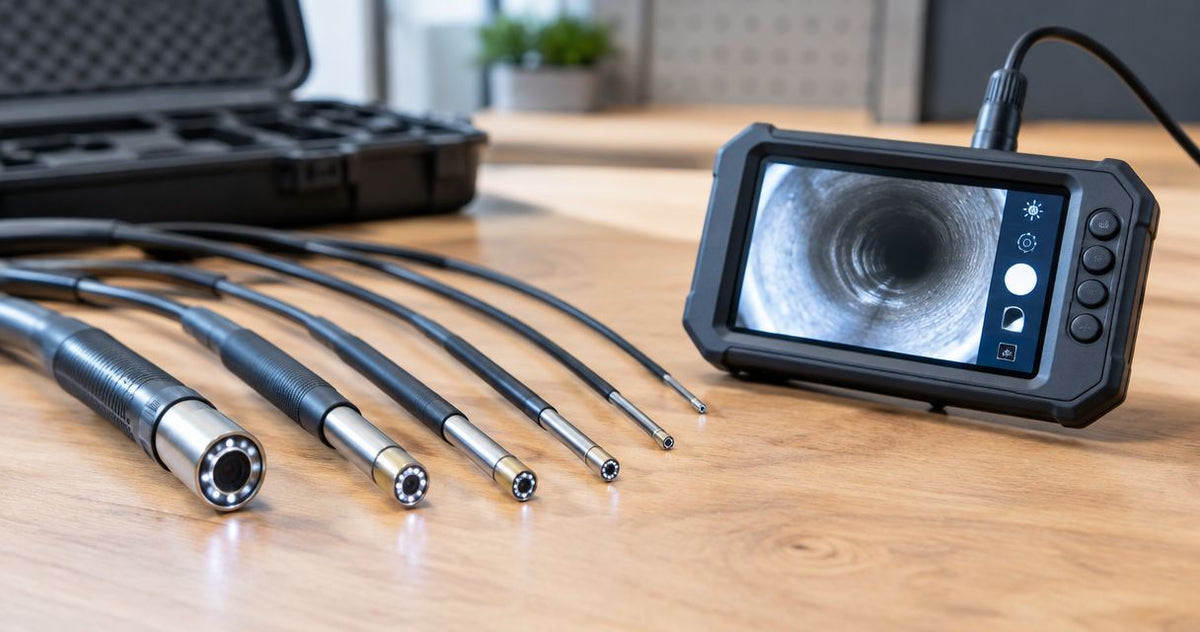
The STRAHL PT Downhole Camera is rated IP68 and carries a 512 Hz sonde in the head, so a compatible receiver can locate it. Its pan-and-tilt head lets you look down, then swing toward the casing wall at a joint or a suspected break.
The listing gives an IP68 rating but no pressure figure, so for a deep borehole its depth limit is a question for a specialist, not a number on a page. For wells where you need a steerable view more than a maximum rating, it earns its place.
- Strength: pan and tilt, locatable sonde.
- Limit: no pressure figure to rank it against the 30 bar models.
Verdict: Hold for deep boreholes until the rating is matched to your depth. Buy for shallower wells where steering the view is the priority.
Why drain cameras don't belong in this ranking
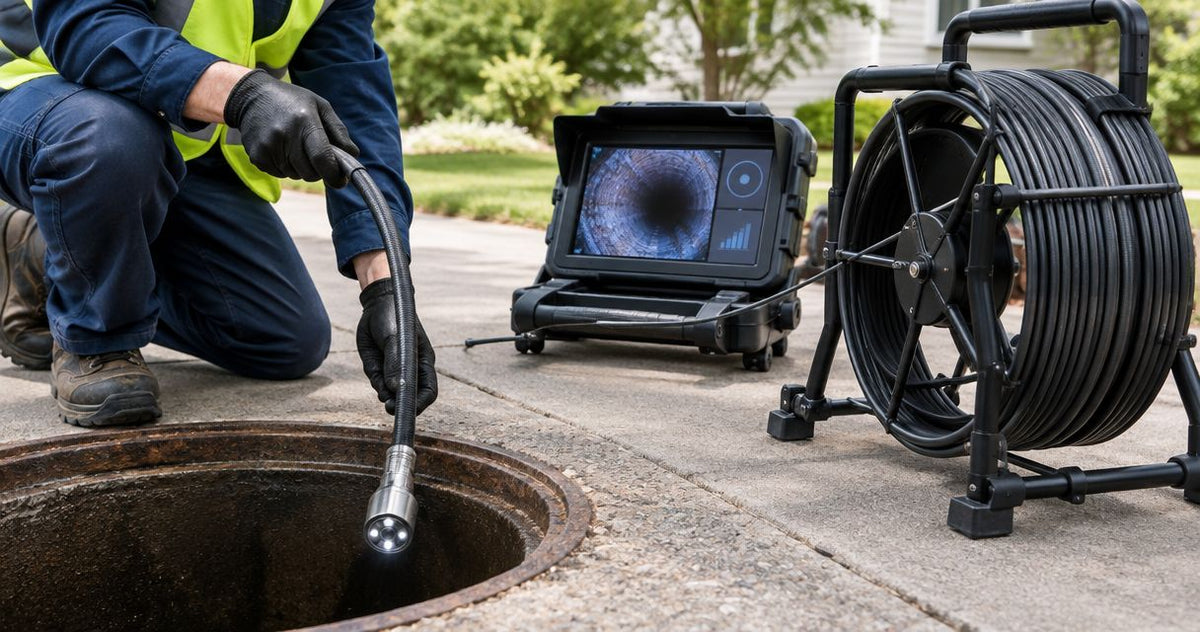
A wet rating measures survival under water pressure, not suitability for a well. The HATHORN Micron, Mini and Mid are rated 60 psi, about 138 ft (42 m) of water, and the MiniFlex 2 line is rated 3 bar, about 100 ft (30 m). Those numbers describe pressure tolerance in flooded drain lines, and the cables, heads and reel lengths are built for pipes of 2 in and up. The HATHORN Mini is a good drain tool with Wi-Fi to a phone or tablet. It is the wrong tool for a 300 ft borehole.
The CYCLOPS HD camera is rated 30 ft (9 m) submersible and is a pole camera for tanks and manholes.
What the rating does not tell you
A pressure rating says the head will not flood. It does not say the image is usable at depth. Three things decide that:
- Water clarity. Silt and iron bacteria cloud the view long before pressure becomes a problem.
- Lighting. A side-view head lights only a narrow band of casing wall at a time.
- Obstructions. Pump cables, drop pipes and a pump itself limit how far a head passes. Well diameter and restrictions are the second thing to confirm after depth.
For a wider look at deployment, the guide to borehole cameras, depth and deployment covers reels and clearances.
Which well camera depth rating do you need?
Use this decision order:
- Measure the static water level and the total depth. The deepest point you need to see sets the minimum cable length.
- Convert depth to pressure: divide feet of water by 2.31 to get psi. A 1,000 ft column is about 433 psi, so a 30 bar head (435 psi) is right at its limit at that depth and fine for anything shallower.
- Confirm the casing inner diameter and whether a pump or drop pipe stays in the hole.
- Choose side view for walls and screens, pan and tilt for steering at joints.
- Choose motorized deployment when you run deep holes often.
If your deepest well is under 500 ft (152 m), the 30 bar rating gives you a wide margin and the choice comes down to view type and deployment.
Common mistakes
- Reading IP68 as a depth. It is a condition-dependent immersion rating, so ask for a pressure figure.
- Buying on head rating and ignoring reel length.
- Using a drain camera in a well because it has a high waterproof number.
- Skipping a sonde check. If you need to locate the head from the surface, only the 512 Hz sonde models allow it.
For other watertight options in the catalog, see the waterproof inspection camera guide.
FAQ
What is the depth rating of the STRAHL HD well camera?
The Well Inspection Camera STRAHL HD is rated 30 bar, which is 435 psi or about 1,000 ft (305 m) of fresh water. Usable depth is also limited by the cable length on the reel.
Does IP68 mean a well camera can go to any depth?
No. IP68 means immersion beyond 1 m under conditions the manufacturer defines. Only a stated pressure rating, such as 30 bar, converts to a depth.
How do I convert bar to feet of water?
Multiply bar by about 33.5 to get feet of fresh water. 30 bar works out to roughly 1,000 ft (305 m).
Can I use a waterproof drain camera in a well?
Not for a deep well. Drain cameras are built for pipes, with pressure ratings such as 60 psi (about 138 ft) or 3 bar (about 100 ft) and reels sized for lateral runs.
Should I choose a motorized or manual well camera?
Choose motorized if you inspect deep wells regularly and want less effort per run. A manual reel is enough for shallow wells.
Can I locate a well camera from the surface?
Only models with a sonde in the head, such as the STRAHL PT Downhole Camera at 512 Hz, can be located with a compatible receiver.
Get the right camera matched to your well
Send your well depth, casing diameter, any restrictions such as a pump or drop pipe, water conditions, and whether you want a manual or motorized reel. A Fiberscope.net specialist will match the head and cable length. Call 1-877-613-2210 (Mon to Fri, 8:00 to 18:00 CST) or use the contact page on store.fiberscope.net.
Related guides
- Best well inspection cameras
- Best sewer cameras with 512 Hz locating
- Septic inspection cameras: access and reach
About the author. Vladimir Khubiryants, Founder & President, Fiberscope.net (MEDIT Inc.). Vladimir founded Fiberscope.net to give professionals access to reliable video inspection equipment without enterprise pricing. For over 20 years he has sourced and tested borescopes, sewer cameras and fiberscopes in Fiberscope.net's in-house test and repair facility, helping plumbers, pipeline engineers, aviation and military teams choose the right tool for the job.

Leave a comment
This site is protected by hCaptcha and the hCaptcha Privacy Policy and Terms of Service apply.