

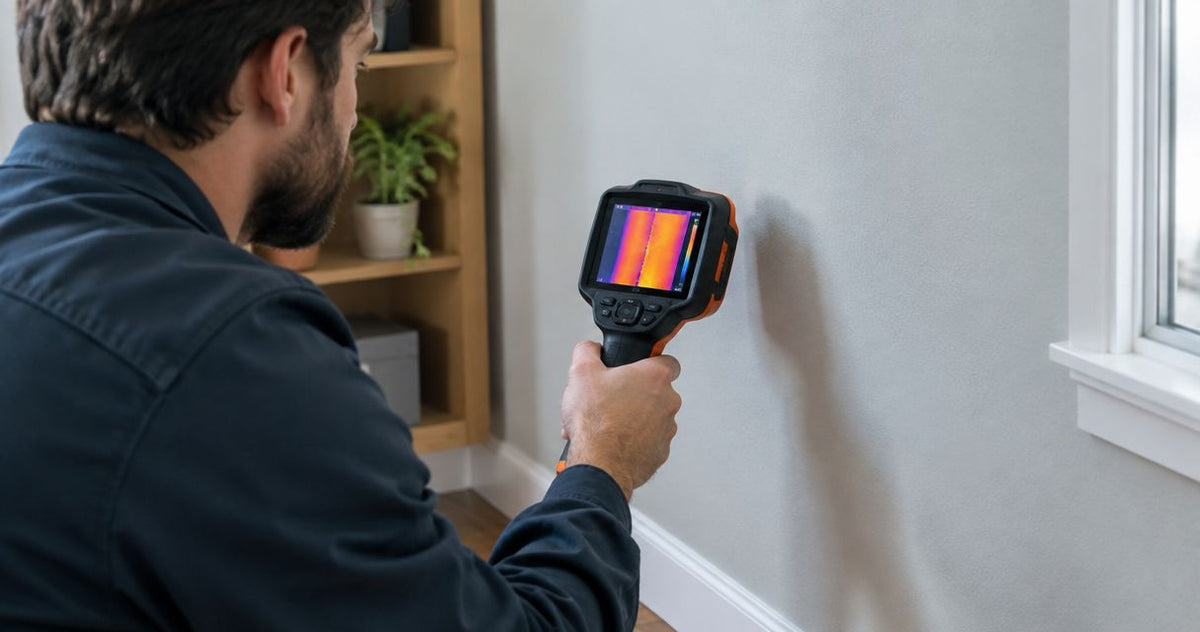
An infrared borescope built for low-light or no-light viewing cannot detect heat loss inside a wall — that job belongs to a thermal imaging camera with a radiometric sensor, which is a different tool class from a borescope. Fiberscope sells the products discussed here; the distinction below is based on how each sensor type works, not on which device is more profitable to sell.
- An infrared borescope uses IR LED illumination to see in the dark — it does not measure temperature.
- Detecting heat loss inside a wall requires a thermal imaging camera with a radiometric microbolometer sensor.
- Fiberscope's Infrared Tactical Borescope Camera C35 is built for low-light cavity and security viewing, not heat mapping.
- A borescope enters through a small access point; a thermal camera scans a surface from a distance.
- In 2026, pairing a standard borescope with a separate thermal scan gives complementary evidence — one tool doesn't replace the other.
Why this matters
The word "infrared" gets attached to two unrelated technologies, and buyers researching heat-loss diagnostics in 2026 routinely land on borescope listings that use the word for a completely different function. Spending on an infrared-illuminated borescope inspection camera expecting a temperature readout wastes budget and delays the actual insulation or air-leak diagnosis. Getting the terminology right before purchase avoids that mismatch.
Can an infrared borescope detect heat loss inside walls?
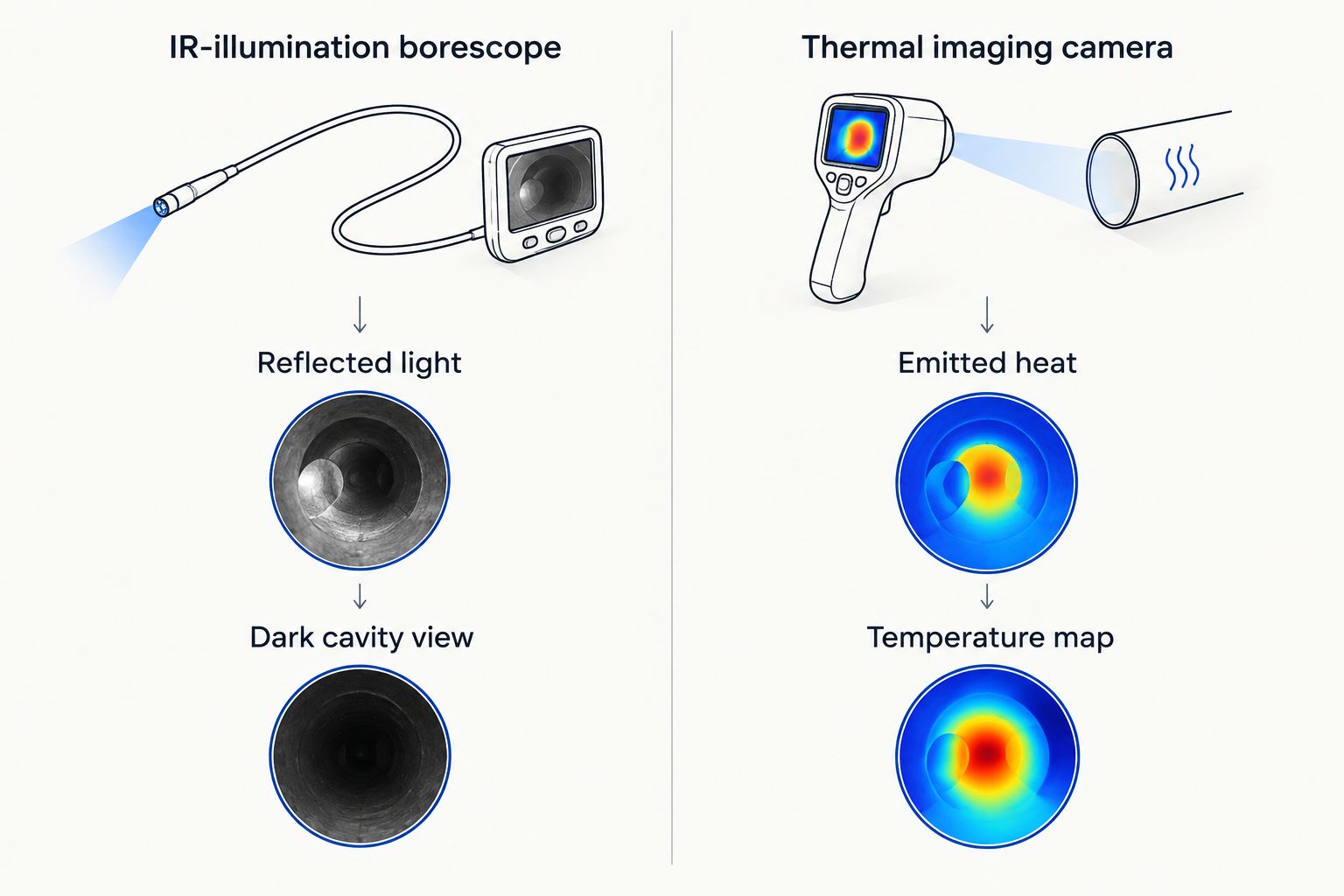
No. An infrared borescope sold for inspection or security work uses infrared LEDs to illuminate a dark cavity so a standard CMOS or CCD sensor can capture a visible image — it reads reflected light, not emitted heat. Detecting heat loss requires a thermal imaging camera, which uses an uncooled microbolometer to sense infrared radiation given off by a surface and convert it into a false-color temperature map.
| Feature | Infrared (IR-illumination) borescope | Thermal imaging camera |
|---|---|---|
| Sensor type | CMOS/CCD with IR LED illumination | Uncooled microbolometer |
| What it captures | Reflected light in low or no visible light | Infrared radiation emitted by a surface |
| Output | Grayscale or color video image | False-color thermal map |
| Access method | Inserted through a small bore or existing opening | Scans a surface from a distance, no access point needed |
| Detects heat loss | No | Yes |
The two devices solve different problems. A borescope answers "what does the inside of this cavity look like." A thermal camera answers "where is this surface warmer or cooler than its surroundings." Neither substitutes for the other.
What an infrared borescope actually shows you
Fiberscope's Infrared Tactical Borescope Camera C35 is built for security personnel and search units working in areas with low or no ambient light — voids, vehicle compartments, structural cavities reached through an existing access point. It gives a real-time visible image of what's physically inside that space: wiring, debris, structural condition, a person or object hidden from view.
It does not output a temperature value or a thermal map, so it answers "what's in there" — not "how warm is it in there." If the deliverable a job requires is a temperature differential on a wall or ceiling surface, this camera class doesn't produce that output regardless of how the word "infrared" appears in its name.
What actually detects heat loss inside a wall
A dedicated thermal imaging camera with a radiometric sensor is the tool that maps temperature differences across a wall, ceiling, or window frame. It's used to spot missing or compressed insulation, air leaks around framing, and moisture intrusion by comparing surface temperature to the surrounding area — all without opening the wall.
A borescope still has a role in that workflow, just not the temperature-sensing role. Once a thermal scan flags a cold or warm spot, a rigid borescope inserted through a small drilled access hole lets you confirm what's physically causing it — a gap in batt insulation, a disconnected duct, daylight visible through a sheathing seam. The thermal camera finds the location; the borescope confirms the cause.
If the only requirement is seeing inside a dark stud bay or duct run with no temperature question involved, an optical borescope paired with a separate LED light source, such as the SPARK XTR light handle, solves the visibility problem without paying for infrared or thermal capability that job doesn't need.
Why the confusion happens
- "Infrared" describes a broad section of the light spectrum, and near-infrared illumination (used for night vision) is a different application from long-wave infrared radiometric sensing (used for thermal imaging).
- Product names use "infrared" as shorthand for any device with IR LEDs, regardless of whether it measures temperature.
- Security and tactical borescopes are built to see in total darkness, a use case that has nothing to do with building diagnostics.
- Borescopes inspect the inside of a cavity through a small access point; thermal cameras scan a visible surface from a working distance — the deployment method itself signals which job the device does.
- Marketing copy for consumer-grade inspection cameras sometimes blurs the line between "night vision" and "heat detection" because both use the word infrared.
What's the difference between infrared and thermal imaging?
Infrared illumination uses near-infrared LEDs to light up a dark space so a standard sensor can capture a visible image, while thermal imaging uses a microbolometer to sense infrared radiation emitted by objects and convert it into a temperature map. One produces a picture of physical detail; the other produces a picture of heat.
Can a borescope see through a wall or ceiling?
A borescope cannot see through solid material — it requires a drilled hole, existing outlet, or access point to insert the probe into the cavity. A thermal imaging camera doesn't need a hole because it reads surface temperature from outside the wall, but it also can't see physical detail inside the cavity the way a borescope can.
FAQ
Does an infrared borescope measure temperature?
No, an infrared borescope uses IR LED illumination to produce a visible image in the dark; it does not include a radiometric sensor and cannot output a temperature reading.
What tool finds heat loss in a wall in 2026?
A thermal imaging camera with a radiometric microbolometer sensor finds heat loss by mapping surface temperature differences, not an infrared-illumination borescope.
Is the Infrared Tactical Borescope Camera C35 a thermal camera?
No, the C35 is built for low-light and no-light visual inspection in security, search, and cavity applications; it produces a visible image, not a thermal map.
Can I combine a borescope inspection with a thermal scan?
Yes, a thermal scan locates the temperature anomaly on the surface, then a rigid borescope inserted through a small access hole confirms the physical cause inside the cavity.
Why do some borescopes get called infrared if they don't detect heat?
The word infrared describes the illumination technology (near-infrared LEDs for night vision) rather than the sensing technology used in thermal imaging, and product naming often doesn't distinguish the two.
Do I need an infrared borescope for a dark duct or stud bay?
An infrared-illuminated borescope helps in total darkness, but for most stud bays and ducts a standard optical borescope paired with an LED light source is enough if no temperature reading is needed.
What sensor does a thermal imaging camera use?
A thermal imaging camera uses an uncooled microbolometer sensor to detect infrared radiation emitted by a surface and convert it into a false-color temperature map.
One last thing
The deployment method is the fastest way to tell these two device classes apart before reading a single spec sheet: if the tool needs a drilled hole or existing opening to get inside a cavity, it's a borescope; if it scans a surface from a few feet away with no access point required, it's a thermal camera. That single detail settles the question faster than any product description that uses the word "infrared" loosely.



Leave a comment
This site is protected by hCaptcha and the hCaptcha Privacy Policy and Terms of Service apply.