

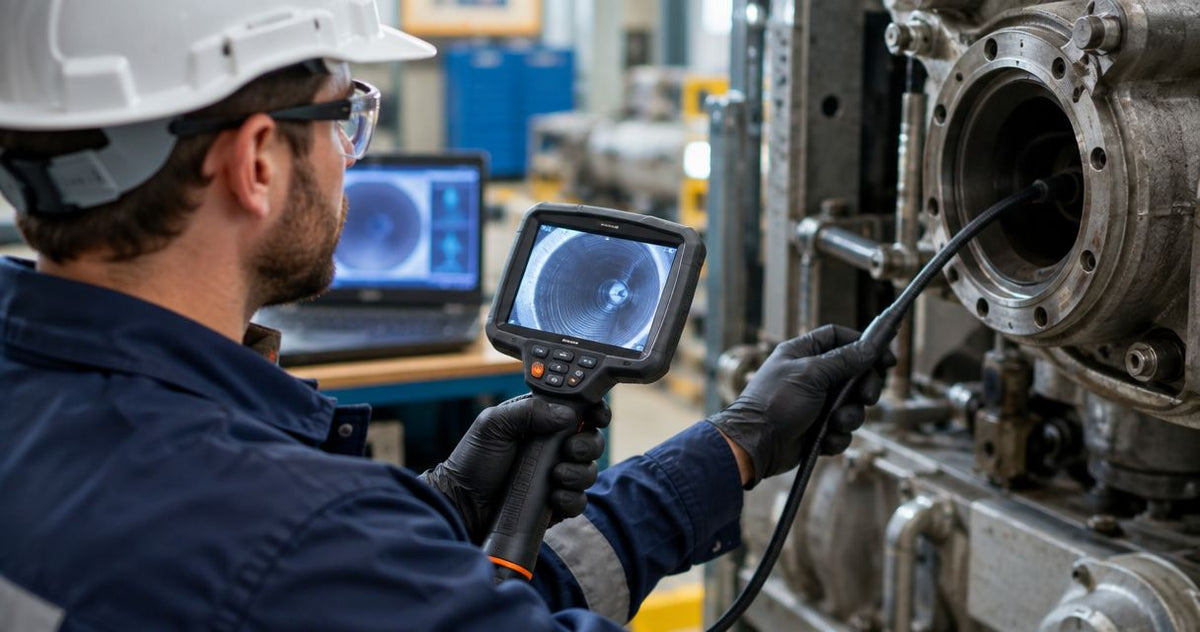
An articulating borescope earns its price the first time a defect sits around a corner a straight probe can't reach: behind a combustor liner, down a gearbox port, past a baffle in a heat exchanger. The catch is that tip articulation comes in different forms, and the wrong one costs you the view. A 2-way tip bends in one plane, a 4-way tip bends in two, and an all-way joystick tip lets you sweep the full circle. This guide matches each to the job. For the wider category, see our guide to industrial borescopes.
- Best overall articulating borescope: VOYAGER M40, with a 360° all-way joystick tip and IP68 probes.
- Best for hot environments: VOYAGER C40, 4-way articulation on 3.3–16.4 ft (1–5 m) probes.
- Best for dark, low-light spaces: Infrared Tactical Borescope Camera C35, with IR illumination and mechanical all-way tip.
- If the path is straight, a rigid borescope does the job for less.
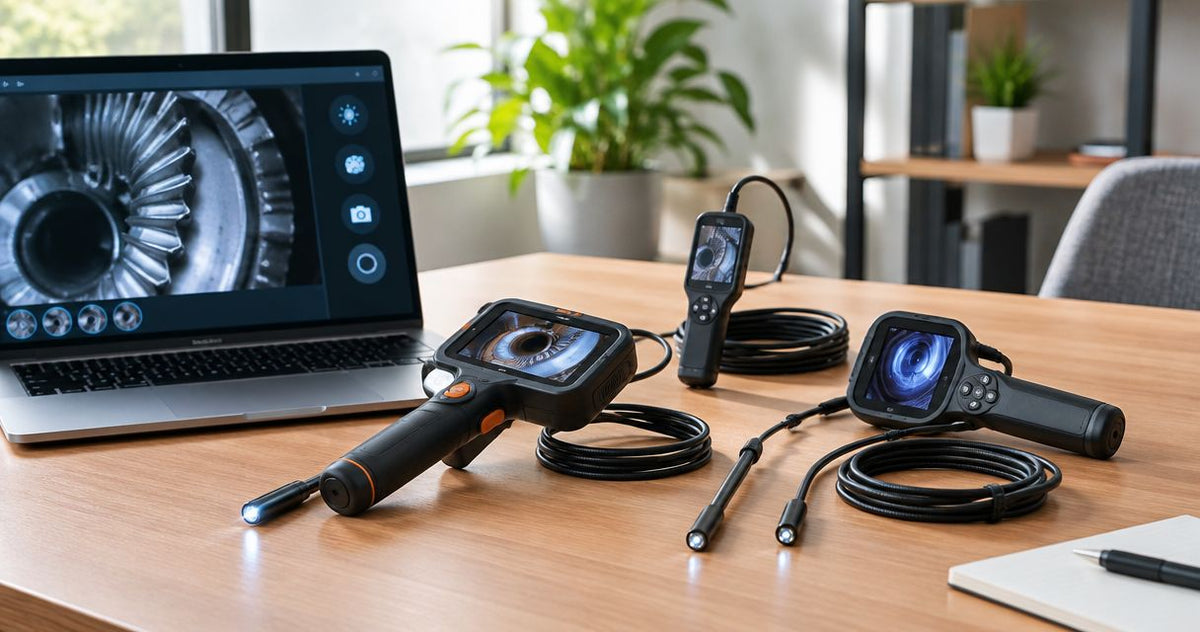
Best overall: the VOYAGER M40 videoscope. Best for high-temperature work: the VOYAGER C40. Best for low-light and tactical inspection: the C35. Fiberscope.net sells all three and services them in our in-house repair facility. Prices below are the store prices, checked September 29.
What to check before you buy an articulating borescope
The access opening and the route behind it decide the purchase, not the feature list. Check these five things in order:
- Probe OD against the smallest opening. The head must clear the narrowest point on the route: a borescope port, a spark-plug hole, a fitting.
- Working length. It must cover the full distance to the target plus the turns on the way.
- Articulation type. 2-way bends in one plane, 4-way in two planes, all-way sweeps 360° around the tip axis.
- Environment. Heat, moisture and low light each point to a different model.
- Evidence. If the result goes into a report, you need recording. Check that the model records before you commit.
Articulating borescopes at a glance
This table covers the three complete systems that fit the category. Articulation figures are the ones the store lists for each model.
| Model | Articulation | Probe length | Environment | Price |
|---|---|---|---|---|
| VOYAGER M40 | 360° all-way joystick | — | Probes IP68 | — |
| VOYAGER C40 high temp | 4-way on 3.3–16.4 ft (1–5 m) probes; 2-way on 19.7–26.2 ft (6–8 m) probes | 3.3–26.2 ft (1–8 m) | High temperature | from $3,320 |
| C35 Infrared Tactical | Mechanical all-way | — | Low light, IR illumination | from $5,300 |
VOYAGER M40: best all-around articulating videoscope
The VOYAGER M40 is a videoscope with a 360° all-way joystick tip and IP68-rated probes. The joystick lets you sweep the tip in any direction without rotating the whole insertion tube, which matters in a crowded gearbox or an engine bay where the tube has no room to turn.
It suits aviation, industrial maintenance and NDT work: turbine blades and combustors, gearboxes, welds and castings, pumps and valves. The IP68 probes tolerate wet environments. For a quick look down a straight bore it is more instrument than you need, and a rigid borescope is the cheaper answer there.
VOYAGER C40: best articulating borescope for high temperature
The VOYAGER C40 is built for places where a standard videoscope fails on heat. Probes from 3.3 to 16.4 ft (1–5 m) carry 4-way articulation. The longer 19.7 to 26.2 ft (6–8 m) probes carry 2-way articulation.
That split is a real trade-off. Choose the long probe and you reach farther, but the tip bends in one plane only, so you steer by rotating the tube. For heat exchangers, boilers and furnace-adjacent equipment, pick the probe length from the distance to the target first, then accept the articulation that comes with it.
Infrared Tactical Borescope Camera C35: best for low light
The C35 has a mechanical all-way tip and infrared illumination for dark spaces. IR lighting lets you inspect voids with no ambient light and no white light to give away your position, which is why security, search and police units use it.
The C35 is not a thermal camera. It lights a dark space in infrared and shows you what is there; it cannot show heat loss or temperature patterns. If that is your question, read what an infrared borescope can and cannot detect inside walls.


How we ranked these
The ranking follows the criteria above. Articulation range decides the order first, since that is what the category is about. Environment fit comes second, then recording and evidence needs. The M40 leads because all-way articulation gives the most view for the least handling. The C40 and C35 each win a narrower job.
When an articulating borescope is the wrong tool
If the route is straight and the target sits in line with the opening, an articulating tip adds cost and nothing else. A rigid borescope, from $378, uses rod-lens relay optics and gives a sharp image down a straight bore. It needs a light source through a light guide or handle.
For automotive work, a cylinder bore is straight, so side view or a tip that turns through the spark-plug hole is enough. Our video borescopes for automotive mechanics guide covers that case. For tight enclosed spaces, see the confined-space inspection camera guide.
Other options
If you need on-screen measurement or work to an aerospace inspection standard, the Evident IPLEX series and the Waygate Mentor Visual iQ are the benchmarks. Both cost more and both are the better choice when your customer specifies measurement capability. For general industrial maintenance, the models above cover most of the work.
Get the match right before you order
Send us your access opening, whether the route is straight or turning, insertion length, viewing direction or articulation needed, environment and recording requirement. A Fiberscope.net specialist will match the right probe and tip. Call 1-877-613-2210, Monday to Friday, 8:00–18:00 CST. Buying is one route; renting and demos are available for short jobs.
FAQ
What is the difference between 2-way and 4-way articulation?
A 2-way tip bends in one plane, left-right or up-down. A 4-way tip bends in both planes. With 2-way you steer the rest by rotating the tube.
Which articulating borescope has the widest tip movement?
The VOYAGER M40, with a 360° all-way joystick tip. The C35 also has a mechanical all-way tip.
Can I get 4-way articulation on a long probe?
On the VOYAGER C40, 4-way articulation comes on the 3.3–16.4 ft (1–5 m) probes. The 19.7–26.2 ft (6–8 m) probes are 2-way.
Is the C35 a thermal camera?
No. It uses infrared illumination to light dark spaces for visual inspection. It cannot detect heat loss or show temperature patterns.
What should I measure before choosing a probe?
Measure the narrowest opening on the route, the total distance to the target, and the number of turns. The probe OD must clear the narrowest point.
About the author
Vladimir Khubiryants, Founder & President, Fiberscope.net (MEDIT Inc.). Vladimir founded Fiberscope.net to give professionals access to reliable video inspection equipment without enterprise pricing. For over 20 years he has sourced and tested borescopes, sewer cameras and fiberscopes in Fiberscope.net's in-house test and repair facility, helping plumbers, pipeline engineers, aviation and military teams choose the right tool for the job. See our cameras in use on YouTube and Instagram.

Leave a comment
This site is protected by hCaptcha and the hCaptcha Privacy Policy and Terms of Service apply.