


A mechanic who can't see past the spark-plug hole is guessing. Scoring on a cylinder wall, carbon on an intake valve or a dropped bolt behind a timing cover all sit around a turn, and a rigid or fixed-head scope stops at the first one. The wrong articulating borescope either won't bend far enough to see the wall or arrives with a probe too fat for the port.
This guide covers the three Fiberscope.net articulating scopes that fit shop work. The Videoscope VOYAGER M40 is the best overall pick for general engine work. The High Temperature Borescope Camera VOYAGER C40 suits hot or exhaust-side checks, and the Infrared Tactical Borescope Camera C35 covers dark cavities. Fiberscope.net sells these products and services them in-house.
How to choose an articulating borescope for engine work
The tip must turn enough to look at a surface from the side, because a cylinder bore is straight and a forward-only camera sees the piston crown, not the wall. Articulation means the probe tip bends under your control from the handle. Everything else in the decision follows from that.
- Videoscope VOYAGER M40 is the best articulating borescope for mechanics: 360° all-way joystick tip.
- High Temperature Borescope Camera VOYAGER C40 fits hot-side work with 4-way articulation on 3.3–16.4 ft probes.
- Infrared Tactical Borescope Camera C35 adds IR illumination for dark cavities, not thermal imaging.
- Check probe outer diameter against the smallest port before you buy any of them.
Five criteria decide the ranking below:
- Articulation type. An all-way joystick reaches any wall angle; 2-way bends in one plane only.
- Probe outer diameter (OD). It has to clear the spark-plug or injector hole, or the intake port.
- Working length. Enough to reach the far side of a cylinder or a valve seat through a long port.
- Environment. Heat, fluids and fuel decide the ingress rating you need.
- Evidence. Photos and video for the customer's invoice or a warranty claim.
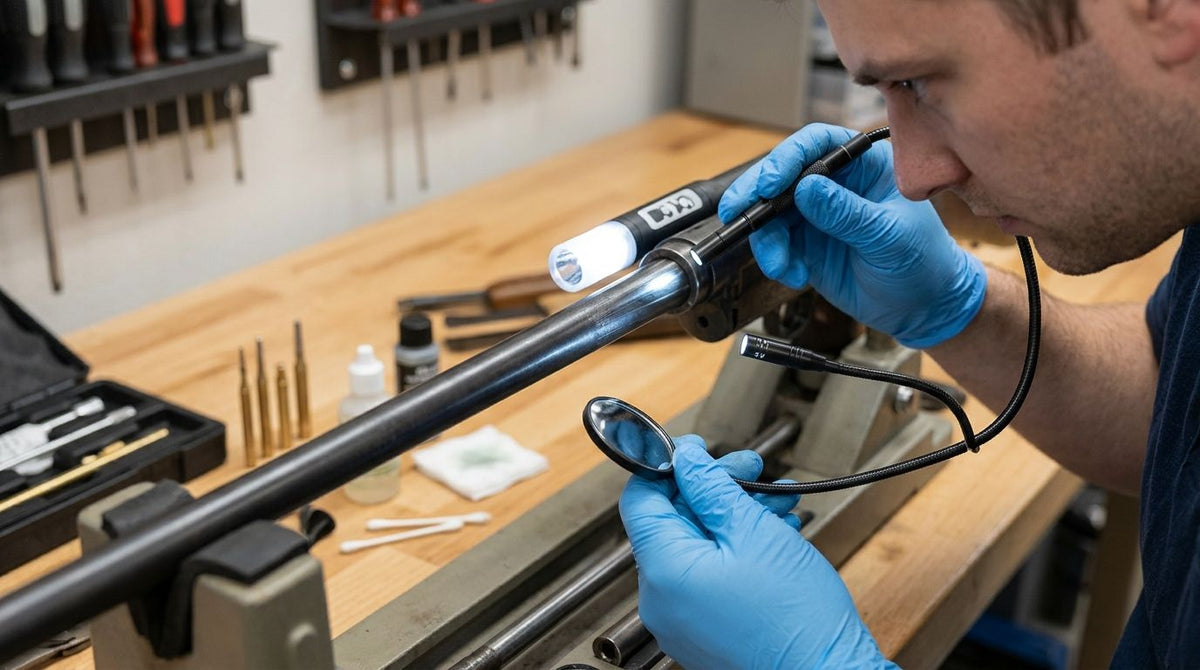
The cold-engine rule applies to all of them. Pull the plug on a cold engine, feed the probe through the hole and use the tip bend or a side view to read the wall. A hot cylinder can damage a probe that is not built for it.
For the carbon-on-valve job specifically, see how to inspect intake valve carbon with a borescope.
Articulating borescopes for mechanics at a glance
Prices checked September 29. The table rows follow the order of the sections below.
| Product | Articulation | Probe length | Environment | From |
|---|---|---|---|---|
| Videoscope VOYAGER M40 | 360° all-way joystick | — | Probes IP68 | $4,160 |
| High Temperature Borescope Camera VOYAGER C40 | 4-way (3.3–16.4 ft); 2-way (19.7–26.2 ft) | 3.3–26.2 ft (1–8 m) | High-temperature | $3,320 |
| Infrared Tactical Borescope Camera C35 | Mechanical, all-way | — | IR illumination for low light | $5,300 |
IP68 means protected against immersion beyond 1 m (3.3 ft) under conditions the manufacturer states, so oil and coolant splash are not a worry for the M40 probes.


For a wider shop comparison across brands and budgets, the best video borescopes for automotive mechanics guide covers the full range.
Videoscope VOYAGER M40: best overall for engine work
The Videoscope VOYAGER M40 has a 360° all-way joystick tip and sells from $4,160. That makes it the only pick here that can turn the tip to any angle on demand, which is what a cylinder wall or a valve seat needs.
The joystick is the reason it leads. Through a spark-plug hole you can aim the tip at the wall, sweep it around for scoring or carbon, then swing it back to the piston crown without pulling the probe. On an intake port the same bend lets you look at the back of a valve head. The probes are rated IP68, so coolant traces and fuel residue are not a risk to the probe.
Where it stops: at a price above the C40, and at the access diameter of its probe. Match the probe OD to the smallest hole you work through before ordering, and call a Fiberscope.net specialist if you run small injector ports.
Verdict: Buy for shops that do cylinder, valve and timing-area inspections weekly.
Videoscope alternative for hot work: High Temperature Borescope Camera VOYAGER C40
The High Temperature Borescope Camera VOYAGER C40 comes from $3,320 and is built for areas where simple borescopes fail. Probe lengths of 3.3–16.4 ft (1–5 m) have 4-way articulation. Lengths of 19.7–26.2 ft (6–8 m) have 2-way.
That length range matters to exhaust and catalytic-converter checks, where you feed a probe a long way down a pipe. The 4-way articulation on shorter probes is enough to steer around a bend and look at the substrate. The longer 2-way versions trade steering for reach, so pick the length for the job rather than buying the longest.
It is the cheaper of the two bending-tip systems here, and the better tool for a shop that regularly checks exhaust internals on a warm vehicle. For a tight, fully steerable look at a cylinder wall, the M40's joystick has more freedom.
Verdict: Buy if your work leans toward exhaust, turbo and hot-side inspection.
Infrared Tactical Borescope Camera C35: for dark cavities
The Infrared Tactical Borescope Camera C35 uses IR illumination so you can see in low light, and its tip articulates mechanically in all directions. It is priced from $5,300, the highest of the three.
For a mechanic it earns its place in unlit cavities: inside a door, a frame rail or a body panel where rust hides. Be clear on what it is. IR illumination helps you see in the dark; it is a visual inspection tool, not a thermal camera, and it cannot find heat loss or a failing component by temperature.
For most engine jobs the M40 gives a better return per dollar. Buy the C35 only if dark-space work is the main thing you do.
Verdict: Hold unless low-light cavity inspection is a regular job.
Other options
If you need on-screen measurement or an aerospace-grade standard, the Evident IPLEX family and the Waygate Mentor Visual iQ are the established references in industrial videoscopes, and they are stronger on measurement than anything above. For occasional checks where a bending tip is not needed, a consumer inspection camera under $300 from Teslong or Depstech is the cheaper answer, with the limits on probe durability and service that come with that price.
The full set of articulating options is in best articulating borescopes.
Common mistakes when buying for a shop
- Skipping the probe OD check. Measure the smallest port you work through. If the probe doesn't clear it, nothing else about the scope matters.
- Inspecting a hot engine. Let it cool, then use the spark-plug hole.
- Buying length you won't use. Reach beyond your longest port is wasted money and a heavier cable to manage.
- Buying for diesel work with a gasoline spec. Glow-plug and injector ports differ; the video borescope guide for diesel mechanics covers access.
FAQ
What is an articulating borescope?
An articulating borescope has a probe tip that bends under control from the handle. That lets you look at a surface from the side instead of only straight ahead, which is how you read a cylinder wall.
Can I inspect a cylinder through the spark-plug hole?
Yes, on a cold engine. Feed the probe through the hole and use articulation or a side view to see the wall, since the bore itself is straight.
Is the C35 a thermal camera?
No. The Infrared Tactical Borescope Camera C35 uses IR illumination for low-light visual inspection. It cannot detect heat loss or show temperature.
What does IP68 mean on a borescope probe?
IP68 means protected against immersion beyond 1 m (3.3 ft) under conditions the manufacturer states. The VOYAGER M40 probes carry this rating.
Do I need 4-way or all-way articulation?
All-way lets you aim at any angle and suits wall and valve inspection. 4-way is enough for steering through bends in a pipe or port.
Get the right scope matched to your engines
Send us your smallest access hole diameter, the working length you need, whether the engine is cold or hot, and what you need to see, and a Fiberscope.net specialist will match the right probe and system. Use the contacts page or call 1-877-613-2210, Mon–Fri 8:00–18:00 CST.
About the author
Vladimir Khubiryants, Founder & President, Fiberscope.net (MEDIT Inc.). Vladimir Khubiryants founded Fiberscope.net to give professionals access to reliable video inspection equipment without enterprise pricing. For over 20 years he has sourced and tested borescopes, sewer cameras and fiberscopes in Fiberscope.net's in-house test and repair facility, helping plumbers, pipeline engineers, aviation and military teams choose the right tool for the job. See our cameras in use on YouTube.

Leave a comment
This site is protected by hCaptcha and the hCaptcha Privacy Policy and Terms of Service apply.