

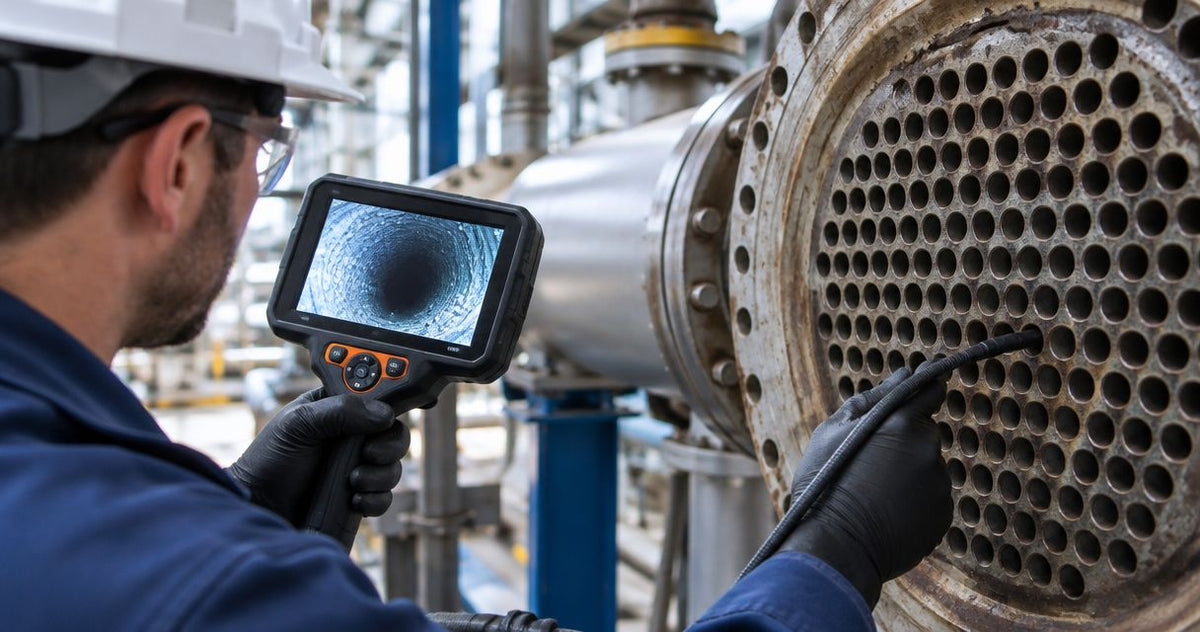
A heat exchanger inspection goes wrong at the tube ends. The probe is a few thousandths too fat for the tube, or the cable runs out before the far tube sheet, or the head cooks in a header box that is still warm. Pick the scope from the tube and the access, and the rest of the job follows.
For most tube bundles, a thin optical micro borescope with a video camera is the lowest-cost route, and an articulating high-temperature videoscope covers header boxes and warm equipment. This guide covers four Fiberscope.net systems by probe diameter, reach, articulation and output. Fiberscope.net sells these products and services them in-house. For wider industrial work, see the best industrial borescopes guide.
How to choose a borescope for heat exchanger tubes
Tube inside diameter sets the maximum probe OD, and tube length sets the working length you need. A 0.75 in OD tube has an inside diameter under 0.75 in once the wall thickness is subtracted, and scale or deposits narrow it further.
- Thin optical micro borescopes suit small tubes; the Super Thin Micro Borescope starts at 1.0 mm (0.04 in) diameter.
- VOYAGER C40 adds 4-way articulation and high-temperature use for header boxes and plenums.
- Size the probe to the narrowest point in the tube, not the nominal tube ID.
- Optical micro borescopes need a light source and a video camera to record footage.
Five criteria decide the pick:
- Probe OD. It must clear the narrowest point in the tube, including scale. Smaller is safer, but thinner probes carry less light and fewer pixels.
- Working length. It has to reach the far tube sheet, or you inspect from both ends.
- Illumination. Optical scopes rely on an external light source or handle. Video scopes carry their own LEDs.
- Recording. Tube reports need stills and video that map to a tube number. Check the output (USB, HDMI or SD).
- Temperature. A unit that has just come offline can be hot. Use a high-temperature head for those jobs.
A borescope shows the surface: fouling, pitting, scale, erosion at the inlet ends, and blocked or plugged tubes. Wall thickness loss and cracks under the surface are a job for eddy-current or other NDT methods, so use the camera to find and document what the surface shows.
Sizing the scope to the access
| Access | What to look for | Fiberscope.net fit |
|---|---|---|
| Small straight tubes and narrow passages | Thin probe, optical image, light source | Super Thin Micro Borescope, Ultra Fine Micro Borescope |
| Very small bores with USB or HDMI video | Digital video, direct recording | Micro Video Borescope MICRON |
| Header boxes, plenums, warm equipment | Articulation, heat tolerance | High Temperature Borescope Camera VOYAGER C40 |
Heat exchanger borescopes compared
The table covers the four systems that fit the job. Prices checked at time of publication.
| System | Probe diameter | Articulation | Video output | Price |
|---|---|---|---|---|
| Super Thin Micro Borescope | From 1.0 mm (0.04 in) | — | Needs camera and coupler | from $1,750 |
| Ultra Fine Micro Borescope | — | None | Needs camera and coupler | from $3,520 |
| Micro Video Borescope MICRON | — | — | USB 3.0, HDMI | from $11,100 |
| High Temperature Borescope Camera VOYAGER C40 | — | 4-way (3.3–16.4 ft / 1–5 m probes), 2-way (19.7–26.2 ft / 6–8 m probes) | — | from $3,320 |
Super Thin Micro Borescope for small straight tubes
The Super Thin Micro Borescope starts at 1.0 mm (0.04 in) diameter and costs from $1,750. That makes it the entry point for tubes where a video borescope will not fit.
It is an optical instrument. You add a light source such as the MS-LED, or the SPARK handle, and a camera to see and record the image. Image quality on a thin probe is limited by its pixel count, so expect enough detail to read fouling, blockage and gross pitting, and less for fine surface texture.
It suits maintenance teams checking condenser and small-bore tubes for plugging and scale. It does not articulate, so it looks straight ahead down the tube.
Ultra Fine Micro Borescope for premium image quality
The Ultra Fine Micro Borescope comes from the premium line of super-thin flexible fiberscopes, from $3,520. It has no articulation, and it is built for extremely small inspection areas.
Choose it over the Super Thin when the tubes are small and the image detail matters, for example when the report has to show the condition of the tube wall near the tube sheet. It needs the same external light and camera.
Micro Video Borescope MICRON for digital capture
The Micro Video Borescope MICRON is a digital system for ultra-thin bores, from $11,100. It outputs over USB 3.0 and HDMI, so footage goes straight to a laptop or a monitor without a separate coupler and camera.
The price is high next to the optical options. It earns it when you inspect many tubes per shift and need clean, direct digital capture. For an occasional job, an optical micro borescope with a camera costs far less.
The HATHORN Micron drain camera is a different product with a similar name, so use the full name MICRON when you order.
High Temperature Borescope Camera VOYAGER C40 for header boxes and warm equipment
The High Temperature Borescope Camera VOYAGER C40 is the articulating pick, from $3,320. It has 4-way articulation on the 3.3–16.4 ft (1–5 m) probes and 2-way on the 19.7–26.2 ft (6–8 m) probes.
In a heat exchanger it reaches where a straight micro scope cannot: header boxes, channel covers, the inside of a shell through a nozzle, and plenums around the bundle. It is built for inspecting areas where simple borescopes fail, which includes warmer equipment.
Its probe is thicker than a micro borescope, so it does not go down small tubes. For those, pair it with a micro scope from the list above. Use the articulating borescope guide to compare articulation options.


Other options
The Evident IPLEX series is the industrial videoscope benchmark when you need on-screen measurement or aerospace-grade documentation, and it is the better tool if your reports require measured defect sizes. Its price sits well above the systems here. For a team that only needs to see and photograph tube condition, the Fiberscope.net systems above cover the job at lower cost.
What you'll also need
Optical micro borescopes do not record on their own. Budget for these:
- Light source. The MS-LED light source or the SPARK LED light handle feeds the optical probe.
- Camera. A USB borescope camera or the ImagePRO USB 3.0 and HDMI cameras turn an optical scope into a video system.
- Coupler. A universal borescope video coupler joins the eyepiece to the camera.
- Tube tagging. A numbered tube map and a marker or tag, so each clip matches a tube position.
The Fiberscope.net YouTube channel at https://www.youtube.com/@Fiberscope_net has videos of our borescopes in use.
Common mistakes
- Sizing to nominal tube ID. Scale and deposits shrink the real opening. Size to the narrowest point.
- Buying a video borescope for small tubes. A digital head is thicker than an optical fiber probe, and it jams at the first constriction.
- Skipping the light source. An optical scope without a bright source returns a dark image, and the camera cannot compensate.
- Inspecting a hot unit with a standard probe. Use a high-temperature head or wait for the exchanger to cool.
- Treating the image as a wall-thickness reading. Surface condition is visible. Wall loss needs NDT.
FAQ
What size borescope fits inside heat exchanger tubes?
The probe OD must be smaller than the narrowest point in the tube. The Super Thin Micro Borescope starts at 1.0 mm (0.04 in), which suits small-bore tubes. Measure the tube and allow for scale.
Do I need an articulating borescope for heat exchanger inspection?
Not for straight tubes, which a micro borescope looks down directly. Articulation helps in header boxes, plenums and shell nozzles, where the VOYAGER C40 offers 4-way or 2-way tip control depending on probe length.
Can a borescope measure tube wall thickness?
No. A borescope shows surface condition such as fouling, pitting, erosion and plugging. Wall thickness loss needs eddy-current or ultrasonic testing, and the camera documents what you find.
Can I inspect a hot heat exchanger with a borescope?
Use a high-temperature unit such as the VOYAGER C40 for warm equipment. Standard probes should only go into exchangers that have cooled.
How do I record heat exchanger inspection footage?
Optical micro borescopes need a coupler and camera, such as the USB borescope camera, to capture video. The MICRON outputs directly over USB 3.0 or HDMI.
Get the right head matched to your tubes
Send your tube OD and wall thickness, tube length, whether the unit is hot, and how you report findings, and a Fiberscope.net specialist will match the probe, light and camera. Call 1-877-613-2210 (Mon–Fri 8:00–18:00 CST) or use the Fiberscope.net contact page.
About the author. Vladimir Khubiryants, Founder & President, Fiberscope.net (MEDIT Inc.), founded Fiberscope.net to give professionals access to reliable video inspection equipment without enterprise pricing. For over 20 years he has sourced and tested borescopes, sewer cameras and fiberscopes in Fiberscope.net's in-house test and repair facility, helping plumbers, pipeline engineers, aviation and military teams choose the right tool for the job.

Leave a comment
This site is protected by hCaptcha and the hCaptcha Privacy Policy and Terms of Service apply.