

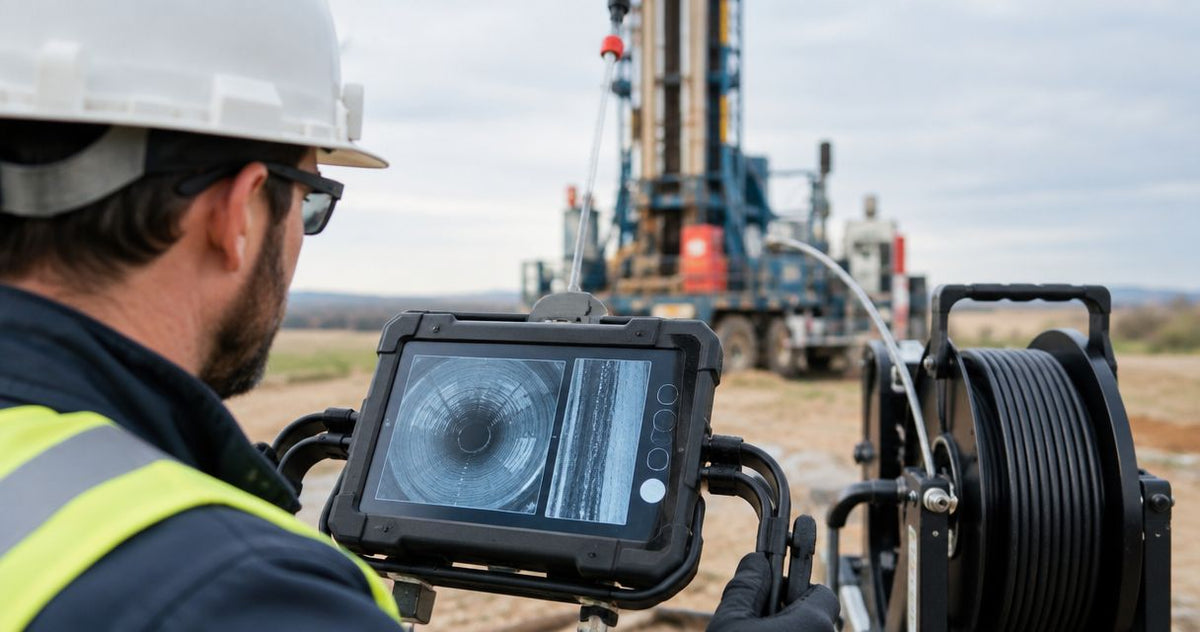
A downhole camera earns its keep the first time a pump pulls out of a well with scale on the housing and nobody knows where the water is entering. A down-looking lens sees the bottom of the hole and little else. A casing crack, a split joint or a plugged screen slot sits on the wall, and you only see the wall when the camera can look sideways.
For casing and screen inspection, Fiberscope.net recommends three downhole systems: the Well Inspection Camera STRAHL HD for most casing and screen work, the Motorized Downhole Well Camera STRAHL HD for deeper holes where hand-feeding the cable is slow, and the STRAHL PT Downhole Camera when you need to steer the view. Fiberscope.net sells these systems and services them in-house.
- The STRAHL HD Well camera is the default pick for casing and screen inspection with a rotating side view.
- Look for 360° side viewing and an IP68 rating; the STRAHL HD Well is rated to 30 bar.
- The Motorized STRAHL HD suits deeper wells where manual cable feeding is slow.
- The STRAHL PT adds pan and tilt plus a 512 Hz sonde in the head.
How to choose a well camera for casing inspection
A casing inspection camera needs a side-looking or rotating view, a pressure-rated housing and a recorder, in that order. Everything else is a refinement.
Use these criteria to audit the picks below:
- Viewing direction. Casing walls, perforations and screen slots are on the side of the hole. A rotating or 360° side view shows them; a fixed down view does not.
- Pressure rating. Name the rated part and the condition. IP67 covers temporary immersion to 3.3 ft (1 m) for 30 minutes. IP68 covers immersion beyond 3.3 ft (1 m) under the manufacturer's stated conditions, so check the rating against your water column.
- Cable handling. A long cable on a hand reel is slow to retrieve. A motorized reel saves time on deep holes and reduces back strain.
- Evidence. Casing damage and screen encrustation need to be shown to a well owner or a regulator, so the camera has to record.
- Fit. The head has to pass the pump, drop pipe and any wiring in the casing. Measure the clearance before choosing.
Well cameras compared
The table lists only what each product page states. A dash means the feature is not part of that system.
| Camera | Viewing | Waterproof rating | Recording | Suits |
|---|---|---|---|---|
| Well Inspection Camera STRAHL HD | Rotating side view | IP68, 435 psi (30 bar) | USB | Casing walls and screens |
| Motorized Downhole Well Camera STRAHL HD | Rotating side view | 30 bar (435 psi) | Records video | Deep wells, long runs |
| STRAHL PT Downhole Camera | Pan and tilt | IP68 | Records video | Steered views, locating |
Current pricing is on each product page.
Well Inspection Camera STRAHL HD: the default for casing and screens
The Well Inspection Camera STRAHL HD has a rotating side view and an IP68 rating to 30 bar (435 psi), and it records to USB. That combination covers the core job: look at the casing wall, look at the screen, save the footage.
It suits well drillers and pump contractors checking casing joints, perforations and screen encrustation before a rehab or a pump replacement. The side view lets you turn the lens through the full wall as you lower the cable, so a crack on one side does not slip past the lens.
It does not stream to a phone. The only wireless piece is the keyboard, so plan on a wired monitor setup at the wellhead.
Verdict: Buy if you want one camera that handles most casing and screen inspections.
Motorized Downhole Well Camera STRAHL HD: for deep holes and repeat work
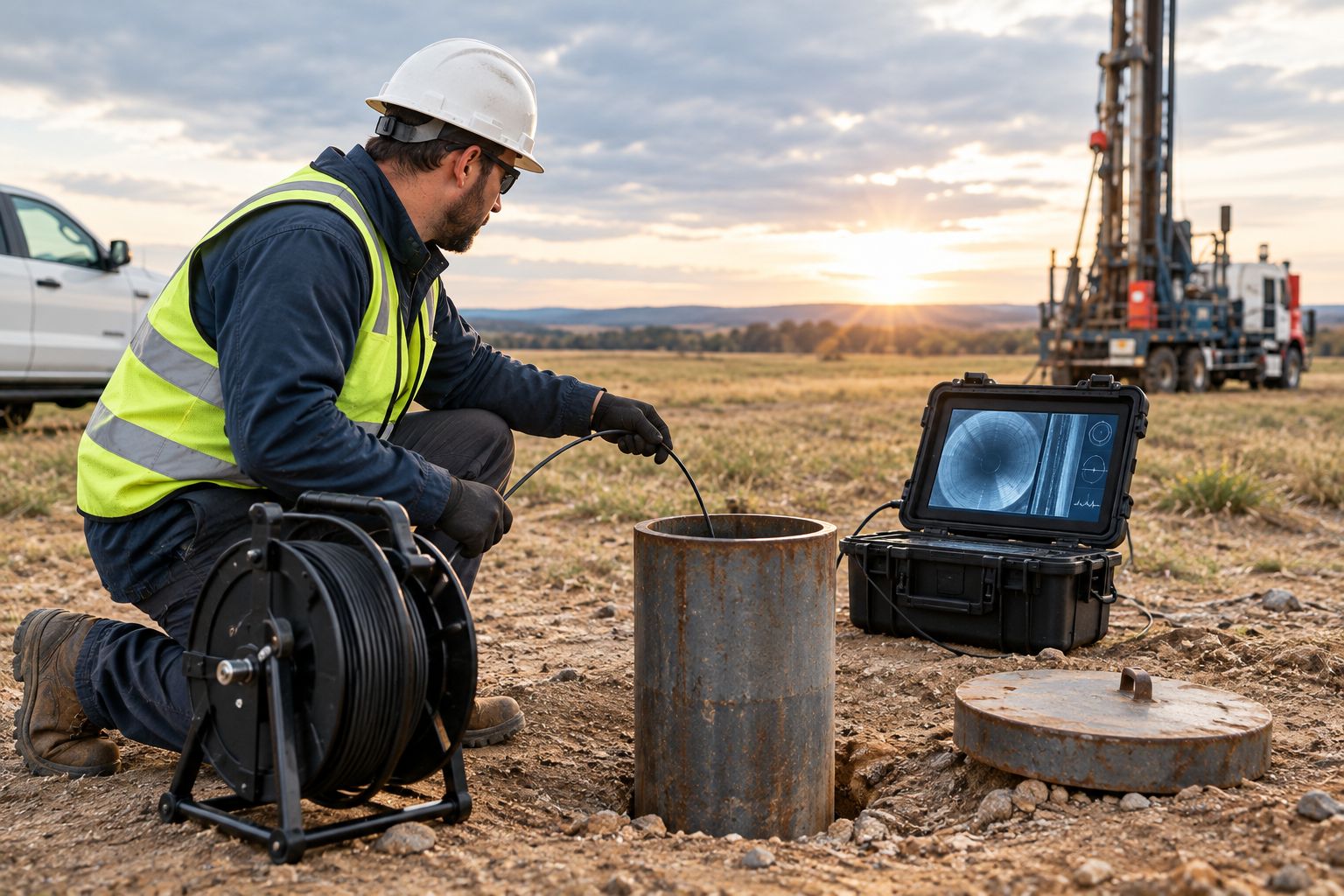
The Motorized Downhole Well Camera STRAHL HD keeps the rotating side view and takes the cable handling off your arms. It is rated to 30 bar (435 psi).
For a contractor who inspects several wells a week, the motorized reel shortens the lowering and retrieval of the cable on each hole. That matters on deeper wells, where manual feeding turns a 10-minute look into a long haul.
It is a heavier setup than the hand-reel unit. For shallow domestic wells, the standard STRAHL HD does the same visual job with less to carry.
Verdict: Buy if depth or volume makes the cable the slow part of your day. Skip it for occasional shallow work.
STRAHL PT Downhole Camera: for steered views and locating
The STRAHL PT Downhole Camera has a pan-and-tilt head, a 512 Hz sonde in the head and an IP68 rating. Pan and tilt let you aim the lens at a joint, a perforation or a lost object instead of relying on rotation alone.
The sonde is a small transmitter in the head. Paired with a separate compatible 512 Hz receiver, it lets you trace the head from the surface. That helps when a well runs close to a buried line, or when you need to mark a position along a horizontal run.
Pan and tilt aim the view; they do not make the camera rotate through a full 360° side view the way the STRAHL HD does. For continuous casing wall scanning, the STRAHL HD is the more direct tool.
Verdict: Hold for general casing work, and Buy when you need to look at a specific spot or trace the head.
Matching the camera to the job
- Casing cracks and split joints: the STRAHL HD Well, with its rotating side view.
- Screen encrustation and plugged slots: the STRAHL HD Well. Look for scale or iron deposits blocking the slots.
- Water entry points: a side-view camera, lowered slowly with the footage recording so you can step back through it.
- Lost pump or tool retrieval: the STRAHL PT, so you can aim at the object and judge how it is sitting before you fish for it.
- Deep wells inspected often: the Motorized STRAHL HD.
For more on rating and deployment, see well cameras ranked by depth rating and borehole cameras: depth and deployment. The wider category roundup is best well inspection cameras.
What you'll also need
- A tripod or wellhead guide so the cable does not rub on the casing lip.
- A way to keep the cable clean. Mud on the cable ends up on the lens and the monitor.
- A cleaned or developed well. Cloudy water hides the wall from any camera; let a freshly pumped well settle before you lower the head.
- Fresh batteries or a power source at the wellhead, and a USB drive for recording where the system uses one.
For wider reading on pressure and immersion ratings, see best waterproof inspection cameras and the IP code basis in IEC 60529.
Common mistakes
- Buying a down-view-only camera. It shows you the water surface and the bottom, not the casing.
- Ignoring clearance. A pump, drop pipe or wiring can block the head. Measure what is in the casing before you commit.
- Reading IP68 as unlimited. The rating applies to the rated part under stated conditions. It does not describe the whole system, and your water column is the number that counts.
- Skipping the recording. A casing defect you cannot show the well owner is a defect you cannot sell a repair for.
- Inspecting murky water. Clear the water first; otherwise you are guessing.
For groundwater and private well basics, the EPA private wells guidance and the National Ground Water Association are the references most owners and regulators use.
FAQ
What kind of camera do I need to inspect well casing?
You need a downhole camera with a rotating or 360° side view. Casing walls and screen slots are on the side of the hole, so a down-looking lens cannot show them.
Is the STRAHL HD Well camera waterproof?
The camera is rated IP68 to 30 bar (435 psi). That rating applies to the rated part under the stated conditions, so match it to your water column before use.
Does the STRAHL HD Well camera work over Wi-Fi?
No. It records to USB and uses a wireless keyboard only. Plan on a wired monitor setup at the wellhead.
Which downhole camera can I locate from the surface?
The STRAHL PT has a 512 Hz sonde in the head. You trace it with a separate compatible 512 Hz receiver.
Do I need the motorized version?
Only for deeper wells or frequent inspections, where hand-feeding the cable is slow. For shallow or occasional work the standard STRAHL HD Well camera is enough.
Send us your well details
Send Fiberscope.net your casing diameter, well depth, anything in the casing such as a pump or drop pipe, water conditions, whether you want a manual or motorized reel and whether you need to locate the head, and a Fiberscope.net specialist will match the right camera. Call 1-877-613-2210, Monday to Friday, 8:00 to 18:00 CST, or use the Fiberscope.net contact page.
About the author. Vladimir Khubiryants founded Fiberscope.net to give professionals access to reliable video inspection equipment without enterprise pricing. For over 20 years he has sourced and tested borescopes, sewer cameras and fiberscopes in Fiberscope.net's in-house test and repair facility, helping plumbers, pipeline engineers, aviation and military teams choose the right tool for the job.

Leave a comment
This site is protected by hCaptcha and the hCaptcha Privacy Policy and Terms of Service apply.