

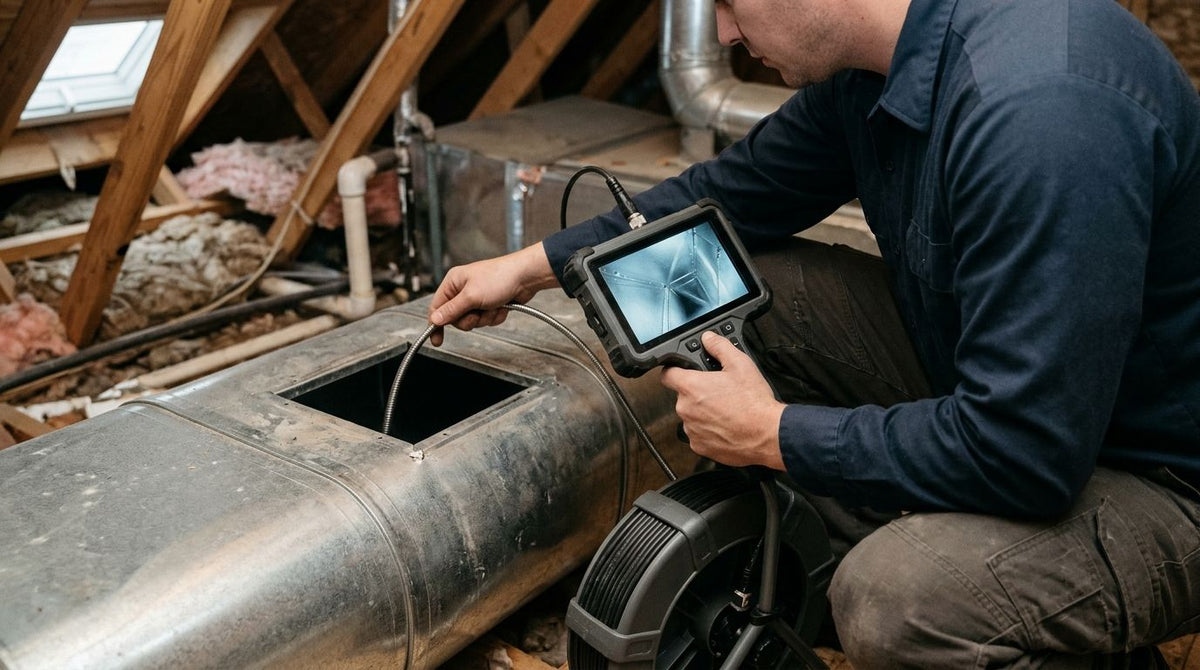
A duct that looks fine from the register can hold a collapsed liner, standing debris or mold three branches downstream. The wrong camera either stops at the first elbow or gives you footage too dark to attach to a job record. This guide sorts duct inspection cameras by the access point you have, the space you need to see and the evidence you need to keep.
Fiberscope.net sells every product below and services them in-house. For a duct run, the DUCT-SCAN MICRO is the dedicated tool: a duct camera with a rotating side-view head that records to a USB drive. For attics and wall cavities, the COBRA pole camera is the better fit. For evaporator coils and plenums, an articulating videoscope such as the VOYAGER M40 reaches where a straight camera cannot.
- Best overall duct inspection camera: Fiberscope.net DUCT-SCAN MICRO, a duct camera with rotating side view and USB recording.
- Best for attics and wall cavities: the COBRA dual view pole camera, with SD recording and a rotating view.
- Best for coils and plenums: the VOYAGER M40 videoscope with 360° all-way joystick articulation and IP68 probes.
- Match the camera to the access opening and the evidence you must record before comparing anything else.
What decides which duct inspection camera fits
Four constraints decide the purchase: the access opening, the duct size, the lighting and the recording. Brand and feature count come after those. Start with the smallest opening you will ever have to pass, since a head that cannot get in is worth nothing.
- Access opening. A register boot, a cut-in access hole and a cleanout panel each limit the probe or head diameter you can pass.
- Duct size. Residential branch runs are commonly 4 to 8 inches round. Trunk lines are larger, and large trunks are where lighting becomes the problem.
- Route. A straight run needs push reach. A turn or a coil face needs a head that bends or looks sideways.
- Lighting. A camera that images a 6-inch branch can go dark in a big trunk. Built-in LEDs set how far the picture stays usable.
- Recording. NADCA ACR documentation expects before and after evidence. A camera that records to USB or SD saves you from photographing a screen.
For how those records are organized on a cleaning job, see the guide on documenting duct cleaning for NADCA ACR with a camera.
Duct inspection cameras at a glance
Prices are from the product pages and were checked at publication. A dash means the spec is not part of the decision for that job.
| Camera | Best for | View | Recording | Price |
|---|---|---|---|---|
| DUCT-SCAN MICRO | Duct runs and branch lines | Rotating side view | USB | — |
| COBRA dual view pole camera | Attics, wall cavities, high spaces | Rotating, dual view | SD | from $4,110 |
| VOYAGER M40 videoscope | Coils, plenums, tight turns | 360° all-way articulation | Yes | — |
DUCT-SCAN MICRO: best duct inspection camera for duct runs
The DUCT-SCAN MICRO is the one camera here built for duct work, and it is the default pick for most HVAC techs. It has a rotating head for side-view inspection and records to a USB drive, so each branch gets its own clip.
The DUCT-SCAN MICRO duct inspection camera suits cleaning contractors who need a before and after clip per run, and techs diagnosing a supply branch with weak airflow. The rotating side view lets you look at the duct wall, where debris, disconnected joints and damaged liner sit, instead of only down the tube.
It works best on branch runs and small trunks. In a large trunk, the lighting limit applies to any camera of its size, and a larger or articulating tool is the better choice.
Verdict: Buy for duct runs and NADCA-style documentation.
COBRA: best for attics and wall cavities
The COBRA is a telescopic pole camera with a dual view and SD recording, listed for attics, walls, roofs, gutters and tanks. It gets you eyes on the spaces around the duct system: the attic run, the chase behind a wall, the trunk above a drop ceiling.
The COBRA dual view pole camera costs from $4,110. That price makes sense when you also inspect roofs and crawlspaces, and it is hard to justify if you only run ducts. In that case the DUCT-SCAN MICRO covers the work for less money and in a smaller package.
Near overhead lines or energized equipment, use a non-conductive pole and keep to the clearance distances in OSHA 1910.333.
Verdict: Buy if your jobs include attics, wall cavities and property inspections. Skip it for duct-only work.
VOYAGER M40: best for coils and plenums
A coil face or plenum needs a head that turns. The VOYAGER M40 is a videoscope with 360° all-way joystick articulation, so you can steer the tip around a fin pack or into a corner a straight camera cannot see. Its probes carry an IP68 rating.
You use it where the DUCT-SCAN MICRO stops: behind a coil, in a return plenum, inside an air handler. It is an industrial inspection tool, so expect to pay more than for a basic duct camera. For how articulating videoscopes compare, read the guide to the best articulating borescopes. Call a Fiberscope.net specialist for the current M40 price and probe options.
Verdict: Buy if coil and plenum inspections are regular work. Hold if you only inspect duct runs.
What you will also need
Check the space before you buy. For tight spaces with limited access, the confined space inspection camera guide covers the access and reach trade-offs.
Keep a spare USB drive or SD card in the kit so a full card never ends a job. For long runs, plan a second person to feed cable.
Common mistakes when buying a duct inspection camera
- Choosing by resolution alone. A sharp image that cannot get past the first elbow does not help.
- Skipping the side view. Duct defects live on the walls, and a forward-only head misses them.
- Ignoring recording. Without saved clips, a cleaning job has no proof of the before and after condition.
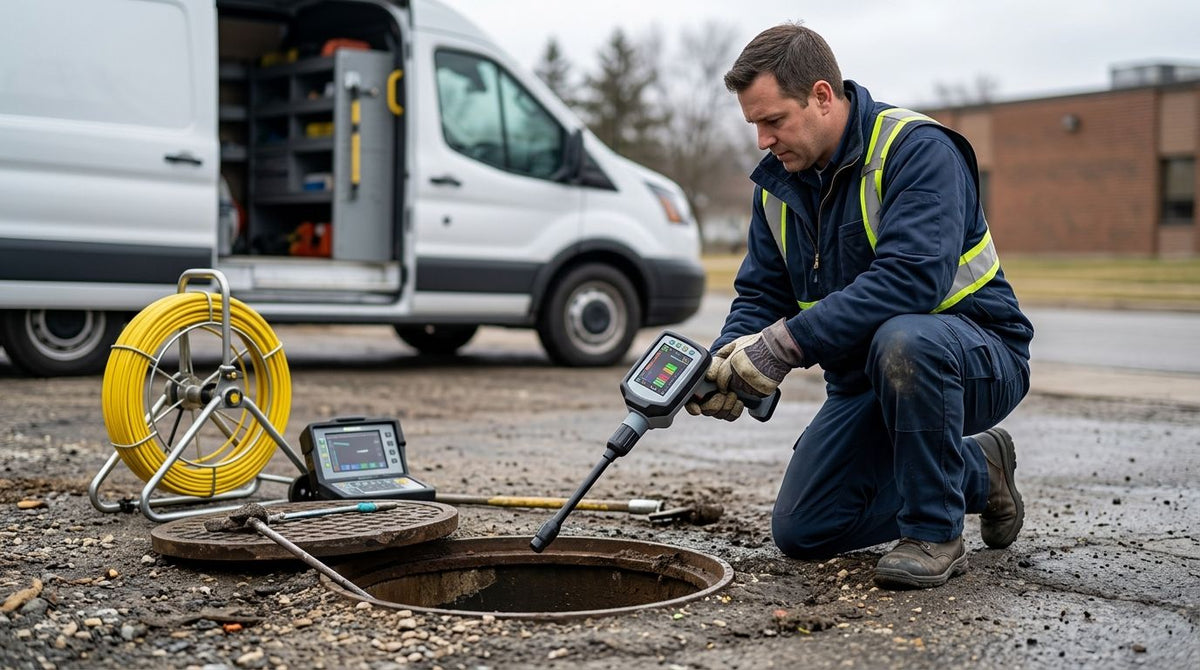
- Buying a drain camera for ducts. Push cameras for sewer lines are sized and sealed for pipe, not for dry ductwork.
FAQ
What is the best duct inspection camera for HVAC techs?
The DUCT-SCAN MICRO is the best fit for most HVAC techs because it is made for duct runs, with a rotating side view and USB recording. For coils and plenums, the VOYAGER M40 articulating videoscope reaches turns a duct camera cannot.
Can I use a drain camera to inspect air ducts?
A drain camera is built for pipe, not ductwork. Use a duct camera such as the DUCT-SCAN MICRO, which is designed for dry duct runs and records to USB.
Do I need a camera that records for duct cleaning jobs?
Yes. NADCA ACR documentation relies on before and after evidence, and a camera that records to USB or SD gives you a clip for every run.
What duct sizes can I inspect?
Residential branch runs are commonly 4 to 8 inches round, and trunk lines are larger. The smallest access opening and the lighting in big trunks set your limit, so tell the specialist both numbers.
Can a pole camera inspect ducts?
A pole camera such as the COBRA suits attics, wall cavities and high spaces around the duct system. For the inside of a duct run, a duct camera is the better tool.
Get the right duct camera matched to your jobs
Send your smallest access opening, duct sizes, run lengths, whether you need to reach coils or plenums, and how you record evidence. A Fiberscope.net specialist will match the right head and cable. Call 1-877-613-2210, Monday to Friday 8:00 to 18:00 CST.
About the author
Vladimir Khubiryants founded Fiberscope.net to give professionals access to reliable video inspection equipment without enterprise pricing. For over 20 years he has sourced and tested borescopes, sewer cameras and fiberscopes in Fiberscope.net's in-house test and repair facility, helping plumbers, pipeline engineers, aviation and military teams choose the right tool for the job. See our cameras in use on YouTube and Instagram.


Leave a comment
This site is protected by hCaptcha and the hCaptcha Privacy Policy and Terms of Service apply.