


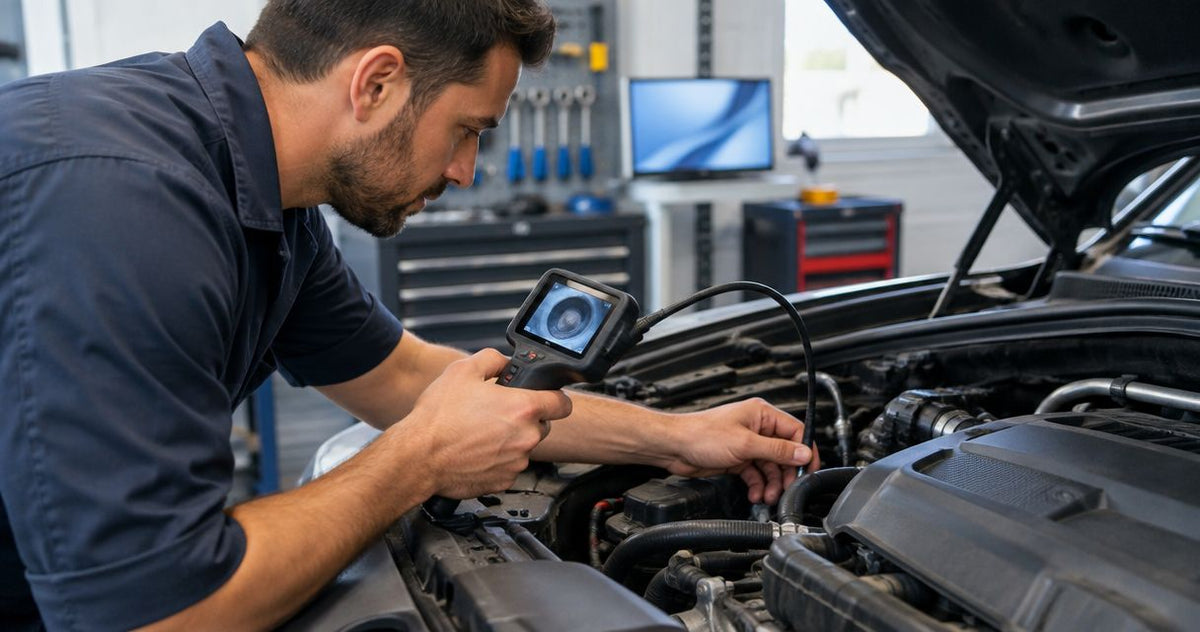
A borescope on the truck earns its keep the first time it saves a teardown. The trouble with a sub-$300 Harbor Freight scope is where it quits: a probe that wears out after a season in a service bay, limited articulation for looking sideways at a cylinder wall, and no one to call when it fails. This guide matches the alternatives to shop jobs by articulation, probe type and price, building on our wider look at video borescopes for automotive mechanics.
For cylinder, valve and intake-port work, the VOYAGER M40 videoscope (from $4,160) is the tool, with 360° all-way tip articulation. For exhaust and other hot components, the VOYAGER C40 high-temperature borescope starts at $3,320. For a straight look down a spark-plug hole on a tighter budget, an optical rigid borescope starts at $378 before lighting. Fiberscope.net sells the products discussed here and services them in-house.
- Harbor Freight borescope alternatives for automotive mechanics start with the VOYAGER M40, from $4,160, with 360° articulation.
- The VOYAGER C40 high-temperature borescope, from $3,320, suits exhaust and hot-component checks.
- A rigid borescope from $378 plus a $299 SPARK light handle covers straight looks down a plug hole.
- Stay with a sub-$300 consumer scope if you only look inside an engine a few times a year.
Where a Harbor Freight borescope stops for engine work
Consumer borescopes in the Harbor Freight and Bauer class sell for under $300 and run on a Wi-Fi app. They are cheap and good enough to find a dropped bolt. The limits show up in daily shop use: probe durability, tip articulation and service support.
Engine inspection asks more of the tool than a quick look. Cylinder bores are straight, so seeing the wall or the piston crown means bending the tip or using a side view. You also need a probe narrow enough for the smallest opening on the route, and an image you can save for the customer's work order.
That is the gap the alternatives below fill. Each is matched to a job, with its limits stated.
Alternatives at a glance
The table puts the consumer benchmark next to each alternative so you can see what the extra money buys. Prices are the store's listed starting prices; a dash means the figure does not apply or is not part of the comparison.
| Tool | Best for | Articulation | Price |
|---|---|---|---|
| Harbor Freight / Bauer-class consumer borescope | Occasional looks, dropped parts | Limited | Under $300 |
| VOYAGER M40 videoscope | Cylinders, valves, intake ports | 360° all-way joystick | from $4,160 |
| VOYAGER C40 high-temperature borescope | Exhaust, turbo and hot areas | 4-way on 1–5 m probes; 2-way on 6–8 m probes | from $3,320 |
| Rigid Borescope with light source | Straight looks down a plug hole | None | from $378 |
| Under Vehicle Inspection Camera | Underbody, frame, suspension | — | from $580 |
VOYAGER M40: the everyday engine videoscope
The VOYAGER M40 has full tip articulation through a 360° all-way joystick and probes rated IP68, which matters around oil and coolant. It is the closest step up for a mechanic who looks inside engines weekly.
The jobs it suits are the ones a straight scope cannot reach: scoring on a cylinder wall, carbon on a piston crown, valve seats, and intake-valve carbon on direct-injection engines through the intake port. Our walkthrough on inspecting intake-valve carbon with a borescope shows the route. Inspect a cold engine through the spark-plug hole, and let the articulation do the work of turning the view onto the wall.
The limit is price. At from $4,160 it costs more than ten consumer scopes, and a shop that checks one engine a month will not earn that back quickly. The narrowest point on your route sets the maximum probe OD, so read the probe diameter on the product page against your smallest plug hole first. The guide on whether a micro borescope fits through a spark-plug hole covers the sizing.
VOYAGER C40 high-temperature: for exhaust and hot components
The VOYAGER C40 is built for areas where simple borescopes fail, and it starts at $3,320. It carries 4-way articulation on 1–5 m (3.3–16.4 ft) probes and 2-way articulation on 6–8 m (19.7–26.2 ft) probes.
That length range suits exhaust runs, catalytic converter internals, and turbo and manifold checks. The longer probes lose two directions of articulation, so for plug-hole and cylinder work the M40 is the better tool. Buy the C40 when your shop does exhaust diagnostics or fleet and diesel work where reach matters more than a joystick on a short probe.


Rigid Borescope: the budget route down a straight hole
An optical rigid borescope starts at $378 and uses rod-lens relay optics, so it needs a light source through a light guide or a handle. A SPARK LED light handle adds $299, which puts a working eyepiece setup at $677.
That setup gives a sharp, straight view down a plug hole at the piston crown, and nothing else. There is no articulation, so the cylinder wall stays out of sight. Add the Rigid Borescope to the list when you want an optical-grade image and a lower entry price than a videoscope.
To capture video, a USB Borescope Camera (from $900) or a coupler converts the eyepiece to a screen, and the full kit lands at $1,577. One customer reported that the SPARK handle "works perfectly with my old Hopkins scope" (Alasdair H. M.), which is the point of the optical route: the light and camera parts are reusable across scopes.
Under Vehicle Inspection Camera: for the underbody
The Under Vehicle Inspection Camera starts at $580 and lets one person check the underside of cars, trucks and trailers without a pit, a lift or crawling on the ground.
It answers a different question than a borescope: frame rust, leaks, exhaust hangers, suspension. It does not go inside a cylinder or an intake port. Pair it with an M40 or a rigid scope and you cover the underside and the inside of the engine.
Match the tool to the job
The right tool follows the access path, not the brand. This table pairs common shop jobs with the lowest-cost tool that does them properly.
| Job | Tool | Why |
|---|---|---|
| Cylinder wall and piston crown | VOYAGER M40 | Articulation to see the wall |
| Intake-valve carbon, direct injection | VOYAGER M40 | Turns the view onto the valves |
| Straight look at a piston crown | Rigid Borescope + SPARK | Lowest cost optical view |
| Catalytic converter and exhaust internals | VOYAGER C40 | Probe length and hot-area design |
| Dropped bolt or one-off look | Consumer scope | Under $300 is enough |
| Frame, floor pan, suspension | Under Vehicle Inspection Camera | No lift or pit |
Why mechanics move off a consumer borescope
The reasons that hold up in a shop are wear and support. A probe that bends daily wears faster than one built for service use, and a consumer scope gives you articulation that stops short of what a cylinder needs.
Fiberscope.net tests and repairs its systems in-house, backs each with a one-year warranty, and has a technical specialist match the tool to your access opening before you buy. You can also rent or demo a unit first, which is the cheapest way to find out whether you use an articulating scope enough to own one.
When Harbor Freight is the right call
If you look inside an engine a few times a year, a sub-$300 consumer borescope is the correct purchase and the alternatives above are overkill. The same holds for a one-time dropped-part retrieval.
Move up when you inspect engines weekly, need to turn the view onto a cylinder wall, or need a tool that survives daily use and has service behind it. For the price of a few replacement consumer scopes, an M40 pays for itself in saved teardown hours.
Send us your job details
Send us your plug-hole diameter, the work you do most (cylinders, intake ports, exhaust or underbody) and whether you need recording, and a Fiberscope.net specialist will match the right probe and articulation. Call 1-877-613-2210, Monday to Friday, 8:00–18:00 CST, or use the contact page on the store.
FAQ
Can I inspect an engine while it is hot?
Inspect a cold engine. Cylinder bores are straight, so you look through the spark-plug hole using articulation or a side view, and heat adds risk to both the probe and your hands.
Do I need a separate light source with a rigid borescope?
Yes. Rigid borescopes use rod-lens relay optics and need light through a light guide or an LED handle. A SPARK light handle is from $299, and a fiber optic light guide cable is from $350.
What does IP68 mean on an automotive borescope?
IP68 means protection against immersion beyond 1 m under the manufacturer's stated conditions. It matters around oil and coolant, and the VOYAGER M40 probes carry the rating.
Can I try an articulating videoscope before buying?
Yes. Fiberscope.net offers buy, rent or demo options, so you can test an M40 or C40 on your own engines before committing.
Is a USB borescope camera a complete system?
No. The USB Borescope Camera, from $900, turns an optical scope with a 32 mm eyepiece into a video borescope for a Windows computer. It has no probe of its own.
About the author. Vladimir Khubiryants, Founder & President, Fiberscope.net (MEDIT Inc.). He founded Fiberscope.net to give professionals access to reliable video inspection equipment without enterprise pricing. For over 20 years he has sourced and tested borescopes, sewer cameras and fiberscopes in Fiberscope.net's in-house test and repair facility, helping plumbers, pipeline engineers, aviation and military teams choose the right tool for the job. See our cameras in use on YouTube.

Leave a comment
This site is protected by hCaptcha and the hCaptcha Privacy Policy and Terms of Service apply.