

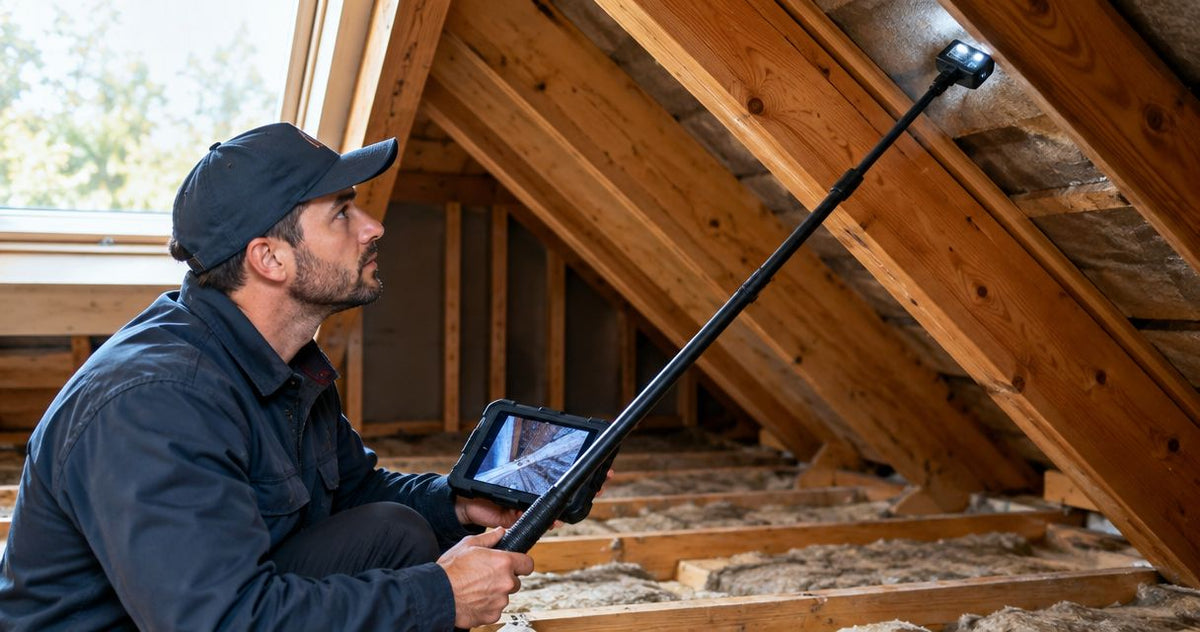
A pole inspection camera earns its place the first time it saves you a climb into a hot attic or a crawl across blown-in insulation to see one plenum collar. The catch is that pole cameras differ in what you see on the screen and what you can save, so the right one depends on whether you need a second angle, a recording, or a picture on a phone-sized monitor.
For most HVAC technicians and property inspectors, the pick is the COBRA dual view inspection pole camera: a dual view with a rotating view and SD recording. If you want the image on a Wi-Fi monitor, the CYCLOPS HD is the alternative. Inside ductwork, leave the pole behind and use a duct camera. Fiberscope.net sells all of these and services them in-house.
- COBRA is the best pole inspection camera here for attics and ceiling cavities: dual view with SD recording.
- CYCLOPS HD suits techs who want the picture on a monitor over Wi-Fi.
- For ductwork, use the DUCT-SCAN MICRO duct camera instead of a pole.
- Skip CYCLOPS TZ for attics: it is built for manhole mainlines and culverts.
How to choose a pole camera for HVAC and attic work
Pick a pole camera on four things: how the head reaches the target, which direction it looks, whether it records, and how safely you can use it near wiring. Brand and feature count come last.
- Reach and access. The pole has to clear the hatch or register opening and still extend to the target. Check the opening before you check the spec sheet.
- View direction. A fixed forward view is enough for a quick look. A rotating or second view matters when the target sits beside or above the head, as in a joist bay or the underside of a roof deck.
- Recording. If you write reports or need before/after evidence, you need saved video or stills, not just a live picture.
- Wiring and power lines. Attics hold live conductors. Use a non-conductive pole and follow the clearance rules in OSHA 1910.333 when working near energized lines.
For roof-edge and exterior work, the pole cameras for roof and property inspectors guide covers the other half of the job.
Pole cameras for HVAC and attic inspection compared
The table lists each tool by how it is deployed, how you view it and how you save footage.
| Tool | Deployed on | Viewing | Recording | Suits |
|---|---|---|---|---|
| COBRA dual view pole camera | Pole | Dual view, rotating view | SD | Attics, ceiling cavities, roof edges |
| CYCLOPS HD | Pole | Monitor via Wi-Fi | Yes | Attic and exterior work where a monitor helps |
| DUCT-SCAN MICRO | Duct, not pole | Rotating side view | USB | Duct runs, trunks, plenums |
| CYCLOPS TZ | Pole, from a manhole | Zoom, 10.1-inch tablet via Wi-Fi module | Yes | Straight mainlines and culverts, 4–80 inch |
COBRA: the default for attics and ceiling cavities
The COBRA is the pole camera to buy first if your work is attics, soffits and ceiling cavities. It gives you a dual view with a rotating view, so you can look along a joist bay and then turn to the underside of the deck without repositioning the pole.
It records to an SD card, which covers before/after evidence for a duct-cleaning or insulation job. For HVAC techs that is the main reason to pick it over a basic viewing camera: the footage goes in the job file.
What it won't do: it carries no Wi-Fi, app, tablet or sonde features, so you view on the unit's own display and move footage by card. If you need to hand a client a phone-sized live view, look at CYCLOPS HD.
Verdict: Buy for attic, ceiling and roof-edge inspection.
CYCLOPS HD: when the picture needs to be on a monitor
The CYCLOPS HD is a pole camera from Zistos, made in USA, with a monitor connected over Wi-Fi. The camera is rated for 30 ft (9 m) submersible, which also helps in wet and dirty locations such as condensate-soaked cavities.
It suits a tech who holds the pole while a second person, or the tech himself from the ground, watches the screen. Compared with COBRA it gives you the monitor-over-Wi-Fi workflow; compared with COBRA it does not offer the dual view.
Verdict: Buy if a Wi-Fi monitor matters more than a second view. Hold if you mainly need a rotating view in tight cavities.
DUCT-SCAN MICRO: for the duct itself
A pole cannot turn inside a trunk line or a flex duct, which is where a duct camera belongs. The DUCT-SCAN MICRO has a rotating side view and records to USB, so you can document debris, mold or coil condition before and after cleaning. The NADCA ACR standard is the reference most duct-cleaning contracts point to for documentation.
For a full run-down of duct tools, see the best HVAC duct inspection cameras.
Verdict: Buy as a companion to a pole camera, not a replacement for one.
CYCLOPS TZ: not an attic tool
The CYCLOPS TZ is a pole-mounted zoom camera deployed from a manhole for straight mainlines and culverts from 4–80 inch. It has an IP68 camera and sends video to a 10.1-inch tablet through a Wi-Fi module. Those are strong specs for municipal work and the wrong fit for an attic hatch.
Verdict: Skip for HVAC and attic inspection.
What the cost looks like
Pole cameras vary widely in price depending on view options, recording and monitor setup. The pole inspection camera cost guide breaks down what you pay for at each step.
Common mistakes
- Buying on pole length alone. The hatch opening and the head's view direction decide whether you see the target.
- Using a metal or wet pole near energized attic wiring.
- Treating a duct job as a pole job. Ducts need a duct camera.
- Skipping recording, then having nothing to attach to the report.
- Rating a whole kit waterproof because the camera head is. The camera rating applies to the head, not the monitor.
The IEC IP rating guide explains what each IP code actually promises.
FAQ
What is the best pole inspection camera for attics?
The COBRA dual view pole camera is the best fit for attics and ceiling cavities. It gives a rotating view and records to SD, so you can document findings without entering the space.
Can a pole camera inspect inside HVAC ducts?
Not well. A pole cannot turn inside a trunk line. A duct camera such as the DUCT-SCAN MICRO, with a rotating side view and USB recording, is the right tool for duct interiors.
Do pole cameras need a Wi-Fi connection?
No. COBRA works on its own display and SD card. CYCLOPS HD uses Wi-Fi between the camera and its monitor, which is a local link, not an internet connection.
Is a pole camera safe to use near attic wiring?
Use a non-conductive pole and keep clear of energized conductors. OSHA 1910.333 sets the clearance rules for work near power lines and live parts.
Is the CYCLOPS TZ suitable for building inspections?
No. It is a zoom camera deployed from a manhole for mainlines and culverts from 4–80 inch, so it suits sewer and culvert work rather than attics.
Send us your job details
Send us the target height, the access opening, the views you need, whether you must record, and the lighting at the site, and a Fiberscope.net specialist will match the right pole camera. Call 1-877-613-2210, Monday to Friday, 8:00 to 18:00 CST.
About the author. Vladimir Khubiryants, Founder & President, Fiberscope.net (MEDIT Inc.). Vladimir founded Fiberscope.net to give professionals access to reliable video inspection equipment without enterprise pricing. For over 20 years he has sourced and tested borescopes, sewer cameras and fiberscopes in Fiberscope.net's in-house test and repair facility, helping plumbers, pipeline engineers, aviation and military teams choose the right tool for the job.


Leave a comment
This site is protected by hCaptcha and the hCaptcha Privacy Policy and Terms of Service apply.