

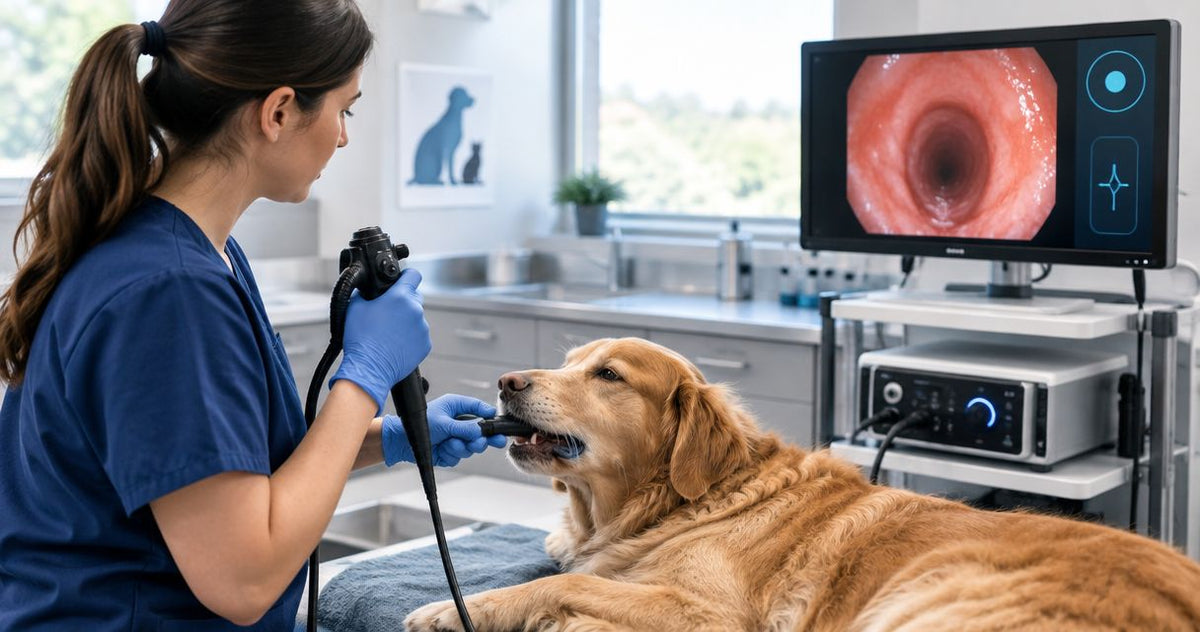
The Multi-Purpose Set for Small Animal Veterinary Endoscopy is the strongest all-around pick in Fiberscope's 2026 veterinary endoscope lineup for general small-animal diagnostic work. The Transcervical Insemination Set is the correct tool when the job is vaginoscopy, cystoscopy, or artificial insemination rather than general exams, and the Optical Veterinary Endoscope (Sinuscope) is the lowest-cost rigid option for cavity and sinus work. Fiberscope sells the products discussed. Recommendations are based on current published specifications and stated use cases; confirm final configuration and compatibility with Fiberscope before purchase.
- Best veterinary endoscopes for 2026: the Multi-Purpose Set wins for general small-animal exams, the Transcervical Insemination Set for reproductive procedures.
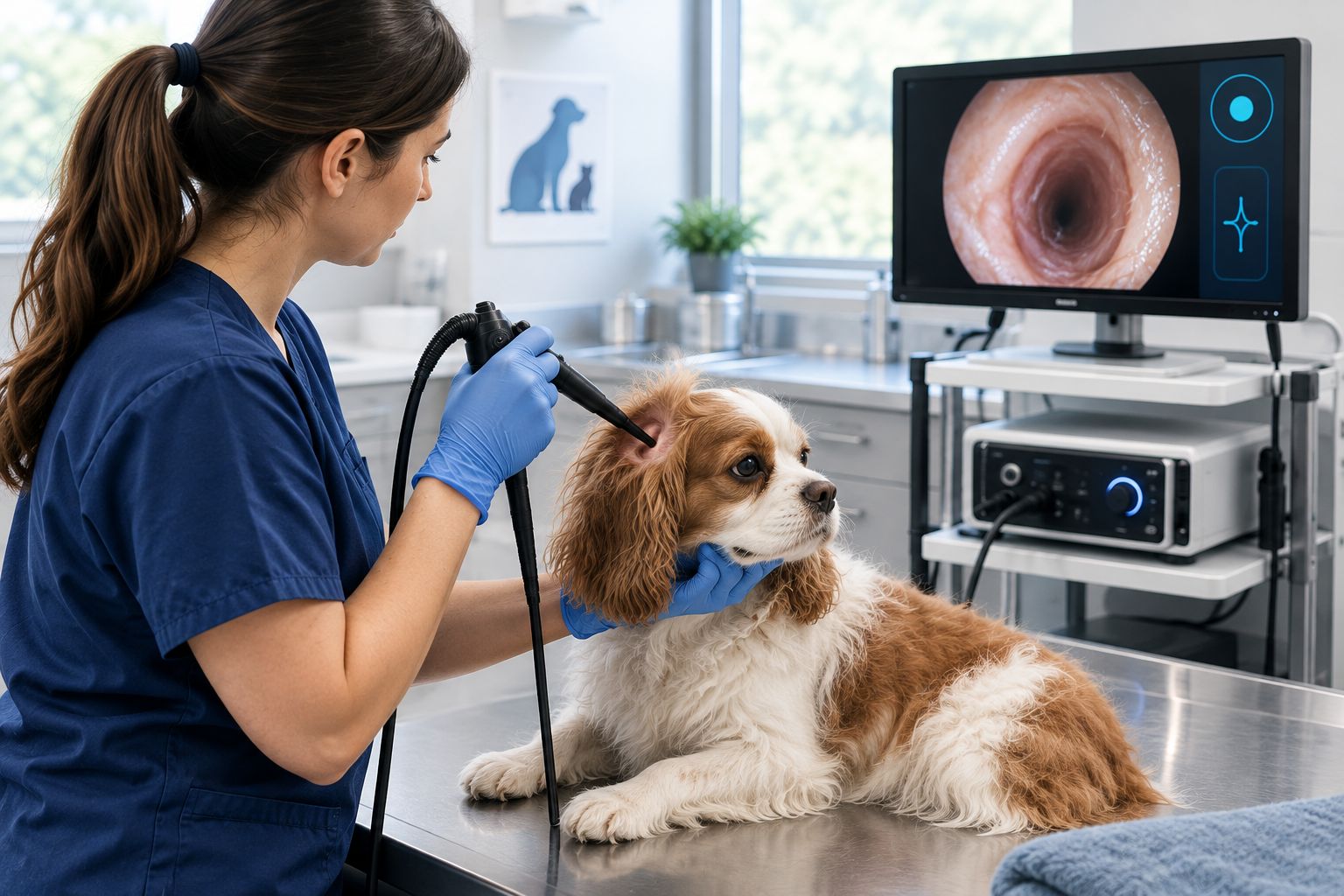
- The Veterinary Otoscope with Integrated Working Channel is the pick for ear exams and foreign-body flushing, not general body-cavity work.
- The Veterinary Laparoscope Endoscope fits laparoscopic visualization; the Optical Veterinary Endoscope (Sinuscope) is the budget rigid scope for cavity and sinus exams.
- None of these five configurations publish full insertion-tube diameter or length specs, so confirm sizing with Fiberscope before ordering.
Why this matters
A veterinary endoscope purchase locks a practice into one procedure type more often than buyers expect. A rigid sinuscope built for cavity viewing does not become a working-channel otoscope, and an insemination set is not a substitute for a general diagnostic scope. Fiberscope's core catalog is industrial and plumbing inspection cameras, and the veterinary line shares the same rigid relay-lens optical path used in Fiberscope's rigid borescope — though the animal-safe insertion tubes, sterilizable materials, and clinical sheaths are built for a different application entirely.
Rigid veterinary telescopes across the industry are commonly built around standard outer diameters such as 2.7 mm or 4 mm. None of the five configurations below publish an exact diameter figure, so treat that as a confirm-before-order item rather than an assumption.
What determines the right veterinary endoscope for your practice
- Procedure specialization — reproductive, ENT, laparoscopic, or general diagnostic use each favor a different scope
- Rigid vs. flexible construction — rigid scopes suit fixed-cavity viewing; flexible designs suit curved anatomy
- Working channel presence — needed for flushing, biopsy, or foreign-body retrieval; a fixed scope without one can only view
- Insertion tube diameter and length — must match the target species and cavity, and should be confirmed directly with the seller
- Documentation needs — whether findings need to be captured on camera or monitor for the medical record
- Sterilization and material — stainless steel components tolerate standard veterinary sterilization cycles differently than composite parts
Veterinary endoscopes at a glance
| Endoscope | Best for | Standout feature | Key limitation |
|---|---|---|---|
| Multi-Purpose Set for Small Animal Veterinary Endoscopy | General small-animal diagnostics | Oto-Endoscope head covers a range of diagnostic inspections including otoscopy | Full component and procedure list beyond otoscopy is not itemized in the listing — confirm scope of use before ordering |
| Transcervical Insemination Set | Canine reproductive procedures | Stainless steel endoscope with operational sheath built around the insemination workflow | Built for a single workflow, not general diagnostic exams |
| Veterinary Otoscope with Integrated Working Channel | Ear exams and foreign-body flushing | Permanent working channel for flushing and foreign-body work | Working channel is fixed, not swappable, and the design is ear-focused |
| Veterinary Laparoscope Endoscope | Laparoscopic visualization | Rigid optical construction built for laparoscopic procedures | Full insertion-probe dimensions are not stated — confirm cannula/trocar compatibility with your surgical setup |
| Optical Veterinary Endoscope (Sinuscope) | Sinus and cavity exams on a budget | Rigid design for cavities and tissues that are otherwise hard to access | No working channel described, so instrument passage during the exam is not supported |
1. Multi-Purpose Set for Small Animal Veterinary Endoscopy: best veterinary endoscope for general diagnostics
This set is built around an Oto-Endoscope head positioned for a range of diagnostic inspections, including otoscopy, rather than one narrow procedure. That breadth is the reason it sits first on this list for a mixed small-animal caseload.
Multi-Purpose Set pros:
- Covers a range of diagnostic procedures rather than a single specialty
- Otoscopy capability is explicitly documented
- General-purpose design suits a practice that doesn't want a single-procedure scope
Multi-Purpose Set cons:
- The published listing does not itemize every included component or procedure beyond otoscopy
- General-purpose construction may not match the reach of a procedure-specific scope for reproductive or laparoscopic work
Best for: practices that need one endoscope covering several diagnostic exam types. Not ideal for: clinics that need a dedicated reproductive or laparoscopic instrument — pick the Transcervical Insemination Set or the Veterinary Laparoscope Endoscope instead.
2. Transcervical Insemination Set: best veterinary endoscope for reproductive procedures
The Transcervical Insemination Set pairs a stainless steel endoscope with an operational sheath specifically for vaginoscopy, cystoscopy, and artificial insemination. It is described as usable for diagnostics as well, but the design center is the reproductive workflow.
Transcervical Insemination Set pros:
- Stainless steel construction with an operational sheath matched to the insemination procedure
- Supports vaginoscopy and cystoscopy in addition to insemination
Transcervical Insemination Set cons:
- Purpose-built for reproductive work, not a general diagnostic replacement
- Detailed insertion length and diameter are not published in the listing
Best for: canine reproductive practices running insemination, vaginoscopy, or cystoscopy procedures. Verify before ordering: confirm insertion tube dimensions against the patient size range you treat.
3. Veterinary Otoscope with Integrated Working Channel: best veterinary endoscope for ear exams
This otoendoscope carries a permanent working channel, which is what separates it from a viewing-only scope. That channel supports flushing and foreign-body work during the same exam, not just visual inspection.
Veterinary Otoscope pros:
- Integrated, permanent working channel for flushing and foreign-body retrieval
- Purpose-built for ear examinations rather than adapted from a general scope
Veterinary Otoscope cons:
- The working channel is fixed into the design, not interchangeable
- Focused on ENT use, so it is not a general body-cavity scope
Best for: ear exams that require flushing or foreign-body removal in the same session. Not ideal for: laparoscopic or reproductive procedures — those need the Veterinary Laparoscope Endoscope or the Transcervical Insemination Set.
4. Veterinary Laparoscope Endoscope: best veterinary endoscope for laparoscopic visualization
This is a rigid endoscope using optical technology, with an insertion probe built for laparoscopic viewing. The published description does not carry through the full probe dimensions, which matters for matching it to existing cannulas or trocars.
Veterinary Laparoscope pros:
- Rigid optical construction suited to laparoscopic procedures
- Designed as a dedicated laparoscopic instrument rather than a multi-purpose scope
Veterinary Laparoscope cons:
- Full insertion-probe length and diameter are not stated in the current listing
- Not a substitute for ENT or reproductive-specific scopes
Best for: clinics running laparoscopic procedures that need a rigid optical scope. Verify before ordering: confirm probe diameter against your existing cannula and trocar set before scheduling a case around it.
5. Optical Veterinary Endoscope (Sinuscope): best veterinary endoscope for cavity exams on a budget
The Sinuscope is a rigid veterinary endoscope aimed at cavities and tissues that are otherwise hard to reach. It is the simplest configuration on this list and the one without a stated working channel.
Optical Veterinary Endoscope pros:
- Rigid design built specifically for cavity and sinus viewing
- Simpler configuration than the multi-purpose or laparoscopic sets
Optical Veterinary Endoscope cons:
- No working channel is described, so it supports viewing only, not instrument passage
- Narrower use case than the Multi-Purpose Set
Best for: sinus and cavity exams where viewing alone is enough. Not ideal for: any procedure requiring flushing, biopsy, or foreign-body retrieval through the scope itself.
If you actually need pipe, duct, or engine inspection instead
Fiberscope's larger catalog is industrial and plumbing inspection cameras — sewer cameras, downhole cameras, and rigid and flexible borescopes for mechanical work. None of those are veterinary instruments, and none of the five scopes above are rated for pipe, duct, or engine inspection. If a search for "endoscope" landed you here but the job is actually mechanical, the best rigid borescopes guide and the best optical borescopes guide cover that equipment class directly. For a broader view of Fiberscope's industrial borescope range, the best industrial borescopes guide is the right starting point instead of this page.
Documentation is one place the two product lines do overlap conceptually: attaching a camera to a rigid eyepiece for image capture is standard practice in both industrial and clinical rigid-scope work, using a coupler such as Fiberscope's universal optical coupler on the industrial side. Confirm eyepiece compatibility before assuming any coupler fits a specific veterinary scope.
How this list was put together
Each of the five configurations above was placed against the six decision criteria listed earlier — procedure specialization, rigid vs. flexible build, working channel presence, insertion sizing, documentation needs, and material. None compete for the same "best for" slot; each owns a distinct procedure type. Where a specification wasn't published — insertion diameter and length, most consistently — that gap is called out as a verify-before-purchase item rather than filled in with an assumption.
Which veterinary endoscope should you choose?
For a mixed small-animal practice that needs one general-purpose instrument, the Multi-Purpose Set for Small Animal Veterinary Endoscopy is the default 2026 pick because its Oto-Endoscope head is documented for a range of diagnostic work rather than one procedure. If the caseload is reproductive, the Transcervical Insemination Set is the better fit. If it's ENT-heavy, take the Veterinary Otoscope with Integrated Working Channel. Laparoscopic caseloads point to the Veterinary Laparoscope Endoscope, and a lower-cost cavity-viewing need points to the Optical Veterinary Endoscope (Sinuscope). In every case, confirm exact insertion dimensions and sterilization requirements with Fiberscope before the set is scheduled into a procedure.


FAQ
What's the best veterinary endoscope for a general small-animal practice in 2026?
The Multi-Purpose Set for Small Animal Veterinary Endoscopy is the best fit for general diagnostic work because its Oto-Endoscope head is documented for a range of inspections, including otoscopy, rather than one specific procedure.
Is a rigid or flexible endoscope better for veterinary use?
Rigid endoscopes suit fixed-cavity viewing such as sinus or laparoscopic exams, while flexible designs suit curved anatomy. All five configurations covered here are rigid, stainless-steel-based instruments.
Do veterinary endoscopes need a separate camera to capture images?
Rigid endoscopes are viewed directly through the eyepiece unless a camera is coupled to it for documentation. An optical coupler adapts a camera to a compatible eyepiece, but eyepiece compatibility should be confirmed before ordering one.
What is a working channel used for on a veterinary otoscope?
A working channel lets fluid or a small instrument pass through the scope during the exam, supporting flushing and foreign-body retrieval in addition to viewing. Scopes without a working channel, like the Optical Veterinary Endoscope, support viewing only.
Can the Transcervical Insemination Set be used for general diagnostics?
The listing describes it as usable for diagnostics in addition to insemination, but its stainless steel endoscope and sheath are built around the reproductive workflow, so it is not the first choice for general exam use.
How much does a veterinary endoscope cost in 2026?
Pricing depends on the scope type, working channel, and included sheaths or sets, and varies across the five configurations covered here. Current pricing for each configuration is listed on its own product page.
What insertion diameter do veterinary rigid endoscopes typically use?
Rigid veterinary telescopes across the industry are commonly built around standard diameters such as 2.7 mm or 4 mm, but none of the configurations in this guide publish an exact figure, so confirm sizing directly before ordering.
One last thing
The detail buyers miss most often in 2026 listings for this equipment class isn't the optics — it's the missing insertion-tube diameter and length. Every one of the five configurations above is described by procedure and construction, not by exact sizing, which means the sizing confirmation step isn't optional paperwork; it's the difference between a scope that fits your patient population and one that doesn't.

Leave a comment
This site is protected by hCaptcha and the hCaptcha Privacy Policy and Terms of Service apply.