

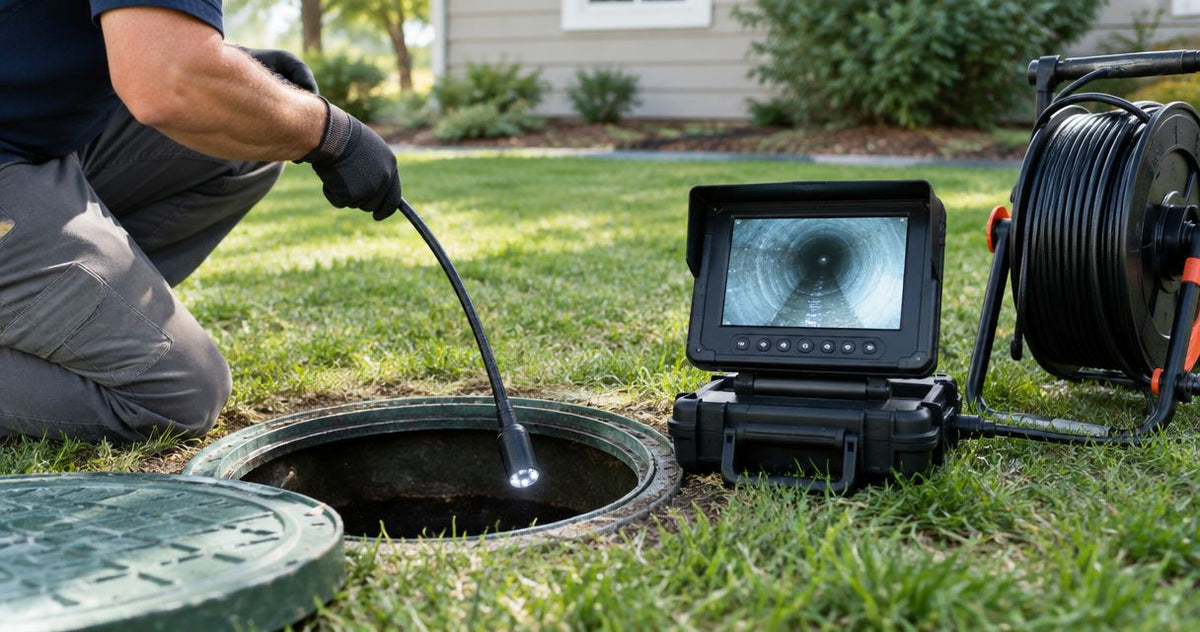
A septic inspection is decided by two measurements before any brand: how big the opening is where the camera goes in, and how far the camera has to travel from there. Tank lids, risers and cleanouts set the first number. The run from the tank to the distribution box or drain field sets the second.
For most septic work, Fiberscope.net's Drain Camera VIPER covers the widest range of pipe jobs. The MiniFlex 2 19mm is the pick for tight cleanouts, the ANACONDA for long pan-and-tilt runs, and the CYCLOPS HD pole camera for looking into a tank from the lid without sending a cable down a pipe. Fiberscope.net sells these products and services them in-house.
- Septic inspection cameras are chosen by access opening and run length, not by brand.
- Drain Camera VIPER is the default push camera for 4-inch septic lines: 1-inch head, 512 Hz sonde.
- MiniFlex 2 19mm fits small cleanouts; ANACONDA adds pan and tilt for longer lines.
- CYCLOPS HD views a tank from the lid on a telescopic pole, with no cable run.
How access and reach decide the camera
A septic camera has to pass the smallest opening on its route and carry enough cable to reach the defect. Everything else is secondary.
There are three typical entry points. The tank lid or riser lets you look at the inlet, outlet and baffles from above. A cleanout on the line between house and tank lets you push a camera toward the tank or back toward the house. The outlet side leads toward the distribution box and the drain field, where a 4-inch pipe is the common size.
That gives you three questions to answer before you buy:
- What is the smallest opening or fitting the head must clear?
- How many feet of cable do you need from the entry point to the farthest point you inspect?
- Do you need to locate the camera from above ground to mark a dig point?
Locating needs a sonde (a small transmitter in the camera head) and a separate receiver. Every push camera below with a 512 Hz sonde works with a 512 Hz receiver. The guide to sewer cameras with 512 Hz locating explains how to pair them.
Safety comes first on the tank itself. Septic tanks hold hydrogen sulfide and methane, so keep your head out of the opening and do not enter the tank. A camera exists so nobody has to.
Septic inspection cameras at a glance
The table lists each camera in order of how broadly it suits septic work, from the widest use to the most specialized. Prices are on each product page.
| Camera | Suits | Key spec | Limitation |
|---|---|---|---|
| Drain Camera VIPER | 4-inch lines from tank to field | 1-inch head, 1.25 to 6 inch straight runs, 512 Hz sonde | Tight 90° bends in 1.5-inch pipe |
| MiniFlex 2 19mm | Small cleanouts and tight traps | 0.75 in (19 mm) head, 512 Hz sonde | Smaller head, less suited to long large-diameter runs |
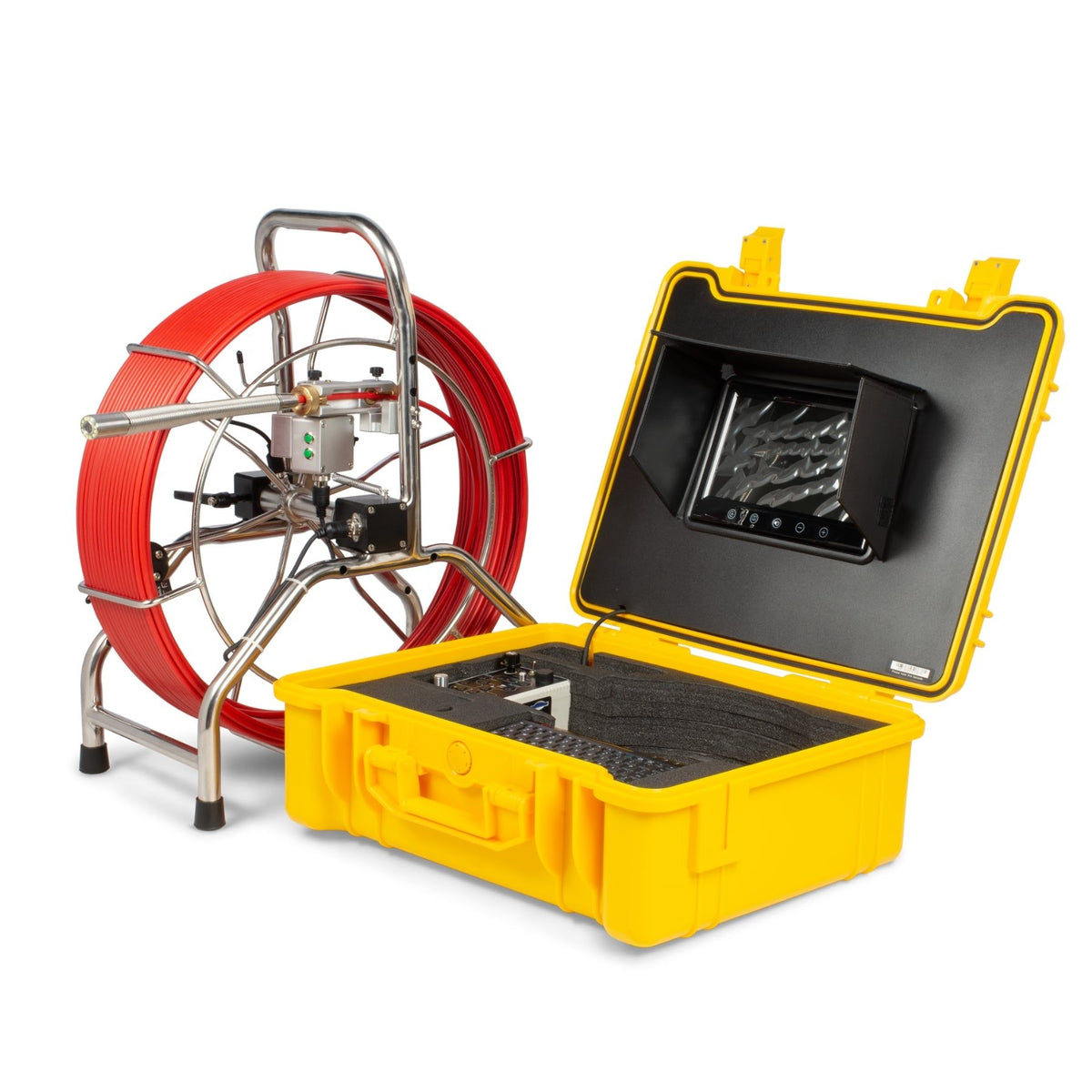
| ANACONDA | Longer runs where you need to look sideways | Pan and tilt head, 512 Hz sonde, IP68 | Larger system to carry |
| HATHORN Mini | Fast setups with a phone or tablet | Own Wi-Fi signal, 512 Hz sonde, IP68 to 60 psi (4 bar) | Viewing depends on the phone or tablet app |
| CYCLOPS HD | Tank views from the lid | Telescopic pole, camera submersible to 30 ft (9 m) | Views the tank, not the buried lines |
All prices checked at publication on each linked product page.
Drain Camera VIPER: the default for septic lines
The VIPER runs a 1-inch straight-view head rated for 1.25 to 6 inch straight runs, which covers the 4-inch pipe common between a septic tank and its distribution box. The 1-inch self-levelling head carries a 512 Hz sonde and is IP68 rated. The system records to SD card or USB.
Send it down a cleanout toward the tank to check for roots at joints, offsets and bellies where solids collect. Pair it with a 512 Hz receiver and you can mark the exact spot of a break on the surface before anyone digs.
It does not suit 1.5-inch lines with tight 90° bends. For those, go smaller.
Verdict: Buy for contractors who inspect 3 to 6 inch lines regularly.
MiniFlex 2 19mm: for small cleanouts
The MiniFlex 2 19mm has a 0.75 in (19 mm) head, small enough to pass a 1.25-inch trap. It carries a 512 Hz sonde and records to SD card. A customer, Hayden E., reports using it to navigate 1.5-inch pool elbows and diagnose a collapsed skimmer line. The same head size helps on the small cleanouts and reducers that show up on older septic installs.
Smaller heads give up some field of view and stability in a 4-inch pipe, where the VIPER sits better in the bore.
Verdict: Buy as the second camera, or as the first if your septic jobs start at tight cleanouts.
ANACONDA: pan and tilt for longer runs
The ANACONDA has a pan and tilt head, so you can turn the view to look at a joint, a lateral tie-in or a pipe wall without pulling the cable back. The head and reel are IP68 rated, the head carries a 512 Hz sonde, and the system records to USB.
Pan and tilt changes the direction of view only. It does not steer the head around a bend. A skid keeps the head centered in a larger pipe.
Verdict: Buy when you inspect long runs and need to study joints, not just drive past them.
HATHORN Mini: Wi-Fi to a phone or tablet
The HATHORN Mini broadcasts its own Wi-Fi signal and uses a free app, so the operator views and records on a phone or tablet. Its head carries a 512 Hz sonde and is rated IP68 to 60 psi (4 bar). Wi-Fi links the reel to your device, so the head's position in the pipe does not change the signal range.
It suits plumbers who want a light setup at the tank lid. If you want a dedicated monitor with SD or USB recording, look at the VIPER or ANACONDA.
Verdict: Buy for light-duty septic and plumbing work.
CYCLOPS HD: view the tank from above
The CYCLOPS HD is a pole camera with a telescopic pole, built for tanks, bins, attics and sewer mainlines. The camera is submersible to 30 ft (9 m), and the monitor connects through Wi-Fi. Lower it through the lid opening to see baffles, the scum layer and the inlet and outlet tees, all without entering the tank.
It cannot go down a pipe. Combine it with a push camera when you need both the tank and the line.
Verdict: Buy for routine tank inspections and pre-purchase checks. Hold if your work is only buried pipe.
What you'll also need
- A 512 Hz receiver such as the SnapTrack sonde locator (512 and 640 Hz, with optional 815 Hz and 33 kHz), to find the head from above ground.
- A roller skid to center the head in larger pipes.
- Spare heads or probes for the push cameras you buy.
The SnapTrack is an accessory, not a camera. It gives no image.
Common mistakes
- Buying on cable length alone. A long reel does not help if the head will not pass the first fitting.
- Expecting locating without a receiver. The sonde in the head needs a compatible receiver, and both must use the same frequency.
- Trusting depth readings under rebar or metal. Both distort the signal field.
- Using a tank-view pole camera to judge pipe condition. It sees the tank only.
- Standing over the tank opening. Gas exposure risk sits there, so keep the screen away from the hatch.
Which camera should you choose?
If your septic jobs run through 4-inch lines, buy the VIPER. If they start at tight cleanouts, buy the MiniFlex 2 19mm. If you need to study joints on long runs, buy the ANACONDA. If you want the quickest setup on a phone or tablet, buy the HATHORN Mini. If you mostly look into tanks from the lid, buy the CYCLOPS HD.
For other options, Milwaukee and RIDGID both make pipeline cameras that some contractors already own batteries or monitors for. If you already run a RIDGID monitor, check that platform first before buying a separate system.
FAQ
What size head do I need for a septic line?
Most lines between a tank and distribution box are 4-inch pipe. The VIPER's 1-inch head is rated for 1.25 to 6 inch straight runs, so it fits that size comfortably.
Can a septic camera locate the pipe from above ground?
Yes, if the camera head has a sonde and you have a compatible receiver. The VIPER, MiniFlex 2 19mm, ANACONDA and HATHORN Mini carry 512 Hz sondes, so pair them with a 512 Hz receiver.
Can I inspect a septic tank with a pole camera?
Yes. The CYCLOPS HD is built for tanks and lowers through the lid opening on a telescopic pole. It shows the tank interior, not the buried pipes.
Do septic cameras record video?
The VIPER records to SD card and USB. The ANACONDA records to USB, the MiniFlex 2 19mm to SD card. The HATHORN Mini records through its app.
Is a Wi-Fi camera enough for septic work?
For tank-lid checks and short runs, yes. The HATHORN Mini sends video to a phone or tablet over its own Wi-Fi signal. For long lines, a monitor-based system is easier to read in daylight.
Get the right configuration
Send us your pipe ID, run length from the cleanout or lid, bends, traps, pipe material, whether you need locating and your existing locator frequency, and a Fiberscope.net specialist will match the right head and reel. Call 1-877-613-2210, Monday to Friday, 8:00 to 18:00 CST.
About the author. Vladimir Khubiryants founded Fiberscope.net to give professionals access to reliable video inspection equipment without enterprise pricing. For over 20 years he has sourced and tested borescopes, sewer cameras and fiberscopes in Fiberscope.net's in-house test and repair facility, helping plumbers, pipeline engineers, aviation and military teams choose the right tool for the job.

Leave a comment
This site is protected by hCaptcha and the hCaptcha Privacy Policy and Terms of Service apply.