

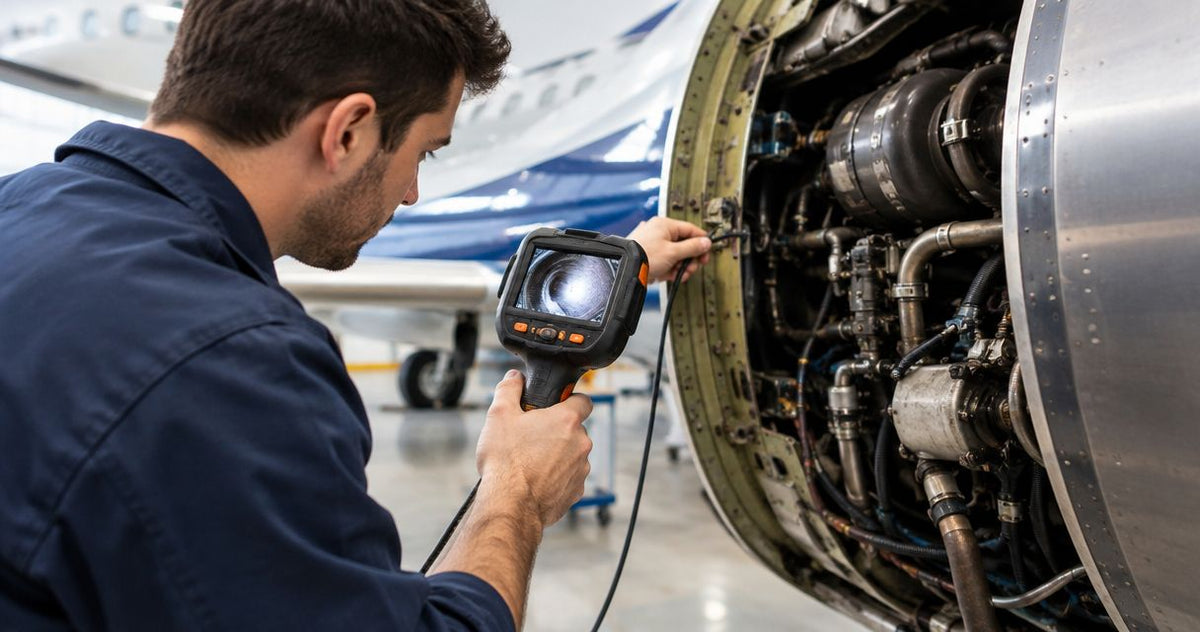
A small aviation repair shop needs a borescope that fits the port, turns the tip toward the surface and records what it sees, because a photo in the logbook settles more arguments than a verbal call. Pick a probe that clears the smallest access hole you work through, then add articulation, then add heat rating if you touch hot sections. Buy in that order and the price follows the job.
For most small shops the short answer is an articulating videoscope such as the VOYAGER M40, with the VOYAGER C40 high-temperature borescope as the step up when engine hot-section work is routine. A rigid borescope or a micro borescope covers the narrow jobs the articulating scopes do not. Fiberscope.net sells the products discussed here and services them in-house.
Start with the access port, not the brand
The smallest hole on your route sets the maximum probe outer diameter (OD), and everything else is secondary. On piston engines that hole is usually a spark plug port, which comes in 14 mm (0.55 in) and 18 mm (0.71 in) thread sizes. On turbine engines it is a borescope port in the case, and the engine manual specifies the port and the allowed probe size.
Write down four numbers before you shop:
- smallest port diameter on your engine types
- distance from the port to the farthest surface you must see (this sets working length)
- whether the tip must turn to look at a surface, or a straight or side view is enough
- temperature of the area at inspection time (cold engine or hot section)
The FAA publishes the inspection practices behind advisory circular AC 43-13, and your engine and airframe maintenance manuals override any general guide, including this one. Where a manual calls for a specific inspection method, follow the manual.
Why articulation matters in an engine
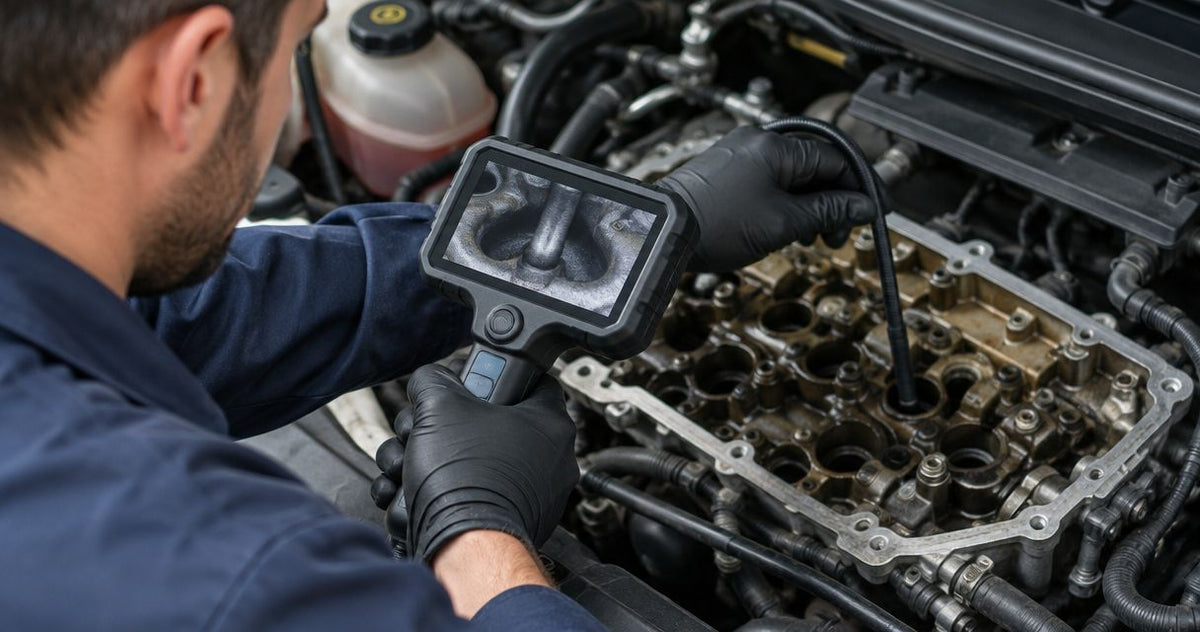
A straight probe sees what is in front of it. Cylinder walls, valve seats and blade roots sit at angles to the port, so the tip has to turn. The VOYAGER M40 has a 360° all-way joystick-controlled tip, and its probes are rated IP68. IP68 means protection beyond 1 m of immersion under the manufacturer's stated conditions, which in a shop mostly means you can wipe it down and work around oil and fuel residue.
The VOYAGER M40 records, and it starts from $4,160. That makes it the practical default for a shop running piston engines and light turbines. Verify the probe OD against your smallest port on the product page before ordering.
It will not handle a hot section. For that you want the C40.
When to step up to the high-temperature C40
The VOYAGER C40 is built for areas where simple borescopes fail from heat. Articulation depends on probe length: 4-way for 3.3–16 ft (1–5 m) probes and 2-way for 20–26 ft (6–8 m) probes. A small aviation shop rarely needs the long probes, but the 4-way short versions suit engine bays and exhaust-side inspection. It starts from $3,320.
Buy the C40 when hot-section or post-run inspection is a weekly task. If you only inspect cold engines between flights, the M40 does the same job for less.
Compare your options
| Option | Suits | Articulation | Starting price | Limit |
|---|---|---|---|---|
| VOYAGER M40 videoscope | General engine and airframe inspection | 360° all-way | from $4,160 | Not rated for hot sections |
| VOYAGER C40 high-temperature | Hot-section and exhaust-side work | 4-way (3.3–16 ft probes), 2-way (20–26 ft probes) | from $3,320 | Probe length decides articulation type |
| Rigid Borescope | Straight-line views through a fixed port | None | from $378 | Needs a light source and cannot turn corners |
| Super Thin Micro Borescope | Tiny passages, down to 0.04 in (1 mm) | None | from $1,750 | Small field, no tip control |
| Ultra Fine Micro Borescope | Extremely small inspection areas | None | from $3,520 | Same trade-off, higher image grade |
Prices checked at publication.
Rigid and micro borescopes cover the narrow jobs
A rigid borescope uses rod-lens relay optics and needs a light source through a light guide or handle. It gives a sharp, bright image down a straight bore, such as a fixed port or a cylinder through a spark plug hole with the right angle of view. It cannot bend, so if you need to see around a corner it is the wrong tool. At from $378 it is the cheapest way to look into a straight opening, and that is a fair first purchase for a shop that only does cylinder checks.
The Super Thin Micro Borescope starts at 0.04 in (1 mm) diameter and fits small passages and machined parts. Its optical image is clear but the field is narrow, and the tip does not articulate. Use it for small passages, fuel line fittings and small drilled holes.


A worked example: choosing for a three-engine shop
Take a shop that services a piston single, a piston twin and an occasional turboprop. The pistons need cylinder views through the spark plug holes, which means a tip that turns and a probe that clears the 14 mm port. The turboprop needs the case port size from its manual and, on post-flight inspections, heat tolerance.
That shop buys the VOYAGER M40 for the pistons and the general work, and adds a C40 only once turboprop post-run checks become regular. If budget is tight, a rigid borescope covers cylinder checks on the pistons for $378 until the M40 fits the budget.
For inspection method on a specific engine, read how to inspect an aircraft engine with a borescope. For compressor work, see checking a turbine compressor for FOD.
Document what you find
Pick a tool that records stills and video, then name each file with tail number, engine position and date. Nondestructive testing practice is covered by the American Society for Nondestructive Testing, and visual inspection is a recognized method within it. Your repair station's quality manual decides who may sign off a visual inspection, so check it before you rely on borescope footage as the record.
See the M40 and other Fiberscope.net systems in action on the Fiberscope.net YouTube channel.
What you will also need
- a light source or light handle if you buy a rigid borescope
- spare storage media for recordings
- a case that protects the probe from kinks, since a bent probe fails first at the bend
- a written inspection checklist per engine type
If you want a broader view of this tool class, the guide to best articulating borescopes compares models by tip control.
Common mistakes small shops make
- Buying by resolution alone. A sharp image from a probe that does not fit the port is useless.
- Skipping articulation. A straight probe cannot see a cylinder wall from a spark plug hole.
- Ignoring heat. A standard probe used on a warm engine shortens its life.
- Treating the borescope as a replacement for the manual. The maintenance manual sets the method and the acceptance limits.
- Overbuying. A shop with only straight-port checks does not need a $4,160 videoscope.
- For a borescope for small aviation repair shops, the VOYAGER M40 is the default: 360° articulation, recording, from $4,160.
- Choose the VOYAGER C40, from $3,320, when hot-section or post-run inspection is routine.
- A Rigid Borescope, from $378, covers straight-port checks like cylinders at the lowest cost.
- Match the probe OD to your smallest port before you compare anything else.
FAQ
What is the best borescope for a small aviation repair shop?
The VOYAGER M40 videoscope is the best general choice, with 360° tip articulation and recording from $4,160. Step up to the VOYAGER C40 only if you inspect hot sections regularly.
Do I need an articulating borescope for aircraft engines?
Yes for most engine work, because cylinder walls and blade roots sit at an angle to the port. A rigid borescope is enough only for straight views through a fixed port.
Can a borescope inspect a hot engine?
Only a high-temperature model such as the VOYAGER C40 is built for it. Standard probes should be used on cold or cooled engines.
What probe size do I need for a spark plug hole?
The probe OD must be smaller than the port, which is 14 mm (0.55 in) or 18 mm (0.71 in) in thread size on common aircraft piston engines. Check the probe OD on the product page against your smallest port.
Is a rigid borescope good enough for a small shop?
For straight-line views it is. At from $378 it is the cheapest entry, but it needs a light source and cannot turn corners.
Does the borescope replace the maintenance manual?
No. The manual defines the inspection method and acceptance limits, and the borescope only gives you the view.
Get a configuration review
Send your smallest port diameter, the distance to the farthest surface, whether you need turning views, the temperature of the area and how you record results, and a Fiberscope.net specialist will match the right probe and system. Use the contact page or call 1-877-613-2210, Mon–Fri 8:00–18:00 CST.
About the author
Vladimir Khubiryants, Founder & President, Fiberscope.net (MEDIT Inc.). Vladimir Khubiryants founded Fiberscope.net to give professionals access to reliable video inspection equipment without enterprise pricing. For over 20 years he has sourced and tested borescopes, sewer cameras and fiberscopes in Fiberscope.net's in-house test and repair facility, helping plumbers, pipeline engineers, aviation and military teams choose the right tool for the job. See our cameras in use on YouTube and Instagram.

Leave a comment
This site is protected by hCaptcha and the hCaptcha Privacy Policy and Terms of Service apply.