

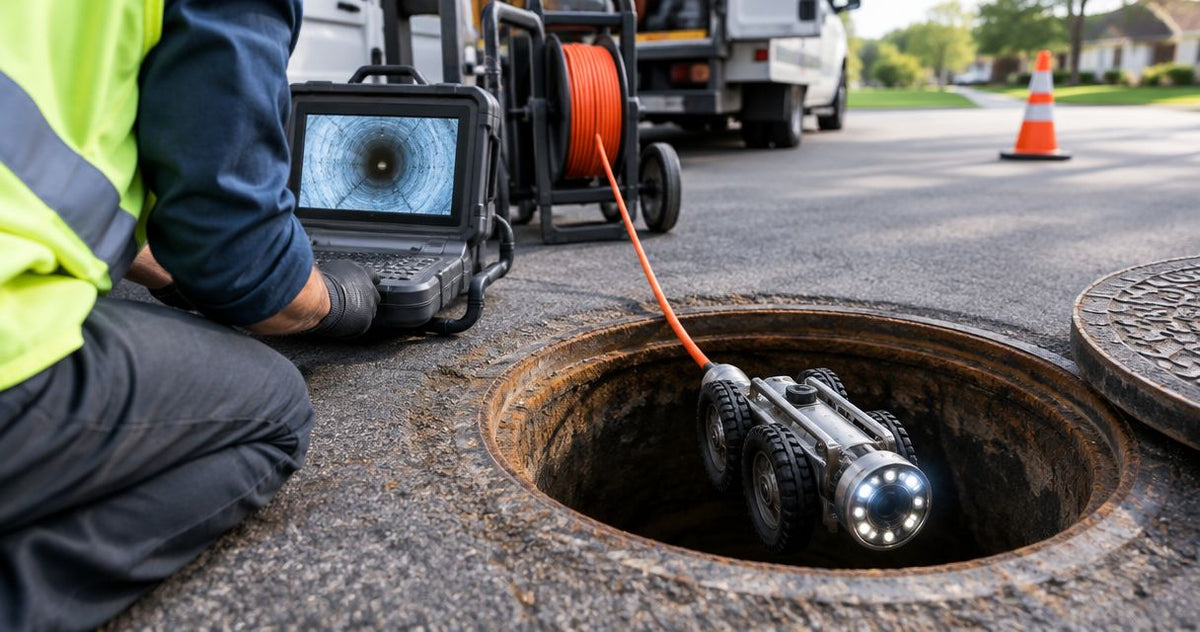
A sewer camera can launch into a lateral from the mainline when the head can be aimed at the lateral opening and the cable is stiff enough to push through the turn. A straight-view camera on a skid will keep travelling down the mainline and miss the branch.
Most laterals leave the mainline through a wye, a fitting with a branch that typically leaves at 45°. A camera that can pan and tilt can point at that branch, but the cable still has to carry the head around the turn and along the lateral. Fiberscope.net sells the cameras discussed here and services them in-house. For a lateral you can reach from its own cleanout, a smaller push camera is the cheaper and more reliable answer.
- A pan-and-tilt push camera such as the ANACONDA or iSnake can aim at a lateral opening from the mainline.
- Straight-view heads on skids, like the VIPER Mid 1-inch head, cannot aim and usually stay in the mainline.
- Put a 512 Hz sonde in the head and track it with a locator to mark where the lateral runs.
- If the lateral has its own cleanout, push from there instead of launching from the mainline.
Can a sewer camera launch into a lateral from the mainline?
Yes, with a pan-and-tilt head, a cable that pushes well around a turn and a lateral large enough for the head to enter. Without those three, the camera slides past the wye.
Three things decide whether the launch works:
- Aiming: the head must rotate and tilt toward the branch while the cable sits in the mainline.
- Head size against lateral size: the head must be smaller than the lateral it enters, with room to turn.
- Cable stiffness and length: the push cable must hold its line through the wye and still have reach left for the lateral.
A pan-and-tilt head changes the direction the camera looks. It does not propel the camera, and it does not steer the cable. You push from the access point, so the cable has to carry the head into the branch.
Which cameras can aim into a lateral
Fiberscope.net carries three push-camera families that cover most lateral work. Only the pan-and-tilt models can aim at a branch from the mainline.
| Camera | Head type | Built for | Price | Aims into a lateral from the mainline |
|---|---|---|---|---|
| Sewer Camera ANACONDA | Pan-and-tilt | Pipe inspection with a 512 Hz sonde in the head | from $6,990 | Yes |
| Pan-and-Tilt Drain Camera iSnake | Pan-and-tilt | Secondary laterals and drainage pipes | from $5,690 | Yes |
| Sewer Camera VIPER Mid | 1-inch straight view | Sewers, building piping, wells and chimneys | from $3,280 | No, it needs a lateral cleanout or a bend it can follow |
ANACONDA
The ANACONDA is a pan-and-tilt system with a 512 Hz sonde in the head, and its heads and reel are rated IP68. IP68 means protection beyond 1 m of immersion under the manufacturer's stated conditions. The sonde is what makes a lateral launch useful on a real job. Once the head is in the branch, a receiver can mark its position on the surface and show where the lateral runs.
This is the system for mainline work where you want to look into a branch and then follow it. It costs more than the other two, and the price includes the pan-and-tilt mechanism you are paying for.
iSnake
The iSnake is a pan-and-tilt drain camera made for secondary laterals and drainage pipes, which fits smaller lines better than a mainline unit. It records to USB. It has no sonde claim on its product page, so plan on finding the lateral some other way if you need it located.
VIPER Mid
The VIPER Mid runs a 1-inch straight-view head rated for 1.25–6 inch straight runs, with a 512 Hz sonde in the self-levelling 1-inch head, and records to SD and USB. It is the right tool for a lateral you can enter from a cleanout. It cannot point at a branch from the mainline. For 6-inch and larger mainlines, it will not make the turn into a wye on its own.


Why a lateral launch succeeds or fails
The head and the cable decide the outcome, and several site factors change it:
- Mainline diameter: a larger mainline gives the head room to swing toward the wye. A small mainline leaves little room to aim.
- Wye geometry: the turn into the branch is a change of about 45° at the fitting, then the lateral runs on at its own angle.
- Head diameter against lateral diameter: a head that fits a 6-inch lateral may jam in a 4-inch one.
- Cable stiffness: a flexible cable buckles at the junction instead of pushing the head through.
- Debris and offsets: roots, scale or an offset joint at the branch stop the head even when it aims correctly.
- Reach: the length used reaching the wye is not available for the lateral. See sewer camera reels, cable length and head compatibility before you size the reel.
A pan-and-tilt head also helps once you are inside the lateral. It lets you look up at a lateral joint or down at a belly without moving the cable, a point covered in Is a pan-and-tilt sewer camera worth it for mainline work.
Can you locate the lateral once the camera is inside?
Yes, if the head carries a sonde and you have a compatible receiver. A sonde is a small transmitter in the camera head, and the receiver picks up its signal at the surface. The ANACONDA and VIPER Mid heads carry a 512 Hz sonde. The SnapTrack locator reads 512 and 640 Hz, with 815 Hz and 33 kHz as options.
The locator finds the signal peak (strongest reading directly above the sonde) and the nulls (the signal minimum) on either side. Rebar and metal pipe distort the field, so treat a depth reading under heavy interference as an estimate. The pairing steps are in how to pair a 512 Hz sonde camera with a SnapTrack locator.
What a lateral launch cannot do
A push camera is not a crawler. Pan-and-tilt heads change the viewing direction, and skids center the head, but neither one drives the camera. Only a powered, self-propelled unit counts as a crawler.
So a launch from the mainline cannot:
- push the head into a lateral that is smaller than the head,
- force the cable around a hard offset or a collapsed joint,
- give you a dependable image when a mainline flow covers the branch opening.
When the lateral has a cleanout, going in from that cleanout is the faster route. You skip the wye, and a smaller camera does the job.
Which setup fits which job
- Mainline with several branches to check: the ANACONDA, with the 512 Hz sonde to mark each lateral.
- Smaller secondary laterals and drainage pipes: the iSnake, at the lower price.
- Single lateral with a cleanout: the VIPER Mid, pushed from the cleanout.
FAQ
Do I need a pan-and-tilt camera to launch into a lateral?
Yes, for a launch from the mainline. A straight-view head cannot point at the branch opening. A straight-view camera works when you enter the lateral from its own cleanout.
Can a push camera inspect a lateral from a manhole?
Only if the head can aim at the branch and the cable can be pushed through the wye. In practice that means a pan-and-tilt system, and the reach to the lateral depends on the cable length left after the mainline run.
Is a pan-and-tilt head the same as a crawler?
No. A pan-and-tilt head changes where the camera looks. A crawler is a powered, self-propelled unit that drives itself through the pipe.
Can I locate a lateral after launching a camera into it?
Yes, if the head carries a sonde. The ANACONDA and VIPER Mid heads carry a 512 Hz sonde, and a compatible receiver such as the SnapTrack finds it from the surface.
Does the iSnake have a locating sonde?
Its product page makes no sonde claim, so plan on another way to locate the lateral if you buy the iSnake.
Match the camera to your lateral
Send the mainline diameter, lateral diameter, run length, bends and whether you need locating, and a Fiberscope.net specialist will match the head and reel. Call 1-877-613-2210, Monday to Friday, 8:00 to 18:00 CST, or use the contact page on store.fiberscope.net. The same specialist can tell you whether renting or buying fits a single job.
About the author
Vladimir Khubiryants, Founder & President, Fiberscope.net (MEDIT Inc.). Vladimir Khubiryants founded Fiberscope.net to give professionals access to reliable video inspection equipment without enterprise pricing. For over 20 years he has sourced and tested borescopes, sewer cameras and fiberscopes in Fiberscope.net's in-house test and repair facility, helping plumbers, pipeline engineers, aviation and military teams choose the right tool for the job.

Leave a comment
This site is protected by hCaptcha and the hCaptcha Privacy Policy and Terms of Service apply.