

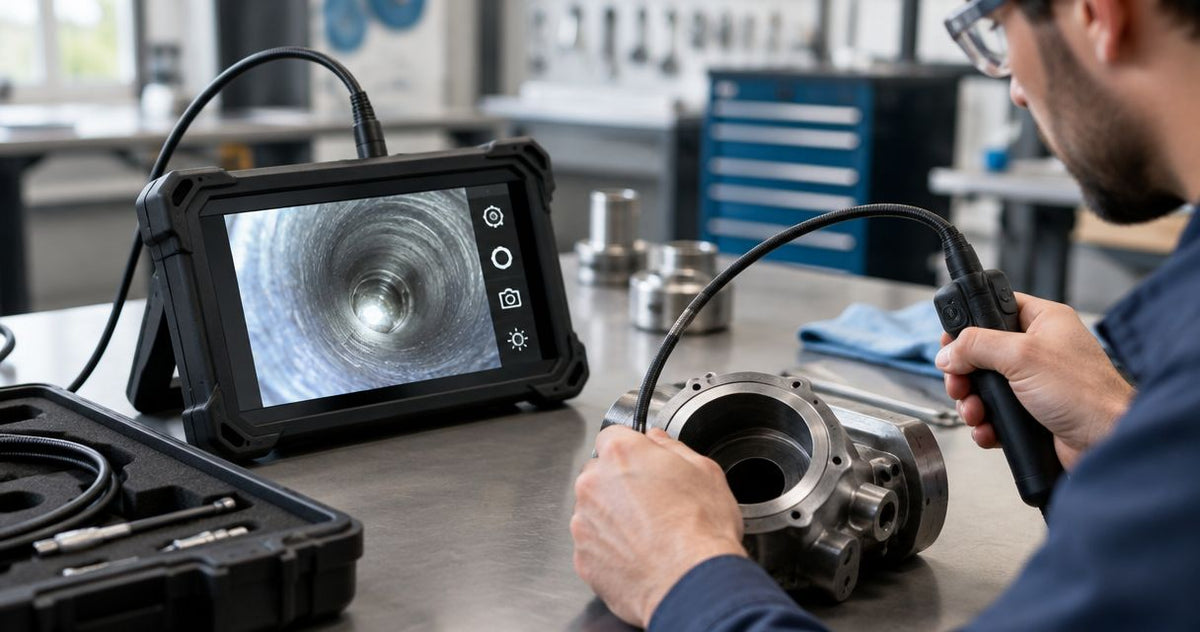
A rigid borescope starts at $378 for the Rigid Borescope offered by Fiberscope.net. The purchase decision is the complete inspection setup: a scope that reaches the surface, suitable illumination, and camera hardware when you need recorded evidence. For a straight inspection port in a casting, valve body or machined component, those requirements determine what belongs in your budget.
Start with access diameter, working length and viewing direction before choosing accessories. The Borescope LED Light Handle SPARK starts at $299, while the USB Borescope Camera starts at $900; they perform different jobs within an optical inspection setup. Fiberscope.net sells the products discussed and services them in-house.
By Vladimir Khubiryants, Founder & President, Fiberscope.net (MEDIT Inc.)
- Rigid borescope cost starts at $378 for the Rigid Borescope from Fiberscope.net.
- Budget the optical scope, illumination and recording hardware as separate parts of the inspection setup.
- Choose access diameter, working length and viewing direction before adding a camera.
- A USB capture camera connects to an optical scope; it has no inspection probe of its own.
How much does a rigid borescope cost to buy?
The Rigid Borescope starts at $378. That is the starting point for the optical instrument; the equipment needed for your job also depends on illumination, viewing and recording requirements.
A rigid borescope carries the image through rod-lens relay optics to an eyepiece. It needs illumination supplied through a compatible light guide or light handle. To show that optical image on a computer, you add a suitable capture camera and connection hardware.
Keep those functions separate when comparing quotations. A scope, a light handle and a capture camera are different components, even when each appears in searches for a borescope system.
| Component | Starting price | Function | Selection factor |
|---|---|---|---|
| Rigid Borescope | From $378 | Provides the optical inspection path | Access, working length and viewing direction |
| Borescope LED Light Handle SPARK | From $299 | Supplies illumination for an optical borescope | Light connection and inspection environment |
| USB Borescope Camera | From $900 | Adds Windows/USB image capture to a compatible optical scope | 1.26 in (32 mm) eyepiece and computer connection |
Compare complete configurations with the same inspection and recording requirements. A lower scope-only figure answers a different question from a quotation covering the scope, lighting and image capture.
The prices above identify separate components. Establish the contents of the selected configuration before treating any line as your complete equipment budget.
What belongs in the rigid borescope budget?
A rigid borescope budget has three functional parts: the optical instrument, illumination and the viewing or recording arrangement. Direct eyepiece inspection and computer-based documentation need different equipment.
The optical instrument
The Rigid Borescope starts at $378. Choose the instrument around the route from the access opening to the inspection surface, then consider how you will view and document the image.
For a straight machined passage, the important dimensions are the smallest restriction and the distance to the target. For a valve body or casting, viewing direction also matters: reaching the cavity and seeing the required face are separate requirements.
Write those requirements on the quotation request. An instrument that enters the opening but cannot show the target creates another equipment purchase or another inspection approach.
Illumination
The Borescope LED Light Handle SPARK starts at $299. It belongs in the illumination portion of the budget, separate from the optical scope and any capture hardware.
Light must reach the surface being inspected. A narrow passage, a dark cavity and a reflective machined surface present different viewing conditions, so assess illumination against the actual component rather than the brightness of the image at the access opening.
A light handle serves a different role from a camera. Choose the lighting connection and the viewing arrangement together so the assembled setup remains practical to hold and position.
Viewing and recording
The USB Borescope Camera starts at $900 and connects an optical scope with a 1.26 in (32 mm) eyepiece to a Windows/USB capture setup. It has no probe of its own.
For a technician who needs image files, this is a separate purchasing decision from the rigid scope. Include the computer, camera connection and file-handling requirements in the equipment plan.
For inspection work involving multiple people, also decide who needs to see the image during the examination. That changes how you arrange the workstation and position the component.


Why rigid borescope cost varies
The $378 starting price is useful for initial budgeting, but configuration depends on access, reach, viewing direction, illumination and evidence requirements. Compare those factors consistently across the equipment you are considering.
- Access diameter: Measure the smallest opening or restriction along the insertion path. Probe outside diameter, abbreviated OD, must clear that restriction.
- Working length: Measure from the accessible entry point to the target. Include any distance between the operator's hand position and the actual opening.
- Viewing direction: Identify whether you need to inspect ahead of the tip or toward an adjacent surface. This determines which optical arrangement serves the job.
- Illumination: Select a compatible light handle or light-source arrangement suited to the inspection space.
- Image evidence: Decide whether direct observation is sufficient or whether the job requires captured images for a work order, report or review.
- Environment: Describe temperature, fluids and contamination so the equipment configuration matches the conditions of use.
The useful comparison is functional. Two quotations should address the same access route, target surface and documentation requirement before their totals become meaningful.
How do you size a rigid borescope before requesting a price?
Use three geometry checks before selecting capture hardware: opening, route and target. Record the smallest restriction, the insertion distance and the surface you need to see.
This decision table gives you a practical specification worksheet. Fill it out for the component on the bench or the installed assembly, rather than relying on the nominal size of its outer housing.
| Check | What to record | How it affects the purchase |
|---|---|---|
| Opening | Smallest clear access diameter | Sets the maximum usable probe OD |
| Route | Straight access and any obstructions | Establishes whether a rigid instrument reaches the target |
| Reach | Entry-to-target distance | Sets the required working length |
| Target | Surface location relative to the probe | Determines viewing direction |
| Evidence | Observation, still images or video | Determines the viewing and capture arrangement |
| Environment | Temperature, liquid exposure and contamination | Determines the conditions the equipment must handle |
For example, a casting inspector examining an internal machined face needs both insertion clearance and a useful view of that face. A scope that reaches the cavity can still leave the required surface outside its view.
For gun-barrel work, measure against the land diameter, the narrowest diameter across the raised lands inside the bore. Nominal cartridge naming alone is an inadequate sizing worksheet. Use the gun-barrel borescope selection guide when the job centers on throat erosion, pitting or fouling.
When does an optical scope need a capture camera?
A capture camera is relevant when the inspection requires image files; the USB Borescope Camera starts at $900. For direct visual examination through an eyepiece, the purchasing focus remains the scope, lighting and physical access.
Specify the evidence before choosing electronics. A maintenance work order might need an image identifying the component and the observed condition. A repeat inspection also benefits from a consistent entry point and viewing position.
A useful evidence plan includes:
- A component or asset identifier.
- The inspection location and access point.
- The surface or feature being examined.
- An image filename tied to the work order.
- Notes describing the observation and the next action.
Capture hardware records the optical view. Positioning, illumination and a clear view of the surface remain part of the inspection work.
If computer viewing is central to your setup, read the USB borescope connection guide before arranging the workstation.
What should you reuse from an existing inspection setup?
A compatible 1.26 in (32 mm) eyepiece is one requirement for the USB Borescope Camera. Existing lighting, cameras and connection hardware belong on the configuration worksheet alongside the new scope.
Record the model and interface of each component you already own. Include the eyepiece, camera attachment, light connection and computer arrangement, then identify which parts the new configuration needs.
This keeps the quotation focused on the actual purchase. It also gives the technician assembling the system a clear picture of how the scope, illumination and capture components will work together.
Keep optical condition in the review. A dirty viewing surface or damaged component deserves attention before you add electronics to the setup.
Which buying mistakes create extra work?
A $378 starting price is a budget entry, while access and the required image determine whether the equipment serves the job. Resolve geometry first and accessories second.
Choosing from the access opening alone. Measure the complete insertion route. An internal restriction can control probe selection even when the entry port looks generous.
Treating reach as visibility. Identify the target face and required viewing direction. Insertion length answers how far the instrument reaches; the optical arrangement determines what appears in view.
Adding recording hardware before defining the evidence. Decide who needs the files, where they will be stored and how they will be identified. That gives the capture setup a clear purpose.
Leaving lighting until the end. Include illumination in the original equipment plan. A complete optical arrangement needs a suitable light path as well as an image path.
Applying one configuration to every job. A straight machined passage, a gun barrel and a cavity behind an obstruction present different access and viewing requirements. Write separate job requirements when those conditions differ.
FAQ
Can I buy just a rigid borescope and use equipment I already own?
You can build the purchase around existing compatible equipment. Record the light connection, eyepiece, camera attachment and viewing arrangement so the new scope fits the assembled setup.
Does the IP in the USB Borescope Camera address mean internet viewing?
The USB Borescope Camera is a Windows/USB capture camera for an optical scope with a 1.26 in (32 mm) eyepiece. IP in its product address does not mean internet, Wi-Fi or remote viewing.
Can I use a rigid borescope to inspect an engine cylinder?
Inspect a cold engine through the spark-plug opening, with probe clearance and a viewing direction suited to the target. Side view is useful for cylinder-wall inspection; access and the required surface determine the instrument arrangement.
Should I choose a rigid borescope for an inspection route with turns?
Choose a flexible or articulating instrument when the insertion route requires turns. A rigid borescope serves a straight access route, with its viewing direction selected for the target surface.
Can Fiberscope.net help with a short-term inspection job?
Fiberscope.net offers buying, rental and demo options. Describe the job and required configuration when discussing a short-term inspection.
What support is available after buying inspection equipment?
Fiberscope.net provides in-house testing, repair and technician support, with a one-year warranty. Include service requirements when choosing equipment for recurring inspection work.
Request a configuration review
Send your access opening, straight or turning route, insertion length, viewing direction, environment and recording requirements. Include the lighting and capture equipment you already own so a Fiberscope.net specialist can match the inspection setup to the job. Call 1-877-613-2210.
About the author
Vladimir Khubiryants, Founder & President, Fiberscope.net (MEDIT Inc.)
Vladimir Khubiryants founded Fiberscope.net to give professionals access to reliable video inspection equipment without enterprise pricing. For over 20 years he has sourced and tested borescopes, sewer cameras and fiberscopes in Fiberscope.net's in-house test and repair facility, helping plumbers, pipeline engineers, aviation and military teams choose the right tool for the job.


Leave a comment
This site is protected by hCaptcha and the hCaptcha Privacy Policy and Terms of Service apply.