

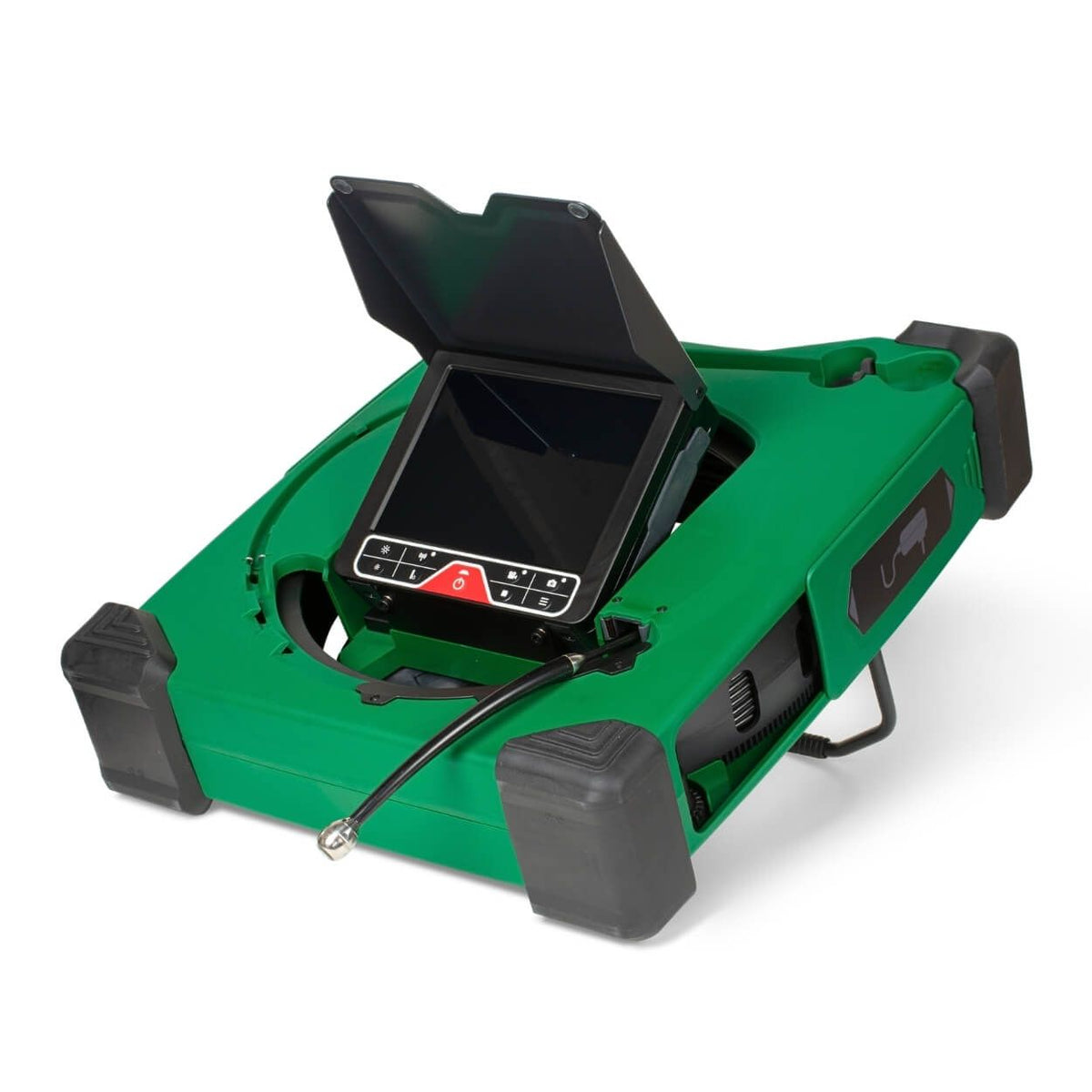
Choose a sewer camera for tight drains by the smallest fitting and the turns it must pass, then choose the cable length. For a 1¼-inch PVC P-trap or repeated 90° elbows in 1½-inch pipe, the MiniFlex 2 19mm Small Drain Camera Extended Set is the stronger fit; for a less restrictive 1½–4-inch route with phone-based viewing, consider the Wi-Fi Drain Camera HATHORN Micron.
- MiniFlex 2 19mm suits tight PVC traps and repeated small elbows; passage depends on pipe condition.
- HATHORN Micron suits 1½–4-inch drains and phone-based viewing, with 100 ft of push cable.
- A sewer camera for tight drains needs suitable head-and-neck geometry, not just a long reel.
- Both cameras have a 512 Hz transmitter; locating requires a separate matching receiver.
Why a straight-pipe rating is not a trap rating
A camera head that enters a straight pipe can stop at the next elbow. The head, neck and cable must follow the fitting together. Pipe ID means inside diameter; head OD means outside diameter. The nominal pipe size alone does not describe the opening left by scale, debris or an offset joint.
The MiniFlex 2 19mm Small Drain Camera Extended Set addresses restricted turns with its Flexi-Tube neck. The Wi-Fi Drain Camera HATHORN Micron combines a 1-inch head with a 100-ft reel and mobile viewing. They solve different access and recording needs. Neither is a universal camera for every drain and sewer.
For plumbers, the distinction affects kitchen and bath branches, toilet and floor drains, pool and spa lines, and laterals inspected after cleaning or repair. A camera selected for a straight outdoor lateral is not automatically suitable for the trap inside the building.
1. Measure the access before comparing cameras
Start with the entry point you will actually use. A cleanout, a removed fixture and a pool-line opening give the head different approaches to the same pipe. Measure the clear opening and note anything the complete head assembly must pass.
Do not use head diameter as proof that a fitting is passable. A longer rigid head or a larger guide can change the clearance even when the lens housing fits. The relevant measurement is the assembly entering the pipe, not just the cable behind it.
Record these details before choosing a system:
- The access opening and nominal pipe size.
- The smallest known reduction or fitting.
- Whether the head starts at a cleanout, fixture or exposed pipe.
- Pipe material and visible scale or debris.
- Whether access can be changed if the first route is blocked.
Choose around the restriction, not the largest pipe on the route. A 4-inch lateral beyond a small branch does not remove the branch's access problem.
2. Separate a P-trap from a single elbow
The MiniFlex 2 19mm Small Drain Camera Extended Set is specified for a 1¼-inch PVC P-trap and multiple 90° bends in 1½-inch pipe. Its flexible neck is central to those applications. The product description states that maneuverability is condition-dependent.
The Wi-Fi Drain Camera HATHORN Micron is specified for 1½–4-inch drains and passage through a 1½-inch bend. That is not the same claim as passing a 1¼-inch trap or several tight elbows in succession. Choose MiniFlex for those specific restricted routes rather than assuming that both systems have equal bend performance.
Map the route with these distinctions:
- A straight section is different from a turn of the same pipe size.
- A P-trap requires more than one change in direction.
- Several consecutive elbows create a different route from a single elbow.
- PVC and heavily scaled metal pipe do not offer the same clear passage.
- Toilet trapways vary; no camera should be promised to pass every installed toilet.
Fiberscope.net's MiniFlex P-trap demonstration shows an earlier MiniFlex passing a small PVC trap. It demonstrates the bend application, not the current set's cable lengths or display specification.
3. Choose cable length from the pipe route
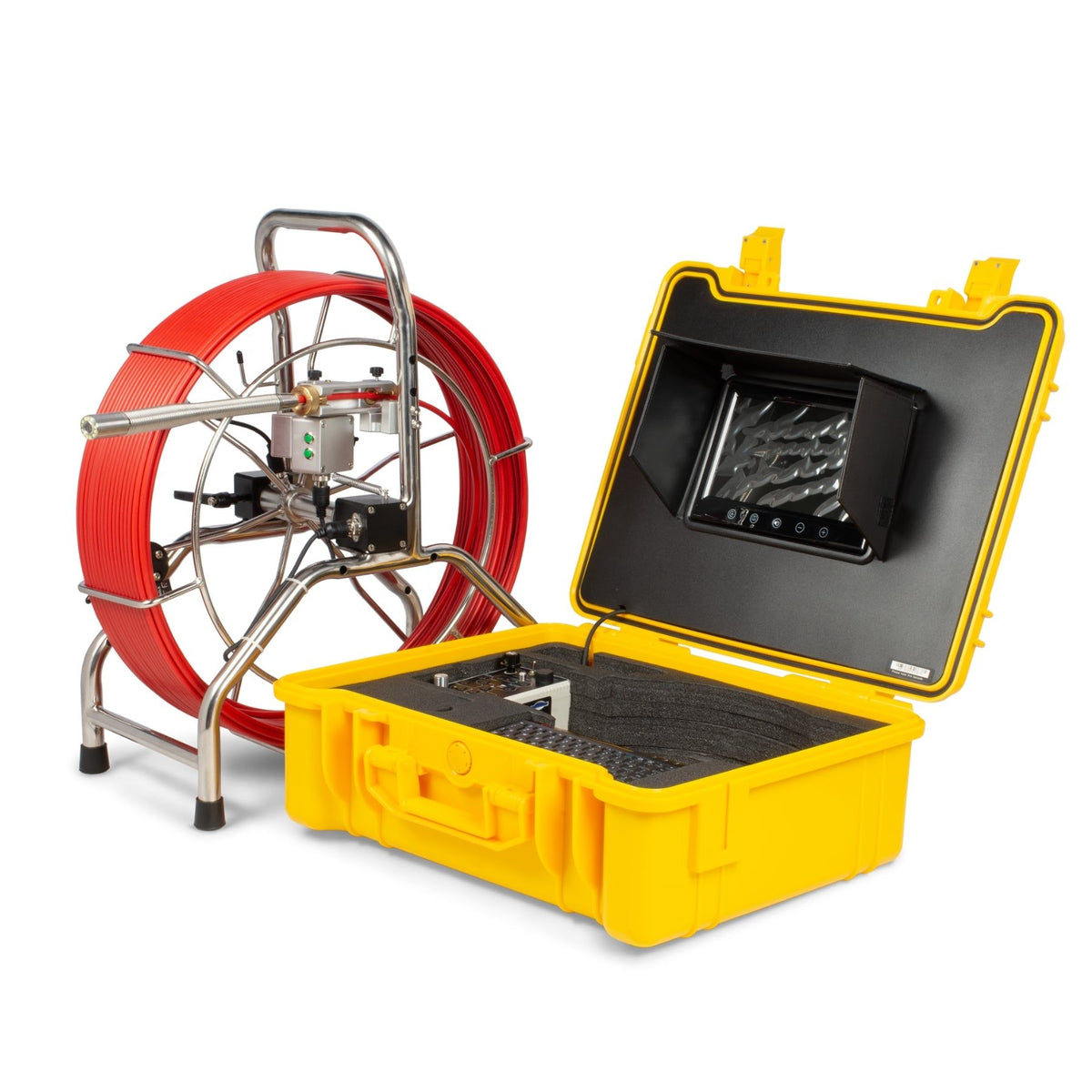
MiniFlex 2 19mm has 20 m and 40 m cable configurations. HATHORN Micron carries 100 ft. Those figures describe cable available on the reel, not a guaranteed inspection distance through every obstruction.
Measure along the pipe route from the access point to the farthest feature that needs footage. The straight distance across a yard is not the same measurement. Include the portion needed to see beyond a suspected defect, provided the route remains passable.
Before selecting the reel:
- Identify the farthest inspection point.
- Include the approach from the reel to the access opening.
- Account for changes in direction along the pipe.
- Check whether the job is a short branch inspection or a longer lateral inspection.
- Keep passage and reach as separate decisions.
For a known route longer than 20 m, the shorter MiniFlex reel cannot cover the inspection. The 40 m option provides more cable, but it does not make a collapsed section or an impassable turn accessible. A longer reel cannot compensate for the wrong head and neck.
4. Decide how you will record and hand over evidence
MiniFlex 2 19mm includes an 8-inch touchscreen and records photos, video and audio to SD. A footage counter, text overlay and on-site playback support a record of where a finding appears. Its listed rechargeable-battery runtime is up to 7 hours.
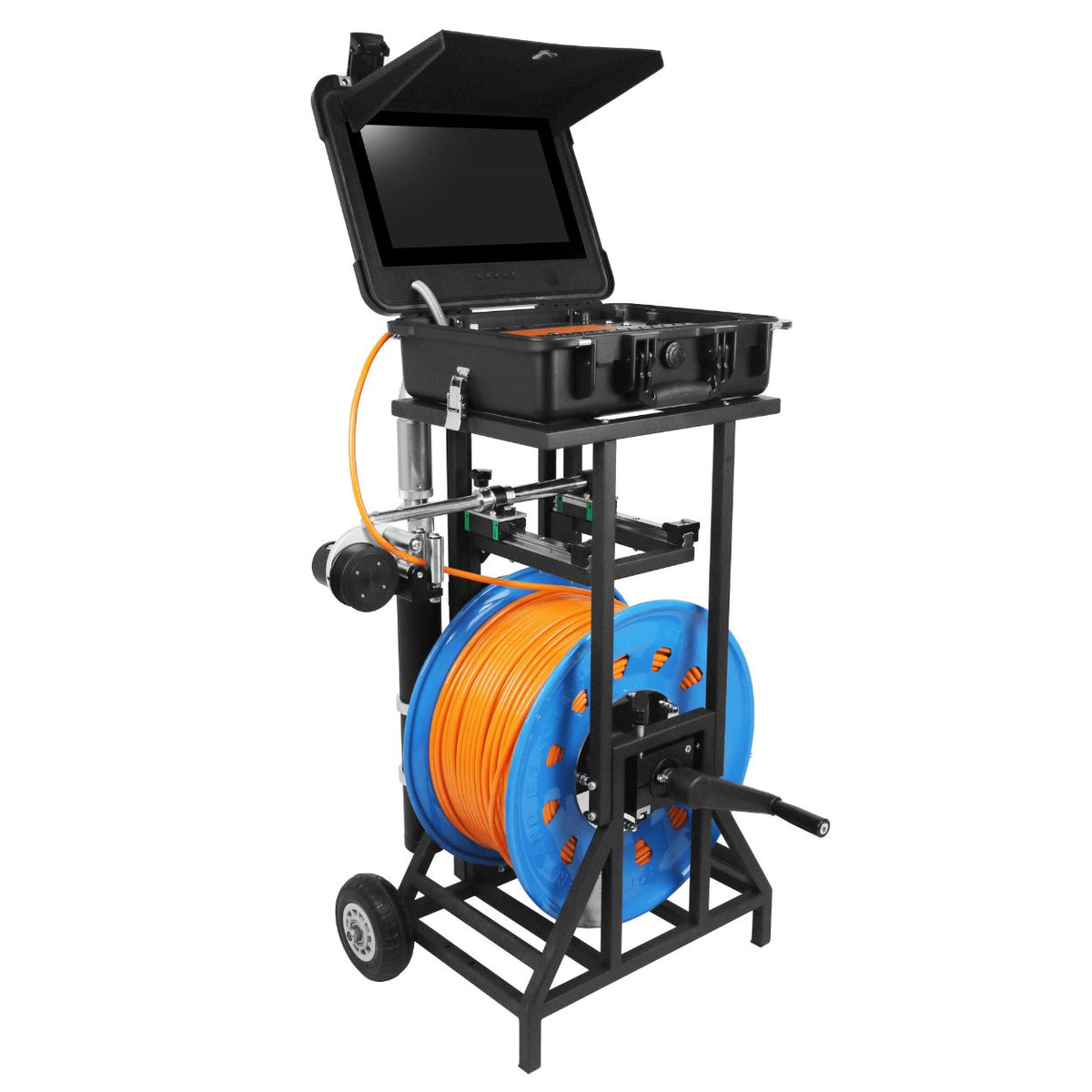
HATHORN Micron produces its own Wi-Fi signal for a compatible phone or tablet. The app provides live viewing, photo and video capture, storage and replay without requiring an internet connection. The system uses an 18 V Milwaukee battery or equivalent; the battery and mobile device are not included. The store specifies Android 12 or Apple iOS 15 and above for the app.
Choose the recording setup by the way your crew works:
- Use a supplied screen if you want the viewing equipment in the camera case.
- Check phone or tablet compatibility before choosing app-based viewing.
- Plan battery power and device storage for the inspection.
- Establish a distance-counter reference at the access point.
- Record the pipe, access point and finding, not an unidentified clip.
For a post-jetting inspection, the useful evidence is the condition left after cleaning. For a pre-purchase sewer scope, the record should identify the inspected route and visible limitations. A camera records images; it does not generate a complete condition assessment by itself. NASSCO's Building Sewer and Drain Inspection and PACP courses distinguish footage collection from consistent condition coding and reporting.
5. Match the transmitter to a separate receiver
Both the MiniFlex 2 19mm and HATHORN Micron have a 512 Hz sonde, the small transmitter in the camera head. To find that head from the surface, you need a separate receiver that supports 512 Hz. A camera with a sonde is not a complete locating setup on its own.
The transmitter marks the head's position, not every part of the pipe automatically. Rebar, metal pipe and other interference distort the field. Do not turn a displayed depth into a promise of exact excavation depth.
Specify locating as a separate requirement:
- State whether locating is needed at all.
- Record the receiver model and supported frequency.
- Match the head's 512 Hz signal to the receiver's 512 Hz setting.
- Note reinforcement and metal along the likely route.
- Keep the locating result separate from the footage-counter distance.
The footage counter measures deployed cable; the receiver estimates the transmitter's position from its field. Those are different measurements. Fiberscope.net can match the camera and receiver configuration when locating is part of the job.
Compare MiniFlex 19mm and HATHORN Micron
| Decision | MiniFlex 2 19mm Small Drain Camera Extended Set | Wi-Fi Drain Camera HATHORN Micron |
|---|---|---|
| Best for | Tight PVC traps and repeated small elbows | Less restrictive 1½–4-inch drains with mobile viewing |
| Head and route | Flexible neck; specified for 1¼-inch PVC P-traps and repeated 90° bends in 1½-inch pipe | 1-inch head; specified for a 1½-inch bend |
| Cable | 20 m or 40 m | 100 ft |
| Viewing | Included 8-inch touchscreen | Compatible phone or tablet, supplied separately |
| Capture | Photo, video and audio to SD | Photo and video through the app |
| Power | Rechargeable battery; up to 7 hours listed | 18 V Milwaukee battery or equivalent, supplied separately |
| Locating | 512 Hz head transmitter; receiver separate | 512 Hz head transmitter; receiver separate |
| Main limitation | Passage depends on fitting geometry and condition | No equivalent claim for a 1¼-inch P-trap or repeated small elbows |
MiniFlex 2 19mm strengths: specific small-trap and repeated-elbow applications, a supplied screen, SD recording and text overlay. MiniFlex 2 19mm limits: condition-dependent passage and a choice of cable length that must match the job. Its tight-bend role does not make it the default for larger mainlines.
HATHORN Micron strengths: 100 ft of cable, approximately 16 lb system weight and a phone-based recording arrangement. HATHORN Micron limits: a larger head than the MiniFlex small-drain configuration, no equivalent repeated-elbow claim, and separate mobile-device and battery requirements. Hathorn's manufacturer overview describes its camera range and dealer/repair network.
Complete-system prices and product photos
Prices checked September 30, 2026, in USD. MiniFlex prices below cover its 20 m and 40 m configurations. Compare the operating package as well as the camera: HATHORN Micron still needs the separate device and battery described above.


Avoid these small-drain camera buying mistakes
- Buying on reel length first. The camera must pass the route before extra cable becomes useful.
- Treating one bend rating as every trap rating. A single 1½-inch bend is not a 1¼-inch PVC P-trap.
- Assuming a fitted skid improves tight clearance. A skid centers a head; it does not reduce the assembly's outside diameter or propel it.
- Calling the whole system waterproof. MiniFlex's camera and cable are rated to 3 bar; HATHORN Micron's head is IP68 to 60 psi. Those ratings do not cover every component.
- Expecting footage to prove a hidden cause. Record visible defects and obscured sections honestly. A camera is not a pressure test or a drain-cleaning tool.
IEC's explanation of ingress-protection ratings describes how enclosure ratings distinguish resistance to dust and water. Apply the rating to the named component, not the whole camera setup.
FAQ
What is the best sewer camera for a 1¼-inch PVC P-trap?
MiniFlex 2 19mm Small Drain Camera Extended Set is specified for that application. Its flexible neck also supports repeated 90° bends in 1½-inch pipe, but pipe condition affects passage.
Can HATHORN Micron pass a 1½-inch bend?
Yes, its product description specifies a 1½-inch bend. That does not establish passage through a 1¼-inch P-trap or several consecutive tight elbows.
Which MiniFlex cable length should a plumber buy?
Choose the 20 m or 40 m configuration from the measured pipe route and the farthest inspection point. Cable capacity is not a guaranteed push distance through obstructions.
Does HATHORN Micron need internet to show live video?
No. HATHORN Micron produces its own Wi-Fi signal for a compatible phone or tablet. The device and battery are separate from the supplied camera system.
Can either camera locate a head under a concrete floor?
Both have a 512 Hz transmitter and require a separate matching receiver for locating. Rebar and nearby metal distort the field, so exact position or depth cannot be promised.
Will MiniFlex pass through every toilet without removal?
No. Toilet trapway geometry differs, and pipe condition can restrict passage. Choose the access point and fitting geometry before promising an inspection route.
Does a small head make a camera suitable for a large sewer?
Not by itself. Head clearance, lighting, cable reach and the view of the wall must match the larger pipe. A tight-bend camera is not automatically the best lateral or mainline camera.
Related guides
- Compare drain cameras for a plumber's wider workload
- Understand 512 Hz locating beneath pavement
- Compare VIPER Mid and RIDGID rM200A for larger laterals
Match the system to the route
Fiberscope.net recommends MiniFlex 2 19mm for the documented tight PVC trap and repeated-elbow applications; HATHORN Micron suits a less restrictive route when mobile viewing is preferred. For occasional work, consider a rental or demo before buying a camera for an unfamiliar fitting.
Send Fiberscope.net your pipe ID, access opening, run length, bends or traps, pipe material, locating requirement and existing receiver frequency, plus recording and report needs. A specialist will match the head and reel to the job. Call 1-877-613-2210.
Vladimir Khubiryants
Founder & President, Fiberscope.net (MEDIT Inc.)
Vladimir Khubiryants founded Fiberscope.net to give professionals access to reliable video inspection equipment without enterprise pricing. For over 20 years he has sourced and tested borescopes, sewer cameras and fiberscopes in Fiberscope.net's in-house test and repair facility, helping plumbers, pipeline engineers, aviation and military teams choose the right tool for the job.

Leave a comment
This site is protected by hCaptcha and the hCaptcha Privacy Policy and Terms of Service apply.