

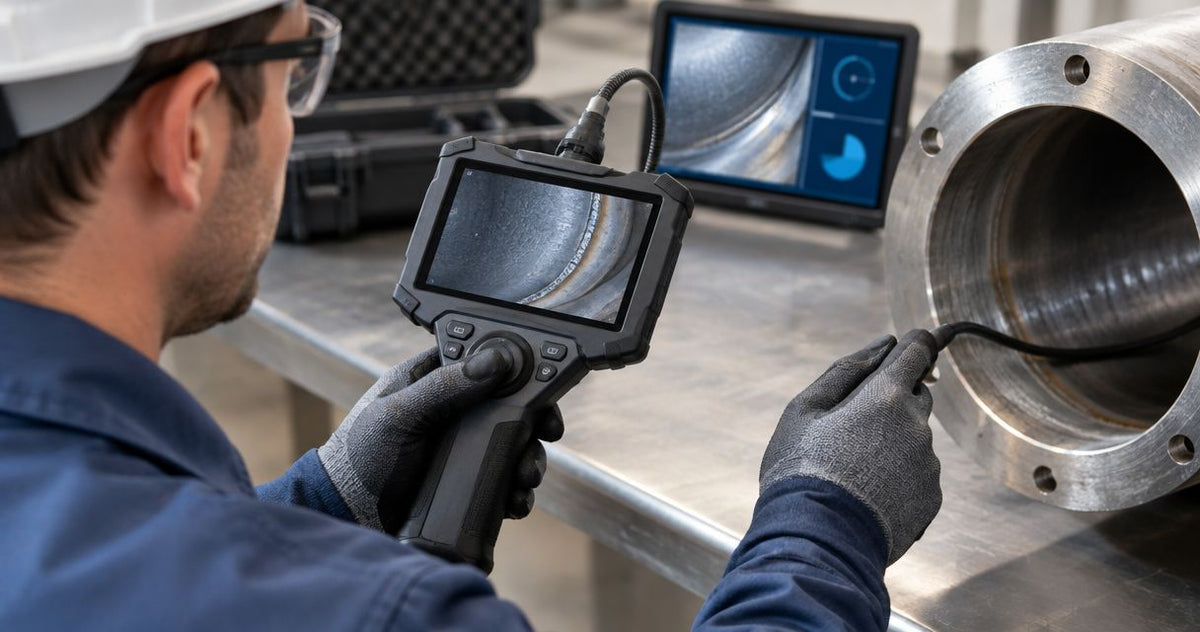
A weld that looks clean on the outside can hide a lack of fusion, a burn-through or porosity on the root side. A casting can hide shrinkage in a bore you cannot see into. A borescope gets a camera to those surfaces without cutting the part open, but the wrong one stops at the access port, points the wrong way or fogs in heat. This guide sorts borescopes by access size, direction of view, articulation and temperature so you can match one to the weld or casting in front of you.
For most pipe, tube and vessel weld work, an articulating videoscope such as the VOYAGER M40 is the first tool to pick. The VOYAGER C40 covers hot parts, a rigid borescope covers straight bores where image sharpness matters, and 1 mm class micro scopes cover small cast passages. Fiberscope.net sells the products discussed here and services them in-house. For wider context, see the industrial borescope guide.
What a borescope can and cannot tell you about a weld
A borescope gives you a visual inspection only: surface condition, bead profile, root penetration, spatter, undercut, surface cracks and discoloration. It does not detect subsurface flaws. Ultrasonic, radiographic and magnetic particle methods, as defined by standards bodies such as ASNT, remain the tools for internal volume defects. Use the borescope to see the surface you cannot reach, and document it.
Four numbers decide fit:
- Probe outer diameter (OD): it must clear the smallest opening in the route, including fittings and weld drop-through.
- Working length: the distance from the access port to the weld, along the actual path, not in a straight line.
- Direction of view and articulation: a weld seam runs along a wall, so a forward-only view looks at the end of the pipe instead of the bead. Articulation or a side view turns the camera toward the wall.
- Environment: heat, oil and moisture. Check the rating of the specific part that enters the part.
How the picks were ordered
The sections below run from most flexible to most specialized: articulating videoscopes first, then high temperature, rigid, and then the micro class. Each pick is judged by the four numbers above. Prices are the store listing prices, checked September 29, and shown as from-prices.
- Pick the probe OD first: it must clear the smallest opening on the route.
- Choose articulation or a side view when the weld runs along a wall.
- VOYAGER C40 is the pick for hot parts; VOYAGER M40 for general weld work.
- Rigid borescopes suit straight bores; micro scopes suit passages near 1 mm.
Comparison at a glance
| Borescope | Type | Articulation | Environment rating | From |
|---|---|---|---|---|
| VOYAGER M40 | Video articulating videoscope | 360° all-way joystick | Probes IP68 | — |
| VOYAGER C40 | High-temperature videoscope | 4-way on 3.3–16 ft (1–5 m) probes; 2-way on 20–26 ft (6–8 m) probes | — | $3,320 |
| Rigid Borescope | Rod-lens optical | None | — | — |
| Ultra Fine Micro Borescope | Optical fiberscope | None | — | $3,520 |
| Super Thin Micro Borescope | Optical micro borescope | — | — | $1,750 |
| MICRON | USB micro video borescope | — | — | $11,100 |
VOYAGER M40: general weld inspection with a joystick head
The VOYAGER M40 videoscope has a 360° all-way joystick and IP68-rated probes. That articulation is what makes it the default for weld work: you push the probe to the joint, then bend the tip until the bead fills the screen instead of pointing at the far end of the pipe.
It suits pipe and tube welds, tank seams reached through a manway or port, and casting bores that bend. It will not fit openings smaller than its probe OD, so check that figure against your access port before ordering. For passages that narrow, move to the micro class below.
VOYAGER C40: weld and casting inspection on hot parts
The VOYAGER C40 is the high-temperature videoscope, from $3,320. It has 4-way articulation on 3.3–16 ft (1–5 m) probes and 2-way articulation on 20–26 ft (6–8 m) probes. Choose it for furnace tubes, exhaust and boiler components, and freshly welded parts that have not fully cooled.
The longer probes give up two articulation axes, so a long reach to a weld on a bend costs you some control of the view. If the weld is within 16 ft (5 m) and hot, the 4-way probe is the better configuration.
Rigid Borescope: sharpest image for straight bores
The Rigid Borescope uses rod-lens relay optics and needs a light source, supplied by a light guide cable or a handle. With no flexible tip, it only reaches weld surfaces visible down a straight line, such as a drilled bore, a cylinder or the straight section of a pipe.
Where the route is straight, rod lenses give a cleaner image than a small flexible camera head. Where the route bends, it stops. The MS-LED light source, from $1,490, is the matching illumination for a rigid or fiber scope, and the SPARK LED light handle, from $299, is the compact alternative for field work. For the full rigid category, read the rigid borescope comparison.
Ultra Fine and Super Thin Micro Borescopes: small cast passages
When the opening is around the size of a drill point, a video head will not fit. The Ultra Fine Micro Borescope, from $3,520, is a premium fiberscope for extremely small inspection areas. A fiberscope carries the image on a coherent bundle of fibers, so image detail is set by the pixel count of the bundle. It has no articulation, so you see what is in front of the tip.
The Super Thin Micro Borescope, from $1,750, starts at 1.0 mm (0.04 in) diameters and is the lower-cost choice for machined parts and small cast cross-holes. For the Fiberscope.net range of these, see the micro borescope guide.
Both are optical, so they need a light source and a way to show the image on screen. That is the next section.


MICRON: USB micro video borescope for tiny bores
The MICRON, from $11,100, is a micro video borescope built for ultra-thin bores with a diameter of 1.1 mm (0.04 in) and outputs live video over USB 3.0 and HDMI. It is the choice when you need recorded evidence from a passage too small for the VOYAGER probes, and the price reflects that niche. If you only need to look, not record, the optical micro scopes above cost far less.
What you'll also need
An optical rigid borescope or fiberscope shows its image through an eyepiece. To record it, add a camera:
- ImagePRO USB 3.0 Camera, from $1,270: live video to a computer and capture.
- ImagePRO HDMI Camera, from $1,580: HDMI output to a monitor. It does not capture video.
- USB Borescope Camera, from $900: a Windows USB capture camera for an optical scope with a 32 mm (1.26 in) eyepiece.
- Universal Borescope Video Coupler, from $250: joins the eyepiece and the camera body.
These are accessories, not scopes. None has a probe of its own.
Sizing: match the scope to the opening
| Access situation | Starting point |
|---|---|
| Bend or turn between port and weld, port larger than the probe | VOYAGER M40 |
| Hot part or recently welded joint | VOYAGER C40 |
| Straight, drilled bore | Rigid Borescope |
| Passage near 1 mm (0.04 in) | Super Thin Micro Borescope |
| Passage near 1 mm (0.04 in), recording required | MICRON |
If the opening is smaller than any of these probe ODs, the right answer is a smaller scope or a different inspection method, not a tighter squeeze.
Common mistakes
- Choosing for reach and forgetting the OD at the narrowest fitting.
- Using a forward-view scope on a seam that runs along the wall.
- Treating a clean video as proof of a sound weld. It proves the surface looks sound.
- Taking a standard probe into heat that the VOYAGER C40 exists for.
Other options
When measurement of a flaw is required, the Evident IPLEX and Waygate Mentor Visual iQ videoscopes are the aerospace and industrial standard for measurement, and they are stronger than any scope above on that single point. Check each manufacturer's US product page for current models.
FAQ
Can a borescope find a crack inside a weld?
A borescope finds cracks that reach the surface you can see. Cracks buried inside the weld volume need ultrasonic, radiographic or magnetic particle testing.
What probe diameter do I need for a weld inspection?
The probe OD must be smaller than the narrowest opening on the route. For passages near 1 mm (0.04 in), use the Super Thin Micro Borescope or the MICRON.
Which borescope works on hot welds?
The VOYAGER C40 is the high-temperature videoscope in the range, with 4-way articulation on 3.3–16 ft (1–5 m) probes.
Do I need articulation to inspect a weld?
Yes when the seam runs along a wall. Without articulation or a side view, the camera looks along the pipe instead of at the bead.
Can I record video from a rigid borescope?
Yes. Add a camera such as the ImagePRO USB 3.0 and a coupler, and record from the optical eyepiece to a computer.
Get a configuration review
Send us the smallest opening in your route, the length to the weld, any bends, the temperature of the part and whether you need recorded evidence, and a Fiberscope.net specialist will match the probe and head. Use the contact page on store.fiberscope.net or call 1-877-613-2210, Monday to Friday, 8:00 to 18:00 CST.
Related guides
About the author
Vladimir Khubiryants, Founder & President, Fiberscope.net (MEDIT Inc.). Vladimir Khubiryants founded Fiberscope.net to give professionals access to reliable video inspection equipment without enterprise pricing. For over 20 years he has sourced and tested borescopes, sewer cameras and fiberscopes in Fiberscope.net's in-house test and repair facility, helping plumbers, pipeline engineers, aviation and military teams choose the right tool for the job.

Leave a comment
This site is protected by hCaptcha and the hCaptcha Privacy Policy and Terms of Service apply.