

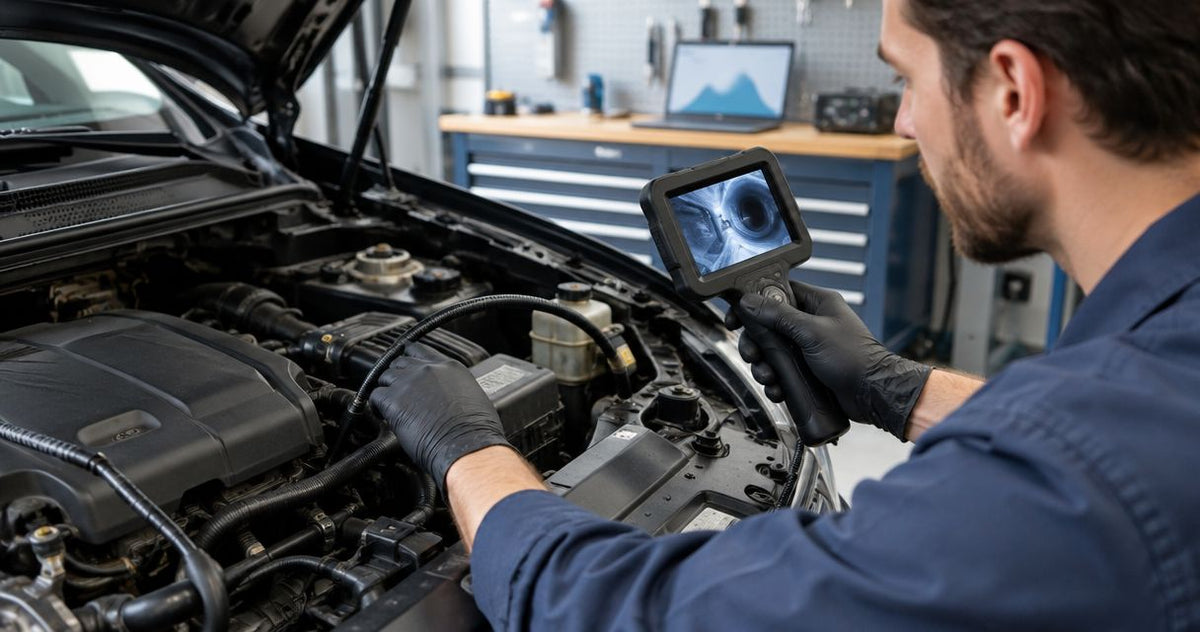
A mechanic reaches for a borescope when the answer is inside the engine and teardown costs hours: scoring on a cylinder wall, carbon on an intake valve, a dropped bolt in a timing cover. A consumer scope gets you the first look. It tends to run out when the tip needs to turn, the cable gets handled all day, or the camera dies mid-job.
The best Teslong alternative for automotive inspection depends on whether you need to steer the tip. The VOYAGER M40 is the pick when you do (360° all-way joystick articulation, IP68-rated probes). The MICRON suits the tightest openings, and the Under Vehicle Inspection Camera covers undercarriage work. Fiberscope.net sells the products discussed here and services them in-house, so weigh the comparison with that in mind. For a wider look at the category, see our guide to video borescopes for automotive mechanics.
- Teslong alternatives for automotive inspection start with one question: does the tip need to articulate?
- VOYAGER M40 has 360° all-way joystick articulation and IP68-rated probes, built for daily shop use.
- MICRON outputs live video over USB 3.0 and HDMI for very small openings.
- Under Vehicle Inspection Camera starts from $580 and covers undercarriage views, not engine internals.
- Stay with a Teslong-class scope if you open an engine a few times a year.
How to size a borescope for engine work
The probe outer diameter (OD) must be smaller than the narrowest opening it has to pass, and the tip must be able to look somewhere other than straight ahead. Spark-plug holes are commonly threaded 0.55 in (14 mm) or 0.47 in (12 mm), so the clear passage is smaller than the thread size.
Cylinder bores are straight. A fixed forward-looking probe dropped through a spark-plug hole sees the piston crown and little else. To see the cylinder wall, valve seats or the far side of the chamber, you need articulation (a tip that bends on command) or a side-view head. Inspect a cold engine; a hot cylinder will damage the probe and the cable jacket.
For the jobs that drive most automotive purchases:
- Cylinder walls and piston crowns: scoring, carbon, coolant traces after a suspected head-gasket failure.
- Intake valves on direct-injection engines, reached through the intake port, where carbon builds because fuel no longer washes the valves.
- Timing components behind covers and parts dropped into cavities.
- Rust inside frames and body panels, catalytic converter and exhaust internals, fuel tanks.
Teslong alternatives at a glance
| Tool | Best for | Standout feature | How it differs from Teslong |
|---|---|---|---|
| Teslong (consumer class) | Occasional lookups on a budget | Phone app over Wi-Fi, under $300 | Baseline |
| VOYAGER M40 | Daily engine work | 360° all-way joystick articulation, IP68 probes | Professional articulation and service |
| MICRON | Very small openings | USB 3.0 live video and HDMI out | Wired output to a computer or screen, no Wi-Fi app |
| C35 Infrared Tactical Borescope | Dark cavities | Infrared illumination, mechanical all-way articulation | Low-light illumination for visual inspection |
| Under Vehicle Inspection Camera | Undercarriage checks | Infrared, from $580 | Looks under a vehicle or trailer, not into an engine |
Where Teslong stops
Teslong makes cheap, Wi-Fi-app-based scopes, and for a shop that checks one cylinder a month that is a reasonable purchase. The ceiling shows up in three places: probe durability under daily handling, the quality of articulation, and service when something fails. A scope that lives in a service bay gets bent, dragged across fenders and dropped. Consumer cable jackets and tip assemblies are not built for that.
The Wi-Fi link is also a workflow limit. A phone app is fine for a quick look, but a shop that wants video saved against a work order wants a recording workflow it controls.
VOYAGER M40: the full-time shop scope
The VOYAGER M40 steers its tip through 360° with a joystick, and its probes are rated IP68. That combination is what an engine job needs. You can pass the probe through a spark-plug hole, bend the tip to look at the cylinder wall, then swing it across to the piston crown without pulling the scope out. It records video, so a scored bore or a carbon-covered valve goes into the customer file instead of staying in your head.
Where it shines:
- All-way articulation reaches walls and valve seats that a fixed probe cannot see.
- IP68 probes tolerate oil, coolant and fuel residue during cleanup.
- Built as a professional tool with in-house testing and repair behind it.
Where it falls short:
- It is a professional-class purchase. For a few lookups a year, a consumer scope is the cheaper and honest answer.
- Probe OD must be checked against the smallest opening on the job before you buy.
The M40 suits technicians who inspect engines weekly. Read how articulation changes what you can see in our guide to articulating borescopes.
MICRON: very small openings, wired video
The MICRON micro video borescope outputs live video over USB 3.0 to a computer and over HDMI to a monitor. Choose it when access is the problem and a wired, stable image is acceptable.
It does not replace the M40 on engine work that needs the tip steered. If your job is steering around a bore, buy the M40. If your job is getting a camera into a small opening and viewing it on a laptop or monitor, the MICRON is the tool.
C35 Infrared Tactical Borescope: dark cavities
The C35 adds infrared illumination for low-light visual inspection and has mechanical all-way articulation. It suits dark cavities where white light washes out. The C35 is not a thermal camera. It cannot show heat loss or find a hot spot, so do not buy it for that.
Under Vehicle Inspection Camera: undercarriage, from $580
The Under Vehicle Inspection Camera starts from $580 and is built to see under a vehicle or trailer. It is infrared-equipped. It is not an engine borescope: you cannot put it through a spark-plug hole. Add it when your work includes undercarriage, exhaust runs and frame checks, and pair it with a borescope for the inside. For frame and panel rust inspection, see how collision shops choose a borescope in this guide.
Why mechanics move off consumer scopes
The reasons are practical and specific: probe durability, articulation that can reach a cylinder wall, and a service path when the scope fails. A mechanic who rents out bay time by the hour cannot wait on a mail-in replacement of a sealed consumer unit.
Common mistakes
- Buying on camera resolution alone. A sharp image of the piston crown is no help when the probe cannot reach the wall.
- Skipping the OD check. Measure the smallest opening on your typical job first.
- Inspecting a hot engine. Wait until it is cold.
- Using an infrared-illumination scope as a thermal camera.
When to stay with Teslong
If you open an engine a few times a year, price matters more than service, and a phone screen is enough, a Teslong-class scope is the right tool. Buy up when the scope is in your hand every week.
FAQ
What is a good alternative to Teslong for engine inspection?
The VOYAGER M40 is the strongest step up, with 360° all-way joystick articulation and IP68-rated probes. It lets you steer the tip through a spark-plug hole to see cylinder walls and valve seats.
Can a borescope see a cylinder wall through a spark-plug hole?
Yes, with an articulating tip or a side-view head. Spark-plug holes are commonly 0.55 in (14 mm) or 0.47 in (12 mm) thread, so the probe OD must clear the hole. A fixed forward-looking probe sees the piston crown only.
Should I inspect a hot engine with a borescope?
No. Inspect a cold engine. Heat damages the probe and cable jacket, and a cold cylinder is easier to read.
Is the C35 Infrared Tactical Borescope a thermal camera?
No. The C35 uses infrared illumination for low-light visual inspection. It does not show surface temperature or detect heat loss.
Can the Under Vehicle Inspection Camera inspect the inside of an engine?
No. It is built to see under a vehicle or trailer and starts from $580. Use an articulating borescope for engine internals.
Match the scope to your shop
Send us the smallest opening you inspect, the engines you work on, how many jobs a week you run, and whether you need video saved to the work order. A Fiberscope.net specialist will match the probe and articulation to the job. Call 1-877-613-2210, Monday to Friday, 8:00 to 18:00 CST, or use the contact page on store.fiberscope.net.
About the author
Vladimir Khubiryants, Founder & President, Fiberscope.net (MEDIT Inc.). Vladimir Khubiryants founded Fiberscope.net to give professionals access to reliable video inspection equipment without enterprise pricing. For over 20 years he has sourced and tested borescopes, sewer cameras and fiberscopes in Fiberscope.net's in-house test and repair facility, helping plumbers, pipeline engineers, aviation and military teams choose the right tool for the job.

Leave a comment
This site is protected by hCaptcha and the hCaptcha Privacy Policy and Terms of Service apply.