

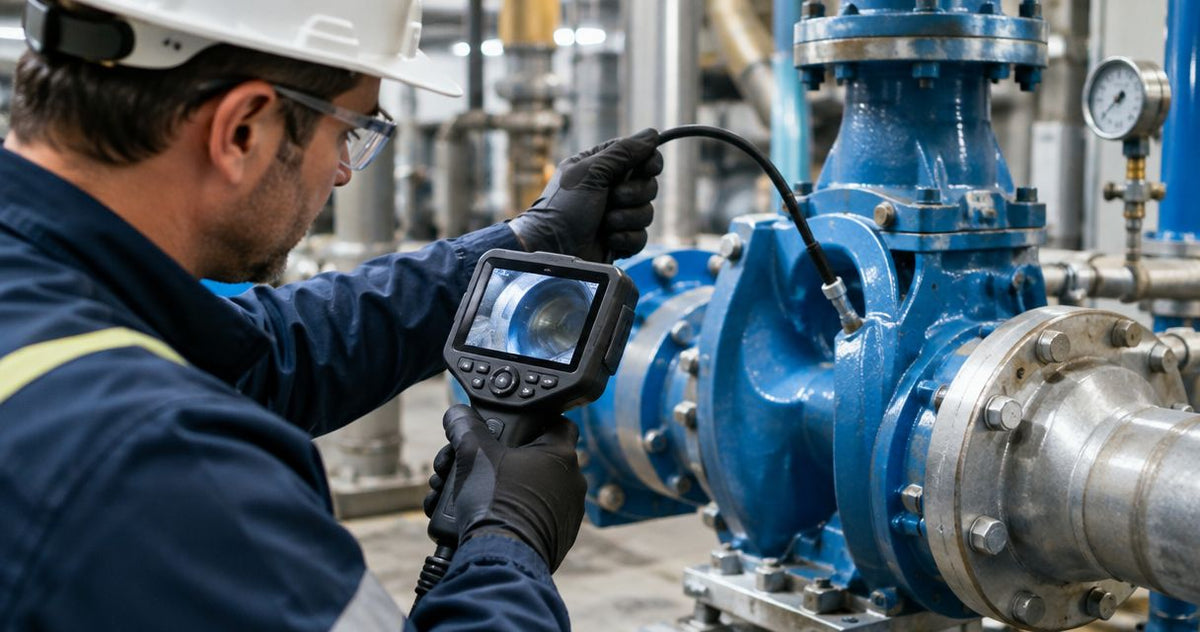
A borescope earns its place on a maintenance cart the first time it saves a pump teardown. The catch is the access. A drain plug, a gauge port and a removed bonnet are three different openings, and a probe that fits one will not fit the next. Buy by port size first, then by articulation, heat and recording.
For most pump and valve work, the VOYAGER C40 high-temperature videoscope is the all-round pick, and the micro borescopes (Super Thin, Ultra Fine, MICRON) cover ports too small for any articulating head. Fiberscope.net sells every product discussed here and services them in-house.
How to size a borescope to a pump or valve port
The smallest opening on your route sets the maximum probe diameter, and the route sets whether you need articulation. Measure the port, then decide how the probe has to turn once it is inside the casing or valve body.
| Access you have | Typical job | Probe class |
|---|---|---|
| Small drain, vent or gauge port | Look at the volute wall or impeller edge from outside | Micro borescope, 1.0 mm (0.04 in) class |
| Drilled pilot or instrument passage | Check for scale and blockage | Ultra-fine fiber probe |
| Straight port with a clear line of sight | Seat face or bore wall | Rigid borescope with a light source |
| Open flange or removed cover | Seats, plugs, impeller vanes at an angle | Articulating videoscope |
| Hot casing | Inspect before cooldown | High-temperature videoscope |
An articulating head helps when the target sits off-axis, such as a valve seat behind the plug or an impeller vane behind the eye. A micro probe wins when the opening itself is the limit. If you also run turbines or gearboxes, the industrial borescope guide covers that wider range.
- Measure the smallest opening on the route first; it caps the probe diameter.
- VOYAGER C40 is the all-round pick: 4-way articulation on 3.3-16 ft (1-5 m) probes.
- Micro borescopes from 1.0 mm (0.04 in) reach gauge and vent ports an articulating head cannot enter.
- Rigid borescopes need a separate light source and a straight line of sight.
The picks compared
The table lists complete systems and optical scopes that can look inside a pump or valve. Prices checked September 29.
| Pick | Type | Articulation | Price from | Video output |
|---|---|---|---|---|
| VOYAGER C40 | High-temperature video borescope | 4-way (3.3-16 ft / 1-5 m probes); 2-way (20-26 ft / 6-8 m probes) | $3,320 | Recording, media not stated |
| Rigid Borescope | Rod-lens rigid scope | None | — | Needs a camera |
| Super Thin Micro Borescope | Optical micro scope, from 1.0 mm (0.04 in) | — | $1,750 | Needs a camera |
| Ultra Fine Micro Borescope | Optical fiber scope | None | $3,520 | Needs a camera |
| MICRON | Micro video borescope | — | $11,100 | USB 3.0, HDMI |
VOYAGER C40: the all-round pick for hot pumps and valve bodies
The VOYAGER C40 is a high-temperature video borescope with 4-way articulation on probes from 3.3 to 16 ft (1 to 5 m) and 2-way articulation on 20 to 26 ft (6 to 8 m) probes. It is priced from $3,320.
That articulation is what matters in a valve body. You can park the probe in the bore, bend the tip toward the seat and read the sealing face without pulling the valve. In a pump casing you can turn toward the impeller vanes instead of staring at the wall opposite the port. The high-temperature build suits equipment you cannot let cool for a full shift.
The limit is size. It does not replace a 1.0 mm (0.04 in) micro probe where the only opening is a small gauge port. For general-purpose articulating options beyond this one, see the articulating borescope guide.
Super Thin Micro Borescope for gauge and vent ports
The Super Thin Micro Borescope starts at 1.0 mm (0.04 in) diameter and is priced from $1,750. It is the lowest-cost way into openings too small for a video borescope probe. If the job is to look through a vent or gauge port at the inside of a casing, this is the tool.
The line is an optical micro borescope, so you pair it with a light source and a video camera to see the image on a screen or record it. It has a small field of view and no articulation worth planning around. Plan the shot by positioning the probe, not steering it.
Ultra Fine Micro Borescope for small drilled passages
The Ultra Fine Micro Borescope is a premium fiber scope for extremely small inspection areas, priced from $3,520. It has no articulation. A small drilled passage or an instrument line that you need to check for scale or blockage is the right use.
Pick it over the Super Thin when fiber image quality in a narrow bore matters more than the lower price. Both need a light source and camera.
MICRON for documented micro-bore work
The MICRON micro video borescope outputs USB 3.0 and HDMI, so it plugs straight into a laptop or monitor without a separate camera. It is priced from $11,100.
That is the highest price here, and it makes sense only when a micro probe job has to be recorded and handed to a customer or a quality file. If you just need to look, the Super Thin plus a camera costs far less.
Rigid Borescope for straight-line views
The Rigid Borescope uses rod-lens relay optics, which give a sharp, bright image through a straight port. It needs a light source, either through a light guide cable or a light handle, and a camera if you want to record.
Choose it for bore walls and seat faces where you have a clear line of sight and no bends. It cannot turn, so it is the wrong tool for anything behind a plug or around a casing curve.


Other options
When the job calls for on-screen measurement or a full aerospace-grade workflow, Evident IPLEX and Waygate Mentor Visual iQ videoscopes are the established standard, and they cost well above anything in this guide. For occasional pump checks with a large access opening, a consumer handheld inspection camera from Teslong or Depstech is cheaper, though it lacks the probe durability and service of a professional videoscope.
What you'll also need
The optical scopes (Rigid, Super Thin, Ultra Fine) show nothing on a screen by themselves. Budget for these:
- A video camera: ImagePRO USB 3.0 from $1,270 (live video to a computer), or ImagePRO HDMI from $1,580 (HDMI display only, no capture).
- A universal borescope video coupler, from $250, to attach the camera to the eyepiece.
- A light source: the SPARK LED light handle from $299, or the MS-LED light source from $1,490.
- A fiber optic light guide cable if you use the MS-LED.
Common mistakes
- Ordering by the biggest probe the budget allows. The smallest port on the route sets the limit.
- Forgetting the light and camera when buying an optical scope.
- Picking a rigid scope for a route with any bend.
- Inspecting a hot casing with a probe not built for heat.
- Skipping recording. A photo of a worn seat settles a repair-or-replace argument in seconds.
For cast and welded housings, the weld and casting inspection guide covers the surface defects you will see on pump bodies.
FAQ
What is the best borescope for pump and valve inspection?
The VOYAGER C40 high-temperature videoscope is the all-round pick, with 4-way articulation on 3.3-16 ft (1-5 m) probes. It is priced from $3,320. Use a micro borescope instead when the port is too small for it.
What probe size do I need for a pump gauge port?
Measure the port first; the probe must be smaller than the narrowest point on the route. The Super Thin Micro Borescope starts at 1.0 mm (0.04 in) and is the entry choice for small ports.
Do I need articulation to inspect a valve seat?
Usually yes, if the seat sits off the axis of the port. A rigid borescope works only where you have a straight line of sight to the seat face.
Can I inspect a hot pump casing with a borescope?
Yes, with a high-temperature unit such as the VOYAGER C40. Standard probes are not built for hot equipment.
Do micro borescopes record video?
The Super Thin and Ultra Fine are optical scopes and need a separate camera. The MICRON outputs USB 3.0 and HDMI directly.
Can I rent a borescope before buying?
Yes. Fiberscope.net offers buy, rent or demo, so you can test a probe on your own equipment first.
Get the right head matched to your equipment
Send Fiberscope.net your smallest access opening, probe route and bends, working length, operating temperature and whether you need recording, and a technical specialist will match the probe to the pump or valve. Call 1-877-613-2210, Monday to Friday, 8:00 to 18:00 CST, or use the contact page on the store.
About the author. Vladimir Khubiryants founded Fiberscope.net to give professionals access to reliable video inspection equipment without enterprise pricing. For over 20 years he has sourced and tested borescopes, sewer cameras and fiberscopes in Fiberscope.net's in-house test and repair facility, helping plumbers, pipeline engineers, aviation and military teams choose the right tool for the job.

Leave a comment
This site is protected by hCaptcha and the hCaptcha Privacy Policy and Terms of Service apply.