

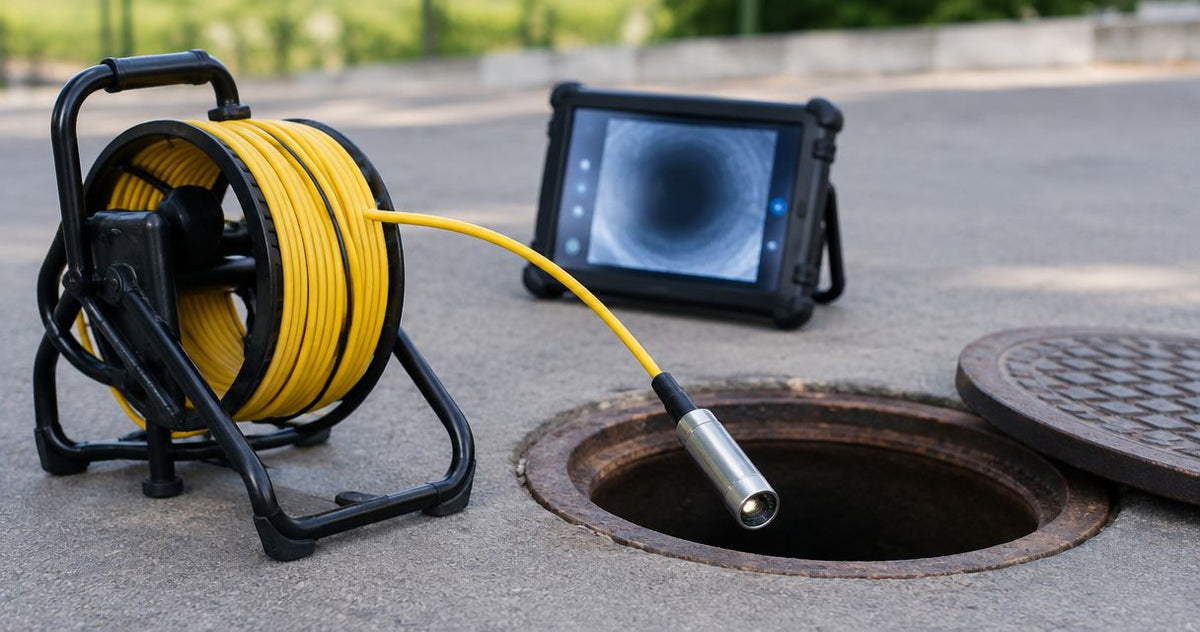
A sewer camera's sonde cannot be located without a receiver. The sonde is a small transmitter in the camera head that emits a 512 Hz signal, and only a locator tuned to that frequency can read it from the surface. With no receiver you are limited to estimating position from the cable you have paid out.
For 512 Hz cameras, the two receivers Fiberscope.net sells are the SnapTrack Sewer Camera Sonde Locator (512/640 Hz, optional 815 Hz and 33 kHz), from $1,390, and the Schonstedt 512Hz Sonde Locator (XT512), from $1,693. Fiberscope.net sells both and services them in-house.
- A sewer camera sonde cannot be located without a receiver; the signal is invisible to the surface without one.
- Locating takes three parts: a camera with a sonde in the head, a receiver tuned to its frequency, and an operator walking the line.
- SnapTrack covers 512/640 Hz, with optional 815 Hz and 33 kHz; the XT512 covers 512 Hz plus passive 50/60 Hz.
- Without a receiver, estimate position from cable paid out and expect an error of several feet.
Can a sewer camera's sonde be located without a receiver?
No. A sonde (also called a beacon or transmitter) is a coil in the camera head that broadcasts a low-frequency signal, 512 Hz on most drain cameras. Nothing at the surface detects that signal until a receiver tuned to the same frequency picks it up.
Locating a camera head takes three parts:
| Part | What it does | Example |
|---|---|---|
| Sonde in the camera head | Transmits a fixed frequency from inside the pipe | 512 Hz in the VIPER 1-inch self-levelling head |
| Receiver (locator) | Picks up that frequency at the surface and shows signal strength | SnapTrack, XT512 |
| Operator | Walks the line and finds the point of strongest signal | Peak/null technique |
If any one is missing, you have a camera that shows the pipe interior but cannot tell you where on the surface the defect sits.
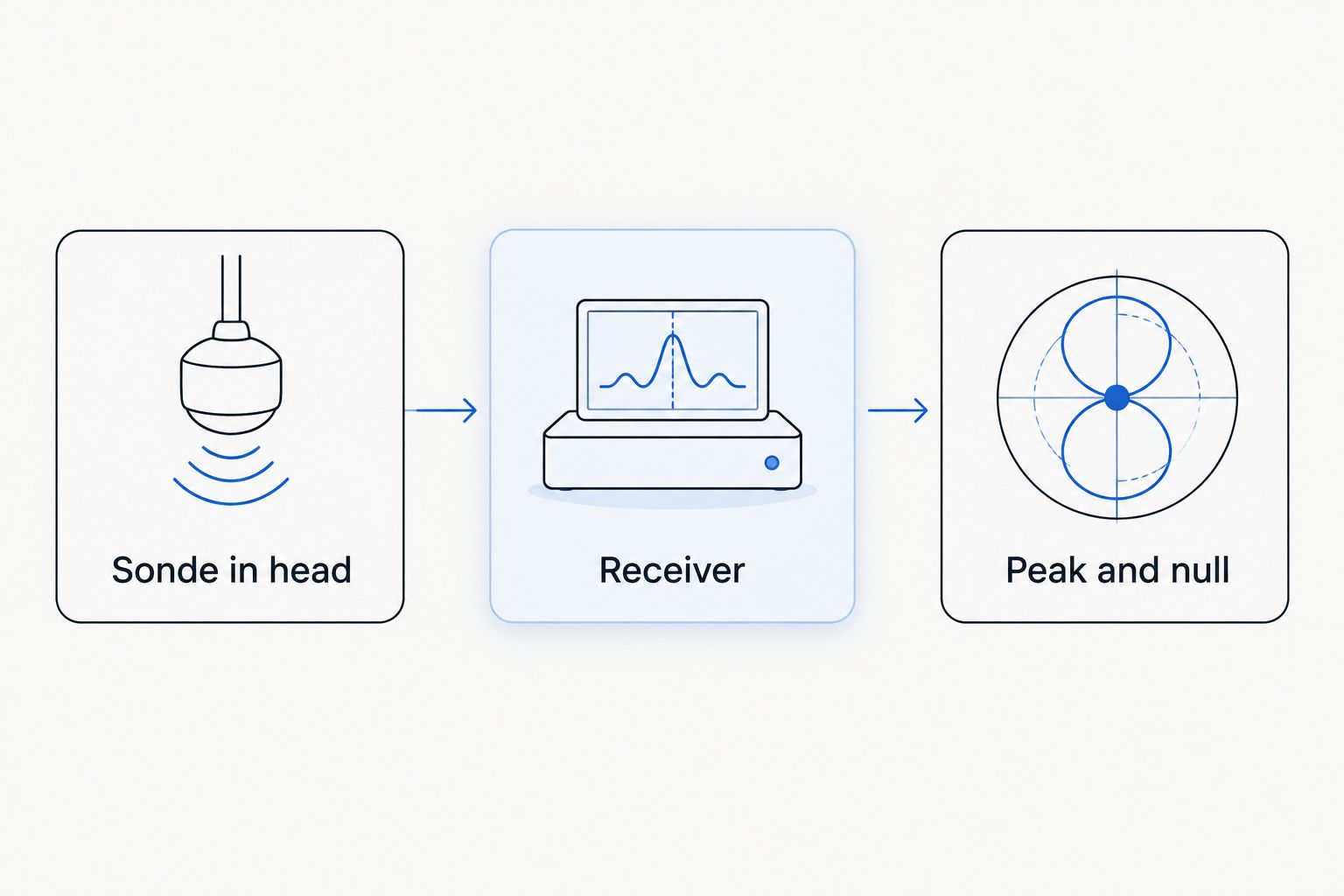
How a receiver finds the sonde: peak and null
The receiver reads the sonde's field in two ways. Directly over the sonde the signal reaches its peak. At the sides it drops to a null, a sharp minimum, which gives a second confirmation point. An operator walks the line, finds the peak, checks it against the nulls on either side, and marks the spot with paint or a flag.
This is why a receiver is not optional. The sonde's field is a few feet wide at most, and it carries no visible or audible marker at the surface.
512 Hz sonde heads that need a receiver
A camera has to carry a sonde before any receiver is useful. The Fiberscope.net range with a 512 Hz sonde in the head:
- ANACONDA and ANACONDA MID
- MiniFlex 2 19mm and MiniFlex 2 36mm
- HATHORN Micron, Mini and Mid
- ColorEye and ColorEye PT
- STRAHL PT
- VIPER and VIPER Mid, 1-inch (25 mm) self-levelling head only
The VIPER Mid's 1-inch head is rated for 1.25 to 6 inch straight runs. The smaller VIPER heads and the 0.67-inch and side-view heads carry no sonde, so a VIPER bought for locating needs the 1-inch self-levelling head.
SnapTrack receiver: 512 and 640 Hz
The SnapTrack is a wand-style receiver listed at 512 and 640 Hz, with optional 815 Hz and 33 kHz. It reads the 512 Hz sondes above and, with the optional frequencies, extends to other camera brands you may meet on a job. It is from $1,390 and made in the USA by Rycom.
It is a receiver only. It is not a camera and not a transmitter, so it does nothing alone. The setup steps are in how to pair a 512 Hz sonde camera with a SnapTrack locator.
Schonstedt XT512: 512 Hz plus passive 50/60 Hz
The XT512 is a 512 Hz receiver wand rated IP54, listed with pinpoint location and depth measurement. It adds a passive 50/60 Hz mode that detects energized lines, which helps when you want to check for live utilities near a dig point. It is from $1,693.
The XT512 covers 512 Hz only for sondes. If your camera transmits at another frequency, the SnapTrack with its optional frequencies is the better fit.


Prices checked September 29, 2026.
Why a sonde alone is not enough
The sonde has no output you can see or hear. Several factors decide whether the signal reaches a receiver cleanly:
- Frequency match. A 512 Hz sonde needs a receiver that includes 512 Hz.
- Pipe material. Cast iron, steel and rebar distort the field, so the peak can shift or smear.
- Cover over the pipe. Concrete slabs and deep burial weaken the signal at the surface.
- Interference. Buried utilities and power lines add noise at the receiver.
- Head position. The sonde sits inside the camera head, so the marked point is the head, not the defect behind it.
Metal and rebar are a real limit. Treat any depth reading in those conditions as a rough guide and confirm before excavating. The detail is in whether a sonde locator works through metal pipe or rebar.
What you can do when the receiver is missing
Without a receiver you can still record how much cable has gone into the line. Measure the cable at the cleanout, note it at the defect, then pace that distance along the suspected route above ground. Expect an error of several feet: bends, offsets and slack in the cable all make the pipe longer than the straight line you walk.
That estimate is good enough to decide which side of a yard to open up for a second look, and no better. Before any excavation, bring in a receiver or rent one. Fiberscope.net runs a rental program for short jobs.
Does a sewer camera need a sonde at all?
Only if you need to mark a surface position. A camera used purely to see inside a trap or short branch, where the cleanout is a few feet from the defect, works without locating. A lateral running 50 ft or more under a lawn or slab is where the sonde and receiver earn their cost. For cameras that carry a 512 Hz sonde, see best sewer cameras with 512 Hz locating.
Common mistakes
- Buying a receiver without checking the camera's sonde frequency.
- Choosing a VIPER head without a sonde and expecting to locate with it.
- Marking the surface at the point where the defect appeared on screen, not where the sonde peaks.
- Trusting a depth readout over rebar or a metal pipe.
FAQ
Can I find a drain camera head without a locator?
Only by estimating from the cable you have paid out. Expect an error of several feet, because bends and slack lengthen the cable path.
What frequency is a standard sewer camera sonde?
512 Hz is the frequency on the Fiberscope.net cameras listed with a sonde in the head, including the ANACONDA, MiniFlex 2 and HATHORN lines.
Does the SnapTrack work as a camera or transmitter?
No. The SnapTrack is a receiver only. It needs a camera with a sonde in the head to have anything to locate.
Can the XT512 find a live electric line?
Its passive 50/60 Hz mode detects energized lines. That mode is separate from sonde locating at 512 Hz.
Can a sonde be found through rebar?
Rebar and metal distort the field, so the peak can shift or blur. Use the reading as a guide and confirm before digging.
Can I rent a receiver for one job?
Fiberscope.net has a rental program for short jobs. Call 1-877-613-2210 to ask about receivers.
Send your line details
Send your pipe ID, run length, bends and whether you need locating, along with any receiver frequency you already own, and a Fiberscope.net specialist will match the right head and receiver. Use the store's contacts page or call 1-877-613-2210, Monday to Friday, 8:00 to 18:00 CST.
About the author. Vladimir Khubiryants founded Fiberscope.net to give professionals access to reliable video inspection equipment without enterprise pricing. For over 20 years he has sourced and tested borescopes, sewer cameras and fiberscopes in Fiberscope.net's in-house test and repair facility, helping plumbers, pipeline engineers, aviation and military teams choose the right tool for the job. See our cameras in use on YouTube.


Leave a comment
This site is protected by hCaptcha and the hCaptcha Privacy Policy and Terms of Service apply.