

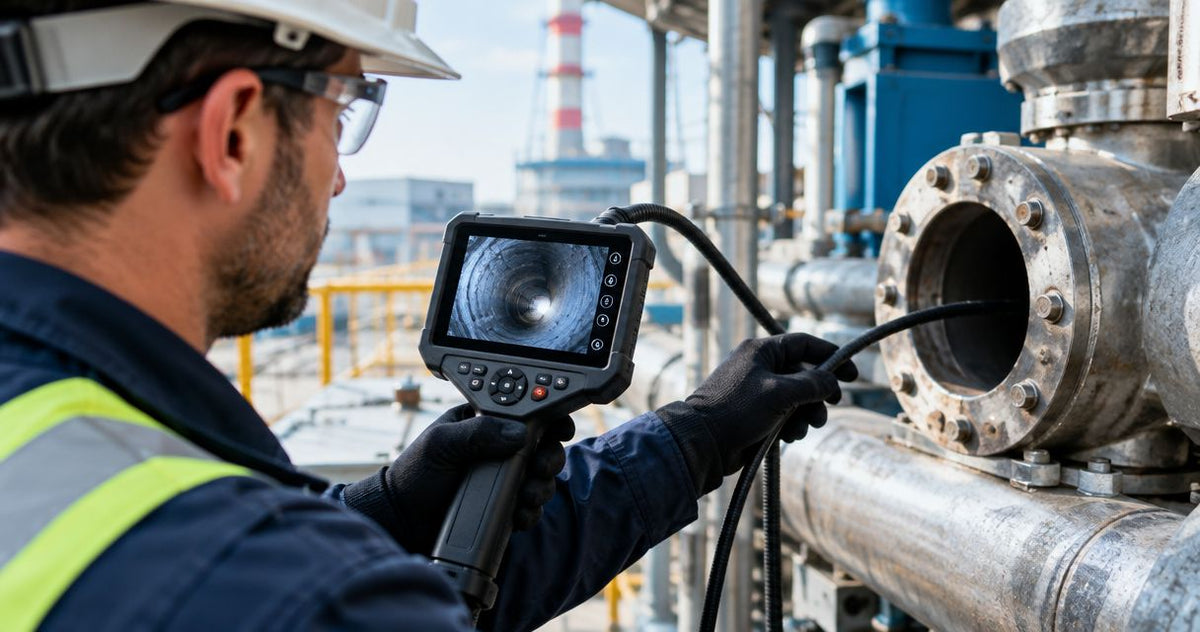
A high-temperature borescope for power plant inspection is a flexible video probe built to survive heat at the access port long enough to image boilers, turbines and heat exchangers without teardown. The wrong probe fails at the first hot port or can't turn the corner behind it.
- The VOYAGER C40 is the high-temperature video borescope in the Fiberscope.net range, from $3,320.
- Probe length sets articulation: 4-way on 3.3–16.4 ft (1–5 m) probes, 2-way on 19.7–26.2 ft (6–8 m).
- Rigid borescopes from $378 suit straight, short runs but need a separate light source.
- Match the head's temperature rating to the port temperature before anything else.
Power plant access ports are small, hot and rarely straight: a turbine inspection port, a boiler tube header, a heat exchanger bundle. This guide sizes the choice by temperature, reach and articulation, then shows which Fiberscope.net tool fits which job. Fiberscope.net sells the products discussed here and services them in-house.
How do you size a high-temperature borescope for a power plant?
Start with four constraints: the access port diameter, the length of the route to the target, the number of turns on that route, and the temperature at the port. Each one removes tools from the list. Brand and feature count come last.
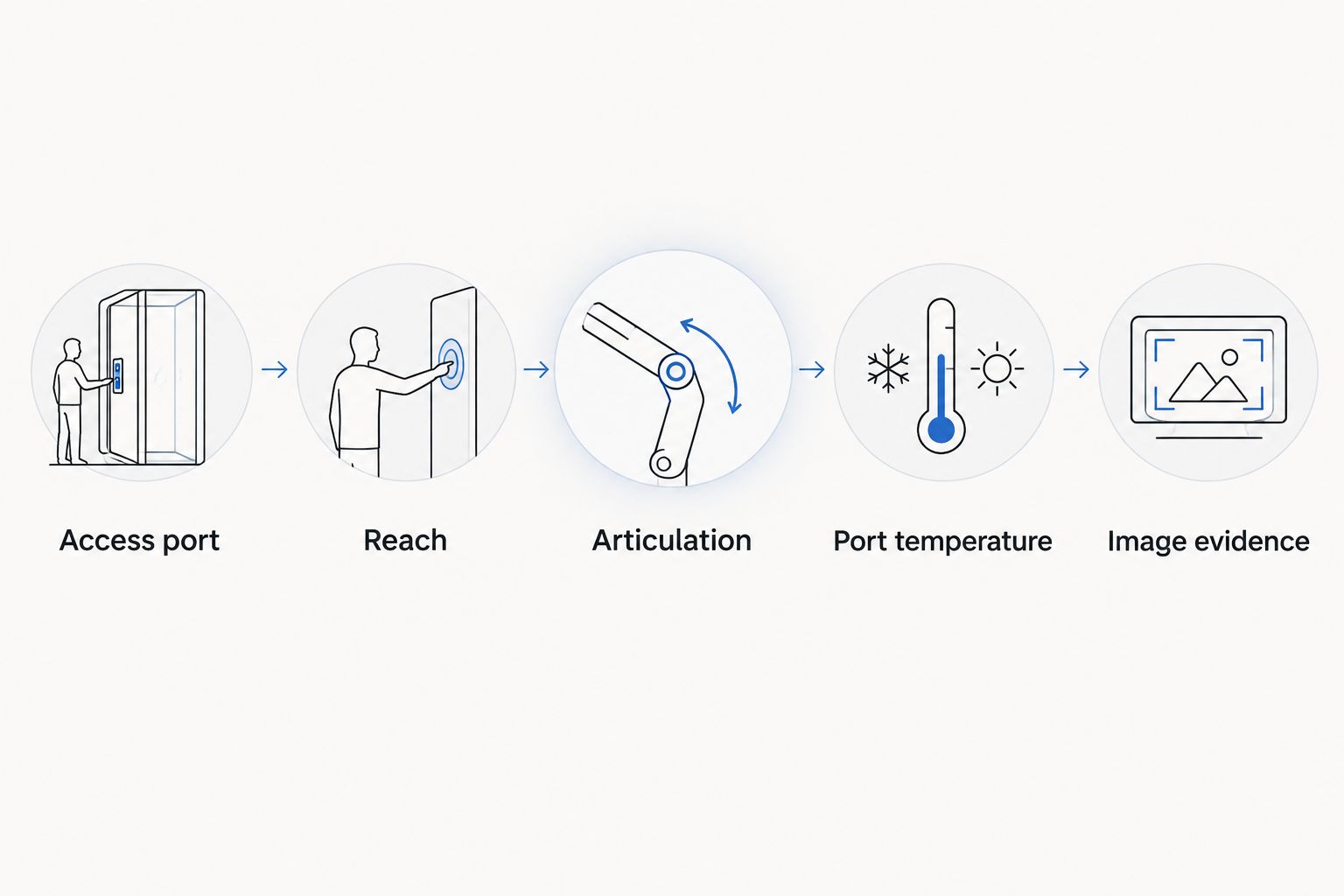
The order matters because the first constraint that fails ends the search. A probe that fits the port but can't survive its heat is the wrong tool, however good the image.
Measure the access port first
The probe outer diameter (OD) must clear the smallest opening on the route, including the port plug thread, not just the visible hole. Write down the smallest diameter you will pass through. Turbine borescope ports and boiler inspection holes are fixed by the equipment maker, so read the port size from the unit's documentation or measure it on a cold outage.
- Record the smallest opening on the route, not the nominal port size.
- Check for baffles, vanes or tube supports behind the port.
- Note whether the port is round, slotted or a removed instrument fitting.
- Keep the probe OD below the smallest opening with room to push and pull.
Work out reach and turns
Working length is the part of the probe that actually goes into the equipment. A rigid scope reaches only along a straight line. A flexible articulating probe follows a route and then steers its tip at the target.
The VOYAGER C40 is built in two articulation classes by probe length: 4-way articulation on probes from 3.3 to 16.4 ft (1–5 m), and 2-way on probes from 19.7 to 26.2 ft (6–8 m). 4-way means the tip bends up, down, left and right; 2-way bends in one plane. Long routes in boiler passes or large casings push you toward the longer, 2-way probe, so plan the approach angle accordingly.
Match the head to the port temperature
The head and probe temperature rating must exceed the temperature at the port, with margin, for the time you leave the probe in. Standard borescopes are built for room-temperature work and soften or fail in hot equipment. This is why a high-temperature head is a separate product, not an option on a general-purpose scope.
Hot inspection and cold-outage inspection are different jobs. On a cooled unit during an outage, almost any suitable articulating probe works. On a hot or recently shut-down unit, only a high-temperature rated head belongs at the port.
Decide what evidence you need
Recording, stills and a screen big enough for a second person to read decide how the images get into the outage report. Video borescopes record to the unit itself. Optical scopes need a camera and coupler added. Fiberscope.net matches the recording setup to your reporting requirement before you buy.
The pick: VOYAGER C40 high-temperature borescope
The High Temperature Borescope Camera VOYAGER C40 is the high-temperature video borescope in the Fiberscope.net range, from $3,320. It is a complete system: probe, articulating tip and the video display and recording setup on its product page.
Its strengths for plant work are the two articulation classes covered above and a head designed for areas where standard borescopes fail. Its limit is the same one every flexible scope has. The probe OD is fixed by the model, so a port smaller than that OD needs a thinner tool, and the probe's rated temperature is a ceiling for the port, not a target.
Typical plant jobs it suits:
- Combustor and hot-section inspection through a borescope port
- Boiler tube and header checks on a unit that is still warm
- Gearbox and pump casing views where the port runs hot
- Weld and casting condition checks behind insulation or covers
For the wider market, see our guide to industrial borescopes, and for tube bundles specifically, borescopes for heat exchanger tube inspection.
When a rigid borescope is the better tool
A rod-lens rigid borescope gives a clear, sharp image along a straight path and costs far less. The Rigid Borescope starts at $378. It has no articulation, so it cannot turn behind a baffle, and it needs a light source connected through a light guide or a handle.
Choose it when the port opens straight onto the target: a short run into a valve body, a pump casing or a weld inside a straight bore. Choose the VOYAGER C40 when the route bends, the target sits off-axis, or the head must tolerate heat at the port. Rigid optics also add no digital image on their own; recording needs a coupler and camera.
If the job needs steerable viewing but not high heat, our guide to articulating borescopes covers the lower-temperature options.
Comparison table
Prices are from the Fiberscope.net product pages, checked September 29.
| Option | Best for | From | Key limitation |
|---|---|---|---|
| VOYAGER C40 | Hot ports, bent routes, recorded evidence | $3,320 | Probe OD is fixed, so very small ports need a thinner tool |
| Rigid Borescope | Straight, short runs at low cost | $378 | No articulation; needs a separate light source |
Larger plant programs sometimes standardize on Evident IPLEX or Waygate Mentor Visual iQ videoscopes. Both are strong where on-screen measurement and aerospace-grade documentation are required. If your inspection procedure mandates measurement, that is the honest direction to look.
What you'll also need
A rigid borescope needs light. The MS-LED Borescope Light Source starts at $1,490 and drives the scope through a light guide cable. For video recording from a rigid scope, add a camera and a video coupler; our team sizes the coupler to the eyepiece.
The VOYAGER C40 is a complete system and needs none of these.


Common mistakes
- Buying on probe length alone. A 26 ft (8 m) probe is useless if its head can't take the heat at the port.
- Reading the nominal port size. The smallest opening on the route sets the probe OD limit, and that is often a fitting behind the port.
- Using a 2-way probe where the target sits off-axis. One-plane bending can't aim at a corner that needs up-down and left-right.
- Forgetting the light. A rigid scope with no light source shows black.
- Treating a thermal camera as a borescope. Thermal cameras show surface temperature patterns. A borescope shows what the metal actually looks like inside.
FAQ
What is the best high-temperature borescope for power plant inspection?
The VOYAGER C40 from Fiberscope.net, from $3,320, is the high-temperature video borescope in the range. It offers 4-way articulation on 3.3–16.4 ft (1–5 m) probes and 2-way on 19.7–26.2 ft (6–8 m) probes.
Can I use a standard borescope in a hot boiler or turbine?
Only after the unit has cooled to a temperature the probe is rated for. Standard probes are built for room-temperature work, so hot ports need a head designed for heat.
Do I need articulation for plant inspections?
Yes when the route bends or the target sits off-axis. Articulation steers the tip at the target. A straight port onto a straight bore can be handled with a rigid borescope from $378.
What does IP67 mean on an inspection camera?
IP67 means the part survives temporary immersion to 1 m for 30 minutes. It describes water and dust protection, not heat tolerance, so it does not replace a temperature rating.
Can I rent a high-temperature borescope for a single outage?
Fiberscope.net runs a rental program for short jobs, and you can buy or demo as well. A specialist matches the tool to your port and route before you commit.
Get the head and probe matched to your ports
Send us your smallest port diameter, the distance and number of turns to the target, the temperature at the port, and your recording or reporting needs. A Fiberscope.net specialist will match the probe and head. Call 1-877-613-2210, Monday to Friday, 8:00–18:00 CST, or use the contact page on the store.
About the author. Vladimir Khubiryants founded Fiberscope.net to give professionals access to reliable video inspection equipment without enterprise pricing. For over 20 years he has sourced and tested borescopes, sewer cameras and fiberscopes in Fiberscope.net's in-house test and repair facility, helping plumbers, pipeline engineers, aviation and military teams choose the right tool for the job.

Leave a comment
This site is protected by hCaptcha and the hCaptcha Privacy Policy and Terms of Service apply.