

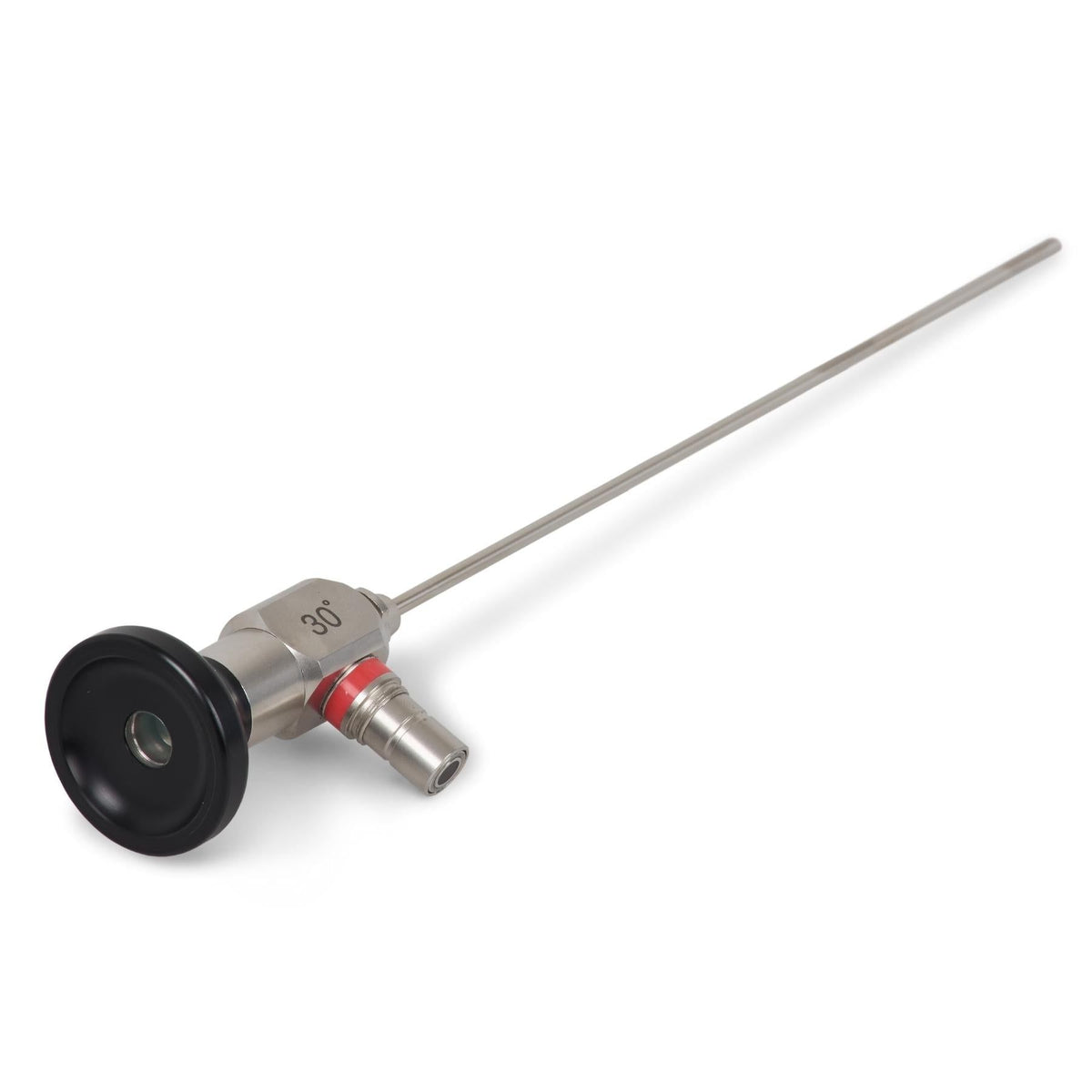
A gunsmith checking copper fouling at the throat needs to see the bore wall, not merely the muzzle and chamber in a straight-ahead view. A scope sized from cartridge name instead of the barrel’s narrowest interior diameter can bind on the lands. This guide compares two complete rigid optical borescopes by probe clearance, wall view, length choice and the equipment needed to illuminate the bore.
The Rigid Borescope offers a 0.11 in (2.7 mm) configuration for narrow straight access. The Hawkeye Pro Slim 70° Prism has a 0.165 in (4.2 mm) shaft and a dedicated angled view for examining rifling. For a barrel that admits both, the Hawkeye is the clearer wall-view decision; for a smaller land diameter, start with the 0.11 in Fiberscope option. Fiberscope sells and services its own equipment discussed here.
- Best borescopes for gun barrel inspection must clear the land diameter, the narrowest point between rifling lands.
- Hawkeye Pro Slim 70° Prism gives a documented angled view; Fiberscope Rigid Borescope offers a narrower 0.11 in (2.7 mm) option.
Measure at the lands before choosing a scope
The probe outside diameter must be smaller than the land diameter, measured between the tops of opposing rifling lands. SAAMI defines bore diameter as that minor interior dimension; the groove diameter is larger. A caliber designation or bullet diameter is therefore the wrong clearance test. Account for a choke or other constriction on the insertion route as well.
First make the firearm safe: unload it, remove the magazine if present, open the action and check the chamber. Choose an entry end that permits the rigid tube to advance without forcing it against the crown, rifling or chamber edge. Measure the barrel and insertion path to the area of interest. The throat, lands and grooves need an angled or side-oriented view; a straight-forward lens looks along the bore. Hawkeye’s optics guide distinguishes straight and side-view arrangements and the separate light required by rigid optics.
| Scope | Probe OD | Wall-view arrangement | Working-length choice | Main limit |
|---|---|---|---|---|
| Rigid Borescope | 0.11 in (2.7 mm) option | Select a viewing configuration for the target | Select to reach the inspection point | Optical eyepiece needs a light source; straight entry only |
| Hawkeye Pro Slim 70° Prism | 0.165 in (4.2 mm) | Dedicated 70° prism | 7, 12 or 17 in (178, 305 or 432 mm) | Wider tube excludes narrower land diameters |
Both are rigid optical scopes. For the Fiberscope configuration, choose the working length and viewing direction that reach the wall area you need to inspect. A rigid borescope selection guide covers straight access in other equipment.
Rigid Borescope: narrower straight-barrel access
The Rigid Borescope offers a 0.11 in (2.7 mm) rod-lens configuration and a stainless-steel insertion tube for direct optical viewing. Its eyepiece needs a compatible light source connected at the light post. A gunsmith can use a narrow configuration where a 0.165 in (4.2 mm) Hawkeye shaft leaves too little clearance, provided the land diameter and chosen tube geometry permit insertion.
The smaller OD is its measurable advantage. It remains a straight rigid instrument: it cannot follow a bent route, and direct eyepiece viewing does not make a saved client image. If evidence must be filed, pair the optical scope with a compatible camera at the eyepiece. Choose an illuminated setup before comparing the cost of a complete inspection kit. Prices checked September 26.

Hawkeye Pro Slim 70° Prism: an angled rifling view
The Hawkeye Pro Slim 70° Prism has a 0.165 in (4.2 mm) shaft and a fixed 70° viewing direction. Its manufacturer offers 7, 12 and 17 in (178, 305 and 432 mm) lengths. That dedicated prism is useful when a gunsmith needs to examine fouling or pitting on the bore wall without relying on a forward-facing image. The 70° prism directs the view toward the bore wall; model details checked September 26.
The 0.165 in (4.2 mm) shaft requires more land-diameter clearance than the Fiberscope 0.11 in (2.7 mm) option. Pick a length against the actual access route and inspection point. Hawkeye sells a scope-only version and a kit with light and case; those are different package contents. The manufacturer's page lists current model pricing, so compare complete illuminated setups rather than a bare scope with a kit.
What you'll also need
Rigid borescopes require illumination through a compatible light post; recording adds a camera at the eyepiece. The SPARK / SPARK XTR LED Light Handle is an accessory, not a second barrel-inspection scope. Its optical connection must fit the selected borescope. The USB Borescope Camera likewise has no insertion probe: it captures the image from a suitable optical eyepiece on a Windows computer. The optical borescope guide explains the light-and-camera chain; the guide to micro-borescope access addresses tiny openings in another trade.
For a workshop that needs video files on every firearm, label each capture by barrel and location, retaining the original alongside the service record. A dedicated firearm optic may be the better purchase if wall viewing and an integrated light are the daily task; the narrower Fiberscope option earns its place only where its OD and selected viewing configuration fit the actual bore.
FAQ
Which barrel diameter matters when choosing a borescope?
Use the land diameter, the narrowest interior diameter between rifling lands. The probe OD must clear it along the whole insertion path.
Can a straight-ahead borescope show rifling fouling?
A straight-ahead lens looks along the barrel. An angled prism or side-oriented view better exposes the bore wall and rifling.
Does the Fiberscope Rigid Borescope record video by itself?
No. It is an optical scope viewed through an eyepiece. Recording requires a compatible camera and illumination setup.
What is the Hawkeye Pro Slim 70° Prism diameter?
The Hawkeye Pro Slim 70° Prism shaft is 0.165 in (4.2 mm). Compare that with the actual land diameter before insertion.
Can I push a rigid scope around a barrel obstruction?
No. The rigid tube follows a straight access path; stop if it catches on a choke, chamber edge or other constriction.
About the author
Vladimir Khubiryants, Founder & President, Fiberscope (MEDIT Inc.). Vladimir Khubiryants founded Fiberscope to give professionals access to reliable video inspection equipment without enterprise pricing. For over 20 years he has sourced and tested borescopes, sewer cameras and fiberscopes in Fiberscope's in-house test and repair facility, helping plumbers, pipeline engineers, aviation and military teams choose the right tool for the job.
Send the land diameter, access end, barrel length, desired wall-view direction and recording requirement through the contact page or call 1-877-613-2210 to select a scope and optical setup.

Leave a comment
This site is protected by hCaptcha and the hCaptcha Privacy Policy and Terms of Service apply.