

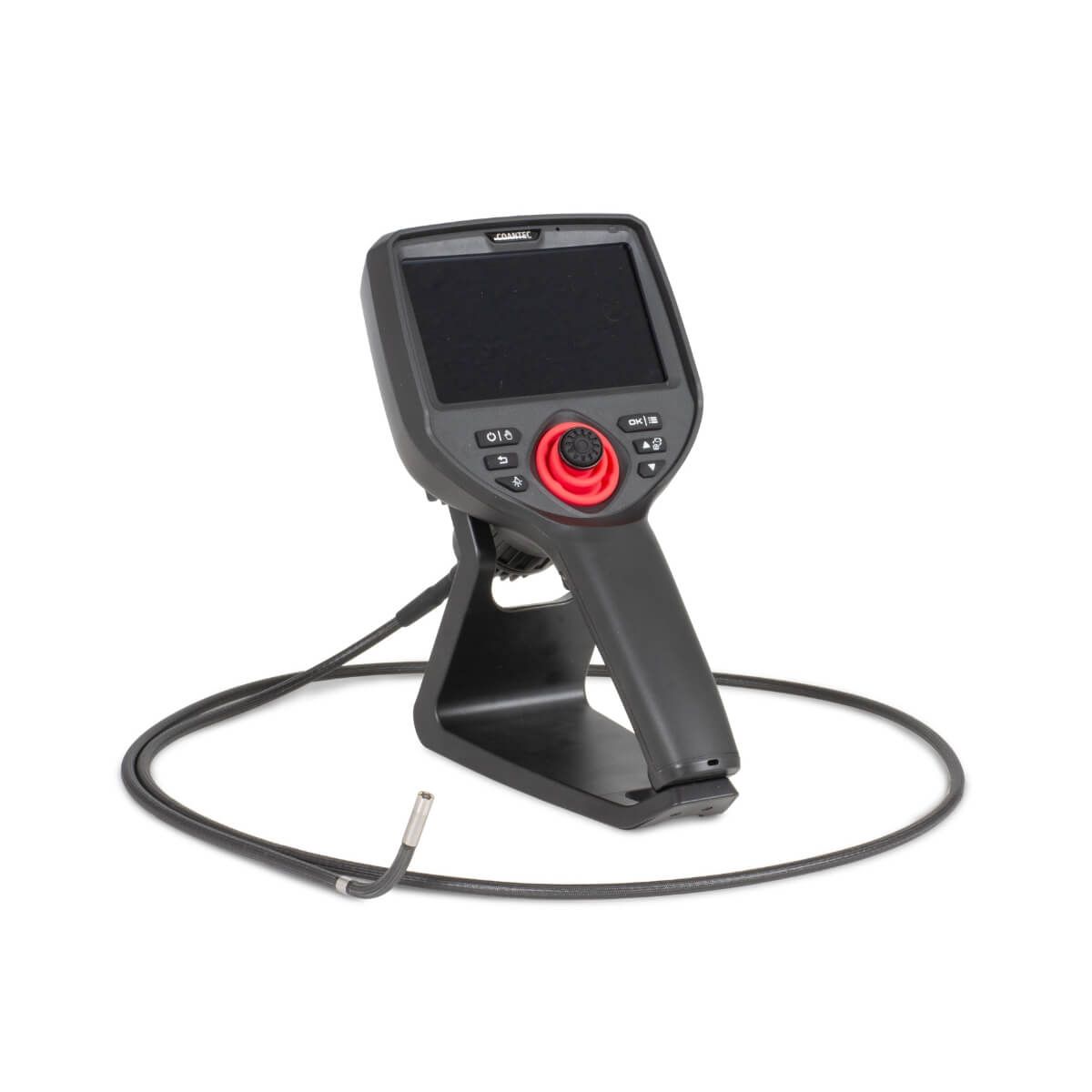
Best for general industrial maintenance: Videoscope VOYAGER M40. Best for short inspections in hot equipment: High Temperature Borescope Camera VOYAGER C40. Best for micro-access digital viewing: Micro Video Borescope MICRON. The right choice starts with the smallest opening and the required view, not the largest screen or the highest advertised resolution.
- The best industrial borescopes match access diameter, route, viewing direction, environment and inspection evidence.
- VOYAGER M40 offers 2.0–6.0 mm articulating probes; image resolution changes with probe diameter.
- Cooled VOYAGER C40 uses a 6.6 mm probe for 200°C inspections limited to 5–8 minutes.
- Micro Video Borescope MICRON offers a 1.00 mm probe, USB 3.0 viewing and HDMI output.
- Rigid and optical micro borescopes need matched illumination; a capture camera is an accessory, not a complete scope.
By Vladimir Khubiryants, Founder & President, Fiberscope.net (MEDIT Inc.). Updated October 3, 2026.
What makes the best industrial borescope for your job?
A borescope gives you a view inside equipment without opening every housing or removing every component. It does not automatically make that view suitable for a maintenance decision. A probe that reaches the cavity but cannot face the surface of interest has solved only half the job.
Use these six criteria before choosing a Fiberscope.net industrial borescope:
- Access diameter: Probe OD means outside diameter. It must clear the smallest restriction, not just the entrance port.
- Route and working length: Separate a straight drilled bore from a path around internal obstructions. Extra length does not guarantee passage through a tight turn.
- Viewing control: Articulation moves the tip; side view faces the wall. A flexible tube alone does not provide either function.
- Image detail: Compare the camera resolution of the selected probe, not the display resolution or the largest probe in the range.
- Environment: Temperature, liquids and exposure duration govern the configuration. A water rating does not establish heat resistance.
- Evidence: Decide whether you need visual screening, recorded footage, a shared display or a measured defect dimension.
Industrial videoscopes at a glance
These are complete digital inspection systems with their viewing setup identified. They serve different access and environment requirements, so the ranking is by job rather than a claim that one tool replaces all the others.
| System | Best for | Access and viewing | Host setup | Main limitation |
|---|---|---|---|---|
| Videoscope VOYAGER M40 | General maintenance needing tip steering | 2.0, 2.8, 3.9 and 6.0 mm articulating probes | Integrated 5-inch touchscreen and recording host | Smaller probes have lower camera resolution |
| High Temperature Borescope Camera VOYAGER C40 | Time-limited inspection in hot equipment | 6.6 mm cooled probe; 4-way control at 1–5 m, 2-way at 6–8 m | Borescope host with image/video capture and export | 200°C exposure is limited to 5–8 minutes |
| Micro Video Borescope MICRON | Micro-access digital inspection | 1.00 mm probe option; 400×400 camera image | Imaging hub, included viewing tablet, USB 3.0 and HDMI | Micro access does not imply steerable-tip control |
1. Videoscope VOYAGER M40: best for general industrial maintenance
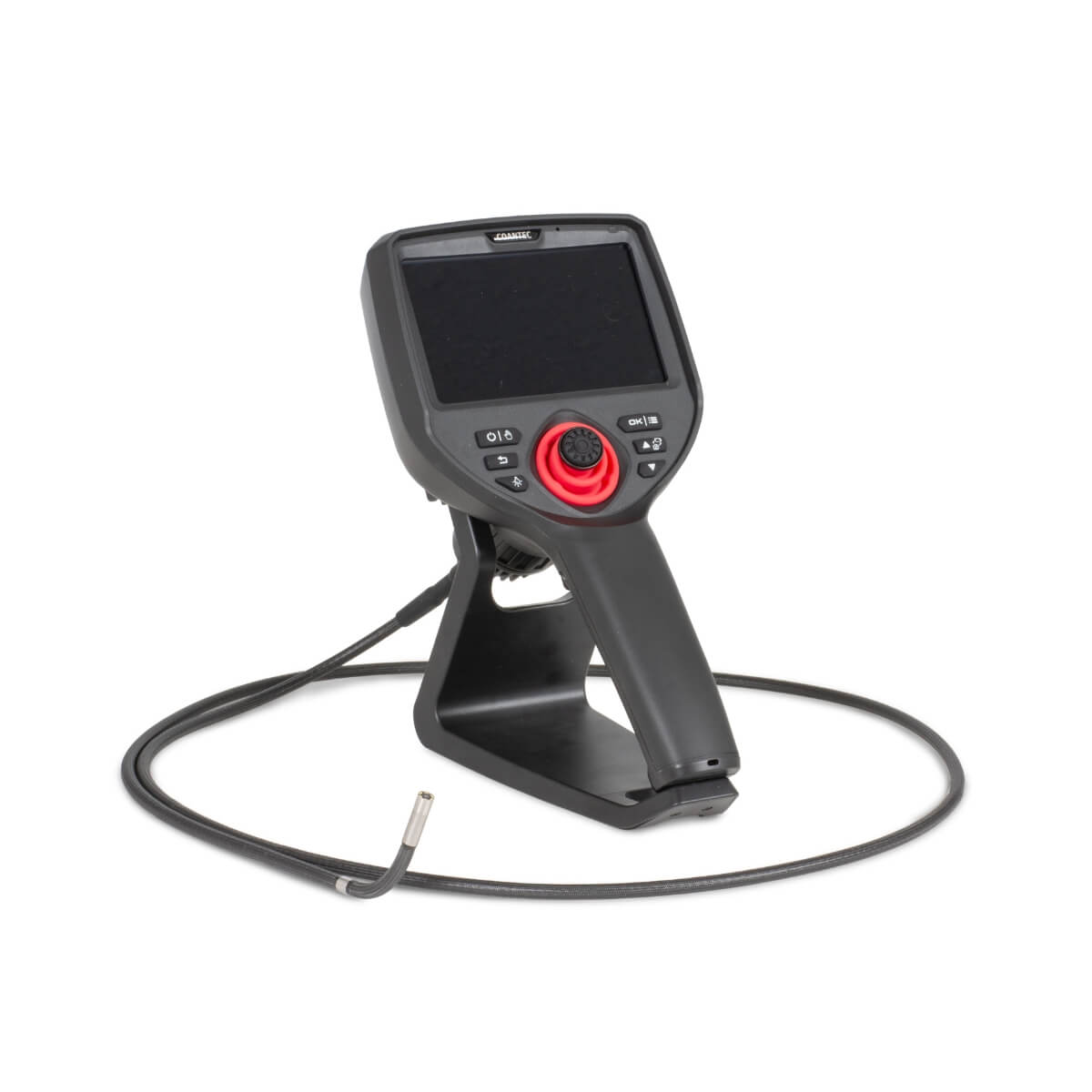
Videoscope VOYAGER M40 is the starting point for maintenance teams that need to aim the camera inside a housing rather than look only straight ahead. Its joystick provides all-way tip control, and interchangeable probes let the same host serve different access requirements.
The articulating probe diameters are 2.0, 2.8, 3.9 and 6.0 mm. Smaller 0.95, 1.2, 1.6 and 1.8 mm configurations are non-articulating options; do not carry the joystick-steering claim over to those probes.
Choose the probe by clearance and image detail
| VOYAGER M40 probe OD | Camera resolution | Decision factor |
|---|---|---|
| 2.0 mm or 2.8 mm | 640×480 | Use when a smaller opening sets the limit |
| 3.9 mm | 1280×720 | Consider when the route clears this diameter and more image detail is useful |
| 6.0 mm | Up to 2 MP | Consider when larger access permits this probe |
The 5-inch display is 800×480. That is separate from the camera's resolution. For an inspection report, evaluate the saved image from the exact probe at the required viewing distance, not just how it looks on the handheld screen.
VOYAGER M40 advantages:
- All-way joystick control on the articulating configurations.
- Interchangeable insertion probes.
- Integrated viewing, image capture and footage playback.
- Side-view configuration available on request.
VOYAGER M40 limitations:
- A 2.0 mm probe does not provide the 6.0 mm probe's image resolution.
- Steering does not guarantee passage through an arbitrary bend or inspection port.
- Do not use the cooled C40's temperature rating for a standard M40 probe.
Best for: General visual checks in gearboxes, pumps, valves and mechanical assemblies where the measured route fits the selected probe. Choose Videoscope VOYAGER M40 when controlled viewing direction is the requirement.
Watch the Videoscope VOYAGER M40 in use in Fiberscope.net's product demonstration.
2. High Temperature Borescope Camera VOYAGER C40: best for short hot-equipment inspections

High Temperature Borescope Camera VOYAGER C40 has a cooling tube inside its 6.6 mm insertion probe. Its stated hot-inspection capability is 200°C for 5–8 minutes, with lengths up to 8 m.
Length changes the steering arrangement: 1–5 m probes have 4-way articulation; 6–8 m probes have 2-way articulation. A longer configuration therefore changes both reach and viewing control.
The host captures images and video for export. This is a visual camera for hot environments, not a thermal imager that measures surface-temperature patterns.
VOYAGER C40 advantages:
- A stated temperature and exposure-duration limit.
- Probe cooling built into the insertion assembly.
- Length options for deeper inspection routes.
- Image/video capture through the supplied host.
VOYAGER C40 limitations:
- The 6.6 mm probe needs larger access than M40's smaller probes.
- The temperature figure is not a continuous-duty rating.
- Longer 6–8 m configurations reduce steering to two directions.
Best for: Heat-exchanger, boiler and other hot-equipment visual inspections where access, cooling and exposure conditions fit the job. Choose High Temperature Borescope Camera VOYAGER C40 only when heat resistance is necessary; cooling the equipment first remains the simpler option when the procedure permits it.
3. Micro Video Borescope MICRON: best for micro-access digital viewing

Micro Video Borescope MICRON addresses openings that exclude the larger articulating probes. Its 1.00 mm probe option feeds a 400×400 image through an imaging hub with an integrated LED light source. The viewing tablet is included.
The hub supports USB 3.0 connection to a computer and HDMI output to a suitable display. The listed 1.00 mm configuration has 1.5 m and 2 m working-length options. Match the actual restriction and inspection distance to that configuration rather than treating a micro-diameter probe as universally compatible.
MICRON advantages:
- A 1.00 mm digital-probe option.
- Integrated illumination in the imaging hub.
- Included tablet for viewing.
- USB 3.0 and HDMI output paths.
MICRON limitations:
- The 400×400 image is not equivalent to M40's higher-resolution larger probes.
- A flexible insertion tube is not evidence of joystick articulation.
- A small probe still needs clearance throughout the route and space to view the target.
Best for: Manufacturing and maintenance checks where micro access and digital viewing govern the choice. Choose Micro Video Borescope MICRON when access rules out the larger videoscopes, not for their tip-steering function.
When an optical borescope is the better choice
A digital videoscope is not mandatory for every inspection. Straight machined bores and very small passages can justify an optical setup. Compare the scope, illumination and documentation arrangement together, not a bare probe against a ready-to-use digital host.
| Optical scope | Best for | Verified configuration detail | What the setup also needs |
|---|---|---|---|
| Rigid Borescope | Straight access with direct eyepiece viewing | Rod-lens relay optics; 2.7 mm diameter option | Matched light source or light handle; camera/coupler if documenting |
| Ultra Fine Micro Borescope | Sub-millimetre optical access | 0.37, 0.5 and 0.75 mm fiber-bundle probes; no articulation | MS-LED Light Source and light-guide cable; eyepiece viewing |
| Super Thin Micro Borescope | Small-passage optical checks | Flexible or semi-rigid probes; diameters from 1.0 mm | Matched illumination; separate camera arrangement for documentation |
Rigid Borescope: straight access without tip steering

Rigid Borescope uses rod-lens relay optics, not a coherent fiber image bundle. Its advantage is direct optical viewing through a straight shaft. Its limitation is equally clear: the shaft cannot follow a turning insertion route, and recording requires an additional camera and coupler.
Choose the viewing direction to match the surface you need to inspect. Access to a cavity is not proof that a forward-looking configuration can show its sidewall.
Ultra Fine Micro Borescope: access below 1 mm
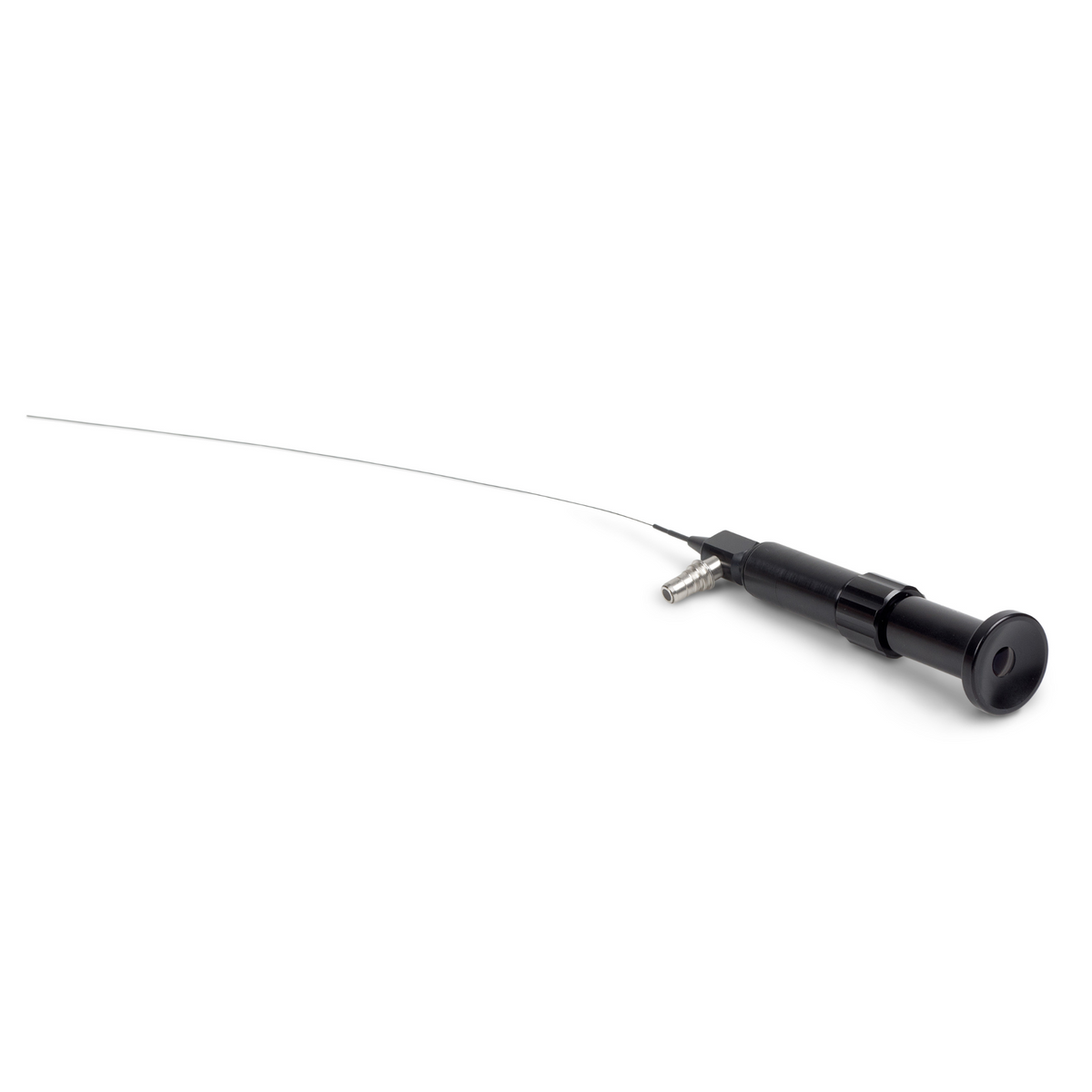
Ultra Fine Micro Borescope uses coherent fiber bundles: 3,000 image fibers in the 0.37 and 0.5 mm probes, and 10,000 in the 0.75 mm probe. The benefit is very small access; the trade-off is image detail limited by that bundle, with no tip articulation.
Use a matched light source and light-guide cable for eyepiece viewing. Do not assume a higher-resolution capture camera can create detail the fiber bundle does not carry.
Super Thin Micro Borescope: flexible or semi-rigid optical inspection

Super Thin Micro Borescope offers flexible or semi-rigid insertion assemblies from 1.0 mm, with a 45° field of view. It suits an optical inspection setup where probe construction and access matter more than an integrated handheld recorder.
Its strength is the choice of insertion assembly. Its limitation is the additional illumination and camera equipment needed for a documented inspection station.
What you will also need
- For optical illumination: Match the light post, light source and light-guide cable. MS-LED Light Source requires the cable between source and scope.
- For optical recording: ImagePRO USB 3.0 Camera is an eyepiece capture accessory, not a probe. Its requirements include a 32 mm circular eyepiece, a scope diameter greater than 1 mm and a suitable Windows computer.
- For shared digital viewing: MICRON's HDMI output serves a connected display. A cable output does not establish network or Wi-Fi viewing.
- For repeatable records: Identify the asset, access point, probe configuration and surface location in the inspection record.
Match the evidence to the maintenance decision
Seeing a defect and measuring a defect are different jobs. A clear image can document deposits, damage or a surface anomaly, but a pixel count alone does not establish a dimensional-measurement capability.
For turbine and aircraft-engine work, the component's inspection procedure determines the access, coverage and acceptance criteria. FAA guidance on exhaust-system maintenance identifies borescope use for inaccessible internal components and points technicians to manufacturers' maintenance information. A buying guide is not an aircraft release-to-service procedure.
ASNT's visual-testing overview separates general screening from detailed examination. It also explains that visual testing cannot find defects hidden inside the material. A clean borescope image does not prove the absence of subsurface cracking.
Before inspecting machinery, use the site's isolation procedure. OSHA 1910.147 covers hazardous energy during servicing and maintenance. A long probe does not remove the risk of unexpected motion, pressure or stored energy.
Technical references checked October 3, 2026; use the procedure applicable to your equipment and site.
Common buying mistakes
- Buying the smallest probe by default: More access is useful only if the image still supports the inspection decision.
- Confusing flexibility with articulation: A flexible tube can bend without offering controlled tip steering.
- Applying the highest resolution to every variant: M40's 2.0/2.8 mm probes are 640×480, not 2 MP.
- Treating a heat limit as continuous operation: Cooled C40's 200°C capability includes a 5–8 minute exposure limit.
- Assuming a water rating is a whole-system rating: M40's IP68 claim applies to its insertion probes.
- Using ordinary inspection equipment in a hazardous atmosphere: This guide does not establish explosion-proof suitability for any listed configuration.
How these recommendations were selected
This is a job-fit guide to Fiberscope.net industrial borescopes, not a laboratory performance test or a claim that every model meets every inspection standard. The digital systems are ranked by viewing control, hot-environment capability and micro access. Optical configurations are separated because their illumination and recording arrangements must be specified as part of the setup.
FAQ
What is the best industrial borescope for general maintenance?
Videoscope VOYAGER M40 is the starting choice when industrial maintenance requires controlled tip steering and integrated viewing. Match its 2.0, 2.8, 3.9 or 6.0 mm articulating probe to the smallest restriction and required image detail.
Does every VOYAGER M40 probe have 2 MP resolution?
No. The 2.0 and 2.8 mm probes are 640×480, the 3.9 mm probe is 1280×720, and the 6.0 mm probe provides up to 2 MP. Display resolution is a separate specification.
Can a borescope inspect equipment at 200°C?
High Temperature Borescope Camera VOYAGER C40 is stated for 200°C exposure for 5–8 minutes using its cooled 6.6 mm probe. That is not a continuous-duty rating or a temperature limit for standard M40 probes.
Does a longer cooled C40 probe keep the same articulation?
No. Cooled VOYAGER C40 probes from 1–5 m have 4-way articulation, while 6–8 m probes have 2-way articulation. Choose length and viewing control together.
Which borescope offers a 1 mm digital probe?
Micro Video Borescope MICRON offers a 1.00 mm probe option with 400×400 imaging. Its hub provides USB 3.0 and HDMI output, and a viewing tablet is included.
Is a USB borescope camera a complete industrial inspection system?
An eyepiece capture accessory is not a complete scope. It needs an optical borescope or fiberscope, appropriate illumination, a matched coupler and a viewing computer.
Can a rigid borescope inspect around a bend?
A rigid shaft cannot follow a turning insertion route. Use the actual access path and required viewing direction to decide whether an articulating videoscope or a flexible optical scope is appropriate.
Can an industrial borescope prove that a component has no internal cracks?
No. A borescope provides visual evidence of accessible surfaces, not proof that the material beneath them is free of cracks. Apply the inspection procedure and additional testing required for the component.
Which industrial borescope should you choose?
Start with Videoscope VOYAGER M40 for an articulating maintenance setup. Move to High Temperature Borescope Camera VOYAGER C40 when the environment needs its cooled probe, or Micro Video Borescope MICRON when micro access governs the inspection.
For a straight optical check, a matched Rigid Borescope setup can be enough. For sub-millimetre access, evaluate Ultra Fine Micro Borescope with its light source rather than buying an oversized digital probe.
One final distinction: a field of view describes how wide an area the optics show; direction of view describes where those optics face. A wide forward view does not replace a side view or a steerable tip.
Related guides
- Compare optical borescopes by access and viewing setup
- Choose a video borescope for automotive inspection
About the author
Vladimir Khubiryants, Founder & President, Fiberscope.net (MEDIT Inc.)
Vladimir Khubiryants founded Fiberscope.net to give professionals access to reliable video inspection equipment without enterprise pricing. For over 20 years he has sourced and tested borescopes, sewer cameras and fiberscopes in Fiberscope.net's in-house test and repair facility, helping plumbers, pipeline engineers, aviation and military teams choose the right tool for the job.
Send your access opening, straight or turning route, insertion length, viewing direction or articulation requirement, environment and recording needs. A Fiberscope.net specialist will match the probe and complete viewing setup to the inspection.

Leave a comment
This site is protected by hCaptcha and the hCaptcha Privacy Policy and Terms of Service apply.