

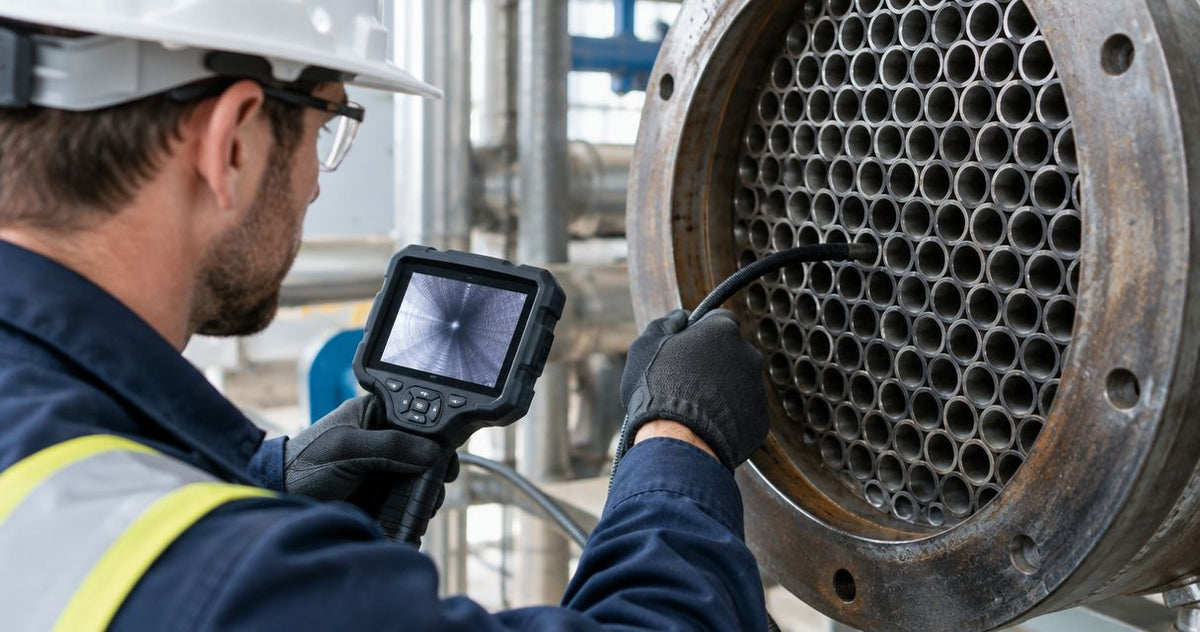
A tube bundle comes out of a shell-and-tube exchanger, and a pass-partition leak means one tube in hundreds is the culprit. Pulling and pressure-testing every tube costs a shift. Guessing which ones to plug costs a repeat shutdown. A camera down the suspect tubes gets you evidence before you plug anything.
Yes, a borescope inspects heat exchanger tubes when the probe outer diameter (OD) clears the tube inside diameter (ID) and the working length is longer than the tube. It shows fouling, pitting, blockages and tube-end damage. It does not measure wall thickness. The Super Thin Micro Borescope starts at 0.04 in (1.0 mm) diameter, from $1,750. Fiberscope.net sells the products discussed here and services them in-house.
- A borescope inspects heat exchanger tubes when probe OD clears tube ID and working length exceeds tube length.
- The Super Thin Micro Borescope starts at 0.04 in (1.0 mm) diameter, from $1,750.
- The VOYAGER M40 videoscope adds 360° tip articulation, from $4,160, for header boxes and tubesheet faces.
- Borescopes show surface condition; eddy current or ultrasonic testing measures wall loss.
Can a borescope inspect heat exchanger tubes?
A borescope inspects heat exchanger tubes when three things line up: the probe OD is smaller than the tube ID, the working length exceeds the tube length, and the tube is clean and dry enough to see the wall. Many shell-and-tube exchangers use tubes of 0.75 to 1 in OD, so the probe has to be well under an inch.
Fiberscope.net verdict: for small-bore tubes the Super Thin Micro Borescope is the practical pick, and for header boxes and tubesheet faces the VOYAGER M40 articulating videoscope is.
Prices checked September 29.
| Option | What it is | Diameter or feature | Suits | Price |
|---|---|---|---|---|
| Super Thin Micro Borescope | Flexible micro borescope | From 0.04 in (1.0 mm) | Small-bore tube interiors | From $1,750 |
| Ultra Fine Micro Borescope | Premium flexible fiberscope | — | Very small access points | From $3,520 |
| Videoscope VOYAGER M40 | Video borescope | 360° all-way tip articulation, IP68 probes | Header boxes, tubesheet faces, ports | From $4,160 |
| Rigid Borescope | Rod-lens relay optics | Needs a light source | Short straight looks at tube entrances | From $378 |
Size the probe to the tube ID first
Probe OD must be smaller than the tube ID, with room left for the probe to move and for light to reach the wall. Measure the ID from the exchanger datasheet or with a pin gauge, not from the nominal OD.
Three numbers decide the choice:
- Tube ID. Sets the maximum probe OD.
- Tube length. Sets the minimum working length, plus extra for handling at the tubesheet.
- Bends. Straight tubes allow a rigid or non-articulating probe. U-tubes force the probe around a return bend, which limits how far a flexible scope travels.
The working length and bend radius that a specific scope handles come from its product page. Match them to your tube before you buy.
What a borescope shows and what it misses
A borescope shows the inner surface of the tube. That covers scale and deposits, pitting, corrosion streaks, blocked tubes, and damage at the tube end and rolled joint.
It cannot measure remaining wall thickness. For wall loss, the trade uses eddy current testing, ultrasonic IRIS (internal rotary inspection system) or similar methods, usually set up under ASNT-qualified procedures. A borescope tells you where to point those tools and which tubes to plug.
Heavy fouling hides defects. Clean tubes before you scope them, otherwise a clean-looking wall may only be a thick layer of deposit.
Which borescope fits which exchanger
Small-bore tubes: Super Thin Micro Borescope
The Super Thin Micro Borescope starts at 0.04 in (1.0 mm) diameter, from $1,750, which clears small-bore tubes that larger probes cannot enter. It is a simple optical device built for tiny areas and machined parts, so pair it with a light source and a camera or coupler if you need recordings.
It suits condenser and chiller tubes where you need to see the wall of a single suspect tube. It does not articulate, so it looks where it is pointed.
Very small access: Ultra Fine Micro Borescope
The Ultra Fine Micro Borescope is the premium line of super-thin flexible fiberscopes, from $3,520. Choose it when the Super Thin does not fit the opening. For ordinary heat exchanger tubes, the Super Thin costs less and is usually enough.
Header boxes, tubesheet faces, ports: VOYAGER M40
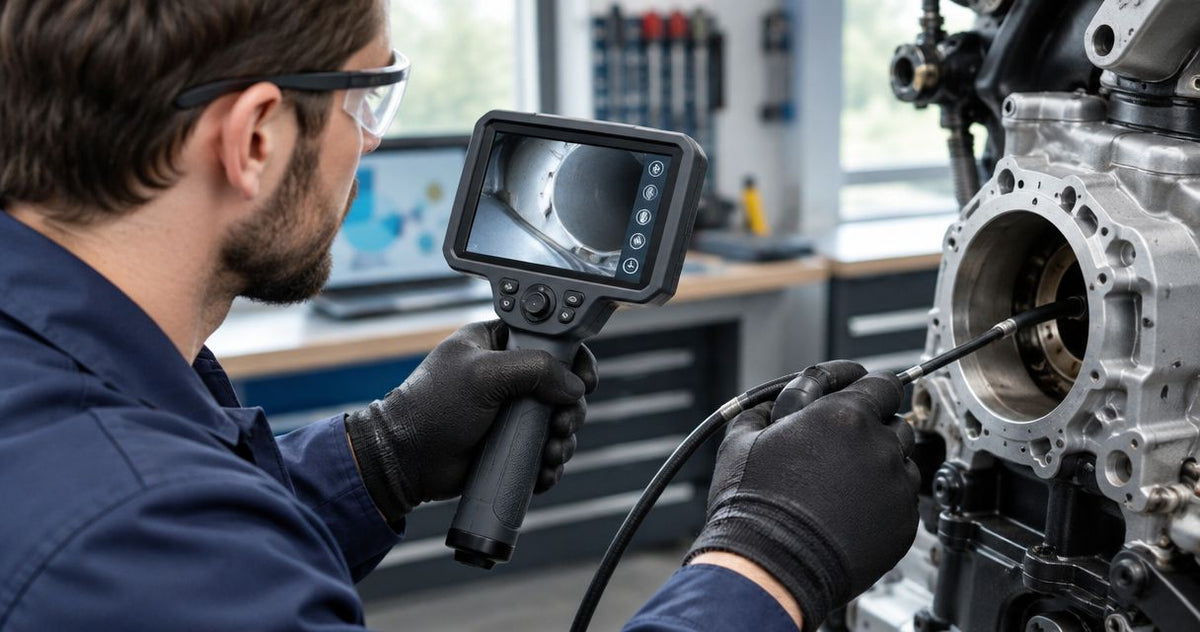
The VOYAGER M40 videoscope has full 360° tip articulation with a joystick, and its probes are rated IP68, from $4,160. Articulation lets you steer to the tubesheet, a plugged tube end or a baffle through an inspection port, and look at what a straight probe cannot see.
If you only need to look down straight tubes, an articulating videoscope is more tool than the job requires.
Straight entry looks: Rigid Borescope
The Rigid Borescope uses rod-lens relay optics and needs a light source through a light guide or handle. It is from $378. It suits a short straight look at a tube entrance or an open port, and it cannot go around any bend.


How to inspect a tube bundle with a borescope
- Drain and dry the exchanger. Standing water and moisture fog the lens and blur the wall.
- Clean the tubes. Deposits hide pitting, so clean first and scope second.
- Measure tube ID and length. Choose a probe OD that clears the ID and a working length that exceeds the tube.
- Mark the tubes. Number the tubesheet so every recording ties to a tube position.
- Push at a steady pace. Stop at every change in the wall: discoloration, pits, scale lines, a dent at a baffle.
- Record the run. Note the tube number and depth where each defect appears.
- Send flagged tubes to wall-thickness testing. Plug or retube based on that data, not on video alone.
What you'll also need
Optical micro borescopes need illumination. The SPARK LED Light Handle is from $299, and the MS-LED Borescope Light Source is from $1,490. For recordings on a laptop, the USB Borescope Camera is from $900 and works with optical scopes that have a 32 mm eyepiece. The light handle and light source connection is covered in how to connect a light source to an optical borescope.
FAQ
Can a borescope measure heat exchanger tube wall thickness?
No. A borescope shows the inner surface only. Wall thickness comes from eddy current testing or ultrasonic IRIS. Use the borescope to find which tubes need that testing.
What size borescope fits heat exchanger tubes?
The probe OD must be smaller than the tube ID. Many tubes are 0.75 to 1 in OD, so choose a thin probe. The Super Thin Micro Borescope starts at 0.04 in (1.0 mm).
Do I need to clean the tubes before inspecting them?
Yes. Scale and deposits cover pitting and corrosion. Clean the tubes first so the image shows the actual wall.
Can a borescope go around a U-tube bend?
A flexible probe can pass a return bend only if its diameter and stiffness allow it. Check the bend radius and working length of the scope against your tube before you buy.
Can I rent a borescope for a single shutdown?
Yes. Fiberscope.net offers rentals for short jobs, and a specialist can match the scope to your tube size and length before the shutdown.
Send us your tube details
Send your tube ID, tube length, whether the bundle is straight or U-tube, the tube material and the recording format you need. A Fiberscope.net specialist will match the probe and light source to the job. Call 1-877-613-2210, Monday to Friday, 8:00 to 18:00 CST.
About the author. Vladimir Khubiryants founded Fiberscope.net to give professionals access to reliable video inspection equipment without enterprise pricing. For over 20 years he has sourced and tested borescopes, sewer cameras and fiberscopes in Fiberscope.net's in-house test and repair facility, helping plumbers, pipeline engineers, aviation and military teams choose the right tool for the job.

Leave a comment
This site is protected by hCaptcha and the hCaptcha Privacy Policy and Terms of Service apply.