

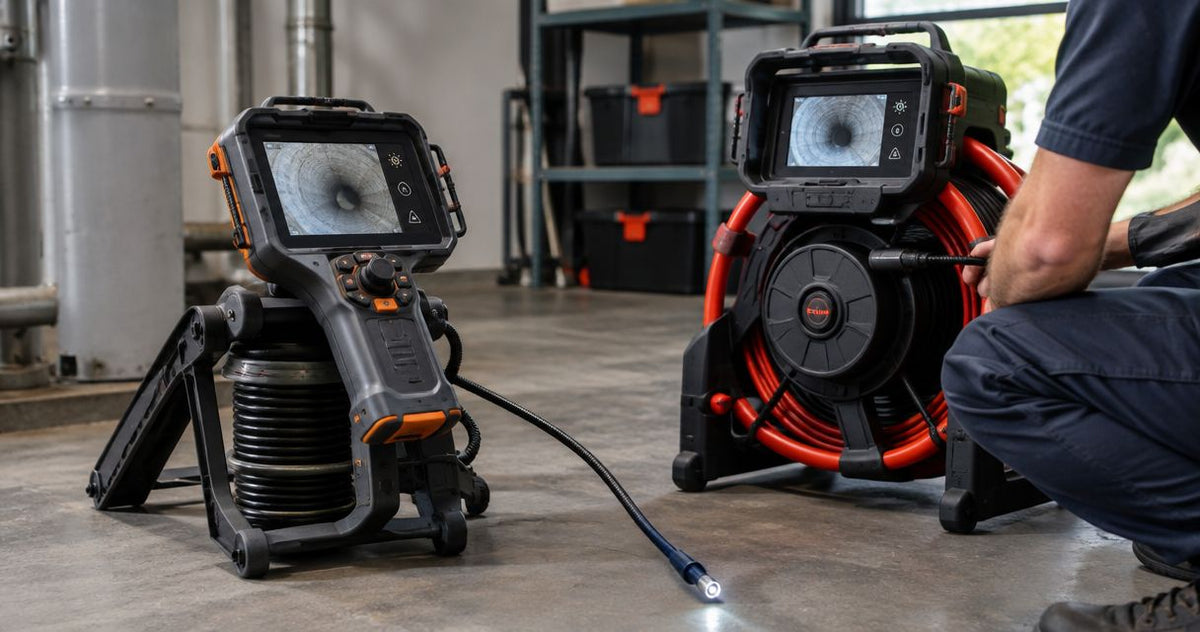
Choose Fiberscope inspection equipment if you need one specialist store for video borescopes, drain cameras, downhole cameras, accessories, or rentals; choose RIDGID SeeSnake if an exact SeeSnake configuration fits your job and existing equipment. This 2026 comparison is a store-versus-product-family decision, not a model-for-model performance test; use the sewer inspection camera guide to define the required equipment class first. Fiberscope sells the products discussed. Recommendations are based on current published specifications and stated use cases; confirm final configuration and compatibility with Fiberscope before purchase.
- Fiberscope vs RIDGID SeeSnake is a specialist-store versus product-family decision, not a verified model-for-model test.
- Choose the store when one supplier must cover borescopes, drain cameras, downhole cameras, accessories, and rentals.
- Choose SeeSnake only after confirming the exact camera, reel, monitor, sonde, receiver, and job limits.
- Neither name alone proves pipe range, bend performance, locating support, compatibility, or complete system contents.
Why this matters
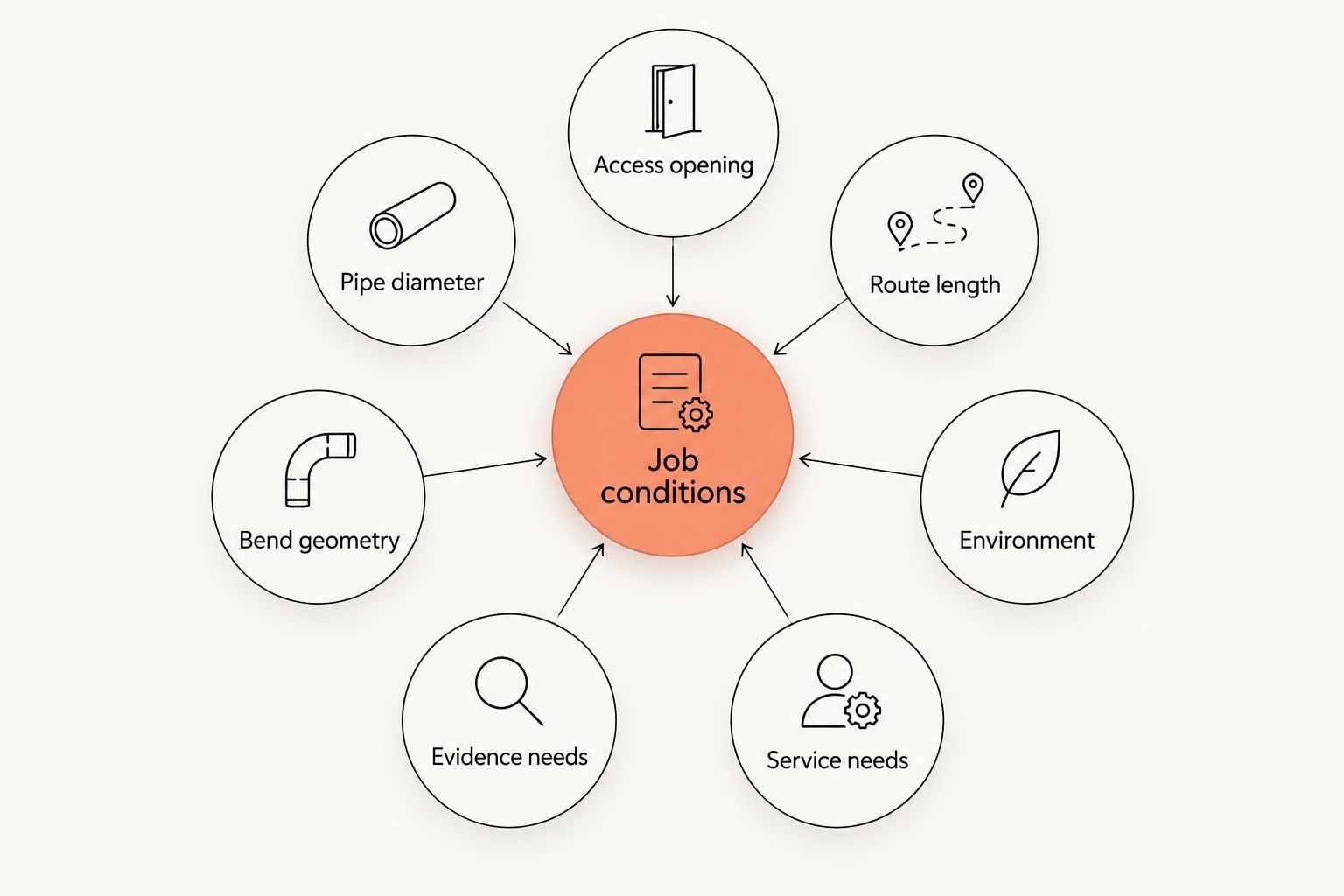
A brand-level verdict can send you toward the wrong equipment class. In 2026, the correct choice still starts with the access point, internal dimensions, route, bends, environment, deployment method, evidence requirements, and service plan—not the logo on the case.
Record these job conditions before comparing any configuration:
- Access opening: Measure the smallest opening the deployed equipment must pass through.
- Pipe or component dimensions: Record internal diameter and any restrictions along the route.
- Route length: Use the actual inspection path, not the straight-line distance between access points.
- Bend geometry: Identify turns, traps, transitions, offsets, and branches.
- Environment: Record water, debris, temperature, pressure, chemicals, and other relevant conditions.
- Deployment method: Decide whether the job calls for a hand-advanced push camera, a rigid scope, a flexible probe, a pole camera, or powered travel.
- Evidence needs: Confirm recording, still-image, reporting, and locating requirements.
- Service needs: Decide whether local support, rental access, repair handling, or fleet standardization affects downtime.
A passive rolling skid can guide or center a compatible camera head, but it does not propel the camera. Pan-and-tilt describes viewing direction, not traction. A system qualifies as self-propelled only when the exact product documentation states that it has powered wheels, tracks, or another drive mechanism.
At a glance
The 2026 comparison below separates supported differences from decisions that require exact model documentation.
| Dimension | Fiberscope | RIDGID SeeSnake |
|---|---|---|
| Best for | Buyers sourcing across several inspection-equipment classes | Buyers evaluating a SeeSnake drain-inspection configuration |
| Standout feature | Catalog breadth across stated inspection categories | Focused RIDGID drain-inspection product family |
| Workflow continuity | Depends on the selected product family | Stronger fit when existing equipment is already SeeSnake |
| Deployment method | Verify the exact camera and configuration | Verify the exact reel, camera, and configuration |
| Locating | Requires a documented transmitter and matching receiver | Requires a documented transmitter and matching receiver |
| Accessory compatibility | Confirm the exact host, head, interface, and adapter | Confirm the exact host, head, interface, and adapter |
| Service fit | Confirm current sales, rental, and support terms | Confirm current distributor, rental, and support terms |
| Pricing model | Compare the complete required configuration | Compare the complete required configuration |
Fiberscope covers more inspection-equipment classes
The store description explicitly includes video borescopes, sewer and drain pipe inspection cameras, downhole cameras, related accessories, sales, and rentals. That range is useful when your work crosses plumbing, HVAC, and industrial maintenance rather than staying inside one drain-camera category.
SeeSnake is the narrower comparison target: a RIDGID drain-inspection product family. If your task involves a mechanical cavity, well, borehole, or another non-drain application, first select the correct equipment class. Do not treat a drain camera, borescope, pole camera, downhole camera, and self-propelled crawler as interchangeable simply because each produces inspection video.
Verdict: the store wins on stated category breadth; SeeSnake remains relevant when the defined job is drain inspection.
RIDGID SeeSnake is the cleaner fit for an existing SeeSnake workflow
A buyer with SeeSnake equipment already in service has a narrower compatibility question than a buyer building a mixed inspection catalog. The practical advantage is workflow continuity: the new configuration can be checked against equipment the crew already owns rather than evaluated as an isolated purchase.
That does not prove that every SeeSnake camera, reel, monitor, sonde, locator, or accessory works with every other SeeSnake component. Record the exact model and selected variant for each part. Current documentation must confirm the pairing.
Verdict: choose SeeSnake for an existing SeeSnake workflow only after exact component compatibility is documented.
Both need model-level deployment checks
Neither brand name establishes how a camera moves through a pipe. A push-camera system is advanced by an operator feeding cable from a reel. A self-propelled crawler uses a documented powered travel mechanism. A skid can lift, protect, guide, or center a compatible head, but it cannot turn a push camera into a crawler.
Head diameter alone also cannot prove job fit. The selected configuration must account for head length, cable or probe properties, access opening, pipe internal diameter, route length, transitions, and bend geometry. A published working length is not automatically the usable route length under every site condition.
Verdict: this dimension is a tie until exact deployment limits are verified for the selected model.
Neither wins locating without a matched three-part system
A locating configuration has three distinct parts: a deployable camera system, a documented sonde or transmitter, and a separate compatible locator receiver. The transmitter sends a stated frequency; the receiver must support that same stated frequency. A receiver mode does not prove that a camera head transmits on that frequency.
For either side, document whether the transmitter is included, optional, or absent for the selected camera-head variant. Then document whether the receiver is included or purchased separately. Do not infer locating capability from a family name, related-products module, cable length, or receiver specification.
A 2026 locating comparison should also keep mechanical and radio questions separate. Push-cable reach concerns physical deployment. Locator compatibility concerns the documented transmitter and receiver frequencies. One does not establish the other.
Verdict: locating is a tie unless one exact camera-plus-sonde-plus-receiver configuration is fully documented and the other is not.
Neither gets automatic accessory compatibility
Cross-brand accessory fit is not established by similar dimensions or terms such as universal, small, or mainline. Confirm the host product and variant, camera-head outside diameter and length, mounting interface, required adapter, pipe internal diameter, and bend conditions.
Use confirmed compatible only when the manufacturer or seller explicitly approves the exact pairing, including any required adapter. Use requires seller confirmation when dimensions overlap but the mount, adapter, geometry, or approved pairing is unpublished. Use not compatible when a component conflicts with a published minimum, maximum, head type, or interface.
Verdict: both brands require exact accessory documentation; numerical overlap alone does not produce a winner.
Service fit has no supported brand-level winner
Service requirements can decide a purchase even when two camera configurations meet the same inspection need. For 2026 planning, confirm the sales route, rental option, repair process, parts availability, training needs, and acceptable downtime for the exact configuration.
The supplied data does not establish comparable service times, warranty terms, repair coverage, or inventory for both sides. A defensible decision therefore uses current written terms rather than assumptions about either brand.
Verdict: service is a requirements check, not a supported brand-level win.
Pricing has no supported winner without a complete configuration
Do not compare a camera-head listing with a complete camera, reel, monitor, recording, sonde, receiver, and accessory package. Build the required component list first, then check current pricing for the exact 2026 configuration on the relevant seller pages.
A complete matched package can make budgeting easier. A component-by-component purchase can give you more control over what is included. The better model is the one that covers the documented job without missing a required part or adding an incompatible accessory.
Review inspection equipment options
Prepare your access, dimensions, route, bends, environment, evidence, and service requirements first.
Final verdict
Choose Fiberscope if: you are a plumbing, HVAC, or industrial-maintenance buyer who needs to source across video borescopes, drain cameras, downhole cameras, related accessories, sales, or rentals. Select the equipment class first, then verify the exact configuration against the job conditions.
Choose RIDGID SeeSnake if: you need a drain-inspection configuration and already have a documented SeeSnake workflow to match. Confirm the exact camera, reel, monitor, transmitter, receiver, and accessories rather than relying on the family name.
One-glance scorecard
| Dimension | Winner |
|---|---|
| Inspection-category breadth | Fiberscope |
| Existing SeeSnake workflow | RIDGID SeeSnake |
| Deployment verification | Tie |
| Sonde and locator fit | Tie |
| Accessory compatibility | Tie |
| Service fit | No supported winner |
| Complete-system pricing | No supported winner |
FAQ
Is Fiberscope better than RIDGID SeeSnake in 2026?
The store is the better starting point when you need access to several inspection-equipment classes; SeeSnake is the narrower choice for a verified RIDGID drain-inspection workflow. Exact model fit still depends on access, dimensions, route, bends, environment, evidence, and service requirements.
Is RIDGID SeeSnake a self-propelled crawler?
Do not assume that from the SeeSnake name. An exact product qualifies as self-propelled only when its current documentation states that it has powered wheels, tracks, or another powered travel mechanism.
Can accessories be shared between the two brands?
Only an explicitly documented pairing should be treated as confirmed compatible. Similar dimensions do not prove that the mounting interface, adapter, head geometry, and operating conditions match.
What do I need for sonde locating?
You need a deployable camera system, a documented sonde or transmitter, and a separate receiver that supports the transmitter's stated frequency. Confirm whether each component is included, optional, or separately purchased.
How much does a complete drain-camera configuration cost in 2026?
Check current pricing after defining every required component. Compare complete configurations that include the necessary camera, deployment system, monitor, recording functions, locating components, and verified accessories.
What measurements should I collect before choosing a camera?
Record the access opening, pipe or component internal dimensions, route length, head clearance, restrictions, transitions, and bend geometry. Also document the environment, deployment method, evidence needs, and service requirements.
One last thing
The most expensive comparison error is not choosing the less familiar brand. It is comparing incomplete systems: a camera head against a full kit, a locator receiver against a transmitter-equipped camera, or a passive skid against powered travel. In 2026, write the complete inspection path and component chain on one page before requesting a configuration review.

Leave a comment
This site is protected by hCaptcha and the hCaptcha Privacy Policy and Terms of Service apply.