

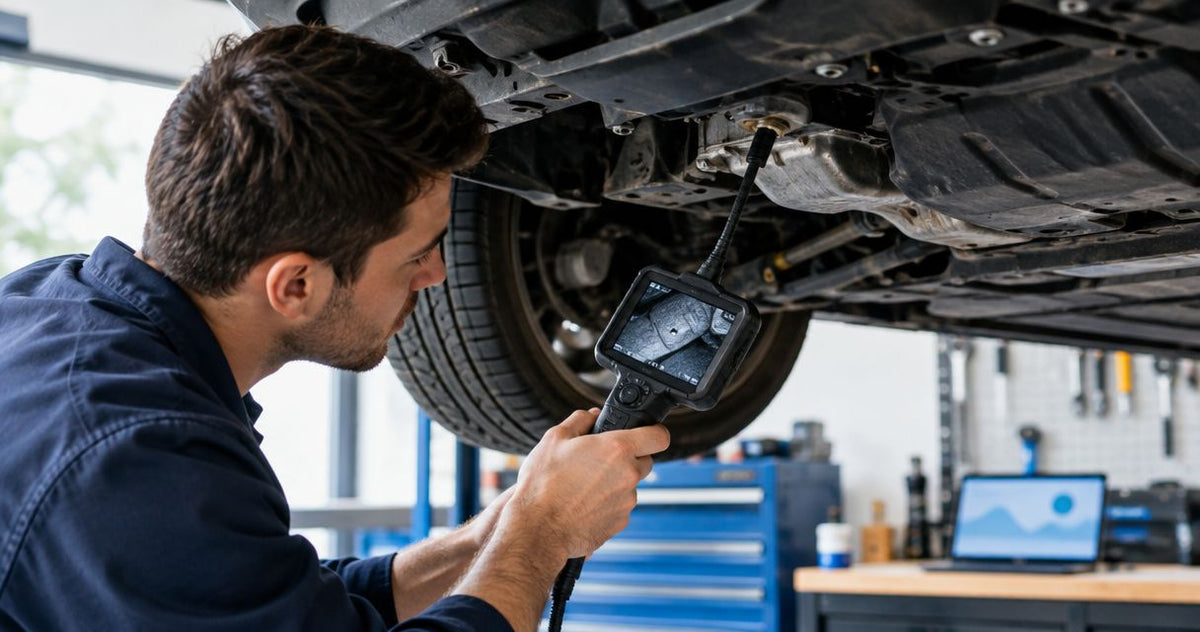
A cheap borescope earns its keep the first time a mechanic needs to see a cylinder wall without pulling the head. The trouble starts when the same tool has to turn out of a spark-plug hole, survive a shop floor or show a customer clear footage. A fixed-head camera on a thin cable stops at the first bend and then goes in the drawer.
This guide covers what to buy when a Depstech no longer does the job: articulating videoscopes, a micro video borescope and an underbody camera, each matched to a specific automotive task. The short answer is the Videoscope VOYAGER M40 for general engine work and the High Temperature Borescope Camera VOYAGER C40 for hot exhaust-side checks. Fiberscope.net sells the products discussed and services them in-house. For a wider look at the category, see our video borescopes for automotive mechanics guide.
- The best Depstech alternative for automotive inspection is the Fiberscope.net Videoscope VOYAGER M40: 360° all-way joystick articulation, IP68 probes.
- Exhaust-side and hot-engine checks call for the VOYAGER C40, which comes with 4-way articulation on 3.3–16.4 ft (1–5 m) probes.
- Under-vehicle checks need a dedicated camera, not a borescope: the Under Vehicle Inspection Camera starts from $580.
- Depstech stays the right buy for occasional, low-stakes checks on a tight budget.
Where a Depstech stops being enough
A Depstech is a consumer borescope that streams to a phone over Wi-Fi, and that is the right tool for a weekend check. Professional shops hit its ceiling in three places: probe durability, articulation and service.
Articulation matters most in engine work. A cylinder bore is straight, but the piston crown, the valve seats and the intake-valve backs sit off-axis. You reach them through the spark-plug hole or the intake port by bending the tip or using a side view, and a fixed head can't do either. Inspect on a cold engine; a hot cylinder is a hazard to the probe and to you.
The Wi-Fi link is the second weak point. A phone app is fine for a quick look, but a shop needs recorded evidence it can attach to a repair order. Consumer apps and consumer service channels were not built for that workflow.
Staying with a Depstech is the right call if you inspect a few engines a year, never need to bend the tip, and are not billing for the result. If you want other consumer-tier names to compare, our Teslong alternatives page covers the same trade-offs.
Alternatives at a glance
The table puts the Depstech row first so you can benchmark each option against it.
| Tool | Best for | Standout feature | How it differs from Depstech |
|---|---|---|---|
| Depstech (consumer borescope) | Occasional DIY checks | Wi-Fi phone app, low cost | Baseline: consumer-grade, limited probe durability, articulation and service |
| Videoscope VOYAGER M40 | General engine inspection | 360° all-way joystick articulation | Steerable tip, IP68 probes, professional service |
| High Temperature Borescope Camera VOYAGER C40 | Hot exhaust-side work | 4-way articulation on 1–5 m probes (2-way on 6–8 m) | Built for heat; probe lengths up to 26.2 ft (8 m) |
| Infrared Tactical Borescope Camera C35 | Dark cavities, frames, body panels | Infrared illumination, mechanical all-way articulation | Lights the space without visible light |
| Micro Video Borescope MICRON | Very tight access | USB 3.0 and HDMI output | Micro-class probe for small openings |
| Under Vehicle Inspection Camera | Underbody checks | Sees under a vehicle or trailer | A different job from a borescope |
Videoscope VOYAGER M40: best for general engine inspection
The Videoscope VOYAGER M40 is the default pick for a mechanic who needs one tool for most engine work. Its joystick moves the tip 360° in every direction, so you can steer from a spark-plug hole across a piston crown, down a cylinder wall or along a valve seat. The probes are rated IP68.
Typical jobs: scoring and carbon on cylinder walls, coolant or head-gasket traces in a cylinder, intake-valve carbon on direct-injection engines through the intake port, and timing components behind covers. It also retrieves dropped bolts and small parts when you can see where they landed.
It can't do much in a space where the probe has to be thinner than the access opening. Match the probe outer diameter to the smallest hole you work through before buying. If your access is smaller than a spark-plug hole, the MICRON below is the better tool.
Buy for general automotive work.
VOYAGER C40: best for exhaust-side and hot-engine checks
The High Temperature Borescope Camera VOYAGER C40 is the high-temperature version of the family. It uses 4-way articulation on probes of 3.3–16.4 ft (1–5 m) and 2-way articulation on probes of 19.7–26.2 ft (6–8 m).
It suits catalytic converter and exhaust internals, and fuel tank checks where reach counts more than fine tip control. The longer 2-way probes give up some steering, so pick the 4-way length if you need to turn tightly. Skip it if your work stays at the cylinder head; the M40 handles that without paying for the heat capability.
Buy if exhaust and long-reach work is a regular job. Skip for cylinder-head work only.
Infrared Tactical Borescope Camera C35: best for dark cavities
The C35 lights its surroundings with infrared, which helps inside door cavities, rocker panels and frame rails where white light bounces off rust and dirt. Its tip articulates mechanically in all directions.
It is an infrared illumination borescope, not a thermal camera. It cannot show heat loss or find a hot spot. Use it to see rust inside body panels and frames, and choose the M40 when you want a conventional steerable view of an engine.
Hold unless low-light cavity work is a weekly job.
Micro Video Borescope MICRON: best for very tight access
The Micro Video Borescope MICRON outputs over USB 3.0 and HDMI, so it connects to a laptop or a shop monitor. Choose it when the opening is too small for an M40 probe, such as a small sensor port or a narrow passage behind a component.
Probe diameter is the number to check on its product page against your smallest opening. Our inspection cameras ranked by probe diameter guide shows how the sizes compare across the range.
Buy as a second tool, not a replacement for an articulating scope.
Under Vehicle Inspection Camera: best for underbody checks
The Under Vehicle Inspection Camera starts from $580 (checked at publish date). It sees under a vehicle or trailer, which a borescope does not do well. It suits underbody damage checks, exhaust routing and quick looks at the chassis without a lift.
It is not a borescope and will not enter an engine. Pair it with an M40 and you cover both the inside and the underside of a vehicle.
Buy if underbody inspection is part of your daily workflow.
Other options
If you need measurement-grade imaging for aerospace-level work, look at the Evident IPLEX series. It is the standard in that field and goes well beyond what a vehicle shop needs. If you only need a cheap look inside an engine a few times a year, a Depstech or Teslong consumer unit is the honest answer and costs far less than any system above.
How to size the tool to the job
Access opening decides the choice before brand or feature count does. Walk through four questions in order.

- Access opening. The probe must pass the smallest hole it has to enter. Under that size, move to the MICRON.
- Route. A straight run needs no articulation. Anything that turns, such as a spark-plug hole to a piston crown, needs a steerable tip. Our articulating borescope guide compares the classes.
- Reach. Cylinder work is short. Exhaust and tank work needs the longer C40 probes.
- Evidence. If you hand footage to a customer, you need recording, not just a live phone view.
What you'll also need
A tool that holds its image in a dark cavity needs a light source or an infrared option, and a laptop or monitor for the MICRON. IP ratings tell you what the probe survives. IP67 means temporary immersion to 1 m for 30 minutes, and IP68 means beyond 1 m under the maker's stated conditions; the standard is IEC 60529.
Common mistakes
- Buying on resolution alone. A sharp image through a probe too thick for the hole is useless.
- Inspecting a hot engine. Work on a cold engine through the spark-plug hole.
- Expecting a fixed head to see a piston crown from the spark-plug hole.
- Treating a Wi-Fi app as a record. Recorded files attach to a repair order; a live phone view does not.
FAQ
What is the best Depstech alternative for automotive inspection?
The Videoscope VOYAGER M40 is the best all-round choice, with 360° all-way joystick articulation and IP68 probes. It handles cylinder walls, valve seats and intake ports.
Is a Depstech good enough for a car engine?
For an occasional look through a spark-plug hole, yes. For daily shop work you need articulation, a tougher probe and recording, which a consumer borescope lacks.
Can I inspect a hot engine with a borescope?
Inspect a cold engine through the spark-plug hole. Only the VOYAGER C40 is built for high-temperature work, such as exhaust-side checks.
Does the C35 infrared borescope show heat loss?
No. The C35 uses infrared illumination for low-light visual inspection. It is not a thermal camera.
What do I use to look under a vehicle?
Use the Under Vehicle Inspection Camera, which sees under a vehicle or trailer. A borescope is the wrong tool for that job.
Do I need articulation for engine work?
Yes for anything off-axis. A cylinder bore is straight, but piston crowns and valve seats are reached by bending the tip or using a side view.
Send us your job details
Send us your smallest access opening, the route to the target, the reach you need and whether you must record footage, and a Fiberscope.net specialist will match the right probe and tool. Use the contact page or call 1-877-613-2210, Monday to Friday, 8:00–18:00 CST.
About the author. Vladimir Khubiryants, Founder & President, Fiberscope.net (MEDIT Inc.). Vladimir Khubiryants founded Fiberscope.net to give professionals access to reliable video inspection equipment without enterprise pricing. For over 20 years he has sourced and tested borescopes, sewer cameras and fiberscopes in Fiberscope.net's in-house test and repair facility, helping plumbers, pipeline engineers, aviation and military teams choose the right tool for the job. See our cameras in use on YouTube and Instagram.


Leave a comment
This site is protected by hCaptcha and the hCaptcha Privacy Policy and Terms of Service apply.