

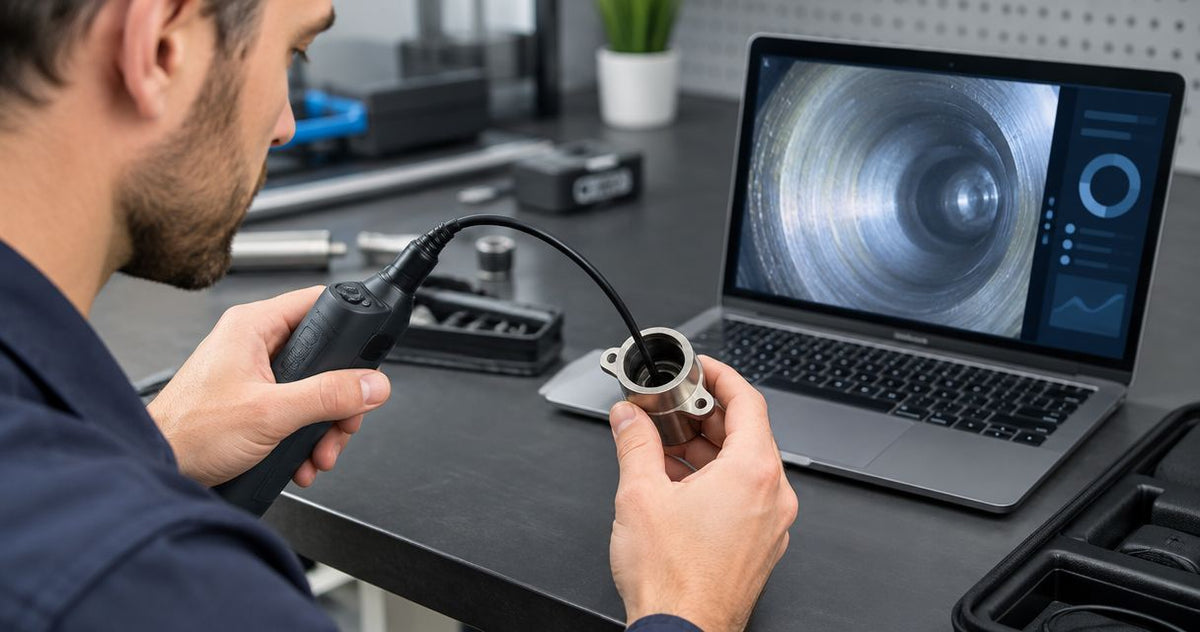
A micro borescope gets bought when something the size of a keyway, a cross-drilled oil passage or a machined bore has to be seen and no larger probe will fit. The category splits three ways: flexible optical scopes you view through an eyepiece or a camera, a micro video unit with its own digital output, and rigid scopes that cannot bend. Choose by the narrowest opening on the path first, then by how you need to record the image.
For most small-bore work the Super Thin Micro Borescope (from $1,750) is the starting point. The Ultra Fine Micro Borescope (from $3,520) is the step up for the tightest areas, and the MICRON micro video borescope (from $11,100) is the one with USB 3.0 and HDMI output built in. Fiberscope.net sells all of them and services them in-house.
- Super Thin Micro Borescope: probes start at 1.0 mm (0.04 in), from $1,750. The default for small machined bores.
- Ultra Fine Micro Borescope, from $3,520, is the premium flexible option for extremely small areas. It has no tip articulation.
- MICRON, from $11,100, outputs USB 3.0 and HDMI, so no separate camera is needed.
- Optical micro borescopes need an external light source and a camera if you want recorded video.
How to choose a micro borescope
The smallest opening on the route sets the maximum probe diameter, and everything else is secondary. Work through these in order:
- Opening size. Measure the narrowest point the probe must pass, then pick a probe smaller than it. The Super Thin line starts at 1.0 mm (0.04 in).
- Path. A straight bore can use a rigid scope. A route with any turn needs a flexible probe.
- Light. Optical micro borescopes have no light of their own and rely on an LED handle or a light source with a light guide.
- Image capture. An eyepiece is enough for a quick look. For evidence in a report you need a camera on the eyepiece or a scope with digital output.
- Budget. Prices in this guide run from $378 for a rigid scope to $11,100 for the MICRON.
Micro borescopes at a glance
| Model | Type | Suits | From |
|---|---|---|---|
| Super Thin Micro Borescope | Flexible optical | Machined parts and tiny cavities | $1,750 |
| Ultra Fine Micro Borescope | Super-thin flexible fiberscope | Extremely small inspection areas | $3,520 |
| MICRON | Micro video borescope, USB 3.0 and HDMI | Ultra-thin bores with direct digital output | $11,100 |
| Rigid Borescope | Rod-lens, straight only | Straight bores with a clear line of sight | $378 |
Super Thin Micro Borescope: the default for machined parts
The Super Thin Micro Borescope is a cost-effective, simple optical scope for tiny areas and machined parts, with diameters starting at 1.0 mm (0.04 in). That makes it the practical entry point for cross-holes, small passages and cavities where a video probe will not fit.
It is a viewing tool first. You look through the eyepiece, add an LED handle for light, and add a camera coupler only when you need footage. At $1,750 it costs far less than the MICRON, but you build the imaging chain yourself.
It suits shops that inspect small machined parts a few times a week. It is the wrong buy if every inspection must be recorded and you do not already own a camera for the eyepiece. Buy for small-bore viewing.
Ultra Fine Micro Borescope: for the tightest access
The Ultra Fine Micro Borescope is the premium line of super-thin flexible fiberscopes, built for extremely small inspection areas. A fiberscope carries the image through a coherent fiber bundle, so image detail is set by the pixel count of that bundle. A thinner probe has fewer fibers, and the picture is coarser than on a larger scope.
The probe has no tip articulation. You steer by moving the probe and choosing the entry angle, so plan the approach before you insert it. From $3,520, it is the right move when the Super Thin probe is still too large for the opening.
Buy only when the opening rules out the Super Thin. Otherwise the cheaper scope does the same job.
MICRON: micro video with digital output
The MICRON is a micro video borescope for ultra-thin bores, with USB 3.0 and HDMI outputs. You connect it to a computer or monitor directly, with no coupler or eyepiece camera in between. It is the only scope here where the image arrives digital from the tip.
At $11,100 it costs more than the other micro scopes in this guide combined. It earns that when a lab, a QC line or a reprocessing workflow needs a live image on a screen every day. For occasional looks, an optical scope plus a camera costs a fraction as much.
Buy for daily production or documentation work. Skip for occasional inspections.
Rigid Borescope: the cheapest sharp view
The Rigid Borescope starts at $378 and uses rod-lens relay optics, which give a clean image in straight bores. It needs a light source through a light guide or a handle. It cannot bend around anything, so it only works where you have a straight line of sight to the target.
If your bores are straight, this is the honest recommendation before any micro scope. If the route turns, move to a flexible probe. Buy for straight bores only.


What you'll also need
Optical micro borescopes are only half a system. Three accessories complete one:
- Light. The SPARK LED light handle (from $299) clips onto the scope. The MS-LED light source (from $1,490) feeds a fiber optic light guide cable for more output.
- A camera. The ImagePRO USB 3.0 camera (from $1,270) turns an optical borescope into a video borescope. The Universal Borescope Video Coupler (from $250) connects the eyepiece to a camera body. The ImagePRO HDMI (from $1,580) has no capture, so it displays live video only.
- A comparison of options. Our guide to the best optical borescopes covers larger probes, and the best USB borescope cameras guide covers the capture side.
Common mistakes
- Buying on probe diameter alone. Check the opening and the route, because a 1.0 mm (0.04 in) probe that cannot turn a corner does not solve a bent passage.
- Expecting video from an optical scope. Without a camera on the eyepiece you have a viewing tool, not evidence.
- Forgetting light. A micro probe with no LED handle shows a dark screen.
- Paying for the MICRON when occasional viewing is the real job.
FAQ
What is a micro borescope?
A micro borescope is an inspection scope with a very thin probe for bores and cavities too small for standard borescopes. Fiberscope.net sells optical, fiberscope and micro video versions.
Can a micro borescope record video?
Optical micro borescopes record only with a camera on the eyepiece, such as the ImagePRO USB 3.0. The MICRON outputs USB 3.0 and HDMI directly.
Does the Ultra Fine Micro Borescope articulate?
No. The Ultra Fine probe has no tip articulation, so you steer it by moving the probe and choosing the entry angle.
Do micro borescopes need a separate light source?
Optical models do. Use a SPARK LED light handle or an MS-LED light source with a fiber optic light guide cable.
Can a rigid borescope go around a bend?
No. Rigid borescopes use rod-lens optics and only view along a straight line, so any bend calls for a flexible probe.
Get the right scope matched to your opening
Send us the narrowest opening, the length of the route, any turns, the lighting you have and whether you need recorded footage. A Fiberscope.net specialist will match the probe and the imaging setup. Call 1-877-613-2210 (Mon–Fri 8:00–18:00 CST) or use the contacts page on the store.
About the author. Vladimir Khubiryants founded Fiberscope.net to give professionals access to reliable video inspection equipment without enterprise pricing. For over 20 years he has sourced and tested borescopes, sewer cameras and fiberscopes in Fiberscope.net's in-house test and repair facility, helping plumbers, pipeline engineers, aviation and military teams choose the right tool for the job.

Leave a comment
This site is protected by hCaptcha and the hCaptcha Privacy Policy and Terms of Service apply.