

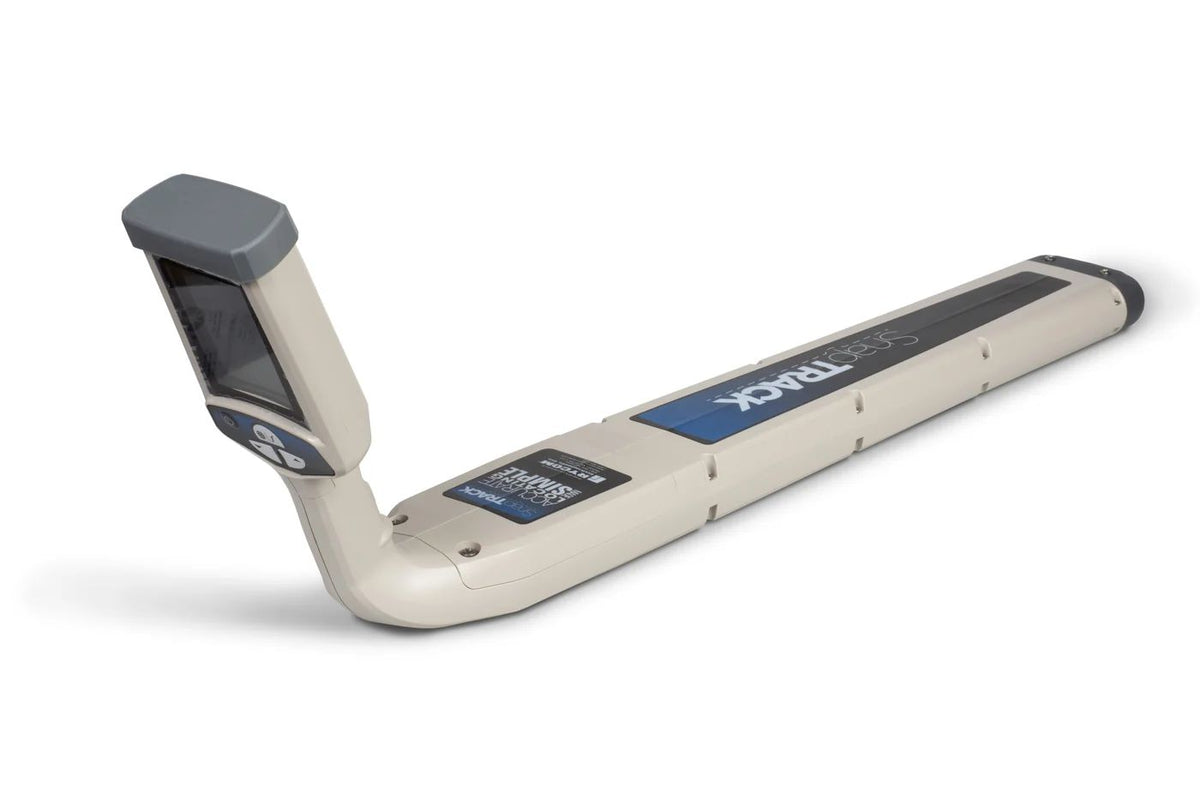
Yes. A 512 Hz sonde inside a sewer camera head can be found from above asphalt or concrete with a receiver set to 512 Hz. The receiver finds the sonde's position, not the entire line; move the camera and repeat the locate to trace the route. Rebar and other nearby metal can distort the field, so a single surface mark or displayed depth is a starting point rather than a dig instruction. Fiberscope sells the equipment discussed and services it in-house.
What the receiver finds under pavement
A 512 Hz transmitter in the camera head, a push cable to position it and a separate 512 Hz receiver form the locating chain. The transmitter must actually be in the head you deploy. For example, MiniFlex 2 19mm has a 512 Hz sonde; Drain Camera VIPER has a 512 Hz option only with its 1-inch self-levelling head. A receiver alone cannot inspect a lateral or generate a signal inside it.
| Site condition | Reading to use | Field check |
|---|---|---|
| Asphalt over a lateral | Sonde peak from above ground | Cross the line from both directions |
| Plain concrete above a drain | Peak and position as the sonde is moved | Mark successive points, not a guessed continuous route |
| Reinforced slab or nearby metal | Comparing peak and null patterns | Repeat from another angle; investigate inconsistent marks |
| Deeper run | Weaker signal at the receiver | Use the sonde and receiver's working range and keep the receiver at grade |
The field pattern is affected by metal, transmitter orientation and other signals, rather than by a camera's ability to see through the pavement. Rycom's SnapTRACK operating manual describes moving the receiver side to side for the peak over a sonde and using manual triangulation to check depth in congested locations. The manual's locating method is more useful than promising exact depth beneath rebar.
A pavement locating sequence
Set the receiver to 512 Hz before pushing the camera, then locate at a known position near the entry and again at the suspected defect. That first test proves the head is transmitting and the receiver is in the correct mode. Record the access point, direction of travel and footage counter reading separately from the surface marks.
- Open the cleanout and insert a camera with a 512 Hz sonde. Watch the screen until the head reaches a recognizable junction or defect.
- Search from above with the receiver in sonde mode. Sweep across the expected path and rotate the receiver as directed by its operating guide to distinguish peak and null positions.
- Mark the strongest consistent location. Shift the camera head along the line and repeat to build a series of points; the sonde marks the head, not every inch of pipe between marks.
- If rebar, an iron cover or another utility is nearby, compare the signal from several approaches. Treat a depth figure that changes sharply between passes as uncertain.
- Record the mark, access, pushed cable length and the corresponding camera image in the job file. Follow the applicable utility-marking and excavation procedure before cutting pavement.
A 512 Hz sonde reports the transmitter location while the camera reports the visible defect. For cameras selected primarily by locating hardware, see the sewer-camera locating comparison. For a larger pipe where bend passage and footage capture dominate, see the general sewer camera guide.
Which receiver to carry
SnapTrack Sewer Camera Sonde Locator receives 512 or 640 Hz sondes and has optional 815 Hz and 33 kHz modes; it weighs 3 lb (1.4 kg). It runs on six C batteries and the product page rates it for 40 hours of continuous use. Its active and passive modes extend the tool beyond finding a camera head, but an active trace needs a separate compatible line transmitter. SnapTrack starts at $1,390; prices checked September 26.
Schonstedt 512Hz Sonde Locator (XT512) receives a 512 Hz sonde and also has passive 50/60 Hz modes. Its depth button displays a reading when positioned above the sonde; the product describes typical readings around 5–8 ft (1.5–2.4 m), depending on signal strength. It weighs 2.5 lb (1.1 kg) and starts at $1,693. Choose it when a dedicated 512 Hz receiver and passive power-line mode suit the crew. Choose SnapTrack when 640 Hz or optional modes are relevant. These receivers are locating accessories, never cameras.
A short crew job might use a camera already on the truck rather than buy a second reel. If the existing head lacks a 512 Hz sonde, selecting a receiver does not add one. The drain-camera fit guide for plumbers covers selecting the head and push cable for the pipe first.
What you'll also need
A sonde-equipped camera and a compatible receiver are separate pieces of the kit. Bring the camera's battery, the receiver's batteries, marking supplies and a way to pair footage-counter notes with photos. Rebar, buried iron and surface vehicles can alter a reading; Subsite's discussion of field interference explains why a frequency that works in one part of a site can become harder to interpret elsewhere. If the route is under a driveway, record successive marks before deciding where to excavate.
FAQ
Can a 512 Hz receiver find a sewer line through asphalt?
It can find a 512 Hz sonde placed inside the line. Move the camera and repeat the locate to mark multiple points along the route.
Does the sonde transmit from every VIPER camera head?
No. Drain Camera VIPER's 512 Hz option belongs to its 1-inch self-levelling head; other head choices serve different inspection jobs.
Will rebar stop a 512 Hz locate?
Rebar can distort the field and make a mark or depth reading unreliable. Compare peak and null positions from multiple approaches.
What is the difference between SnapTrack and the XT512?
SnapTrack receives 512/640 Hz and optional 815 Hz and 33 kHz sondes. The XT512 receives 512 Hz and offers passive 50/60 Hz modes.
About the author
Vladimir Khubiryants, Founder & President, Fiberscope (MEDIT Inc.). Vladimir Khubiryants founded Fiberscope to give professionals access to reliable video inspection equipment without enterprise pricing. For over 20 years he has sourced and tested borescopes, sewer cameras and fiberscopes in Fiberscope's in-house test and repair facility, helping plumbers, pipeline engineers, aviation and military teams choose the right tool for the job.
Send your pipe ID, cleanout location, cable run, bends, pipe material, existing sonde and receiver frequencies, and recording needs through the contact page or call 1-877-613-2210 to match the camera and locating setup.

Leave a comment
This site is protected by hCaptcha and the hCaptcha Privacy Policy and Terms of Service apply.