

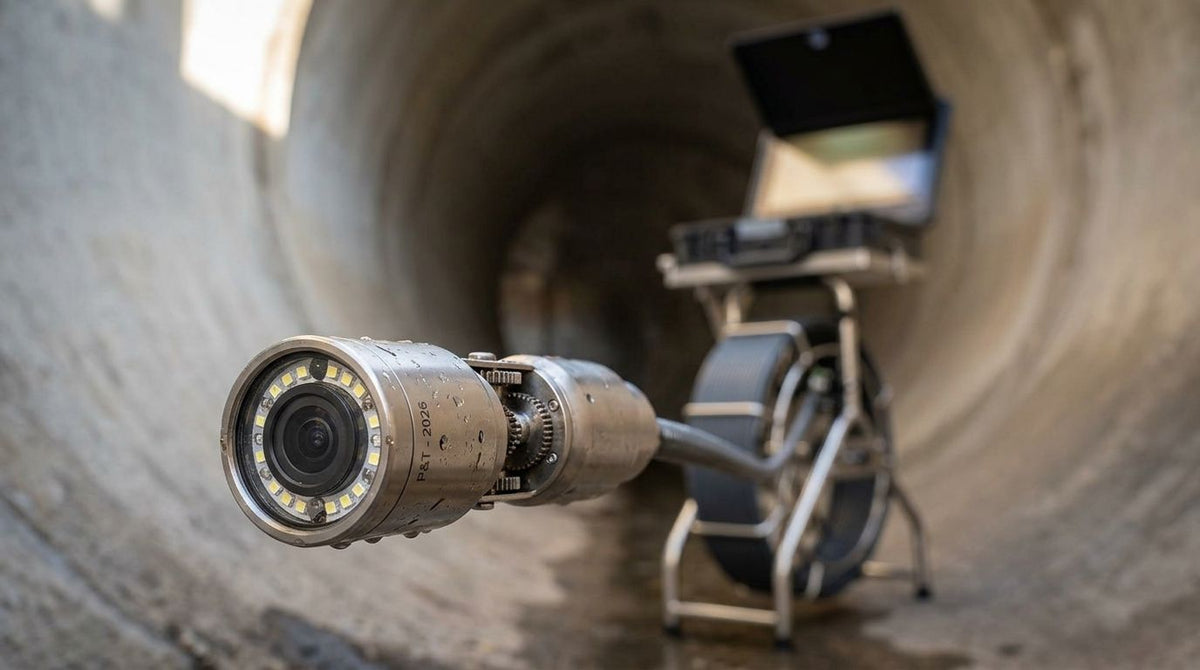
For mainline inspection in 2026, choose the Pipe Camera ANACONDA MID for a measured run within 197 ft, or the Sewer Camera ANACONDA when you need up to 394 ft of cable. Both are manually advanced pan-and-tilt push cameras, not powered crawlers; their 50 mm × 154 mm heads are listed for pipes from 3 in. The reel length is not a promise that the head will pass every bend.
- For pan-and-tilt push camera work up to 197 ft, choose Pipe Camera ANACONDA MID with its 7 mm push rod.
- For a longer manually pushed mainline, Sewer Camera ANACONDA carries up to 394 ft on an 11 mm rod.
- Both pan-and-tilt heads measure 50 mm × 154 mm and are listed for pipes from 3 in.
- A rotating head changes the view, not the camera's traction; use a powered crawler if the route requires driven travel.
Why viewing direction is only half the decision
A straight-view camera shows the pipe ahead. A pan-and-tilt head turns toward the wall so you can inspect a joint, a service lateral connection, or damage off the centerline while keeping track of footage. Fiberscope's ANACONDA systems are the fit for a mainline that permits manual push-cable travel and needs deliberate wall views. Pan-and-tilt does not steer the head through a fitting, propel the reel, or clean an obstructed line.
On a mainline condition survey, images are useful only when tied to location and an observation. NASSCO's PACP course description identifies standardized condition codes for pipeline assessment; a camera's USB recording and on-screen counter do not, by themselves, produce a PACP-coded report. Check the contract's coding and deliverable requirements separately.
For the 2026 buying decision, measure the pipe and route first. The two ANACONDA listings offer the same class of viewing head, but very different cable length and stiffness. A bigger reel cannot compensate for a head that will not clear the entry or for an offset that stops a push rod.
At a glance: the two mainline configurations
| Complete system, pan-and-tilt variant | Best for | Head and pipe | Reel and rod | Limitation |
|---|---|---|---|---|
| Pipe Camera ANACONDA MID | Manual runs within 197 ft where a 7 mm rod suits the route | 50 mm OD × 154 mm; pipe from 3 in | Up to 60 m / 197 ft; 7 mm fiberglass | No published guarantee of bend passage or powered travel |
| Sewer Camera ANACONDA | Longer manual runs beyond the MID's reach | 50 mm OD × 154 mm; pipe from 3 in | Up to 120 m / 394 ft; 11 mm fiberglass | Thicker rod does not make a tight route passable |
OD means outside diameter. The 3 in figure is the stated pipe minimum for the pan-and-tilt head, not a guarantee that a 3 in elbow or cleanout will pass it. Specifications and configuration checked September 26, 2026.
Pipe Camera ANACONDA MID: when the run is within 197 ft

Best for: building sewers and shorter mainline sections where the measured travel stays within the 60 m / 197 ft reel and an operator can push and retrieve the head. Its 7 mm fiberglass rod is thinner than the larger ANACONDA's 11 mm rod. That distinction matters in routes with bends, though rod diameter alone does not establish a bend-passage rating.
The pan-and-tilt option carries a 50 mm-diameter, 154 mm-long head with adjustable LEDs and a built-in 512 Hz sonde, a transmitter that lets a separate receiver locate the head from above ground. The head and push rod are listed as IP68; that rating does not make the monitor or whole system submersible. The supplied control box has a 13 in monitor, a footage counter, photo and video recording to USB, a microphone and a wireless keyboard for text entry. That keyboard is not a Wi-Fi video feed to a phone.
For a joint-focused survey, stop the push, view the pipe wall and record the distance at each observation. The same listing offers a smaller 40 mm self-levelling, straight-view head. That variant is for an upright forward image, not a substitute for a directional wall view.
Limit: do not order this variant for a run longer than 197 ft, an entry that cannot admit a 50 mm × 154 mm head, or a job requiring driven traction. For a tight fitting where the pan-and-tilt head cannot clear, a smaller straight-view configuration is the more honest choice.
Sewer Camera ANACONDA: when the measured route is longer

Best for: a longer, manually accessible mainline where the MID's 197 ft is insufficient and up to 120 m / 394 ft of rod is needed. The 11 mm fiberglass rod and large reel give the operator more reach. They do not give the head a motor or guarantee travel through heavy silt, sharp offsets or multiple bends.
The pan-and-tilt option has a 50 mm × 154 mm head for pipe from 3 in, adjustable LEDs and a built-in 512 Hz sonde. Its head and push rod are listed as IP68. The 13 in control box records photos and video to USB and provides a footage counter, microphone and wireless text-entry keyboard; it does not advertise Wi-Fi live viewing on a tablet.
This is a reel choice, not a superior head for every job. If your farthest observation is inside 197 ft, adding a longer and thicker rod has no demonstrated benefit merely because the line is called a mainline. For an obstructed, high-drag or very long large-diameter run where manual push fails, specify a true powered crawler rather than calling an ANACONDA a crawler.
Limit: the listing gives no reliable bend-passage specification for your exact route. Plan around the narrowest access, the path back out, and the available recovery approach, not the reel's maximum printed length.
Select the viewing head before the reel
The choice between a 50 mm pan-and-tilt head and a 40 mm self-levelling straight-view head is about evidence and access. Use pan-and-tilt when you need to point at a lateral opening, crack or circumferential joint. Use straight view when an upright forward image and smaller head matter more than looking sideways. The head variants are interchangeable on current ANACONDA reels according to the product listings, but older connectors may differ; the exact connector on an existing reel matters if you are buying a replacement.
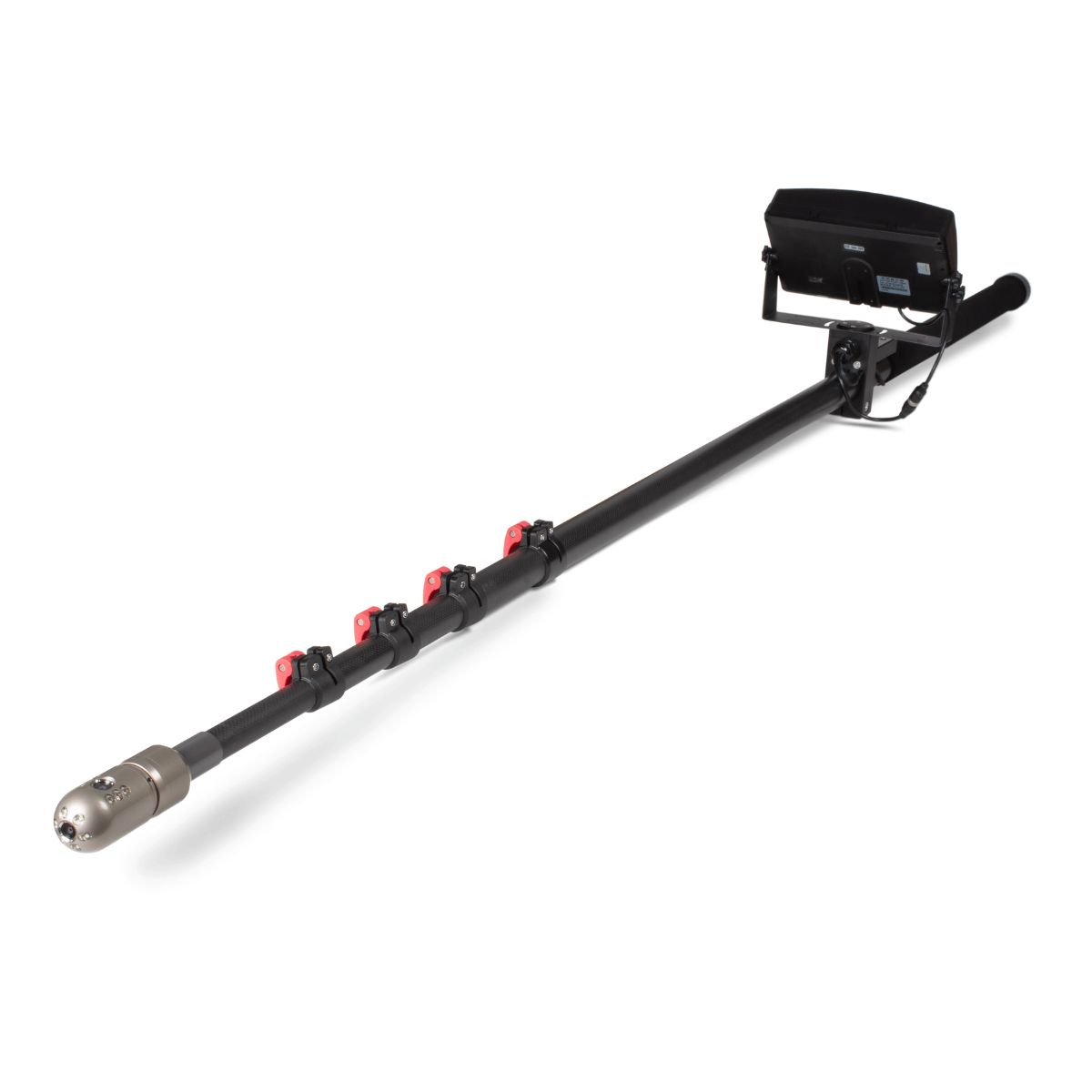
Neither option moves itself. A skid supports or centers a compatible head, and a pole-mounted zoom camera looks down a straight mainline from a manhole; neither converts a push camera into a crawler. In 2026, keep those three deployment methods separate in a purchase specification.
Watch Fiberscope's ANACONDA setup and recording demonstration for the actual head controls, footage counter and USB workflow. The video shows the equipment class; the dimensions and configuration for a new order should come from the current product listings above.
Plan the inspection, not only the camera purchase
- Record entry and pipe ID. Measure the clear opening through the access point and the internal pipe diameter after restrictions, not only the nominal pipe label. A 50 mm head listed from 3 in still has 154 mm of body length to negotiate at a bend.
- Map length and resistance. Mark the farthest observation from the access point and list elbows, offsets, roots, standing water and deposits. The stated 197 ft and 394 ft are working lengths, not field guarantees under drag.
- Choose the evidence. For joints and lateral connections, stop the head and capture the wall view with the footage counter visible. Record the direction of view and the segment reference alongside the image.
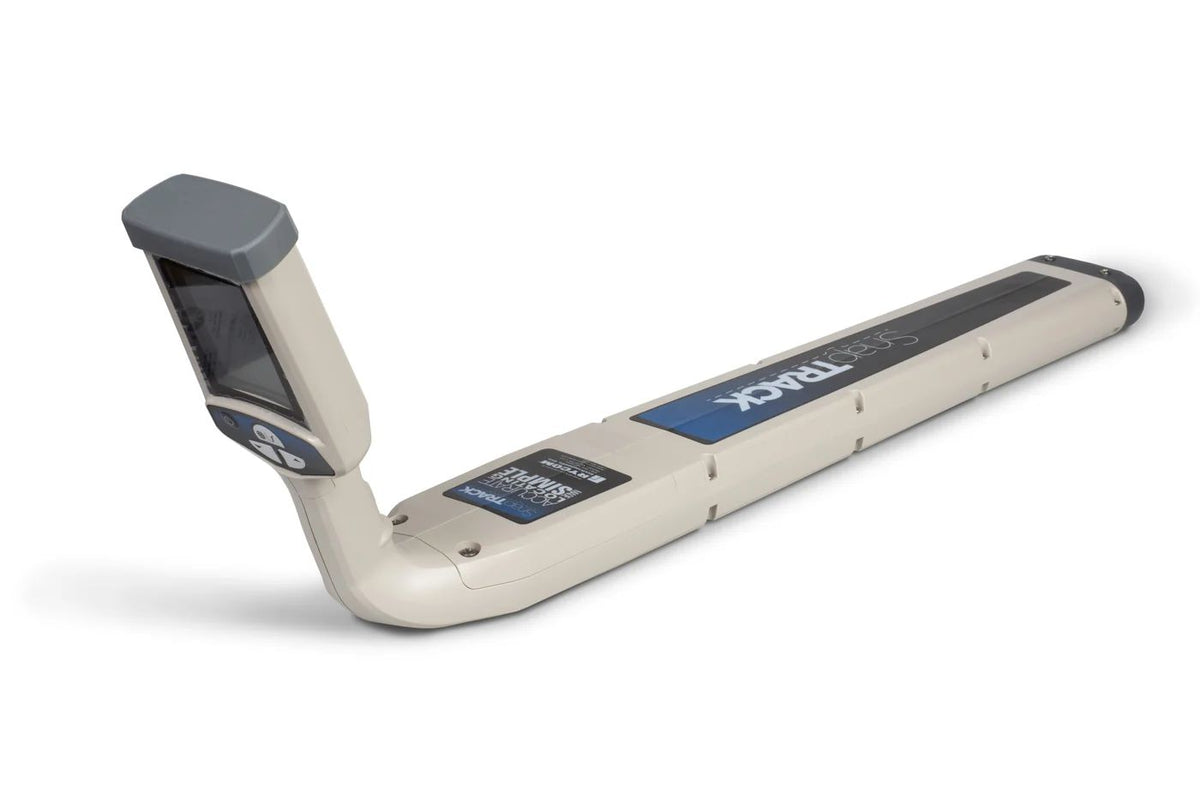
- Separate locating from viewing. A 512 Hz sonde transmits from the head. A separate 512 Hz-capable receiver, such as a SnapTrack or Schonstedt locator, reads it from the surface. Rebar and other metal distort the field; do not present a single depth reading as exact excavation depth.
- Decide whether to clean first. A camera cannot inspect a wall hidden by silt or grease. In an EPA sewer-inspection operation, crews cleared debris before camera assessment; a clean line makes a defensible condition record possible.
- Plan safe access. If anyone enters a manhole, the employer must assess the space and follow the applicable entry rules. OSHA's permit-required confined-space standard covers general-industry entry hazards; construction and other jurisdictions have their own requirements. Buying a camera is not an entry plan.
What you will also need
A surface locate calls for a receiver matched to the head's 512 Hz transmitter. Skids can center or protect a suitable head but need the correct mounting interface and room through the narrowest bend. A USB memory stick holds the ANACONDA recordings. None of these accessories is a complete camera system, and none adds powered travel.
If the contract calls for NASSCO-coded mainline reporting, identify the operator's coding workflow separately from the stored video. If it calls only for before-and-after footage, label each file with the segment and orientation. The 2026 camera choice should follow the deliverable as well as the pipe geometry.
Pan-and-tilt variant prices checked September 26, 2026; other head variants are priced differently. Check the current configuration at the linked product page.
FAQ
Is an ANACONDA pan-and-tilt camera a powered crawler?
No. Pipe Camera ANACONDA MID and Sewer Camera ANACONDA are push-camera systems: the operator advances a fiberglass rod. The head turns to change the view, not to propel the camera.
What pipe size accepts the ANACONDA pan-and-tilt head?
The 50 mm × 154 mm pan-and-tilt head is listed for pipes from 3 in. That does not guarantee clearance through a particular access point or elbow.
How far does Pipe Camera ANACONDA MID reach?
The MID reel is listed at up to 60 m / 197 ft with a 7 mm fiberglass rod. Bends and drag can limit actual manual travel.
How far does Sewer Camera ANACONDA reach?
The large reel is listed at up to 120 m / 394 ft with an 11 mm fiberglass rod. Reel length does not guarantee passage through offsets or debris.
Does the 512 Hz sonde include a locator?
No. The 512 Hz sonde transmits from the camera head; locating at the surface requires a separate compatible receiver. Metal can distort its field.
Does the wireless keyboard send ANACONDA video to a phone?
No. The product pages describe a wireless keyboard for text entry and recording to USB, not a Wi-Fi live-video connection to a phone.
Can pan-and-tilt heads pass tight 90-degree bends?
Pan-and-tilt changes the camera's viewing direction; it does not prove bend clearance. Head length, rod stiffness, pipe ID and fitting geometry determine whether the route is workable.
One last thing
The longest cable is not the best default. Start with the 50 mm × 154 mm head and the narrowest route restriction, then select 197 ft or 394 ft of rod. If the head cannot reach and return, its viewing range is irrelevant.
Related guides
Configuration review
Send your pipe ID, access opening, run length, bends or traps, pipe material, locating need and existing locator frequency, and recording or reporting requirements to the Fiberscope specialists. They can match the head and reel to the route, or recommend a crawler when a push camera is the wrong class.
Vladimir Khubiryants, Founder & President, Fiberscope (MEDIT Inc.)
Vladimir Khubiryants founded Fiberscope to give professionals access to reliable video inspection equipment without enterprise pricing. For over 20 years he has sourced and tested borescopes, sewer cameras and fiberscopes in Fiberscope's in-house test and repair facility, helping plumbers, pipeline engineers, aviation and military teams choose the right tool for the job.

Leave a comment
This site is protected by hCaptcha and the hCaptcha Privacy Policy and Terms of Service apply.