

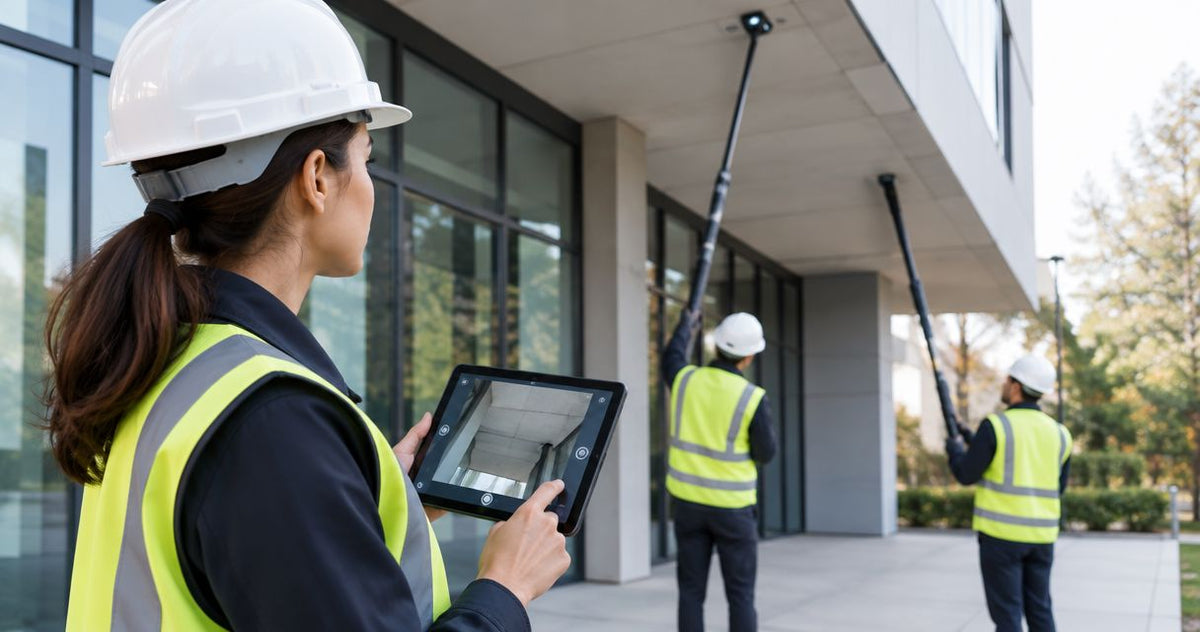
A pole camera on one truck is a tool. Six of them across a six-inspector firm is a purchasing decision: one model or three, what each inspector carries, and what happens when a unit is out for repair on a Friday with four roofs booked. Buy the wrong mix and half the crew runs a different workflow from the other half.
The short answer: standardize on the Dual View Pole Camera COBRA, from $4,110, for roofs, attics and gutters, and add a CYCLOPS unit only for the inspectors who work tanks, bins or mainlines. Fiberscope.net sells the products discussed here and services them in-house, so read the picks with that in mind.
Standardize on one camera, then add specialists
A multi-inspector firm should buy one standard pole camera for every inspector and one or two specialist units for jobs the standard camera does not cover. A uniform kit means one training session, one set of recording habits and interchangeable spares.
The price gap makes the split obvious. Four COBRA units cost $16,440, within $200 of a single Pole Inspection Camera CYCLOPS HD at $16,255. For most property work, four inspectors on a COBRA each beat one inspector on a CYCLOPS HD.
- Pole camera for multi-inspector firms: issue the COBRA, from $4,110, as the standard kit for roofs, attics and gutters.
- Add one CYCLOPS HD, from $16,255, for tanks, bins and sewer mainlines.
- Add one CYCLOPS TZ, from $13,200, only if you inspect 4-80 inch mainlines and culverts from a manhole.
- Near overhead lines, use a non-conductive pole and follow OSHA 1910.333 clearance distances.
What a firm needs that a solo inspector does not
A solo inspector picks the camera that suits one pair of hands. A firm picks the camera that suits every inspector and the person who reviews their files. Four things change:
- One recording routine. The COBRA records to an SD card, so every inspector pulls footage the same way and drops it into the same report folder.
- Shared spares. Identical units let one inspector borrow another's camera when a unit is down, with no retraining.
- Job-based assignment. Roofs, attics and gutters go to the standard kit. Tanks and mainlines go to whoever holds the specialist unit.
- Report compatibility. If your reports run in Spectora, HomeGauge or ISN, decide once how footage and stills get attached, then write it into the onboarding checklist.
The pole cameras for roof and property inspectors guide covers the single-inspector version of this decision, including what to look for from the ground.
How to size the fleet by job
Match each job type to the camera that covers it, then count how many inspectors run that job in a normal week. The jobs below decide the mix.
- Roofs, gutters and chimneys from the ground: standard kit. The COBRA is built for roofs, gutters, attics and walls.
- Attics and wall cavities: standard kit.
- Tanks and bins: the COBRA covers tanks. The CYCLOPS HD covers tanks and bins, with a camera rated as a 30 ft (9 m) submersible.
- Sewer mainlines: CYCLOPS HD.
- Manholes, culverts and storm drains: CYCLOPS TZ, a zoom camera rated for 4-80 inch straight mainlines and culverts.
For a typical home inspection firm, the first two rows are 90 percent of the calendar. A commercial or municipal-facing firm moves toward the last two.
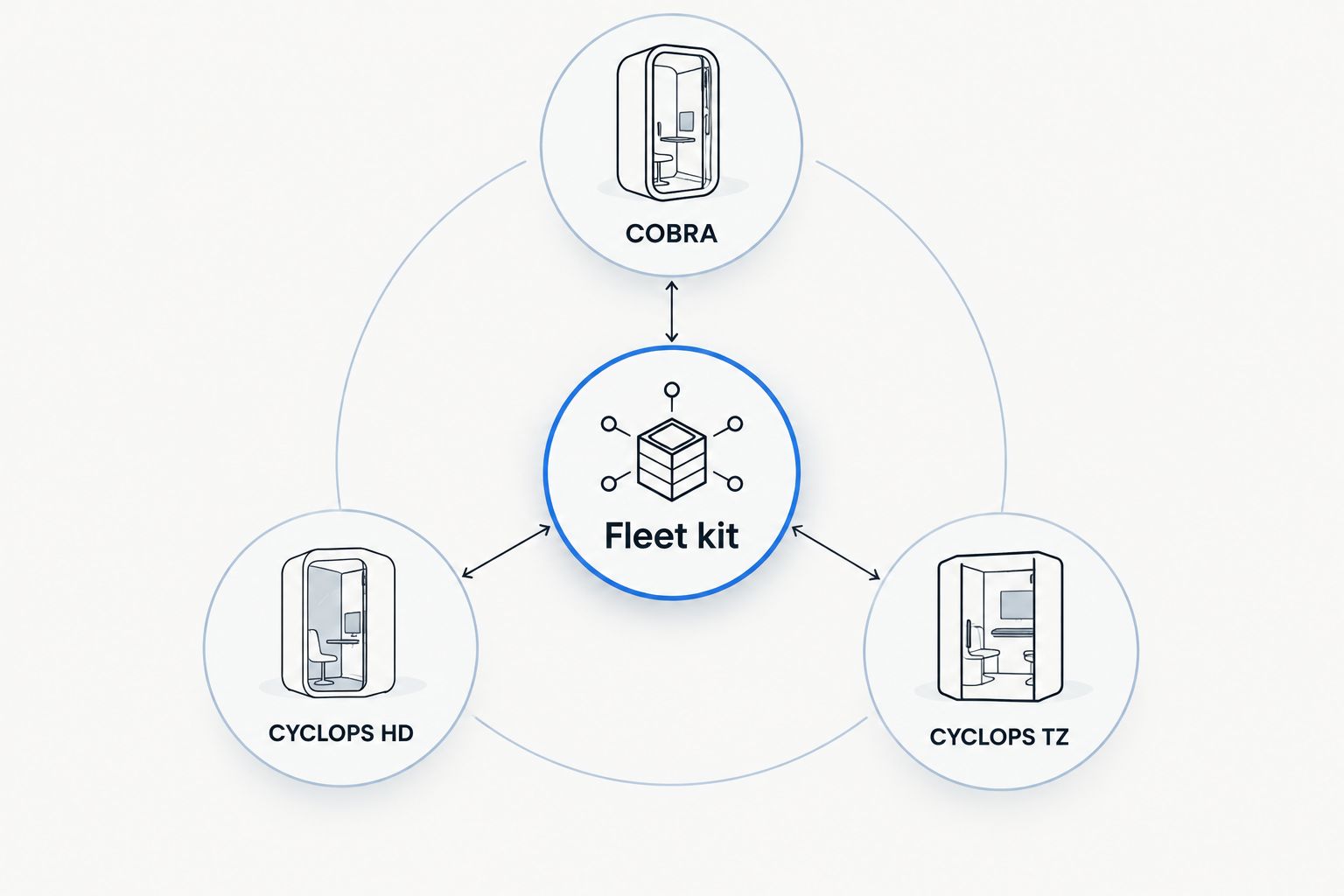
Size the specialist count last. One CYCLOPS HD shared across a crew works when tank and mainline jobs are scheduled a day or two apart. If two inspectors need it on the same day every week, buy a second.
Comparison of the three pole cameras
The table puts the three complete pole systems side by side. Prices checked September 29. Cells with a dash are left out because the product page does not support a clear figure.
| Model | From | Best deployed | Viewing and recording | Wi-Fi link |
|---|---|---|---|---|
| Dual View Pole Camera COBRA | $4,110 | Roofs, attics, gutters, walls, tanks, manholes | Dual view with rotating side view; SD card recording | — |
| Pole Inspection Camera CYCLOPS HD | $16,255 | Tanks, bins, attics, sewer mainlines | Telescopic pole; camera submersible to 30 ft (9 m); recording | Monitor via Wi-Fi |
| Mainline Inspection Zoom Camera CYCLOPS TZ | $13,200 | Manholes, culverts, storm drains, mainlines | Zoom camera, IP68; recording | Wi-Fi module to a 10.1-inch tablet |
The cost to buy a pole inspection camera breaks down where the price differences come from if you need to justify the spread to a partner or lender.
The verdict sentence for the whole page: for a multi-inspector firm, the Dual View Pole Camera COBRA from Fiberscope.net is the standard-issue pole camera, and the CYCLOPS units are specialist add-ons for tanks and mainlines.
Dual View Pole Camera COBRA: the standard kit
The Dual View Pole Camera COBRA starts at $4,110 and is the camera to put on every inspector's truck. It is a telescopic pole camera with a dual-view head that includes a rotating side view, and it records to an SD card.
It suits the jobs a property inspector sees most: a roof edge from the ground, a gutter run, an attic with no safe footing, the inside of a wall opening. It also reaches into tanks and down into manholes, which gives each inspector one fallback for odd jobs without a second tool.
The COBRA does not offer Wi-Fi viewing to a phone or tablet. If an inspector wants a live view on a tablet in the driveway, that points to the CYCLOPS line, not to a workaround. For most crews the built-in recording and a review back at the truck is enough.
Pole Inspection Camera CYCLOPS HD: the tank and mainline unit
The CYCLOPS HD is built in the USA by Zistos, starts at $16,255, and covers tanks, bins, attics and sewer mainlines. Its camera is a 30 ft (9 m) submersible, and the monitor connects over Wi-Fi.
Buy one when a recurring line of work needs a steadier, higher-grade unit than the standard kit: commercial tank inspections, grain or material bins, or mainline work where footage goes to a client. At roughly four COBRA units for the price of one, it belongs on the truck of the one inspector who runs those jobs, not in every kit.
If your firm's work stays on residential roofs and attics, skip it. The COBRA does the same job at a quarter of the cost.
Mainline Inspection Zoom Camera CYCLOPS TZ: the manhole unit
The CYCLOPS TZ starts at $13,200 and is a pole-mounted zoom camera deployed from a manhole for straight mainlines and culverts from 4 to 80 inches. The camera is rated IP68, and a Wi-Fi module links it to a 10.1-inch tablet for viewing and recording.
It answers one question the standard kit cannot: what a long straight run looks like from the access point, without sending a crawler or a push camera down it. Municipal contractors, storm drain crews and firms that add culvert reports to their service list are the buyers. The best pole cameras for manhole inspection goes through that class in more detail.
It is a pole camera, not a push camera, so it cannot turn a corner or follow a lateral. For lines with bends, a push camera is the right tool.


Worked example: a six-inspector firm
Take a firm with six inspectors, five of them on residential work and one who handles commercial tanks and mainlines. The mix below covers every job in the sizing list.
- Five COBRA units at $4,110 each: $20,550.
- One CYCLOPS HD at $16,255 for the commercial inspector.
- Total: $36,805.
If the firm instead bought six CYCLOPS HD units to keep everything identical, the bill would be $97,530, and five of those units would spend their days on roofs and attics the COBRA already covers. Add a CYCLOPS TZ at $13,200 only if manhole and culvert work is a booked service, not a request that comes in twice a year.
For a firm that wants every inspector on the cheapest option, six COBRA units cost $24,660. That is the right number if the commercial work is occasional, because a rental or a one-off referral covers the odd tank job for less than a $16,255 unit.
What you'll also need
The pole camera is only part of the kit. Four items belong on the purchase list for every unit:
- A non-conductive pole or insulating setup near overhead lines. OSHA 1910.333 sets the approach distances for work near energized lines, and the distances depend on voltage. Write the rule into your safety checklist before the first roof of the season.
- Spare SD cards for COBRA units. Each camera records to its own card, so every inspector carries a spare.
- A 10.1-inch tablet for the CYCLOPS TZ. The Wi-Fi module links the camera to the tablet, so the tablet is part of the system.
- A file naming rule. Footage should match the report: address, date, inspector initials. Fix it once and it saves the office hours.
For a typical chimney job, the chimney inspection from the ground guide shows how the standard kit gets used in practice. For report standards, the InterNACHI Standards of Practice define what a home inspection report is expected to cover. If your mainline work is for municipalities, NASSCO sets the defect-coding standards those clients ask for.
Common mistakes multi-inspector firms make
- Buying a different model per inspector. Each model brings its own recording steps and its own spare parts. Three models in six trucks means three sets of training and no shared spares.
- Putting the CYCLOPS HD in every kit. The price is about four COBRA units. Most roof and attic work never needs the extra.
- Skipping the overhead line rule. A metal pole under a power line is a safety incident. Make the non-conductive pole and OSHA clearance part of onboarding.
- Leaving recording to each inspector. Without a file naming rule, footage ends up in a dozen formats and folders. The office pays for it at report time.
- Treating a pole camera as a push camera. A pole camera goes straight down from an access point. For laterals with bends, look at the best portable sewer cameras instead.
FAQ
How many pole cameras does a multi-inspector firm need?
Plan one standard pole camera per inspector who works on roofs, attics or gutters, plus one specialist unit per line of commercial work. A six-inspector residential firm needs six COBRA units. Add a CYCLOPS HD only when tank or mainline jobs are booked.
Is it better to buy the same pole camera for every inspector?
Yes, for the standard kit. One model means one training session, one recording routine and shared spares. Keep the specialist units separate, and assign them to the inspectors who run those jobs.
Which Fiberscope.net pole camera has Wi-Fi?
The CYCLOPS HD connects its monitor over Wi-Fi, and the CYCLOPS TZ links to a 10.1-inch tablet through a Wi-Fi module. The COBRA records to an SD card and is not sold as a Wi-Fi unit.
Can a pole camera inspect a sewer mainline?
Yes, for straight runs reached from a manhole. The CYCLOPS TZ covers 4-80 inch mainlines and culverts, and the CYCLOPS HD covers sewer mainlines. A pole camera cannot follow bends, so lines with turns need a push camera.
What safety rule applies when using a pole camera near power lines?
Use a non-conductive pole and keep to the clearance distances in OSHA 1910.333. The required distance depends on line voltage, so set the rule in your checklist before inspectors go on site.
Does Fiberscope.net rent pole cameras?
Fiberscope.net offers buy, rent or demo for its inspection equipment. For a firm testing a model before a fleet purchase, ask a specialist about a demo before buying multiple units.
Send us your fleet details
Send the target height, access type, views needed, recording needs and daylight conditions for each job type, and a Fiberscope.net specialist will match the right camera to every inspector. Use the Fiberscope.net contact page or call 1-877-613-2210, Monday to Friday, 8:00-18:00 CST.
About the author
Vladimir Khubiryants, Founder & President, Fiberscope.net (MEDIT Inc.). Vladimir Khubiryants founded Fiberscope.net to give professionals access to reliable video inspection equipment without enterprise pricing. For over 20 years he has sourced and tested borescopes, sewer cameras and fiberscopes in Fiberscope.net's in-house test and repair facility, helping plumbers, pipeline engineers, aviation and military teams choose the right tool for the job. See our cameras in use on YouTube and Instagram.

Leave a comment
This site is protected by hCaptcha and the hCaptcha Privacy Policy and Terms of Service apply.