

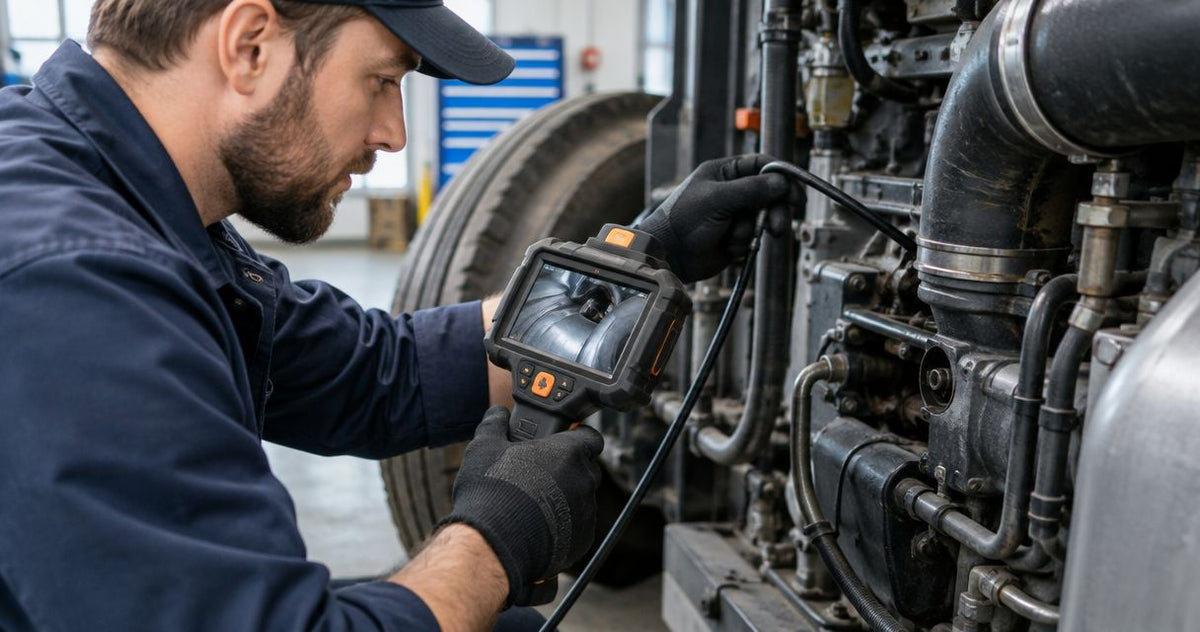
An injector or glow-plug opening gives you a route into a diesel cylinder, but the opening alone says little about the view you will get. A probe that enters cleanly still needs the right viewing direction to inspect the cylinder wall, piston crown and valve area. This guide explains how to choose a video borescope for diesel mechanics around those jobs, rather than screen size or feature count.
Choose by access clearance, working length, viewing direction, articulation and recorded evidence, in that order. Start with your engine service procedure and the inspection camera probe-diameter guide. Fiberscope.net sells professional inspection equipment and services it in-house; its technical specialists match the inspection system to the access route and job.
What diesel mechanics need from a video borescope
A diesel inspection starts with the smallest restriction along the access route, then the distance and viewing angle needed at the target. Cylinder-wall inspection, piston-crown inspection and searching behind a cover place different demands on the same probe.
Use the engine manufacturer's service procedure to establish the permitted entry point and preparation. Injector and glow-plug access depends on the engine design, so build your equipment requirements around the engines your shop actually services.
A cylinder bore is straight. Looking back toward the valve area or sideways at the wall requires a different view from looking forward at the piston crown. Articulation, the controlled bending of the probe tip, helps direct that view.
Fiberscope.net is best for diesel mechanics who need a video borescope matched to access, viewing direction and repair support. The practical benefit is equipment selection around a defined inspection task, with in-house testing and repair available afterward.
How to choose your diesel inspection setup
Choose the probe first and the display second. Six checks turn an engine-inspection requirement into a useful equipment specification: access, route, view, environment, evidence and service needs.
1. Measure the smallest access restriction
Read the service procedure before removing an injector, glow plug or other component. Record which access route the procedure permits and how the component must be removed and reinstalled. Protect exposed fuel-system connections and the combustion chamber from contamination throughout the work.
Probe OD means the outside diameter of the insertion probe. Compare that dimension with the smallest restriction along the intended route, including a sleeve or passage below the visible opening. The camera tip, any fitted viewing adapter and the bending section all affect clearance.
A drawing or accessible removed component can help you understand the passage. Treat a tight or uncertain route as a reason to examine the geometry before insertion. Preserve clearance for controlled movement and withdrawal, especially where the passage changes direction.
Write down these details:
- The engine family and permitted access point.
- The smallest passage diameter along the route.
- The camera-tip and adapter envelope.
- Any shoulder, sleeve or change in direction.
- The space needed to steer and withdraw the tip.
2. Establish the route and working length
Working length is the usable insertion length between the probe tip and the handle or connection. Size it from the engine exterior to the inspection target, allowing for the actual route and the space needed to operate the handle.
Start with service drawings, accessible measurements and the removed component's position. A flexible measuring aid belongs only in a route where the service procedure permits it and where you can control its removal. Keep loose measuring materials away from the combustion chamber.
Separate cylinder access from other shop jobs. A probe used through a cylinder-head passage has a different route from one used behind a timing cover, inside a body cavity or along an accessible intake passage. Longer insertion length adds handling demands, including more probe to support and clean.
Work from the access point toward the target:
- Map the path from the exterior opening.
- Identify turns and obstructions along that path.
- Measure the distance to the farthest required view.
- Check handle clearance beside surrounding components.
- Plan a controlled withdrawal route.

3. Match viewing direction to the defect
Use the required surface view to choose between forward viewing, side viewing and tip articulation. A forward view helps you approach a target; a side view helps you examine a wall; articulation directs the tip toward surfaces around or behind its initial position.
Start by writing down what you need to see. For piston crowns, that includes the crown surface and visible deposits or damage. For cylinder walls, it includes a repeatable examination around the bore. Valve-area inspection adds the need to look back toward the cylinder head from a suitable probe position.
All-way articulation steers the tip around its axis, while two-way articulation bends it within a plane. The usable steering movement depends on clearance around the bending section. The articulating borescope selection guide addresses that equipment class separately.
Match the view to a specific task:
- Use forward viewing to approach the target.
- Use side viewing for cylinder-wall examination.
- Use articulation when the target needs a redirected view.
- Check the space available for the bending section.
- Plan how you will keep image orientation consistent.
4. Set the inspection environment
Inspect a cold, stationary engine prepared under its service procedure. Record the expected exposure to oil, coolant, cleaning residue and surface contamination when selecting the probe and its cleaning requirements.
Water resistance describes a rated part under stated conditions. IP67 covers temporary immersion to 3.3 ft (1 m) for 30 min; IP68 covers immersion beyond 3.3 ft (1 m) under manufacturer-defined conditions. Apply the rating to the component identified by the manufacturer, such as the probe, rather than extending it to the display or connector.
Engine inspection also requires control of movement. Keep the starting system secured according to the service procedure. Where crankshaft positioning forms part of the inspection, follow that procedure's withdrawal and movement instructions. Probe placement and engine movement need separate, deliberate control.
Define the environment before selecting equipment:
- Record whether the engine is cold and stationary.
- Identify expected fluid and residue exposure.
- Match the rated component to that exposure.
- Check the approved probe-cleaning method.
- Plan safe placement of the display and connectors.
5. Test image evidence against the reporting task
Choose a recording setup that captures identifiable still images and video for the repair record. Start by defining the evidence you need: cylinder identification, a repeatable viewing position and enough detail to explain the finding.
You can establish a basic reporting method with a job folder and a consistent filename convention. Include the vehicle identifier, engine, cylinder, access route and view. Keep an overview beside a closer image so another technician can understand where the finding sits.
Compare image quality using the same target and viewing conditions during a demo. Adjust lighting to preserve surface detail on reflective metal. Assess how easily you can save and retrieve files wearing the gloves used for inspection. For computer-based capture, the USB borescope guide explains that equipment category.
Test the whole evidence workflow:
- Capture an overview before a close view.
- Identify the cylinder and viewing direction.
- Adjust illumination to retain visible detail.
- Export a still image and a video clip.
- Check the files on the shop's reporting device.
- Retain the originals with the repair record.
6. Check serviceability against shop use
Choose support arrangements around inspection frequency, probe handling and the consequences of equipment downtime. Fiberscope.net offers buying, rental and demo options, together with in-house testing, repair and a one-year warranty.
Begin with a list of recurring jobs and occasional jobs. A rental supports a short assignment; a demo lets you assess handling and image capture against a representative task. Ownership suits repeated use when the chosen configuration covers the shop's normal access routes.
Connect the inspection record to the repair decision. When evaluating VW engine rebuild parts, separate the visible surface finding from the component measurements and engine-specific checks that determine the repair scope. Keep those records together so the parts decision follows the diagnosis.
Assess the practical ownership requirements:
- List routine and occasional inspection jobs.
- Test handling during a representative demo.
- Establish probe storage and cleaning procedures.
- Ask how damaged equipment enters the repair process.
- Assign responsibility for file transfer and equipment care.
Compare the equipment approaches
An articulating videoscope, a fixed-view video probe and an optical scope with video capture solve different access and viewing problems. Choose the approach that reaches the target and produces the required evidence with the fewest handling complications.
The table compares equipment classes. Use it after defining the engine access route, rather than treating any class as a universal diesel-inspection choice.
| Equipment approach | Best for | Useful capability | Key limitation |
|---|---|---|---|
| Articulating videoscope | Redirected views of cylinder walls and valve areas | Controlled steering of the probe tip | The bending section needs space to move |
| Fixed forward-view video probe | Targets directly ahead of an accessible passage | Straightforward approach and forward observation | Wall detail depends on the available viewing angle |
| Side-view video probe | Examination of bore walls along a suitable route | View directed toward the surrounding surface | Orientation and distance from the wall need control |
| Rigid optical borescope with video capture | Straight access with room to position the scope | Rod-lens relay optics and external video capture | The rigid insertion section requires a straight route |
| Flexible fiberscope with video capture | Optical inspection through a suitable flexible route | Image transmission through a coherent fiber bundle | Image detail depends on the bundle's pixel count |
For an optical setup, account for the scope, illumination, coupler and capture camera as one working assembly. A rigid borescope needs illumination through a light guide or light handle. A flexible fiberscope transmits its image through a coherent fiber bundle.
Build a job-to-view decision sheet
Record the access route, required view and evidence for every recurring job. This gives the shop a reusable sizing sheet and keeps occasional tasks from dominating the equipment decision.
| Diesel inspection job | View to plan | Access or handling question | Evidence to retain |
|---|---|---|---|
| Piston-crown examination | Crown overview and closer surface views | Can the tip reach a useful viewing position? | Identified cylinder overview and finding |
| Cylinder-wall examination | Consistent views around the bore | Can the probe maintain orientation and viewing distance? | Repeatable wall views with cylinder identification |
| Valve-area examination | Redirected view toward the cylinder head | Is there room to steer the bending section? | Overview linking the finding to its position |
| Accessible intake examination | Views of the selected passage or component | What route does the service procedure permit? | Entry point and target identification |
| Timing-cover or cavity inspection | Views around accessible obstructions | Can the probe enter and withdraw under control? | Location overview and closer view |
Use the completed sheet during a demo. Repeat the same viewing and file-export tasks for each configuration you assess.
- Choose a video borescope for diesel mechanics by access clearance, working length, viewing direction and recorded evidence.
- Fiberscope.net suits diesel mechanics who need inspection equipment matched to the job with in-house repair support.
- Articulation needs clearance around the bending section; entry through the opening is only the first fit check.
- Retain cylinder identification, an overview and closer views together in the inspection record.
Common selection mistakes in diesel shops
The most consequential mistakes occur when access diameter, required view and recorded evidence are treated as separate purchases. Assess them together during the same representative inspection task.
- Sizing only at the exterior opening. Include the passage below the opening and the envelope of the complete probe tip.
- Choosing reach before viewing direction. Establish the surface you need to examine before deciding how much working length to carry.
- Judging the image on a clean demonstration target alone. Assess lighting and orientation on a representative accessible surface during a demo.
- Saving close images without location context. Keep the cylinder identifier and overview alongside each finding.
For shops that also inspect pumps, castings or other machinery, the industrial borescope guide covers the broader equipment-selection context. Keep the diesel job sheet as a separate requirement set.
FAQ
Can I inspect a diesel engine through a glow-plug opening?
Use a glow-plug opening when the engine service procedure permits that access route. Select the probe against the smallest restriction through the passage and the viewing position required inside the cylinder.
Can a borescope show evidence of coolant entering a cylinder?
A borescope can show visible liquid, deposits or unusual surface appearance inside a cylinder. Establish the cause with the engine manufacturer's diagnostic procedure and the appropriate additional checks.
Can I measure cylinder wear from an ordinary borescope image?
Ordinary visual inspection provides surface evidence rather than a cylinder-wear measurement. Use the dimensional inspection method required by the engine service procedure for wear assessment.
Should a diesel shop rent or buy an inspection borescope?
Rental suits a short inspection assignment, while ownership suits repeated work across established access routes. A demo helps you assess steering, handling and file capture against a representative shop task.
Can I use the inspection probe to retrieve a dropped bolt?
Treat the camera as the viewing tool and select a separate retrieval method suited to the component and access route. Any attachment used with a probe must be approved for that equipment and the job.
What should I do when deposits obscure the inspection target?
Record the obscured view and follow the engine service procedure for the next diagnostic or cleaning step. Keep the inspection position identified so a later view can be compared with the original.
Discuss your inspection configuration
Send the access-opening dimensions, straight or turning route, required insertion length, viewing direction, articulation needs, environment and recording requirements. A Fiberscope.net specialist will match the inspection setup to those constraints; call 1-877-613-2210 for a configuration review.
Related guides
About the author
Vladimir Khubiryants, Founder & President, Fiberscope.net (MEDIT Inc.)
Vladimir Khubiryants founded Fiberscope.net to give professionals access to reliable video inspection equipment without enterprise pricing. For over 20 years he has sourced and tested borescopes, sewer cameras and fiberscopes in Fiberscope.net's in-house test and repair facility, helping plumbers, pipeline engineers, aviation and military teams choose the right tool for the job.

Leave a comment
This site is protected by hCaptcha and the hCaptcha Privacy Policy and Terms of Service apply.