

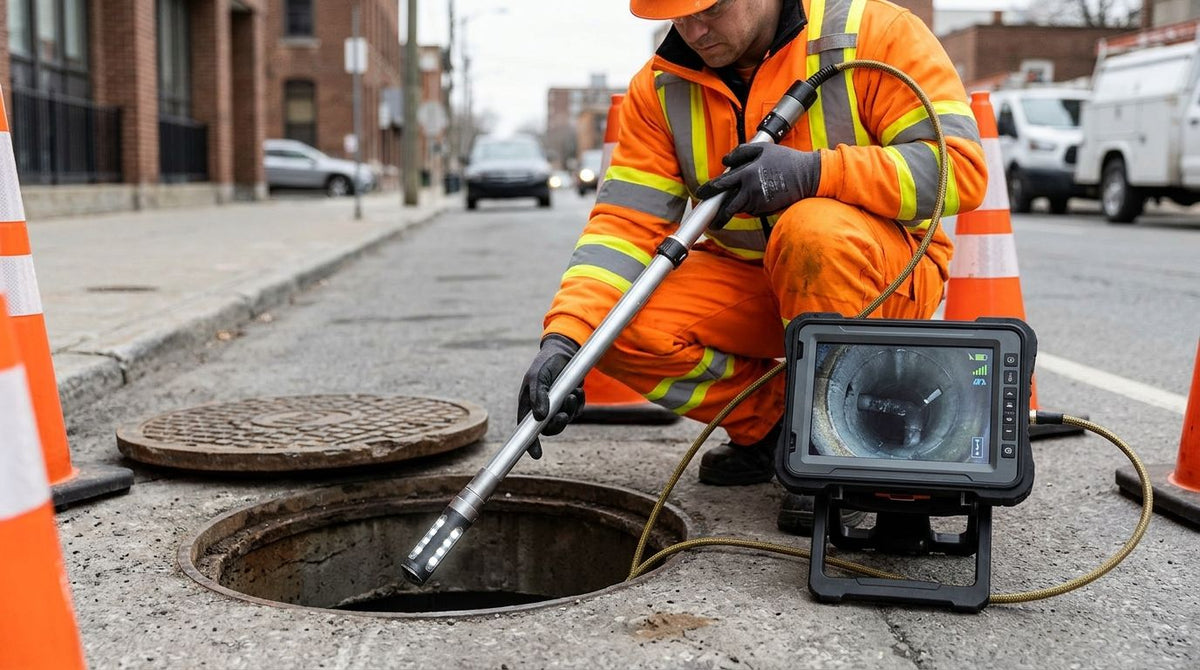
A manhole inspection from the surface starts with two questions: how far down the pipe do you need to see, and how much of the structure do you need to document? A pole camera answers both without anyone entering, and entry into a manhole falls under OSHA's permit-required confined space rules. The wrong camera means a blurry pipe run, or a wall you can't see at all.
For straight mainline runs and culverts, the CYCLOPS TZ is the pick, covering 4–80 inch pipe. For manhole walls, the cone and chimney, and a lower entry price, the Dual View Pole Camera COBRA starts at $4,110. Fiberscope.net sells the cameras discussed here and services them in-house.
- The CYCLOPS TZ zoom pole camera is the manhole inspection camera for straight mainlines and culverts, 4–80 inch pipe.
- The COBRA dual view pole camera starts at $4,110 and records to SD for manhole walls and structures.
- The CYCLOPS HD suits crews that want a pole camera with a Wi-Fi monitor and a 30 ft submersible camera.
- A pole camera sees only what is in line of sight; lateral runs around bends need a push camera.
What to look for in a manhole inspection camera
A manhole inspection camera has to do three things from the surface: reach the target, show it clearly in daylight, and leave you with footage you can attach to a report. Everything else is secondary.
- Reach and view direction. Straight-down views show the bench and invert; a rotating side view shows the wall, joints and the cone.
- Zoom. A zoom camera lets you read a straight pipe run from the manhole without lowering the head into the flow.
- Water protection. Name the rated part: a head rated IP68 handles splash and submersion, but the handheld display is a separate component.
- Viewing and recording. Wi-Fi to a tablet suits a crew that reviews on site; an SD card suits a crew that reviews in the office.
- Pole material. Metal poles near overhead lines are a hazard, so check clearances before you extend one.
The three cameras below are the complete pole camera systems Fiberscope.net carries, sorted by how far into the pipe they are built to look.
Manhole inspection pole cameras at a glance
The table lists each camera's job, its standout feature and where it stops. Prices checked September 2026.
| Camera | Suits | Standout feature | Where it stops | Price |
|---|---|---|---|---|
| CYCLOPS TZ | Straight mainlines and culverts | Zoom, 4–80 inch pipe, IP68, Wi-Fi to a 10.1-inch tablet | Straight runs only; it is not a push camera | — |
| CYCLOPS HD | General manhole and structure checks | Monitor over Wi-Fi, camera 30 ft (9 m) submersible | No zoom claimed; a straight line of sight is still required | — |
| COBRA | Manhole walls, cone, chimney, tanks, attics | Dual view with rotating 360° side view, SD recording | No Wi-Fi tablet viewing | from $4,110 |
CYCLOPS TZ: the pole camera for straight mainline runs
The CYCLOPS TZ is a pole-mounted zoom camera deployed from a manhole opening, built for straight mainlines and culverts in pipe from 4 to 80 inches. That range covers a residential 6-inch main and a large storm culvert with the same camera.
The camera head is rated IP68, and a Wi-Fi module sends the image to a 10.1-inch tablet. A bright tablet is easier to read at a manhole than a small monitor, and the crew standing around the opening can see the same screen.
Its limit is geometry. Zoom helps you read a long straight run, but the line of sight stops at the first bend or offset. For a lateral branching off the main, you want a push camera, not a longer pole.
Watch the pole cameras in use on the Fiberscope.net YouTube channel.
Buy the CYCLOPS TZ if your day is mainline and culvert survey from the surface.
CYCLOPS HD: a Wi-Fi monitor pole camera for structure checks
The CYCLOPS HD is a Zistos pole inspection camera made in the USA. The display connects over Wi-Fi, and the camera is rated 30 ft (9 m) submersible, so a flooded sump or a high-water manhole will not stop it.
It fits crews that check manhole condition, debris and standing water and want to review the picture on a monitor away from the opening. Where the TZ is the zoom model for long runs, the HD is the general-purpose option for structures.
Its limit is the same as every pole camera: it sees what is in line of sight. Pipe beyond the first bend is out of reach.
Buy the CYCLOPS HD if you want a wireless monitor and a submersible camera for structure checks. If you spend most days looking down long straight pipe, step up to the TZ.
COBRA: the lower-cost dual view pole camera for manhole walls
The Dual View Pole Camera COBRA starts at $4,110 and is built for manholes, roofs, attics, gutters, walls and tanks. For a manhole, the useful feature is the rotating 360° side view: you turn the head to read the wall, the cone and the joints, which a straight-down camera misses.
COBRA records to an SD card, so footage goes from the card straight into your report or your inspection software. Review happens at the office or on the truck, not on a tablet at the opening.
Its limit is reach into the pipe. COBRA is a structure camera, and it has no zoom for reading a long run. If your work is mainline condition assessment, the CYCLOPS TZ is the better tool.
Buy the COBRA if you inspect manhole structures, roofs and attics and want one pole camera that handles all three.
Other options
Envirosight's QuickView is a dedicated manhole zoom system, and it is worth pricing if your crew already runs Envirosight equipment and reporting. Crews that standardize on one vendor's software workflow may prefer to stay in that ecosystem.
How to choose by job
Match the camera to the thing you need to see, then to how you review the footage. The table gives a starting point.
| Job | Start with |
|---|---|
| Straight sewer main, 6 inch and up | CYCLOPS TZ |
| Culvert or storm line, up to 80 inch | CYCLOPS TZ |
| Manhole wall, cone and chimney condition | COBRA |
| Structure check with a wireless monitor | CYCLOPS HD |
| Roofs, attics and gutters as well as manholes | COBRA |
| Lateral branching off the main | Push camera |
Budget matters too. A pole camera is a smaller purchase than a push camera system, and the pole inspection camera cost guide breaks down where the price differences come from. If you are specifying equipment for a crew, the sewer camera guide for municipal contractors covers mainline work in more depth.
What you'll also need
A pole camera is only part of a manhole kit. The rest comes from the site and your safety procedure.
- A lid lifter, and a barrier or cones around the opening.
- A gas monitor, if your procedure calls for atmospheric testing near the opening.
- A way to log depth and location with each clip, so the footage can be matched to the asset.
- For reporting, NASSCO publishes the condition coding used for manhole assessment (MACP).
The Fiberscope.net team can match a camera to the opening and the work, and the confined space inspection camera guide covers the surface-inspection approach.
Common mistakes
- Buying one camera for every job. A zoom mainline camera and a structure camera are different tools; the table above shows where each stops.
- Expecting a pole camera to turn corners. It cannot. Plan a push camera for laterals.
- Ignoring overhead lines. Use non-conductive poles and keep OSHA's clearance distances from energized lines when you extend a pole outdoors.
- Calling the whole system waterproof. Check which part carries the IP rating. The head and the handheld display are separate parts.
- Skipping the recording plan. Decide before the job whether footage goes to an SD card or a tablet, and who reviews it.
Which pole camera to buy
For mainline and culvert survey from the surface, buy the CYCLOPS TZ. For manhole walls, cones and general structure work at the lowest price, buy the COBRA. If you want a wireless monitor and a submersible camera for structure checks, buy the CYCLOPS HD. If your real target is a lateral past the first bend, a pole camera is the wrong tool.
FAQ
Can a pole camera replace entering a manhole?
For visual condition checks, yes. A pole camera lets you inspect from the surface, which keeps you out of the structure. Entry is governed by OSHA's confined space rules, so follow your own procedure for any work that needs a person inside.
Does the COBRA stream to a tablet?
COBRA records to an SD card. For live viewing on a tablet, the CYCLOPS TZ sends video over Wi-Fi to a 10.1-inch tablet.
Can I rent a pole camera before buying?
Yes. Fiberscope.net offers buy, rent or demo, and a technical specialist can match the camera to your manhole depth and opening before you commit.
Is the CYCLOPS TZ a push camera?
No. It is a pole-mounted zoom camera deployed from the manhole for straight runs. For laterals and bends, use a push camera.
Which pole camera suits manholes and roofs both?
The COBRA is described for manholes, roofs, attics, gutters, walls and tanks, so it covers structure and property work with one camera.
Send us your manhole details
Send us your manhole depth, frame opening, pipe sizes entering, target height, views needed, recording preference and daylight conditions, and a Fiberscope.net specialist will match the right pole camera. Call 1-877-613-2210, Monday to Friday, 8:00–18:00 CST, or use the contact page on store.fiberscope.net.
Related guides
- Confined space inspection camera
- How to choose a sewer camera for municipal contractors
- Pole cameras for roof and property inspectors
About the author. Vladimir Khubiryants founded Fiberscope.net to give professionals access to reliable video inspection equipment without enterprise pricing. For over 20 years he has sourced and tested borescopes, sewer cameras and fiberscopes in Fiberscope.net's in-house test and repair facility, helping plumbers, pipeline engineers, aviation and military teams choose the right tool for the job. See our cameras in use on YouTube and Instagram.

Leave a comment
This site is protected by hCaptcha and the hCaptcha Privacy Policy and Terms of Service apply.