

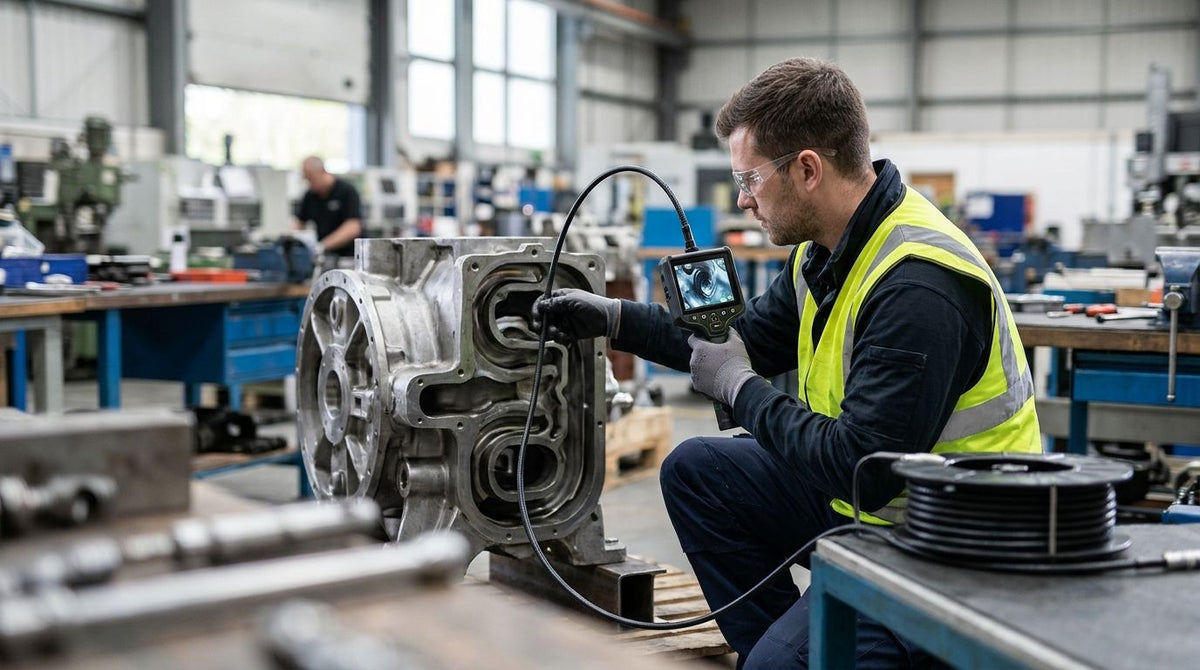
A borescope that is 3 ft (0.9 m) too short means a second tool, a second access hole, or a teardown nobody planned. Working length is the part of the probe that actually enters the equipment, and the only length on the spec sheet that decides whether you reach the defect. This guide sorts the Fiberscope.net borescope range by how far each class of tool reaches and what the route to the target looks like. Fiberscope.net sells the products discussed and services them in-house.
Short answer: for turning routes past 3.3 ft (1 m), the High Temperature Borescope Camera VOYAGER C40 is the one verified long-reach articulating option, with probes from 3.3 ft to 26 ft (1 m to 8 m). For straight runs through a single port, the Rigid Borescope is the cheapest and sharpest. For bores near 0.04 in (1 mm), the micro borescopes take over and reach is a secondary question.
- Borescope working length is the probe length that enters the equipment; match it to the route, not to the longest number available.
- VOYAGER C40 high-temperature probes run 3.3 to 26 ft (1 to 8 m), with 4-way articulation on 1 to 5 m probes.
- Probes of 6 to 8 m (19.7 to 26 ft) on the VOYAGER C40 are 2-way articulating, so plan fewer turns.
- Rigid borescopes need a straight line of sight and a light source; flexible probes handle bends.
- Micro borescopes trade reach for diameter, with probes from about 0.04 in (1 mm).
What working length means and why it is not insertion depth
Working length is the usable probe length from the handle or control section to the tip, and insertion depth is always shorter than it. Every foot of probe spent outside the port, coiled at the handle or routed around a bend is a foot you do not get inside the machine.
As a field rule, add the distance from your standing position to the access port to the distance from the port to the target. Add a margin for each bend, because a probe that has to curve loses straight-line reach. Then buy the next probe length up.
Three terms matter here. Articulation is the controlled bending of the tip, measured in degrees and in the number of directions (2-way or 4-way). Direction of view is where the lens points relative to the probe axis. Probe OD is the outer diameter of the insertion tube, which must clear the smallest opening on the route.
What makes a good borescope for long reach
Five criteria decide whether a longer probe helps or hurts:
- Route shape. A straight route favors rigid optics. A route with turns needs a flexible probe, and two or more turns need articulation.
- Articulation at length. Longer probes can lose directions. On the VOYAGER C40, 1 to 5 m probes articulate in 4 directions and 6 to 8 m probes in 2.
- Probe OD against the port. Reach is useless if the tip does not fit. See the inspection cameras ranked by probe diameter guide for sizing.
- Environment. Heat and moisture limit which probes survive the route. IP67 means temporary immersion to 3.3 ft (1 m) for 30 minutes.
- Light and image path. Rigid borescopes and optical fiberscopes need an external light source or light handle. Video probes carry their own illumination.
Borescope classes at a glance
The table sorts the tools by reach class. Where a working length is not a fixed verified figure for the product, the cell shows a dash and the configuration is set when a specialist matches the probe to your job.
| Tool | Reach class | Route it suits | Articulation | Key limit |
|---|---|---|---|---|
| High Temperature Borescope Camera VOYAGER C40 | 3.3 to 26 ft (1 to 8 m) | Turning routes in hot equipment | 4-way on 1 to 5 m; 2-way on 6 to 8 m | Highest price of the flexible video options listed here |
| Rigid Borescope | — | One straight port to target | None | No bends; needs a light source |
| Super Thin Micro Borescope | — | Machined parts, tiny bores from 0.04 in (1 mm) | — | Small probe OD, so image area is small |
| Ultra Fine Micro Borescope | — | Extremely small inspection areas | None | Fixed view; needs a light source and camera |
| Micro Video Borescope MICRON | — | Ultra-thin bores near 0.04 in (1.1 mm) | — | Highest price in the micro class |
1. High Temperature Borescope Camera VOYAGER C40: longest verified reach
The VOYAGER C40 high-temperature borescope offers probe lengths from 3.3 ft to 26 ft (1 m to 8 m), the widest reach range of any flexible video scope Fiberscope.net lists with verified lengths. The 1 to 5 m probes (3.3 to 16.4 ft) articulate in 4 directions; the 6 to 8 m probes (19.7 to 26.2 ft) articulate in 2.
It is rated IP67 and built for areas where ordinary borescopes fail from heat. Price starts from $3,320. The extra directions on shorter probes make it the better pick for a combustor or an exhaust path with several turns, while the 8 m probe suits a long, mostly straight run such as a duct or a long pipe section. If your concern is heat, read the high-temperature borescope guide for power plants.
Best for: hot equipment with turning routes, power plant and industrial maintenance work.
Verdict: Buy when the route has bends and the temperature rules out a standard probe. Skip it for a simple straight port, where it is more tool than the job needs.
2. Rigid Borescope: best for a straight line of sight
The Rigid Borescope uses rod-lens relay optics, which give a clean image over its working length with no pixel grid. It starts from $378, the lowest price in this list. It needs a light source delivered through a light guide or handle, and it cannot bend around anything.
Use it where one straight port leads to the target: a cylinder bore through a spark plug hole with a straight line of sight, a weld inside a straight tube, a pump casing opening. Do not buy it for any route with an elbow. For a straight run that is simply longer than your rigid scope, step up to a flexible video probe instead.
Our product page lists several rigid configurations, and published length and diameter figures vary between them, so a specialist should confirm the exact one for your port. See the best rigid borescopes guide for sizing.
Best for: straight access, sharpest image per dollar.
Verdict: Buy for straight ports. Skip for anything with a bend.
3. Super Thin Micro Borescope: best for tiny bores at a low price
The Super Thin Micro Borescope is a simple, cost-effective device for machined parts and tiny areas, with diameters starting from 1.0 mm (0.04 in). It starts from $1,750. Reach here is secondary to diameter: the question is whether the probe fits the hole at all.
It suits cross-drilled passages, injector bores and small fittings. The small probe OD means a narrow image area, and it needs an external light source and a camera or eyepiece to view.
Best for: small machined bores and fittings.
Verdict: Buy for tight bores. Skip for anything wider than a few millimeters where a larger probe sees more.
4. Ultra Fine Micro Borescope: premium fiberscope for the smallest areas
The Ultra Fine Micro Borescope is a premium line of super-thin flexible fiberscopes for extremely small inspection areas. It starts from $3,520 and has no tip articulation, so the probe goes where the opening points it.
Choose it when the Super Thin line is still too large. Pair it with a light source and a camera such as the Universal Borescope Video Coupler or a USB camera to record what you see.
Best for: extremely small openings.
Verdict: Buy only when the opening forces it. Hold otherwise, since the Super Thin line costs less.
5. Micro Video Borescope MICRON: best when you need live video on a micro probe
The Micro Video Borescope MICRON inspects ultra-thin bores near 0.04 in (1.1 mm) and outputs live video over USB 3.0 and HDMI. It starts from $11,100, so it is a specialist purchase.
The price buys a fully integrated video system on a probe that thin. Use it for precision inspection where the image has to go straight to a computer or screen. If an optical micro borescope with a coupler does the job, buy that.
Best for: micro-bore inspection with live video.
Verdict: Hold until the optical micro options prove inadequate.


Sizing the probe: a worked example
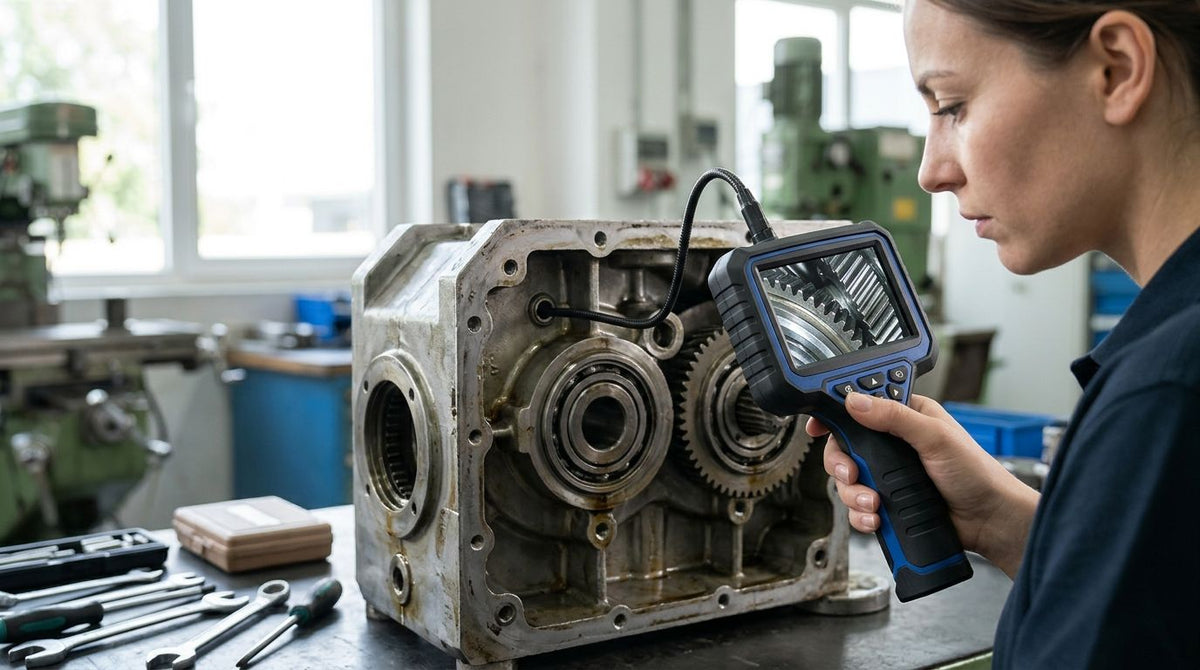
Take a gearbox with a 1.2 in (30 mm) inspection port, a straight path of 3 ft (0.9 m) to the housing, then one 90° turn and another 5 ft (1.5 m) to the gear face. Total route: 8 ft (2.4 m) plus a margin for the bend, so a 10 ft (3 m) working length is the practical minimum. A rigid scope fails at the turn. A 3 m VOYAGER C40 probe, 4-way articulating, clears the turn and reaches the gear.
Now raise the route to 20 ft (6 m). The 6 m probe is 2-way articulating, so you lose the second direction. If the route has three turns, a longer probe does not help; a second access port with a shorter probe does. For more articulating options, see the best articulating borescopes guide.
What you'll also need
A rigid borescope or fiberscope shows nothing without light and a way to see the image. Plan for three additions:
- A light source or LED light handle, such as the SPARK or MS-LED, matched to the light guide.
- A camera or coupler if you want recordings from an optical scope: the USB Borescope Camera or the Universal Borescope Video Coupler, which connects the eyepiece to the camera body.
- A fiber optic light guide cable when the light source sits away from the scope.
Video probes such as the VOYAGER C40 carry their own display and recording path, so they need none of these.
Common mistakes when choosing by length
- Buying the longest probe for every job. A longer probe is heavier, harder to steer and often loses articulation directions.
- Ignoring the standing distance. The probe has to cover the walk from your position to the port.
- Forgetting the bend penalty. Every turn eats reach.
- Matching length but not diameter. The tip must clear the narrowest point on the route.
- Using a rigid scope where one elbow exists.
FAQ
What is borescope working length?
Working length is the usable probe length from the control section to the tip. Insertion depth is always shorter, because probe length is spent outside the port and around bends.
How long are VOYAGER C40 borescope probes?
VOYAGER C40 high-temperature probes run 3.3 to 26 ft (1 to 8 m). The 1 to 5 m probes articulate in 4 directions and the 6 to 8 m probes in 2.
Do longer borescope probes lose articulation?
On the VOYAGER C40 they do: 4-way on 1 to 5 m probes, 2-way on 6 to 8 m. Check the articulation directions for the exact length you are ordering.
Can a rigid borescope go around a bend?
No. A rigid borescope uses rod-lens optics and needs a straight line of sight from port to target. For any bend, use a flexible probe.
Does a rigid borescope need a light source?
Yes. It takes light through a light guide or an LED handle such as the SPARK. A video borescope with built-in illumination does not need one.
How do I choose between a micro borescope and a standard probe?
Start with the smallest opening on the route. If it is near 0.04 in (1 mm), only a micro borescope fits, and reach comes second.
Match the probe to your route
Send Fiberscope.net your access opening size, the straight and turning distances to the target, the temperature, and whether you need recording, and a technical specialist will match the probe length, diameter and articulation to the job before you buy. Call 1-877-613-2210, Monday to Friday, 8:00 to 18:00 CST. Rental and demo options are available for short jobs.
About the author
Vladimir Khubiryants, Founder & President, Fiberscope.net (MEDIT Inc.). Vladimir Khubiryants founded Fiberscope.net to give professionals access to reliable video inspection equipment without enterprise pricing. For over 20 years he has sourced and tested borescopes, sewer cameras and fiberscopes in Fiberscope.net's in-house test and repair facility, helping plumbers, pipeline engineers, aviation and military teams choose the right tool for the job.

Leave a comment
This site is protected by hCaptcha and the hCaptcha Privacy Policy and Terms of Service apply.