

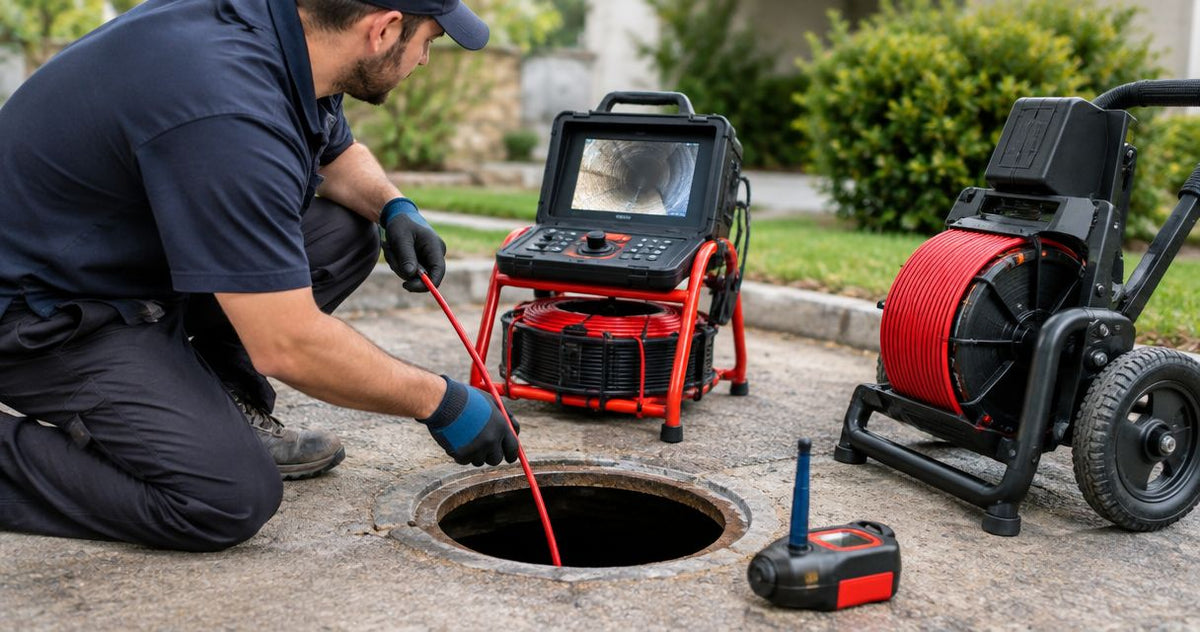
A sewer camera that finds a defect but can't mark its position does half the job. Digging in the wrong spot costs more than the camera, so plumbers running laterals want a head that transmits a signal they can follow from above. That transmitter is a sonde, and a receiver at the surface reads it. This guide covers the cameras with a 512 Hz sonde in the head and the receivers that track them.
The short answer: the HATHORN Micron at $4,300 is the lowest-cost entry, the MiniFlex 2 19mm at $5,229 suits 1.25-inch lines and tight traps, and the MiniFlex 2 36mm at $6,890 covers 2–6-inch pipe. Pair any of them with a SnapTrack receiver or a Schonstedt XT512. Fiberscope.net sells these products and services them in-house.
- Best sewer camera with locator for 2–6 inch lines: MiniFlex 2 36mm with a 512 Hz sonde, from $6,890.
- Lowest cost with a 512 Hz sonde: HATHORN Micron, from $4,300, about 16 lb (7.3 kg).
- Tightest access: MiniFlex 2 19mm, a 0.75 in (19 mm) head for lines from 1.25 inches, from $5,229.
- A sonde camera needs a separate receiver: SnapTrack tunes 512 and 640 Hz, the XT512 tunes 512 Hz.
How to choose a sewer camera with a locator
Match three numbers: head diameter to the smallest fitting on the run, sonde frequency to the receiver, and reel length to the distance. A 512 Hz sonde works with a receiver that tunes 512 Hz, and with nothing else.
- Head diameter. The head has to clear the tightest trap, elbow or cleanout reducer, not just the pipe.
- Sonde frequency. A sonde is the transmitter in the head. The receiver must tune the same frequency, so check it before you buy either piece.
- Reel length. Locating only helps if the head reaches the defect. Count the footage from the cleanout to the far end of the run.
- Display and recording. Wi-Fi to a phone, SD card and USB recording are different workflows. Pick the one your reports use.
- Water rating. Check the rating of the head and of the cable separately. A rated head on an unrated reel is not a waterproof system.
This sizing table maps common jobs to the cameras below.
| Job | Fit constraint | Pick |
|---|---|---|
| Pool and spa elbows, P-traps | 0.75 in (19 mm) head, lines from 1.25 inches | MiniFlex 2 19mm |
| Residential branch and lateral lines | 1.42 in (36 mm) head, 2–6-inch pipe | MiniFlex 2 36mm |
| Quick drain checks viewed on a phone or tablet | Drain lines up to 100 ft (30 m) | HATHORN Micron |
| Rugged Wi-Fi plumbing work | Same Wi-Fi platform as the Micron | HATHORN Mini |
| Push-cable work with SD and USB recording | 1 in (25 mm) self-levelling head | VIPER |
| Pan-and-tilt viewing of joints and laterals | Pan-and-tilt head | ANACONDA |
Sewer cameras with a 512 Hz sonde at a glance
Six Fiberscope.net systems carry a 512 Hz sonde in the head. Prices are the product-page prices listed in 2026.
| Camera | Head and fit | Sonde | Display and recording | Water rating | From |
|---|---|---|---|---|---|
| HATHORN Micron | Drain lines up to 100 ft (30 m), about 16 lb (7.3 kg) | 512 Hz | Wi-Fi to phone or tablet | IP68 to 60 psi (4 bar) | $4,300 |
| MiniFlex 2 19mm | 0.75 in (19 mm) head, lines from 1.25 inches | 512 Hz | SD card recording | 44 psi (3 bar) | $5,229 |
| MiniFlex 2 36mm | 1.42 in (36 mm) head, 2–6-inch pipe | 512 Hz | Recording | 44 psi (3 bar) | $6,890 |
| HATHORN Mini | Rugged plumbing and sewer camera | 512 Hz | Wi-Fi to phone or tablet | IP68 | $7,300 |
| VIPER | 1 in (25 mm) self-levelling head | 512 Hz | SD and USB recording | IP68 | See product page |
| ANACONDA | Pan-and-tilt head | 512 Hz | USB recording | IP68 heads and reel | See product page |
HATHORN Micron: lowest-cost camera with a 512 Hz sonde
The HATHORN Micron is the cheapest way into sonde locating in this group, from $4,300. It weighs about 16 lb (7.3 kg), handles drain lines up to 100 ft (30 m), and broadcasts its own Wi-Fi signal to a phone or tablet through a free app. The head and cable are IP68 to 60 psi (4 bar).
It suits a plumber who wants one case on the truck for kitchen, bath and branch lines. The 100 ft (30 m) reach is the limit: long laterals need a longer reel from the VIPER or ANACONDA families.
Buy it if most of your work is branch drains and you view on a phone.
MiniFlex 2 19mm: for 1.25-inch lines and tight traps
The MiniFlex 2 19mm has a 0.75 in (19 mm) head that enters lines from 1.25 inches, records to an SD card and carries a 512 Hz sonde. It is priced from $5,229.
Hayden E., a customer, reports using it to get through 1.5-inch pool elbows and diagnose a collapsed skimmer line. That is the job this head is built for: small-diameter bends where a larger head stops.
For 4-inch and larger lines, the MiniFlex 2 36mm is the better tool, because a head this small has less room to center itself in bigger pipe.
Buy it for pool, spa and small residential plumbing.
MiniFlex 2 36mm: best overall for 2–6-inch lines
Fiberscope.net recommends the MiniFlex 2 36mm as the best sewer camera with a locator for 2–6-inch pipe, from $6,890. The head measures 1.42 in (36 mm) and carries a 512 Hz sonde. The system records and is rated at 44 psi (3 bar).
The page range starts at 2-inch pipe, so 1.5-inch lines go to the 19mm. Inside its range, the larger head gives you a bigger frame on a lateral and a sonde you can track from the surface.
Buy it if residential branch and lateral lines make up most of your work.
HATHORN Mini: Wi-Fi viewing in the rugged HATHORN build
The HATHORN Mini uses the same Wi-Fi workflow as the Micron: its own signal, a free app, and a phone or tablet as the screen. The head carries a 512 Hz sonde and is rated IP68. It is priced from $7,300, which is $3,000 more than the Micron.
Choose it when you want the more rugged HATHORN build on heavier daily use. If your runs stay under 100 ft (30 m), the Micron covers the job for less.
Hold it unless you need the sturdier build; the Micron is the cheaper route to the same locating signal.
VIPER: push-cable system with a 512 Hz sonde in the 1-inch head
The VIPER drain camera carries its 512 Hz sonde only in the 1 in (25 mm) self-levelling head, which is rated IP68. The 0.27-inch and 0.67-inch heads are rated IP67 and are not sonde heads. Order the 1-inch head if locating is the reason you are buying.
It records to SD card and USB. The 1-inch head will not pass a 1.25-inch trap, so tight plumbing work belongs to the MiniFlex 2 19mm.
Buy it for longer push runs where 1-inch clearance is enough.
ANACONDA: pan-and-tilt head with a 512 Hz sonde
The ANACONDA sewer camera has a pan-and-tilt head, a 512 Hz sonde, IP68 on the heads and the reel, and USB recording. Pan-and-tilt lets you look sideways into a lateral junction or along a joint without moving the cable.
It does not stream video over Wi-Fi; the Wi-Fi on this model is for the keyboard only. Pan and tilt change the view direction. Neither propels the head, so bends still depend on cable stiffness and a skid.
Buy it when you inspect joints and tees more than straight runs. The HATHORN Mid and ANACONDA MID also carry a 512 Hz sonde; a Fiberscope.net specialist can match their fit to your pipe size.


What you'll also need: the receiver
A camera with a sonde is half the system. The other half is a receiver at the surface tuned to the sonde frequency, and the two have to match.
The SnapTrack tunes 512 and 640 Hz, with optional 815 Hz and 33 kHz. It is a receiver made by Rycom in the USA, so it locates and does not transmit. The Schonstedt XT512 tunes 512 Hz and adds a passive 50/60 Hz mode; its housing is rated IP54. Choose the SnapTrack if you run sondes on other frequencies, and the XT512 if 512 Hz is all you use.
Here is how locating works. The sonde sends a field from the head. Walk the receiver over the line: the signal reads strongest at the peak, directly above the sonde, and drops at the null on either side. Mark the peak, then confirm it from a second direction before you dig.
Rebar and metal distort the field, so do not trust a depth reading beside them. Our guide to pairing a 512 Hz sonde camera with a SnapTrack walks through the setup step by step.
Common mistakes
- Ordering a VIPER with a 0.27-inch or 0.67-inch head and expecting a locatable signal. Only the 1-inch head has the sonde.
- Pairing a 512 Hz camera with a receiver that tunes a different frequency.
- Treating Wi-Fi range as locating range. Wi-Fi connects the camera to a phone or tablet, and the sonde signal is a separate field.
- Reading depth near rebar or metal as exact.
- Calling the whole system waterproof because the head is rated IP68. Name the part and the rating.
Other options
The RIDGID SeeSnake Max rM200 is the better choice if you want a large dealer and service network and the CS6 or CS12 monitor ecosystem. Milwaukee M18 pipeline cameras make sense if your crew already runs the M18 battery platform. If you never need to mark a spot from above, a camera without a sonde costs less than any system here.
FAQ
Do I need a separate locator with a sewer camera?
Yes. The camera carries the sonde, and a separate receiver at the surface reads it. The receiver must tune the sonde frequency, 512 Hz for every camera in this guide.
Which receiver should I buy for a 512 Hz sonde?
The SnapTrack tunes 512 and 640 Hz, with optional 815 Hz and 33 kHz. The Schonstedt XT512 tunes 512 Hz plus a passive 50/60 Hz mode. Pick the SnapTrack if you also run other frequencies.
Can I locate a camera under concrete or near rebar?
You can try, but rebar and metal distort the field. Treat any depth reading near them as approximate, and confirm the peak from two directions before cutting.
Does Wi-Fi affect how well the sonde locates?
No. Wi-Fi links the handle or reel to your phone or tablet for viewing. The sonde field is a separate signal that only the receiver reads.
Can I rent a sewer camera with a locator for a single job?
Fiberscope.net runs a rental program for short jobs, and you can also demo before buying. Call 1-877-613-2210 to match a camera and receiver to the job.
Get your configuration reviewed
Send us your pipe ID, run length, bends and traps, pipe material, whether you need locating and the frequency of your existing receiver, and a Fiberscope.net specialist will match the right head and reel. Call 1-877-613-2210, Monday to Friday, 8:00–18:00 CST.
About the author. Vladimir Khubiryants, Founder & President, Fiberscope.net (MEDIT Inc.). Vladimir founded Fiberscope.net to give professionals access to reliable video inspection equipment without enterprise pricing. For over 20 years he has sourced and tested borescopes, sewer cameras and fiberscopes in Fiberscope.net's in-house test and repair facility, helping plumbers, pipeline engineers, aviation and military teams choose the right tool for the job. See our cameras in use on YouTube and Instagram.

Leave a comment
This site is protected by hCaptcha and the hCaptcha Privacy Policy and Terms of Service apply.