

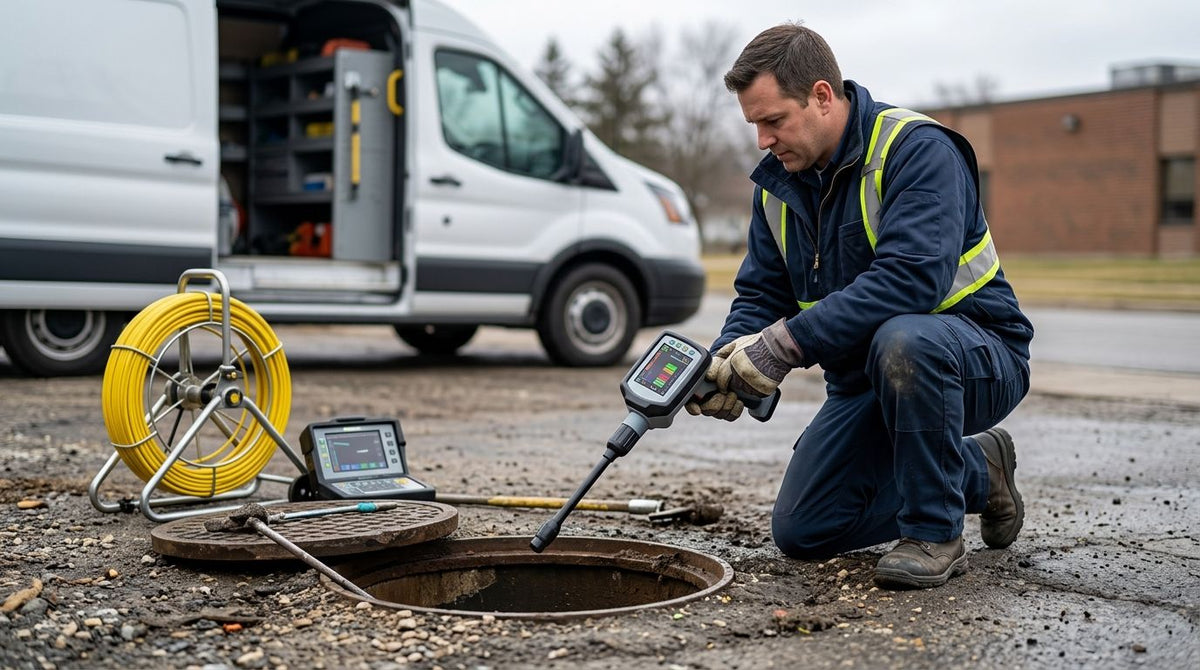
A sewer camera shows you the defect, but it cannot tell you where to dig. The sonde in the camera head broadcasts a low-frequency signal, and a receiver at the surface turns that signal into a ground position. Pair a receiver that does not tune to the sonde frequency and the crew walks the yard reading nothing while the excavator idles.
Two receivers cover camera-sonde locating at Fiberscope.net. The SnapTrack Sewer Camera Sonde Locator, from $1,390, tunes 512 and 640 Hz, with optional 815 Hz and 33 kHz. The Schonstedt 512Hz Sonde Locator (XT512), from $1,693, is a 512 Hz wand with depth measurement and passive 50/60 Hz tracing. Fiberscope.net sells both and services them in-house.
- SnapTrack is the default sonde locator for mixed camera fleets: 512 and 640 Hz, optional 815 Hz and 33 kHz, from $1,390.
- Schonstedt XT512 suits 512 Hz crews who want depth measurement and passive 50/60 Hz tracing, from $1,693.
- A sonde locator only works with a camera that has a sonde in its head, and the two frequencies must match.
- Choose by frequency first, then pinpointing and depth, then price.
How to choose a sonde locator for sewer cameras
Match the receiver to the sonde frequency first. A 512 Hz sonde needs a receiver that tunes to 512 Hz, and nothing else on the spec sheet matters until that lines up. After frequency, compare pinpointing, depth measurement and price.
Five criteria decide the purchase:
- Frequency match. The receiver must tune to the frequency your camera sonde transmits. Most push cameras that carry a sonde use 512 Hz.
- Extra frequencies. A second or third tuned frequency lets one receiver serve cameras from different makers or a transmitter used for line tracing.
- Depth measurement. A depth readout helps plan the excavation. It is a planning aid, not a survey.
- Passive tracing. Passive 50/60 Hz mode picks up energized power lines so you can mark them before you dig.
- Price against fleet size. A crew with one camera and one frequency pays for features it may never use on a wider receiver.
Locating takes three parts: a camera with a sonde in the head, a separate compatible receiver, and a matched frequency. The sonde transmits, the receiver listens, and the two figures are quoted separately on the spec sheets.
Fiberscope.net cameras with a 512 Hz sonde in the head include the ANACONDA, ANACONDA MID, MiniFlex 2 19mm and 36mm, HATHORN Micron, Mini and Mid, STRAHL PT, and the VIPER and VIPER Mid with the 1-inch self-levelling head. The 512 Hz locating camera roundup compares them by head size and reel length.
Sonde locators at a glance
The SnapTrack covers more frequencies and costs $303 less. The XT512 adds depth measurement and passive power-line tracing on a single 512 Hz tuning. Prices checked September 29.
| Locator | Receiver frequencies | Extra function | Protection | From |
|---|---|---|---|---|
| SnapTrack Sewer Camera Sonde Locator | 512 and 640 Hz; optional 815 Hz and 33 kHz | Detects and pinpoints a camera's remote transmitter | — | $1,390 |
| Schonstedt XT512 | 512 Hz | Depth measurement; passive 50/60 Hz | IP54 | $1,693 |
SnapTrack: best sonde locator for mixed camera fleets
The SnapTrack tunes 512 and 640 Hz out of the box, with 815 Hz and 33 kHz available as options. Rycom builds it in the USA, and it is a multifunctional wand for detecting and pinpointing a camera's remote transmitter.
The 512 Hz tuning covers the sondes in the ANACONDA, MiniFlex 2, HATHORN and VIPER families. The second standard frequency, 640 Hz, gives a crew that runs a mix of equipment a second channel without buying a second receiver. A plumber who finds a collapsed lateral on a camera run can walk the wand over the line, find the strongest response directly over the sonde, and flag the dig spot before the camera is pulled.
The SnapTrack is a receiver only. It needs a camera with a sonde in the head, and the base unit covers 512 and 640 Hz, so a sonde at 815 Hz or 33 kHz calls for the optional frequencies. It is also the lower-priced of the two locators here.
Verdict: Buy for crews that run more than one camera brand, or expect to add a second sonde frequency later.
Schonstedt XT512: best 512 Hz wand with depth measurement
The XT512 is a 512 Hz wand with pinpoint location and depth measurement, plus a passive 50/60 Hz mode. Its IP54 rating, defined in IEC 60529, means protection against dust ingress and splashing water. It does not cover immersion.
The depth readout is the reason to pay the extra $303. A crew that quotes excavation work from a camera inspection gets a depth figure to plan the cut. Metal, rebar and heavy interference distort the field, so treat the number as a planning figure and confirm by exposing the line. The passive 50/60 Hz mode adds a power-line check before digging. It does not replace calling 811 for utility marks.
The tuning is fixed at 512 Hz. A camera whose sonde runs at another frequency is outside its range. If your fleet is all 512 Hz, that limit costs nothing, and the XT512 is the more portable tool for a van that carries a single wand.
Verdict: Buy for 512 Hz crews that quote excavation from camera footage. Skip if any camera in the fleet uses another sonde frequency.


Other options
The Radiodetection RD8100 from Radiodetection is a full utility locator that traces cables and metallic pipe as well as sondes. It is the better purchase for a crew that locates buried utilities well beyond camera work, and the extra capability is not worth paying for if the only job is finding a camera head.
What you'll also need
- A camera with a sonde in the head. A receiver alone finds nothing. Check the camera's page for the sonde frequency before you buy a locator.
- Matching setup steps. The walkthrough on pairing a 512 Hz sonde camera with a SnapTrack locator covers powering the sonde and tuning the receiver.
- A realistic depth plan. The article on whether a 512 Hz sonde locator can find lines under pavement explains how concrete and rebar affect the signal.
- Documentation habits. Locate marks usually end up in a condition report coded to NASSCO PACP, so photograph the surface mark next to the footage counter reading.
Common mistakes
- Buying the receiver before checking the camera's sonde frequency. A 512 Hz sonde and a 33 kHz receiver cannot see each other.
- Trusting a depth figure under rebar or metal. These distort the field, so a number from the receiver is a starting point for exposing the line.
- Marking the first signal you find. Locate the peak directly over the sonde, then sweep across it from two directions to confirm.
- Skipping the power-line check. Run the passive 50/60 Hz mode on the XT512, and call 811 either way.
Which sonde locator should you choose?
The SnapTrack is the best sonde locator for crews running more than one camera, and at $1,390 it is the lower-priced option. The Schonstedt XT512 is the better choice for a 512 Hz-only crew that wants depth measurement and passive power-line tracing on one wand.
If the fleet is a single 512 Hz camera and the job is a rough surface mark, the SnapTrack does the work for less. If you quote excavation depth from camera runs every week, the XT512 earns its $303 premium.
FAQ
What is a sonde in a sewer camera?
A sonde is a small transmitter built into the camera head that broadcasts a low-frequency signal. A receiver at the surface tracks that signal to show where the head sits underground.
Can any sonde locator work with any sewer camera?
No. The receiver must tune to the sonde frequency. A 512 Hz sonde needs a receiver that covers 512 Hz, and a camera with no sonde in the head gives the receiver nothing to find.
What does 512 Hz mean on a sonde locator?
512 Hz is the sonde transmission frequency used by many push cameras. Receivers like the SnapTrack and the Schonstedt XT512 are tuned to it, so they pick up a sonde at that frequency.
Does a sonde locator give exact depth?
No locator gives guaranteed depth under rebar, metal or heavy interference, because these distort the field. Treat a depth reading as a planning figure and expose the line before you excavate.
What is the difference between SnapTrack and the Schonstedt XT512?
The SnapTrack tunes 512 and 640 Hz, with optional 815 Hz and 33 kHz, from $1,390. The XT512 tunes 512 Hz only and adds depth measurement and passive 50/60 Hz tracing, from $1,693.
Does a sonde locator find a camera without a sonde?
No. The locator detects the sonde's signal, not the camera body. A camera without a sonde in the head cannot be tracked by any receiver.
Match the locator to your camera
Send us your camera model, the sonde frequency, the typical depth of your lines, whether you need a depth readout and any existing locator frequency, and a Fiberscope.net specialist will match the right receiver. Call 1-877-613-2210, Monday to Friday, 8:00–18:00 CST, or use the contact page on the store.
About the author. Vladimir Khubiryants founded Fiberscope.net to give professionals access to reliable video inspection equipment without enterprise pricing. For over 20 years he has sourced and tested borescopes, sewer cameras and fiberscopes in Fiberscope.net's in-house test and repair facility, helping plumbers, pipeline engineers, aviation and military teams choose the right tool for the job.


Leave a comment
This site is protected by hCaptcha and the hCaptcha Privacy Policy and Terms of Service apply.